The Gulf economic diversification is happening faster than ever as oil-dependent nations move toward green practices. Oil and gas made up about half of the region’s total gross domestic product (GDP) and 70% of government revenues from 2011 to 2015. The Gulf Cooperation Council (GCC) states are now shifting away from this dependence.
Bahrain and the United Arab Emirates lead this push for resource diversity. Their non-oil sectors generated more than 80 and 70 percent of gross domestic product in the last decade. The global economic shift shows in recent growth forecasts too. The UAE should grow by 4.8%, Saudi Arabia by 3.8%, and other GCC members show equally strong outlooks for 2025-2026. These new policies are paying off. Non-oil companies have become more profitable, with policy achievements boosting asset-based returns by 1.8% and equity-based returns by 2.5%.
Let’s take a closer look at Gulf economic diversification, rebuilding and reshaping how these countries utilize their resources. The GCC is moving away from oil dependency to create sustainable models that include renewable resources, agriculture, and innovation. These nations’ strategies to build economic resilience are a great way to learn about how resource-rich regions can adapt to changing global priorities while staying prosperous in the long run.
The end of oil dependency in the Gulf Economies
Oil and gas have built the economic foundations of Gulf Cooperation Council (GCC) states over the last several years. This created massive wealth but also deep dependencies. The path to a diverse economy remains one of the region’s toughest challenges.
How oil shaped the Gulf economy
Oil revolutionized Gulf societies and brought remarkable prosperity with modern infrastructure. Between 2011 and 2015, hydrocarbon production made up about half of the region’s total GDP and generated up to 70% of government revenues. Gulf nations used this wealth to build detailed welfare systems. Their citizens enjoyed subsidized utilities, free education, and healthcare.
The economic model stands out because it distributes oil wealth through large public sectors. More than half of the citizens work in government jobs that come with generous benefits. On top of that, oil revenues helped these climate-vulnerable countries tackle major environmental challenges. This was especially true when dealing with water shortages by funding massive desalination projects that now make up almost 40% of global capacity.
Why oil volatility triggered changes
Oil brought unprecedented wealth, but dependence on it created economic weaknesses. These became clear during price swings. The up-and-down nature of oil markets subjected Gulf economies to cycles that made long-term planning difficult.
Budget breakeven prices show this challenge clearly. Saudi Arabia needs about $94 per barrel to balance its books. The UAE and Qatar sit in a better position with breakeven prices under $40 per barrel. Brent prices should average $65 in 2025-2026, pushing the GCC’s combined budget deficit to 3% of GDP.
The role of global economic transformation
The global energy world faces major restructuring that drives Gulf economic diversification even further. Climate concerns and net-zero emissions targets are altering the map of energy markets. This might reduce the need for oil and gas over time. Gulf states responded by making big strides in renewable energy, particularly solar power.
The GCC’s installed renewable capacity jumped from 196 megawatts in 2015 to 13,491 megawatts by 2024. The UAE and Saudi Arabia broke records for lowest-cost utility-scale solar power. These costs now run lower than gas-fired generation, even with the Gulf’s traditionally cheap gas prices.
Gulf states looked to East Asia’s model of economic transformation. They tried to balance authoritarian governance with market-driven capitalism to help diversify their economies.
Gulf economic diversification strategies
Gulf states throughout the Arabian Peninsula are executing strategic diversification plans. Each state has its unique approach to reshape their economic foundations and reduce their dependence on hydrocarbons.
Saudi Arabia’s Vision 2030 and beyond
Saudi Arabia launched Vision 2030 in 2016 under King Salman and Crown Prince Mohammed bin Salman. This ambitious transformation roadmap exploits the Kingdom’s strategic position and investment potential. The blueprint consists of three phases. The first phase established structural reforms, while the second accelerated investments in key sectors. The third phase will sustain transformation effects and exploit new growth opportunities. The transformation challenge remains significant, as oil still represents approximately 40% of Saudi GDP and 75% of fiscal revenue.
UAE’s digital and tourism-led model
The UAE leads the Gulf economic diversification efforts. The nation has reduced its oil dependency from nearly 90% of revenues in the 1970s to about 30% of GDP by 2022. Abu Dhabi’s Economic Vision 2030 and Dubai’s Strategic Plan have propelled investments in aluminum production, tourism, aviation, and telecommunications. Tourism plays a vital role – Abu Dhabi’s 156 hotels recorded their best year in 2014. Dubai expects its aviation sector to contribute 32% to GDP by 2020. The 18-year-old Dubai International Financial Center now hosts over 2,500 companies. The financial sector contributed 15% to Dubai’s GDP in 2022.
Oman and Bahrain’s fiscal reforms
Oman announced its first diversification strategy “Vision 2020” in 1995 and has since implemented “Vision 2040” to tackle structural economic issues. Bahrain revealed complete fiscal reforms that include fuel price increases, higher utility tariffs, and greater dividend contributions from state-owned enterprises. The country plans to introduce a 10% corporate income tax on companies with revenues exceeding BD1 million or annual net profits above BD200,000 by 2027.
Kuwait and Qatar’s cautious transitions
Kuwait and Qatar show more gradual progress. Kuwait’s “State Vision Kuwait 2035” doesn’t deal very well with implementation challenges. The country remains heavily dependent on hydrocarbons with an overutilized public sector. Qatar launched its National Vision 2030 in 2008 and focuses on “suitable economic diversification” while benefiting from gas reserves that should last 40 years. Recent data shows promise in trade relations. Qatar-Kuwait bilateral trade reached approximately 3 billion USD in 2024, with 23% annual growth since 2019.
The Rise of non-oil sectors and digital innovation
Gulf economic diversification is moving faster toward sophisticated economic pillars beyond traditional oil dependence. Their non-oil sectors continue to reshape the regional economic scene. Large-scale infrastructure and urban development are accelerating diversification, with mega projects driving demand across logistics, housing, and transport. The expanding construction industry in the GCC is becoming a central pillar of non-oil growth, supporting employment, private sector participation, and long-term economic resilience.
Fintech, logistics, and tourism as new pillars
Financial technology is changing how Gulf economic diversification paces. The sector could reach 235 billion USD by 2030. The UAE leads with 329 active fintech companies, while Saudi Arabia follows with 224 as of 2024. Half the GCC population now uses digital wallets. Mobile wallet usage in the UAE has grown beyond 60%. Tourism has become a key economic driver. The sector added SAR 246 billion to the region’s economy in 2024 – 32% higher than pre-pandemic levels. Travel between GCC states increased by 52%, with 19.3 million people visiting member countries.
AI and 5G infrastructure in the UAE and Saudi Arabia
These two nations are investing heavily in strong digital infrastructure. Saudi Arabia wants to lead globally in AI by 2030. The Kingdom’s National Strategy for Data and AI plans to train 20,000 specialists and attract 20 billion USD in investments. Economist Impact suggests AI could add up to 69 billion USD to GCC GDP by 2030. The UAE ranks second among G20 countries for frequency band allocation. This reflects its advanced National Frequency Plan and puts it fourth globally for 5G deployment.
Supporting SMEs and private sector growth
SMEs play a vital role in diversification efforts. Saudi Arabia’s Financial Sector Development Program targets increasing SME bank financing to 20% by 2030, up from 5.7% in 2019. The Kingdom has created sandbox environments to regulate FinTech innovations. Government initiatives like UAE’s National Program for Small and Medium Enterprises help entrepreneurs build and grow their businesses.
At the same time, successful Gulf economic diversification depends heavily on human capital and delivery capability. Governments and private sector actors increasingly invest in project management and capacity building for development sectors to strengthen implementation skills, improve program execution, and ensure diversification initiatives translate into measurable economic outcomes.
Foreign investment and capital market integration
Foreign direct investment keeps growing in the Gulf region. Saudi Arabia saw 6 billion USD in net FDI inflows during Q1 of 2025 – 44% higher than the previous year. GCC’s foreign reserve assets reached about SAR 747 billion by 2023’s end, growing 4.4% annually. The GCC capital markets now make up 4.3% of global capital markets’ total value, placing them seventh worldwide.
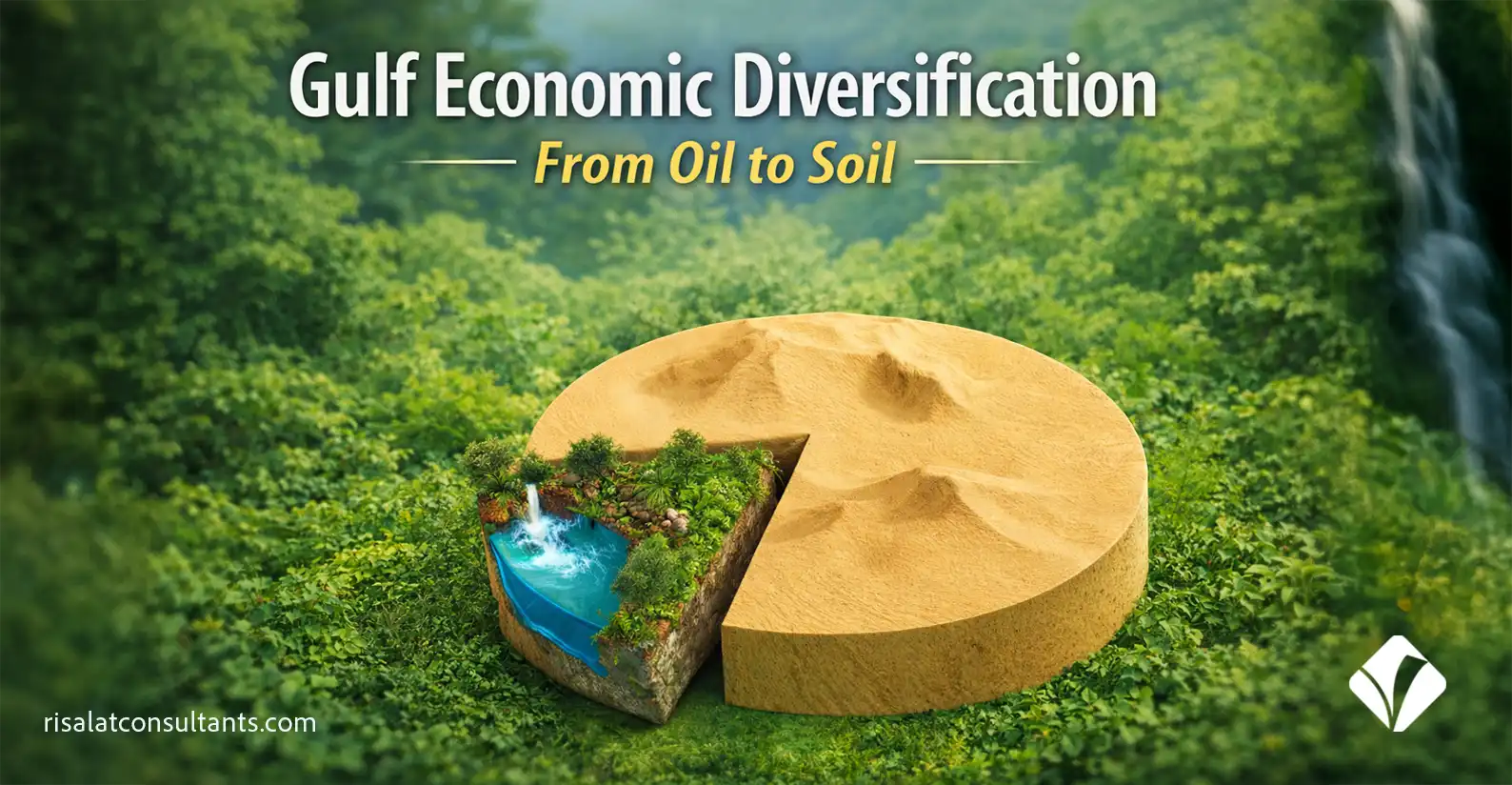
From oil to soil: agriculture and sustainability
The Gulf’s resource economy is moving beyond pipelines and oil fields as agricultural sustainability takes center stage. Desert covers 95% of Saudi Arabian land, yet the region continues to push boundaries of what’s possible in arid environments.
Why sustainable agriculture matters now
GCC states import 85% of their food, with cereals at 90% and rice at nearly 100%. This heavy reliance on imports makes these countries vulnerable to global disruptions, as COVID-19 clearly showed. Food security now stands as a key strategic priority in national visions. Building agricultural resilience increasingly depends on capacity development and knowledge transfer. Comparable initiatives such as soil management and sustainable agriculture training programs show how targeted skills development can improve productivity, conserve resources, and strengthen food systems, lessons that closely align with Gulf ambitions for climate-smart farming. Saudi Arabia’s Vision 2030 shows this commitment by allocating about 10 billion USD to domestic agriculture.
Desert farming and renewable water use
GCC countries have developed groundbreaking farming techniques to deal with water shortages. Their ultra-low-energy drip irrigation systems cut pumping needs by 80%, which allows solar power to run the operations. Root Zone Cooling keeps crops at perfect temperatures even when outside temperatures exceed 42°C. These breakthroughs have boosted water productivity by 78% and reduced operational costs by 27%.
Green economy initiatives in the Middle East
Saudi Arabia’s Crown Prince launched the Middle East Green Initiative in 2021, creating a unique regional alliance to reduce emissions and increase forest cover. The initiative aims to cut emissions by 670 million tons of carbon dioxide equivalent and plant 50 billion trees across the region. This represents 10% of global contributions announced in 2021.
Globally, resource diversification is expanding beyond land-based sectors. Regions such as the Pacific are advancing blue economy approaches to sustainable ocean governance, offering useful parallels for Gulf states seeking integrated models that balance environmental protection with economic development.
Challenges in food security and local production
We have a long way to go, but we can build on this progress. Saudi Arabia uses 67% of its total freshwater for agriculture, and 80% comes from non-renewable groundwater resources. Local crops need up to three times more water than the global average due to environmental conditions. This creates an ongoing challenge between conserving resources and ensuring food security.
Case studies: UAE vertical farms and Saudi agri-tech
Dubai’s Bustanica stands as the world’s largest vertical farm at 330,000 square feet, showcasing the role of agricultural innovation in Gulf economic diversification. The facility produces over 6,500 pounds of leafy greens daily without soil or pesticides and saves 250 million liters of water yearly compared to traditional farming. The Saudi AgriFood Tech Alliance brings together key players to implement agricultural technologies nationwide. They tackle crucial issues from harsh climate conditions to food waste.
Partners in project success since 2011, diagnostics, advisory support and applied learning for ministries, public agencies and project teams.
Need help putting this into practice?
Start with a free 10-minute diagnostic or talk to our experts.