Ключевые факты
- Даты
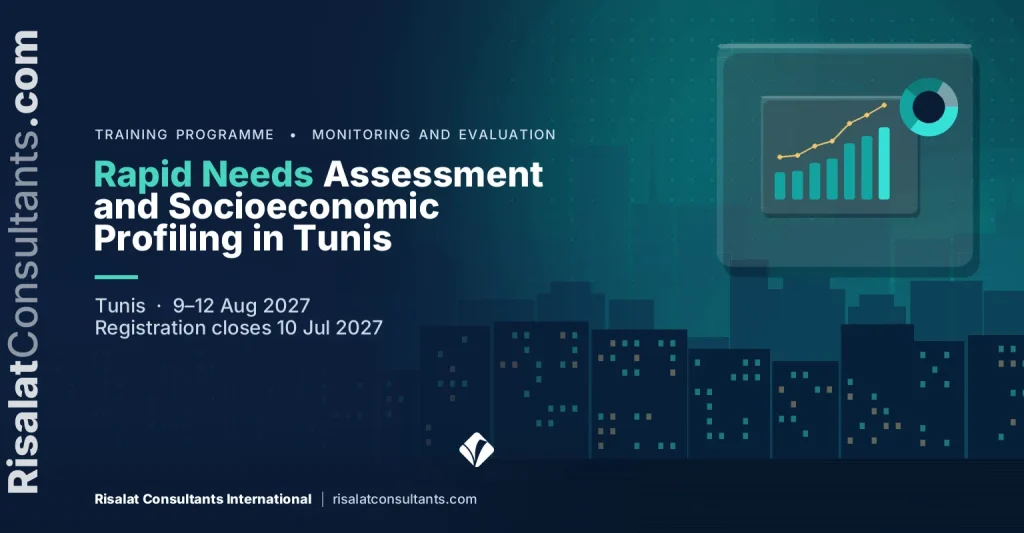
- 9–12 Aug 2027 (4 days)
- Где
- Tunis, Tunisia
- Стоимость на одного участника
- £2 200 (GBP)
- Оплата
- По счету банковским переводом
- Регистрация закрывается
- 10 Jul 2027
- Сертификат
- Сертификат о прохождении
- Корпоративный формат
- Проведите ее для своей команды в удобные вам даты
На этой странице 16 разделов
Обзор программы
Rapid Needs Assessment and Socioeconomic Profiling provides public sector analysts and development practitioners with the skills needed to design, execute, and interpret high-speed field assessments. Convened in Tunis, this intensive four-day programme addresses the acute requirement for reliable, real-time microdata in dynamic operating environments. Participants examine practical methodologies for evaluating community-level vulnerability, service disruption, and structural welfare deficits, ensuring that subsequent recovery initiatives rest upon rigorous, verifiable, and policy-relevant evidence.
The curriculum integrates international statistical standards with pragmatic field collection techniques, focusing on rapid household surveys, multi-dimensional poverty indices, and mobile computer-assisted personal interviewing. Participants work directly with raw microdata, moving from survey design and indicator selection to hands-on dataset cleaning, weighting, and statistical validation. By mastering modern socioeconomic profiling, attendees gain the technical competence to quantify critical basic needs and identify underserved population strata quickly and credibly.
Designed specifically for practitioners operating in or supporting transitional contexts, the course emphasises operational translation of data into policy. Attendees discover how to synthesise descriptive statistics and vulnerability profiles into actionable programmatic priorities, resource allocation formulas, and institutional baselines. Through structured case studies, participants prepare assessments that satisfy the analytical standards of international development partners, multilateral development banks, and domestic planning authorities.
Policy institutions and international partners supporting transitional contexts, notably through frameworks such as the Libya Transition Assistance State and Peacebuilding Fund, face profound information gaps that hinder targeted recovery. In fast-evolving governance environments, outdated national censuses cannot capture rapid population movements, local market breakdowns, or changing welfare dynamics. Timely, high-frequency socioeconomic profiling is critical to establish baseline indicators, prevent resource misdirection, and ensure that post-crisis interventions direct scarce development finance to the most vulnerable households.
Delivered by Risalat Consultants International in Tunis, Tunisia, it combines expert-led sessions, real cases and group work, so that participants can apply what they learn in their own institution.
The Programme Strengthens Institutional Capability
- Core principles of rapid assessment versus comprehensive national household surveys
- Frameworks for multi-dimensional deprivation and basic needs measurement
- Questionnaire design: structuring modules for welfare, assets, and service access
- Sampling methodologies in volatile environments: cluster, purposive, and convenience approaches
- Operational planning, enumerator ethics, and institutional permissions in field settings
- Computer-assisted personal interviewing architectures: ODK and KoboToolbox tool design
- Configuring logic checks, skipping patterns, and field validation constraints in survey forms
- Deployment strategies: offline data collection, server synchronisation, and device security
- Теория изменений и цепочки результатов
- Логические рамки и рамки результатов
- SMART-индикаторы, базовые и целевые значения
- Методы и инструменты сбора данных
It is designed for national statistical agency analysts and demographers, socioeconomic researchers working in public policy institutes, project planning and monitoring specialists from line ministries and others who want practical, current skills in monitoring and evaluation.
- Сбор
- Очистка
- Хранение
- Анализ
- Решение
The Growing Importance of Rapid Needs Assessment and Socioeconomic Profiling in Tunis
Правительства и финансирующие организации хотят знать, что изменилось, а не только сколько потрачено. Рамки результатов, показатели и достоверные данные сегодня определяют, как оценивают программы и получат ли они дальнейшее финансирование.
Многие команды собирают большие объемы данных, но с трудом превращают их в решения. Эффективная система мониторинга и оценки связывает мероприятия с результатами, рано показывает прогресс и поддерживает обучение во всей организации.
Организациям все больше нужны специалисты, способные:
- Разрабатывать рамки результатов с измеримыми показателями
- Собирать и проверять данные, которым можно доверять
- Анализировать ход работ и объяснять отклонения
- Планировать оценки и управлять ими
- Использовать фактические данные для корректировки планов и отчетности о результатах
Сильные системы мониторинга и оценки помогают организациям:
- Наглядно показывать результаты финансирующим организациям и гражданам
- Своевременно выявлять задержки и проблемы
- Повышать качество решений
- Выполнять требования к отчетности и оценке
This Rapid Needs Assessment and Socioeconomic Profiling in Tunis programme brings these elements together in a practical format, so that participants understand not only what good practice looks like but also how to introduce it in their own setting, with the people and resources they have.
Who Should Attend This Rapid Needs Assessment and Socioeconomic Profiling in Tunis Training?
Программа предназначена для:
- National statistical agency analysts and demographers
- Socioeconomic researchers working in public policy institutes
- Project planning and monitoring specialists from line ministries
- Planning officers supporting the Libya transition context
- Donor-funded project officers implementing AfDB, WB, or UN operations
- Monitoring and evaluation specialists responsible for baseline data
- Humanitarian-development nexus assessment coordinators
- Local governance and municipal data collection managers
- Social protection programme analysts designing targeting criteria
- Специалисты и руководители по МиО
- Руководители проектов и программ
- Сотрудники ГРП, отвечающие за отчетность
Программа подходит как опытным специалистам, так и тем, кто переходит к новым обязанностям. Приветствуются группы из разных организаций и стран, поскольку участники многому учатся на опыте друг друга.
Отметьте, что должна уметь ваша команда.
Rapid Needs Assessment and Socioeconomic Profiling in Tunis Training Objectives
Upon successful completion of this Rapid Needs Assessment and Socioeconomic Profiling in Tunis Training, participants will be able to:
- Design rapid household survey instruments that align with standard multi-dimensional poverty measurement frameworks
- Configure secure mobile data collection workflows using contemporary computer-assisted personal interviewing platforms
- Apply systematic probability and non-probability sampling strategies suitable for dynamic and data-scarce environments
- Execute rigorous microdata cleaning, logical validation, and anonymisation protocols on raw assessment datasets
- Calculate core socioeconomic welfare indicators, deprivation scores, and vulnerability thresholds accurately
- Synthesise complex survey microdata into clear, disaggregated socioeconomic profiles for prioritised policy use
- Formulate evidence-based baseline indicators and intervention priorities for donor-financed transition programmes
- Выстраивать теорию изменений и цепочку результатов для программы
- Разрабатывать рамку результатов с SMART-показателями
- Устанавливать исходные уровни, целевые значения и средства проверки
Каждая цель отрабатывается в ходе программы на упражнениях, кейсах или в групповой работе, чтобы участники умели это делать, а не только описывать.
Содержание и структура программы
- Core principles of rapid assessment versus comprehensive national household surveys
- Frameworks for multi-dimensional deprivation and basic needs measurement
- Questionnaire design: structuring modules for welfare, assets, and service access
- Sampling methodologies in volatile environments: cluster, purposive, and convenience approaches
- Operational planning, enumerator ethics, and institutional permissions in field settings
- Computer-assisted personal interviewing architectures: ODK and KoboToolbox tool design
- Configuring logic checks, skipping patterns, and field validation constraints in survey forms
- Deployment strategies: offline data collection, server synchronisation, and device security
- Real-time enumerator monitoring, daily paradata audits, and non-sampling error reduction
- Data protection, privacy considerations, and managing personally identifiable information
- Structuring raw assessment microdata: variable naming, coding schemes, and data dictionaries
- Identifying and addressing missing data, system outliers, and logical inconsistencies
- Constructing socioeconomic status proxies: asset indices and living standard indicators
- Computing multi-dimensional poverty cut-offs using the Alkire-Foster method logic
- Disaggregation analysis by geographical region, displacement status, and household headship
- Synthesising microdata findings into structured institutional socioeconomic profiles
- Translating assessment outcomes into targeted social safety net and recovery priorities
- Establishing empirical baselines for transition assistance and donor-funded operations
- Visualising survey outputs and vulnerability mapping for high-level decision-makers
- Action planning: integrating rapid assessment mechanisms into national planning workflows
Полное содержание по дням
Программа длится 4 дня. Каждый день сочетает выступления экспертов, практическую работу и завершающий практикум или кейс:
- First Day: Methodological Design and Rapid Household Survey Tools
- Second Day: Mobile Data Collection and Field Quality Control
- Third Day: Microdata Cleaning, Processing, and Welfare Indices
- Fourth Day: Socioeconomic Profiling and Evidence-Based Priority Setting
Полное содержание по дням
First Day | Methodological Design and Rapid Household Survey Tools
- Core principles of rapid assessment versus comprehensive national household surveys
- Frameworks for multi-dimensional deprivation and basic needs measurement
- Questionnaire design: structuring modules for welfare, assets, and service access
- Sampling methodologies in volatile environments: cluster, purposive, and convenience approaches
- Operational planning, enumerator ethics, and institutional permissions in field settings
Workshop: Methodological Design and Rapid Household Survey Tools: Applying It to Your Institution
Работая в небольших группах, участники применяют методы дня к примерам из своих организаций и согласовывают практические дальнейшие шаги.
Second Day | Mobile Data Collection and Field Quality Control
- Computer-assisted personal interviewing architectures: ODK and KoboToolbox tool design
- Configuring logic checks, skipping patterns, and field validation constraints in survey forms
- Deployment strategies: offline data collection, server synchronisation, and device security
- Real-time enumerator monitoring, daily paradata audits, and non-sampling error reduction
- Data protection, privacy considerations, and managing personally identifiable information
Workshop: Mobile Data Collection and Field Quality Control: Applying It to Your Institution
Работая в небольших группах, участники применяют методы дня к примерам из своих организаций и согласовывают практические дальнейшие шаги.
Third Day | Microdata Cleaning, Processing, and Welfare Indices
- Structuring raw assessment microdata: variable naming, coding schemes, and data dictionaries
- Identifying and addressing missing data, system outliers, and logical inconsistencies
- Constructing socioeconomic status proxies: asset indices and living standard indicators
- Computing multi-dimensional poverty cut-offs using the Alkire-Foster method logic
- Disaggregation analysis by geographical region, displacement status, and household headship
Case Study: Microdata Cleaning, Processing, and Welfare Indices in Practice
Участники анализируют реалистичный кейс, сравнивают принятые решения с передовой практикой и извлекают уроки, применимые в своих условиях.
Fourth Day | Socioeconomic Profiling and Evidence-Based Priority Setting
- Synthesising microdata findings into structured institutional socioeconomic profiles
- Translating assessment outcomes into targeted social safety net and recovery priorities
- Establishing empirical baselines for transition assistance and donor-funded operations
- Visualising survey outputs and vulnerability mapping for high-level decision-makers
- Action planning: integrating rapid assessment mechanisms into national planning workflows
Capstone Exercise: Rapid Needs Assessment and Socioeconomic Profiling in Tunis Action Plan for Your Institution
Участники объединяют итоги недели в план действий для своей организации с приоритетами, ответственными и первыми шагами и представляют его коллегам и ведущим для обратной связи.
Rapid Needs Assessment and Socioeconomic Profiling in Tunis Training Methodology
The training employs an applied, practitioner-led adult learning methodology combining technical briefings with intensive practical computer lab exercises. Participants work with realistic transitional country datasets, carrying out survey authoring, mobile deployment, and data cleaning tasks. Instruction alternates between methodological presentations, guided analytical clinics, and peer review of assessment frameworks, ensuring that participants master both the theoretical principles and the direct operational execution of rapid socioeconomic assessments.
Программа сочетает:
- Занятия под руководством экспертов по актуальной практике
- Региональные и международные кейсы
- Групповая работа и практические упражнения
- Симуляции и ролевые игры, где это уместно
- Обсуждение собственных задач участников
- Обмен опытом между организациями и странами
- Практические инструменты и шаблоны для работы
- Ежедневная рефлексия и планирование действий
Перед программой короткая предварительная оценка помогает ведущим понять роль и приоритеты каждого участника, чтобы адаптировать примеры и упражнения к группе. Каждый день завершается короткой рефлексией, в ходе которой участники отмечают, что они применят в работе.
- Ресурсы
- Мероприятия
- Результаты деятельности
- Конечные результаты
- Воздействие
Ожидаемые результаты
Upon completion of this Rapid Needs Assessment and Socioeconomic Profiling in Tunis Training, participants will be able to:
- Capability to formulate robust rapid needs assessment questionnaires tailored to crisis-affected contexts
- Practical mastery in authoring and deploying digital survey instruments on mobile platforms
- Proficiency in statistical cleaning, outlier verification, and audit trail maintenance for survey microdata
- Demonstrated ability to compute multi-dimensional deprivation and vulnerability metrics independently
- Competence to produce clear socioeconomic profiles that define baseline parameters for development interventions
- Enhanced institutional capacity to supply credible, timely evidence to international funding mechanisms
- Разрабатывать рамки результатов с измеримыми показателями
- Устанавливать исходные уровни и целевые значения, которые можно отслеживать
Участники уходят с личным планом действий и практическими инструментами, которые можно применять в своей организации с первой же недели после возвращения. Организации, направляющие нескольких участников, могут использовать программу, чтобы согласовать общие методы и шаблоны для разных команд: так улучшения легче закрепить.
£2 200 за участника · оплата по счету банковским переводом · для групп от 5 человек предусмотрена скидка
Пять и более участников от одной организации: укажите групповой тариф в запросе счета.
Ten or more: an in-house version for your institution may cost less per person. Ask for an in-house quote.
Registration closes in 239 days (10 Jul 2027)
Institutional Application of Rapid Needs Assessment and Socioeconomic Profiling in Tunis Training
Программа помогает организациям укрепить:
- Рамки результатов
- Системы показателей
- Качество данных
- Планирование оценки
- Отчетность о результатах
Участники возвращаются с практическими инструментами для улучшения:
- Паспорта показателей
- Инструменты сбора данных
- Отчеты о ходе работ
- Техническое задание на оценку
- Обзоры извлеченных уроков
Программа построена так, чтобы знания переходили из учебной аудитории в организацию. По возможности участники работают с собственными процессами и документами и уходят с планом действий, который их руководители могут рассмотреть и поддержать.
Региональная актуальность и применение
Европа
Европейские организации применяют мониторинг и оценку в рамках детально проработанной нормативной базы и программ реформ. Участники из Европы могут сравнить свою практику с опытом коллег из других регионов и проверить, как устоявшиеся методы работают в иных условиях.
Африка
По всей Африке министерства, ведомства и проектные команды в сфере мониторинга и оценки все чаще работают параллельно с программами, финансируемыми донорами, которые ожидают четких систем и фактических данных. Программа помогает участникам адаптировать лучшую практику к своим организациям и имеющимся ресурсам.
Ближний Восток
На Ближнем Востоке национальные стратегии развития и планы диверсификации предъявляют все более высокие требования к мониторингу и оценке. Участники изучают, как сформировать потенциал, необходимый для этих планов, внутри государственных органов и компаний.
Азия
Организации в Азии сочетают быстрый рост с амбициозными программами модернизации. Участники из Азии могут поделиться опытом быстрого масштабирования систем и узнать о подходах, применяемых в других странах.
Тихоокеанский регион
Малые островные и тихоокеанские государства сталкиваются с особыми ограничениями, связанными с размером, удаленностью и потенциалом. Программа показывает практичные и соразмерные подходы к мониторингу и оценке, подходящих для небольших организаций.
Holding the programme in Tunis, Tunisia brings participants together away from their daily pressures, so they can compare how monitoring and evaluation is handled in different settings. The same programme can also be delivered in-house for one institution, in its own country or online, with cases taken from its current work.
Host Country Profile – Tunisia
Risalat Consultants International runs open-enrolment training programmes in Tunis, Tunisia for officials, project teams and professionals from across the region. Dates, fees and what each programme covers are listed above, and any programme can also be delivered in-house for your institution.
Обучение за пределами своей страны дает участникам время сосредоточиться, по-новому взглянуть на свою организацию и выстроить сеть контактов с коллегами из других стран.
Rapid Needs Assessment and Socioeconomic Profiling in Tunis Training Deliverables
Участники получают поддержку до, во время и после программы, поэтому подготовка, обучение и последующее сопровождение складываются в единый непрерывный процесс.
До программы
- Предварительная оценка участников
- Rapid Needs Assessment and Socioeconomic Profiling in Tunis Readiness Assessment
- Rapid Needs Assessment and Socioeconomic Profiling in Tunis Resource Pack
- Материалы для предварительного чтения
- Бесплатная визовая поддержка и консультации
Во время программы
- Встреча в аэропорту и приветственное сопровождение
- Проживание с завтраком
- Приветственный ужин для нетворкинга
- Комплект участника Risalat (сумка, бутылка, кружка, футболка, кепка, обложка для паспорта, ручки, блокнот, магнит и брелок)
- Comprehensive Rapid Needs Assessment and Socioeconomic Profiling in Tunis Training Manual
- Шаблон теории изменений
- Шаблон паспорта индикатора
- Контрольный список качества данных
- Шаблон технического задания на оценку
- Практические семинары и симуляции
- Групповые дискуссии и обмен опытом
- Ежедневный обед и кофе-брейки
- Полный доступ к инфраструктуре места проведения
- Мини-планшет с цифровыми учебными материалами
- Выездной визит (при наличии)
- Развлекательная экскурсия по городу
После программы
- Сертификат о прохождении
- Награда Risalat за участие в программе
- Справочные материалы после обучения
- Руководство по анализу рамки результатов
- Шаблон отчета о ходе работ
- Поддержка и консультации после обучения
- Отчет по программе
Institutions can also request a tailored in-house version of this programme, delivered at their premises or online. Request a proposal.
Common Challenges in Rapid Needs Assessment and Socioeconomic Profiling in Tunis, And How This Training Helps
Как организациям разрабатывать рамки результатов с измеримыми показателями?
The programme addresses this directly on the first day (Methodological Design and Rapid Household Survey Tools), where participants practise the methods involved and adapt them to their own institution, then build it into their action plan.
Как организациям собирать и проверять данные, которым можно доверять?
The programme addresses this directly on the second day (Mobile Data Collection and Field Quality Control), where participants practise the methods involved and adapt them to their own institution, then build it into their action plan.
Как организациям анализировать ход работ и объяснять отклонения?
The programme addresses this directly on the third day (Microdata Cleaning, Processing, and Welfare Indices), where participants practise the methods involved and adapt them to their own institution, then build it into their action plan.
Как организациям планировать оценки и управлять ими?
The programme addresses this directly on the fourth day (Socioeconomic Profiling and Evidence-Based Priority Setting), where participants practise the methods involved and adapt them to their own institution, then build it into their action plan.
Как организациям использовать фактические данные для корректировки планов и отчетности о результатах?
The programme addresses this directly on the first day (Methodological Design and Rapid Household Survey Tools), where participants practise the methods involved and adapt them to their own institution, then build it into their action plan.
Часто задаваемые вопросы
When and where does the Rapid Needs Assessment and Socioeconomic Profiling in Tunis programme take place?
It runs from 9 Aug 2027 to 12 Aug 2027, in Tunis, Tunisia. The registration deadline is shown at the top of this page.
Кому стоит участвовать?
The programme is designed for national statistical agency analysts and demographers, socioeconomic researchers working in public policy institutes, project planning and monitoring specialists from line ministries, planning officers supporting the Libya transition context, and others who want practical skills in monitoring and evaluation.
Получу ли я сертификат?
Да. Участники, завершившие программу, получают сертификат о прохождении от Risalat Consultants International.
Можно ли провести эту программу только для нашей организации?
Да. Мы можем провести адаптированную корпоративную версию в вашей организации, в другом городе или онлайн на основе ваших собственных кейсов. Воспользуйтесь формой запроса предложения на этой странице.
Нужен ли мне опыт в области мониторинга и оценки?
Специальная подготовка не требуется, достаточно опыта работы в смежной должности. Короткая предварительная оценка помогает ведущим адаптировать занятия к группе.
Who Will Deliver This Programme
Each date is delivered by a team assigned from Risalat's expert network for this subject. For this programme we assign:
How we choose them: Experience in the region of the participants or comparable settings; Command of the financier rules that apply (World Bank, ADB, AfDB, EU, UN) where relevant; Delivery in English; other languages on request for in-house groups; No conflict of interest with participants' institutions.
Names and short CVs of the assigned experts are shared with registered participants and sponsoring organisations before the programme, on request. Are you an expert in this subject? Join our expert network.
Training courses in TunisResearch & Statistics training courses
Why Tunis for this programme
Tunis is the administrative and political hub of Tunisia, hosting major national ministries and public institutions. Visiting delegations can examine public administration practices, trade systems at the Port of Rades, and regional initiatives. The city is straightforward to reach through direct international flights connecting North Africa, Europe, and parts of the Middle East.
The Rapid Needs Assessment and Socioeconomic Profiling in Tunis programme in August 2027 brings together officials and professionals from across the Africa region and beyond. Sessions combine short inputs, case studies and group work on participants' own files, and the city's institutions can be added as a study visit on request.
Getting there: Tunis-Carthage International Airport (TUN).
Узнайте, нужна ли вам виза, с помощью бесплатного сервиса «Проверка визы» и запросите приглашение после регистрации.
Та же тема в других городах
Other programmes in Tunis
- Community-Based Social Cohesion and Local Livelihood Project Design in Tunis
- Post-Crisis Social Protection System Harmonisation and Policy Design in Tunis
- Emergency Shock-Responsive Safety Nets and Rapid Deployment in Tunis
См. также: Программы развития предпринимательства и МСП · бесплатная оценка потребностей в обучении · все программы
For teams and institutions
Bring your team
Teams that learn together apply more at work. Tell us how many people and how you would like to take part: we reply with a group quote within two working days.
More training courses in Tunisia · Все программы в Африке · Полный календарь обучения
Plan this programme in a roadmap: why it matters, why to approve it, the dates to plan and the career it builds.