Key facts
- Dates
- 1–5 Feb 2027 (5 days)
- Where
- TBD, San Jose, Costa Rica
- Fee per participant
- £4,930 (GBP)
- Payment
- By invoice and bank transfer
- Registration closes
- 23 Dec 2026
- Who it is for
- Eco-tourism operators & destination managers; NGOs and development agencies focused on tourism; Public sector tourism planners and environment…
- Certificate
- Certificate of completion
- In-house option
- Run it for your team, on your dates
Programme Overview
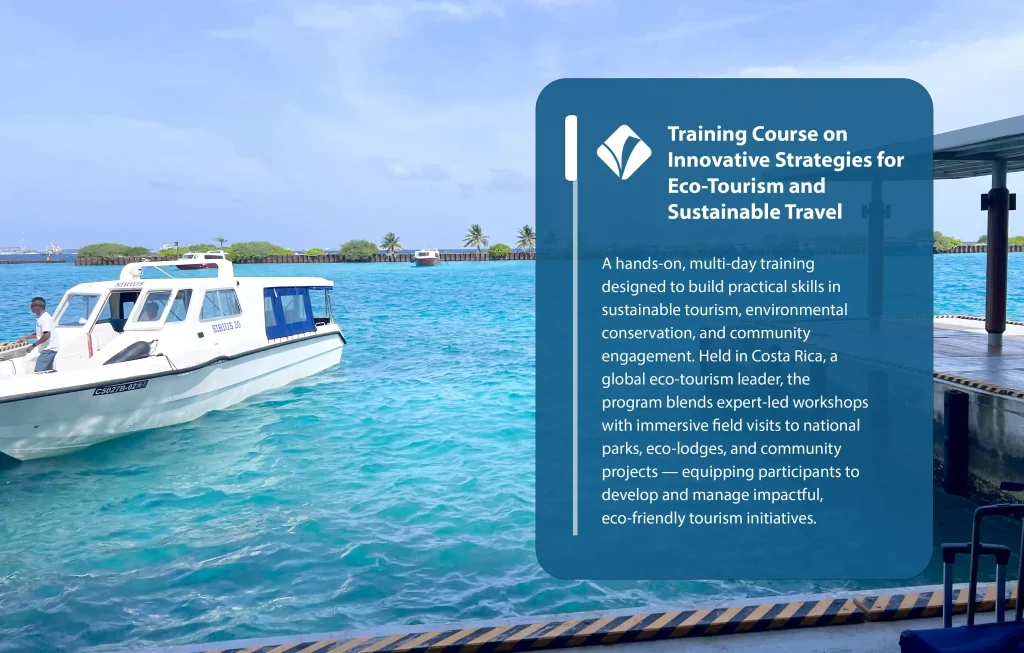
As the global tourism industry shifts toward sustainability, it’s no longer enough to “do less harm”. This forward-thinking training in San Jose dives deep into regenerative practices, inclusive travel design, and innovative green operations that empower destinations and businesses to thrive while protecting the planet.
From digital storytelling to climate-conscious product design, participants will explore creative, actionable, and measurable ways to reshape the future of travel. This course is ideal for tourism professionals, sustainability officers, destination planners, and development organizations.
- Funds
- Entity
- Project
- Results
- MRV
Target Audience
This unique programme is best suited for professionals and stakeholders engaged in sustainable tourism, conservation, and community development, including:
- Eco-tourism operators & destination managers
- NGOs and development agencies focused on tourism
- Public sector tourism planners and environment ministries
- Hospitality professionals and green entrepreneurs
- Cultural heritage and Indigenous community representatives
Tick what your team needs to be able to do.
Programme Objectives
By the end of this Training Course Innovative Strategies for Eco-Tourism and Sustainable Travel in Costa Rica, participants will be able to:
- Design regenerative tourism models that restore local environments and empower communities
- Apply geo-cultural mapping techniques for sustainable destination planning
- Develop zero-waste and circular economy strategies in tourism operations
- Integrate indigenous knowledge and ethical co-creation into travel experiences
- Innovate climate-conscious travel products and eco-certification practices
- Utilize digital storytelling and ethical branding to promote eco-destinations
Programme Contents
- Defining regenerative tourism
- Comparing sustainability vs. regeneration
- Introduction to regenerative frameworks and metrics
- Geo-cultural asset mapping techniques
- Community engagement and co-design strategies
- Indigenous partnerships in tourism development
- Building zero-waste hospitality systems
- Ethical practices in nature and adventure travel
- Case study: Circular tourism hubs
- Designing low-emission travel products
- Carbon offset integration
- Green mobility solutions for eco-destinations
- Digital storytelling for eco-tourism
- Building eco-conscious brand identity
- Action planning and feedback session
Full day-by-day contents
First Day – Regenerative Tourism & Global Trends
- Defining regenerative tourism
- Comparing sustainability vs. regeneration
- Introduction to regenerative frameworks and metrics
Second Day – Destination Mapping & Community Empowerment
- Geo-cultural asset mapping techniques
- Community engagement and co-design strategies
- Indigenous partnerships in tourism development
Third Day – Circular Operations & Ethical Experiences
- Building zero-waste hospitality systems
- Ethical practices in nature and adventure travel
- Case study: Circular tourism hubs
Fourth Day – Climate-Conscious Innovation & Mobility
- Designing low-emission travel products
- Carbon offset integration
- Green mobility solutions for eco-destinations
Fifth Day – Branding, Storytelling & Strategic Action
- Digital storytelling for eco-tourism
- Building eco-conscious brand identity
- Action planning and feedback session
Programme Methodology
This Training Course on Innovative Strategies for Eco-Tourism and Sustainable Travel adopts a blended, learner-centered approach, combining theory, practice, and reflection to build capacity in sustainable tourism development. The methodology is designed to foster critical thinking, real-world problem-solving, and cross-sector collaboration.
Core Training Methods:
- Interactive Workshops
Facilitated sessions with presentations, group discussions, and problem-solving exercises.
Topics: environmental stewardship, community engagement, eco-certification, and tourism planning.
Use of case studies from Costa Rica and other leading eco-tourism destinations.
- Field-Based Learning
Guided visits to national parks, eco-lodges, rural tourism initiatives, and conservation projects.
On-site dialogue with local stakeholders, community leaders, and eco-tourism entrepreneurs.
Real-time analysis of sustainability practices and visitor management strategies.
- Participatory Group Work
Small teams co-develop eco-tourism models or action plans tailored to their local contexts.
Includes stakeholder mapping, risk assessments, and business planning exercises.
- Real-World Insights and Practices
Learners engage with real examples and case studies drawn from diverse sectors, including government, NGOs, private enterprises, and Indigenous communities.Topics explore practical approaches to policy implementation, sustainable tourism financing, and inclusive development strategies.
- Simulation & Role-Play
Stakeholder negotiation exercises around land use, conservation conflicts, or visitor impact.
Helps trainees practice communication, collaboration, and conflict resolution.
- Digital Tools & GIS Mapping
Introductory sessions on using basic digital tools for eco-tourism planning and monitoring.
Incorporates GPS mapping, visual storytelling, and data collection techniques.
- Reflection & Action Planning
Daily and final reflection sessions to connect learning to real-world application.
Participants develop a personalized Eco-Tourism Action Plan for post-training implementation.
Host Country Profile
Why Costa Rica is the Smart Choice for Eco-Tourism Training and Investment
Costa Rica is a proven global leader in eco-tourism, attracting over 3 million visitors annually, with nearly 50% seeking nature-based experiences. With over 25% of its land protected through national parks and reserves, and hosting over 500,000 species, about 5% of global biodiversity, the country offers a powerful platform for environmental education and sustainable tourism development.
Costa Rica’s Certification for Sustainable Tourism (CST) programme, recognized by the UNWTO, ensures accountability and quality across eco-lodging and tour operations. Its Payment for Environmental Services (PES) programme has helped reforest more than 1 million hectares, showcasing a successful public-private partnership model for conservation.
With a stable political climate, strong legal frameworks, and a national goal of net-zero emissions by 2050, Costa Rica offers low-risk, high-impact opportunities for NGOs and investors. The country ranks among the top 5 in the Global Green Economy Index, and its eco-tourism sector contributes nearly 6.3% of GDP.
For NGOs, it’s an ideal setting for capacity-building, community engagement, and showcasing scalable sustainability models. For investors, it presents a high-demand, values-driven market with measurable environmental and social returns.
Course Deliverables
Participants will enjoy a full-service experience that covers everything needed before, during, and after the programme:
Before the Programme
- Participant Pre-Assessment to ensure effective preparation
- Complimentary Visa Support & Advisory (E-visa applications are fully processed by our team)
- Airport Pickup & Welcome Assistance
- Accommodation with Breakfast for the full duration
- Welcome Dinner for networking and connecting with fellow Participants & the Risalat Team
During the Programme
- Risalat Training Kit, including: bag, water bottle, coffee mug, t-shirt, cap, passport cover, pens, notebook, magnet, keychain
- Lunch Provided Daily during training days
- Comprehensive Course Manual & Training Materials
- Project-Based Templates, Tools, and Worksheets
- Mini Pad / Tablet for convenient access to digital resources
- Digital Case Studies, Reading Packs & Reference Materials
- Access to Sample Datasets & Practical Exercises
- Field Visit (where applicable)
- Complimentary Refreshments & Full Training Venue Facilities
- Access to Online Learning Resources
- Entertaining City Tour
- Certificate of Completion
- Risalat Programme Participation Recognition Award
After the Programme
- Post-Training Support & Follow-Up Guidance
- Programme Report
£4,930 per participant · invoice and bank transfer · groups of 5 or more receive a discount
Five or more from one organisation: ask for the group rate on the invoice request.
Ten or more: an in-house version for your institution may cost less per person. Ask for an in-house quote.
Registration closes in 59 days (23 Dec 2026)