Welcome to the definitive analysis of consulting business models – where strategic vision meets practical implementation. The contemporary consulting ecosystem reveals a compelling paradox: while established industry titans eliminate 45,000 positions, specialized boutique consulting enterprises demonstrate remarkable 70% profitability rates. This striking dichotomy underscores the fundamental recalibration occurring within the $383 billion digital consulting marketplace, which analytical projections position to reach $900 billion by 2033.
The architectural decision between establishing a boutique consulting enterprise and pursuing independent practice demands sophisticated evaluation of market positioning, operational capabilities, and strategic objectives. Current intelligence indicates that a substantial proportion of the global $150 billion management consulting expenditure now gravitates toward independent practitioners. Furthermore, 45% of conventional management consulting establishments acknowledge revenue displacement to specialized boutique consultancies.
The contemporary consulting professional faces multifaceted considerations when architecting their practice model. Whether your expertise encompasses small business advisory services, strategic business development initiatives, or specialized consulting methodologies, the foundational structure you select will determine your competitive positioning and growth trajectory within this dynamic marketplace.
This comprehensive examination provides strategic intelligence and practical frameworks for both operational models, enabling informed decision-making that aligns with your professional aspirations and market opportunities throughout 2025.
Market Intelligence: The Contemporary Consulting Ecosystem
Professional services markets demonstrate unprecedented velocity of change throughout 2025, establishing fertile ground for enterprising consultants who possess the acumen to capitalize on emerging opportunities. The global strategy consulting sector exhibits robust expansion trajectories, with by 2026 at a compound annual growth rate of 17.4% intelligence that underscores the critical importance of understanding these market dynamics for sustainable success projected growth of nearly 58 billion USD.
Accelerated Evolution Drivers
Contemporary boutique consulting practice bears minimal resemblance to its predecessor models from even a decade past. Economic volatility combined with technological disruption creates fundamental shifts in how consultancies establish competitive differentiation and operational excellence. Current professional sentiment indicates that nearly half of industry practitioners anticipate economic conditions will maintain static trajectories through 2025, while 38% project continued deterioration.
Digital transformation initiatives serve as primary catalysts for this evolution, with by 2033. Enterprise-level organizations demonstrate substantial commitment to these initiatives, nearly three-quarters of companies generating annual revenues exceeding 500 million USD allocate upwards of 5 million USD toward digital transformation projects within the current fiscal year expenditure projections reached over 9 trillion USD.
The pandemic catalyzed a profound reassessment of workforce values, positioning shared purpose as a fundamental component of career decision-making processes. Generational analysis reveals that younger professionals demonstrate diminished interest in traditional people management roles, creating substantial execution gaps that specialized boutique consulting practices can address through targeted expertise.
Digital-First Service Architecture
Digital-first consulting methodologies have progressed beyond conceptual frameworks to establish genuine operational foundations. This paradigm shift does not advocate for the elimination of human expertise, rather, it represents a holistic approach to client experience design. Excellence in digital-first consulting requires the creation of comprehensive client experiences that deliver satisfaction throughout the entire engagement lifecycle and beyond.
Artificial intelligence capabilities have achieved indispensable status within consulting operations, with over 80% of management consultants incorporating AI technologies into their daily professional activities. Emerging boutique consulting enterprises benefit from significant efficiency enhancements through these technologies, 56% of practitioners report that AI integration liberates three to four hours of productive capacity daily. Boston Consulting Group’s implementation data demonstrates that consultants utilizing AI-enhanced tools achieve 25% faster task completion rates while executing 12% more total tasks.
Industry leaders including IBM Consulting and EY exemplify excellence in digital-first methodologies. IBM’s Watson AI platform enables sophisticated data-driven decision-making capabilities for clients, illustrating how advanced technology enhances rather than supplants human expertise. Bain & Company’s strategic partnership with OpenAI facilitates ChatGPT integration to optimize operational efficiency and client engagement protocols.
Client Demand Evolution and Market Recalibration
The most profound shift involves client rejection of standardized, uniform solution approaches. Contemporary organizations demand customized strategies that align precisely with their unique operational requirements, market conditions, and long-term strategic objectives. This evolution creates exceptional opportunities for boutique firms and independent consultants who excel at delivering personalized, high-impact solutions.
The traditional demarcation between strategy formulation and execution has undergone dramatic redefinition. Historical consulting engagements typically concluded with strategic recommendations, yet today’s organizations require partners capable of implementation support. Many enterprises have established internal strategic capabilities and now engage consultants primarily for execution expertise.
Hybrid work environments have fundamentally altered consulting delivery mechanisms, with approximately 58% of consulting services now executed through remote collaboration. This operational shift necessitates sophisticated digital infrastructure, refined processes, and robust governance frameworks, client satisfaction metrics demonstrate 16% higher ratings for organizations that maintain superior remote collaboration capabilities.
For professionals evaluating consulting business establishment in 2025, these evolving client expectations present both sophisticated challenges and distinctive opportunities to establish specialized market positions within this dynamic professional landscape.
Boutique Consulting Enterprises: Strategic Advantages and Operational Constraints
Entrepreneurial leaders examining consulting practice architectures discover that boutique consulting enterprises present a sophisticated alternative to independent practice, each model carrying distinct strategic implications and operational considerations.
Architectural Framework of Boutique Consulting Enterprises
Boutique consulting enterprises operate as specialized, agile consultancies dedicated to delivering bespoke, premium-quality solutions within defined industry verticals, service disciplines, or client requirements. These organizations distinguish themselves from conventional consulting giants through lean operational structures, . Rather than functioning as diminished versions of industry behemoths, boutique enterprises represent specialist organizations, frequently established by domain authorities possessing extensive experience in addressing targeted business challenges typically employing 5-250 professionals
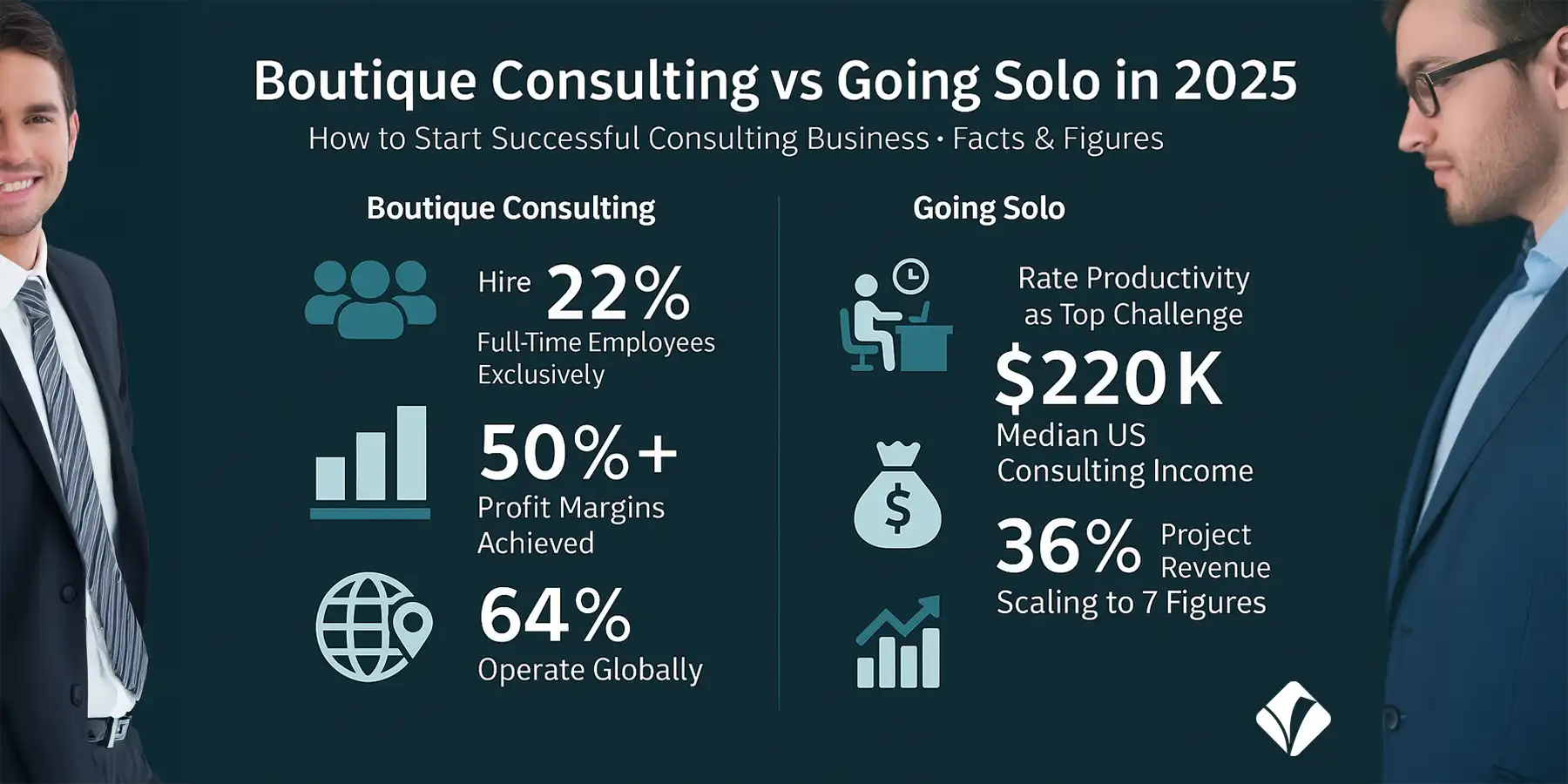
The fundamental attribute of boutique enterprises lies in their concentrated expertise within specialized market segments. This focus enables flattened organizational hierarchies, fostering intimate client partnerships and highly personalized service delivery methodologies. Market analysis reveals that approximately maintain staffing levels below 20 individuals, demonstrating the widespread adoption of this operational model 96.3% of professional services enterprises.
Strategic Advantages: Domain Mastery, Operational Agility, and Financial Performance
Domain specialization constitutes the cornerstone advantage of boutique consulting enterprises. These organizations cultivate profound knowledge within specific sectors that frequently exceeds the capabilities of generalist consultancies. Consider boutique enterprises specializing in healthcare technology or financial services, these firms possess intimate understanding of regulatory frameworks, emerging technological applications, and competitive dynamics that surpass broader consultancies. Such expertise enables more precise methodologies when evaluating strategic partnerships or identifying optimal business development opportunities.
Operational agility represents another critical strength, with boutique enterprises demonstrating exceptional responsiveness to evolving client requirements and market dynamics. Research indicates that boutique firms execute strategic pivots 30% more rapidly than their larger counterparts. The absence of extensive bureaucratic processes enables these organizations to adapt swiftly, positioning clients advantageously relative to industry developments.
Financial performance metrics reveal substantial advantages, with boutique enterprises typically maintaining operating costs 20-30% below larger consultancies. This cost efficiency derives from several factors:
- Reduced infrastructure requirements and fixed cost structures
- Streamlined management hierarchies
- Optimized project execution frameworks
Client organizations realize tangible benefits from this efficiency, one technology enterprise achieved $500,000 in cost savings on a digital transformation initiative by selecting a boutique firm over an established competitor.
Operational Challenges: Growth Constraints, Talent Acquisition, and Market Positioning
Despite these compelling advantages, boutique consulting enterprises encounter substantial obstacles when pursuing expansion. Approximately three-quarters of consultancies fail to achieve sufficient scale for additional personnel. Organizations that successfully grow often confront a precarious operational threshold at 12-13 employees, existing in an uncomfortable middle ground where they become “too large for small-firm agility yet too small for large-firm resources”.
Talent acquisition represents a formidable challenge, as boutique enterprises must compete with prestigious industry leaders possessing established brand recognition when recruiting exceptional professionals. Even successful recruitment from elite firms such as the Big Four can create cultural integration difficulties, as candidates accustomed to structured hierarchical environments may encounter challenges adapting to dynamic, multifunctional operational models.
Market positioning challenges persist as ongoing concerns for boutique enterprises. Without substantial marketing investments or widespread brand recognition, many struggle to maintain consistent client acquisition. This visibility limitation frequently generates cyclical revenue patterns that complicate strategic planning and resource allocation. Leadership misalignment regarding strategic direction and value proposition can compound these market presence challenges.
Entrepreneurs contemplating boutique consulting practice establishment must thoroughly evaluate these strategic advantages and operational constraints to position boutique enterprises effectively within 2025’s competitive consulting environment.
Independent Practice Excellence: The Solo Consultant Framework
Professional autonomy through independent consulting represents a strategic commitment to building advisory excellence centered entirely on individual expertise and specialized domain knowledge. Distinguished from the collaborative structures inherent in boutique firm operations, solo practitioners architect their professional trajectory through direct client engagement and personalized service delivery.
The independent consultant operational model
Independent consultants function beyond conventional employment frameworks, delivering specialized advisory services through direct client relationships without institutional backing. These self-directed professionals establish their own fee structures, engagement parameters, and maintain capacity to serve multiple client organizations simultaneously. The model grants consultants absolute discretion in client selection, engagement architecture, and business management aligned with their professional vision. Organizations frequently engage independent consultants when requiring specialized expertise without the necessity of permanent staffing solutions.
Operational advantages: autonomy, financial efficiency, and lifestyle design
Independent consulting delivers exceptional freedom to architect business operations around optimal lifestyle preferences and professional objectives. Solo practitioners achieve complete economic sovereignty, establishing schedules, selecting projects of strategic interest, and operating from preferred geographical locations. This operational control encompasses all business decisions, enabling rapid strategic pivots based on market dynamics without institutional approval processes.
Financial performance demonstrates compelling advantages, with solo consultants consistently achieving through minimal overhead structures. Successful independent practitioners frequently generate substantial incomes while maintaining reduced working hours compared to traditional corporate environments. The model additionally provides diverse industry exposure and extensive professional network development through collaboration with varied organizational leaders and cross-functional teams profit margins of 70-85%.
Operational constraints: professional isolation, revenue volatility, and scalability limitations
Independent practice encompasses significant operational challenges that demand careful consideration. Professional isolation emerges as a primary concern, with during independent business operations. The absence of consistent colleague interaction can substantially impact mental wellbeing and professional satisfaction 77% of sole traders reporting loneliness
Revenue stability presents another critical challenge. Establishing consistent client pipeline momentum proves particularly difficult during initial business phases. Income patterns fluctuate unpredictably between peak and trough periods, creating complications for personal financial planning and business investment strategies. Independent consultants must personally manage all non-billable operational activities, encompassing invoicing, marketing initiatives, and comprehensive tax administration.
Scalability constraints represent inherent limitations, as income potential remains directly correlated with available personal capacity and energy resources. Without employee leverage or systematic operational frameworks, professional absence directly correlates with revenue cessation unless recurring income mechanisms have been established. Additionally, eventual business exit strategies face limitations in transferable value, as the consultant’s personal expertise constitutes the primary business asset.
Strategic Differentiation: Boutique Enterprise Architecture versus Independent Practice Models
The fundamental choice between boutique firm establishment and independent consulting practice creates distinct operational paradigms, each generating unique strategic advantages and implementation methodologies that define every dimension of professional consulting engagement.
Organizational Infrastructure and Collaborative Dynamics
Boutique consulting enterprises deploy streamlined, specialized organizational architectures typically encompassing a CEO/Founder, operations manager, 2-3 senior consultants, 1-3 junior consultants, plus marketing and administrative support. This configuration generates substantial competitive differentiation as boutique firms maintain elevated percentages of experienced senior consultants who remain directly engaged in client deliverables.
Independent practitioners assume comprehensive responsibility across all business functions, from client development through service execution. While this approach provides absolute operational autonomy, it inherently constrains collaborative innovation potential. Although independent consultants can access professional networks when circumstances require, they operate without the continuous cross-functional collaboration that stimulates breakthrough thinking within boutique environments.
Client Development Strategies and Service Delivery Frameworks
Boutique firms typically deploy resource-intensive client acquisition methodologies, with new client development averaging approximately AUD 4,768.92 in acquisition costs. These enterprises construct systematic client development infrastructures requiring sustained investment but ultimately accelerating growth trajectories.
Independent practitioners generally allocate minimal resources to formal marketing initiatives while investing substantial time in relationship development activities. Their service delivery framework emphasizes individual expertise and direct client engagement, frequently offering rates 60-70% below what clients would invest for equivalent individual services from global consulting establishments. At Reliable International Consulting firm, clients experience this value-oriented methodology while accessing expertise comparable to major market players.
Financial Architecture and Revenue Optimization
The economic profiles demonstrate substantial variance between operational models. Independent consultants routinely achieve profit margins spanning 70-85% due to minimal overhead requirements. Boutique firms establish gross margin targets between 40-60% reduced compared to solo practices yet offering superior revenue scaling potential through organizational expansion.
Brand Development and Market Differentiation
Personal brand equity demonstrates superior performance in initial client attraction compared to institutional branding, yet boutique firms construct enduring business value through systematic institutional brand development. The most effective strategic approach combines both methodologies, individual consultants within boutique firms should cultivate personal brands that operate synergistically with the firm’s comprehensive brand architecture.
Boutique firms establish market differentiation through profound domain expertise, customized methodological frameworks, and innovative service delivery models. Independent consultants position themselves through specialized competencies and direct client relationships, frequently concentrating on market sectors inadequately served by larger consultancies.
Strategic Decision Framework: Selecting Your Optimal Consulting Architecture
The selection between independent practice and boutique firm establishment necessitates rigorous self-evaluation and strategic alignment. Your chosen pathway must harmonize with both your professional aspirations and the contextual realities of your circumstances in 2025.
Strategic Goal Definition and Risk Assessment Protocols
Your consulting business architecture influences every operational dimension, from daily workflow management to eventual exit strategy. Strategic planning methodology demands reverse-engineering your vision, establish your definitive three-to-five-year objective, subsequently decomposing this into quarterly milestone achievements.
Risk assessment varies considerably among consulting professionals. Evaluate your tolerance for:
- Revenue volatility patterns (cyclical income fluctuations)
- Autonomous decision-making versus collaborative governance structures
- Professional-personal integration preferences
Your risk tolerance framework serves as the foundational criterion for all strategic business decisions, reflecting your core financial priorities. Should your assessment indicate an 8/10 or superior preference for lifestyle flexibility coupled with maximum profit optimization, independent practice (generating potential annual revenues of AUD 150K-764.5K) may align with your objectives.
Consulting Specialization Evaluation Matrix
The most distinguished consultants demonstrate precision in target market definition and problem-solution alignment. Niche selection requires analysis at the convergence of:
- Professional expertise (demonstrable competency areas)
- Market demand (existing business challenges requiring resolution)
- Personal engagement (domains generating genuine professional interest)
Affirmative responses to two of these three criteria, particularly when combining expertise with engagement, typically indicate viable consulting specialization opportunities. Specialized positioning enhances all business development activities, from marketing effectiveness to pricing strategy and referral generation.
Implementation Timing: Solo Launch versus Team Development
Independent practice suits professionals prioritizing operational simplicity, lifestyle flexibility, and direct client engagement. The solo model delivers maximum autonomy with 70-85% profit margins. Risalat Consultants International initiated operations through this approach, establishing foundational client relationships before organizational expansion.
Team development becomes strategically appropriate when experiencing consistent annual increases in qualified prospect inquiries from your target client demographic. This pattern indicates sustainable market demand sufficient to support additional personnel. The boutique firm model serves consultants who derive satisfaction from team leadership and seek eventual business monetization, with income potential ranging from AUD 764.5K to 4.59M annually.
Strategic Decision Framework: Charting Your Consulting Excellence Journey
The fundamental choice between boutique firm establishment and independent consulting practice represents more than operational preference, it constitutes a defining moment that shapes your professional legacy and market impact. Both methodologies present compelling pathways to consulting excellence within the dynamic marketplace of 2025, each offering distinct advantages that align with different professional aspirations and risk profiles.
Our comprehensive analysis has illuminated the profound industry recalibration currently unfolding, where digital innovation and artificial intelligence capabilities redefine service delivery paradigms while client expectations gravitate toward specialized expertise and implementation excellence. These market dynamics create exceptional opportunities for agile consulting professionals who demonstrate the vision and dedication necessary to capitalize on emerging trends.
Independent practice delivers unparalleled operational freedom, exceptional profit optimization, and minimal overhead complexity, though practitioners must address inherent challenges including professional isolation and revenue variability. Boutique consulting enterprises provide collaborative environments, enhanced scalability potential, and institutional brand development, while navigating recruitment complexities and sustained growth momentum requirements.
Your individual risk tolerance, financial objectives, and operational preferences should fundamentally guide this pivotal decision. Independent practice enables market validation of your consulting methodology with minimal capital exposure before potentially expanding to boutique architecture once client demand consistently exceeds individual capacity. Indeed, numerous successful boutique enterprises originated with visionary consultants who systematically built specialized teams around proven market demand.
The 2025 consulting marketplace rewards professionals who deliver authentic expertise and quantifiable outcomes rather than conventional advisory approaches. Whether you establish a boutique enterprise or pursue independent practice, sustainable success emerges from identifying the optimal convergence of your capabilities, market demand, and professional passion.
The consulting profession will undoubtedly continue its evolution, yet core principles endure, clients require trusted advisors who comprehend their challenges and deliver practical, measurable solutions. Your chosen pathway should prioritize relationship building, value demonstration, and continuous expertise development. Your consulting excellence journey begins with this strategic decision, embrace it with confidence and unwavering commitment to professional distinction.
Partners in project success since 2011, diagnostics, advisory support and applied learning for ministries, public agencies and project teams.
Need help putting this into practice?
Start with a free 10-minute diagnostic or talk to our experts.