Principais conclusões
- Understanding The Petroleum Aspect of Timor-Leste’s economy. Timor-Leste has depended on oil money to accelerate its economic growth since gaining independence in 2002.
- The Resource Curse and Rentier State Dynamics. Timor-Leste shows classic signs of what economists call the “resource curse” – a paradox where wealth from resources actually holds back development.
- Desempenho Setorial Insuficiente nos Esforços de Diversificação Económica. As tentativas de alargar a economia de Timor-Leste mostram um fraco desempenho em muitos setores produtivos.
- Timor-Leste’s Human Capital and Labor Market Gaps. Timor-Leste struggles with more than just economic diversity issues.
- Institutional and Policy Reform Imperatives. Timor-Leste needs to reform its institutional frameworks and spending patterns to tackle its economic challenges.
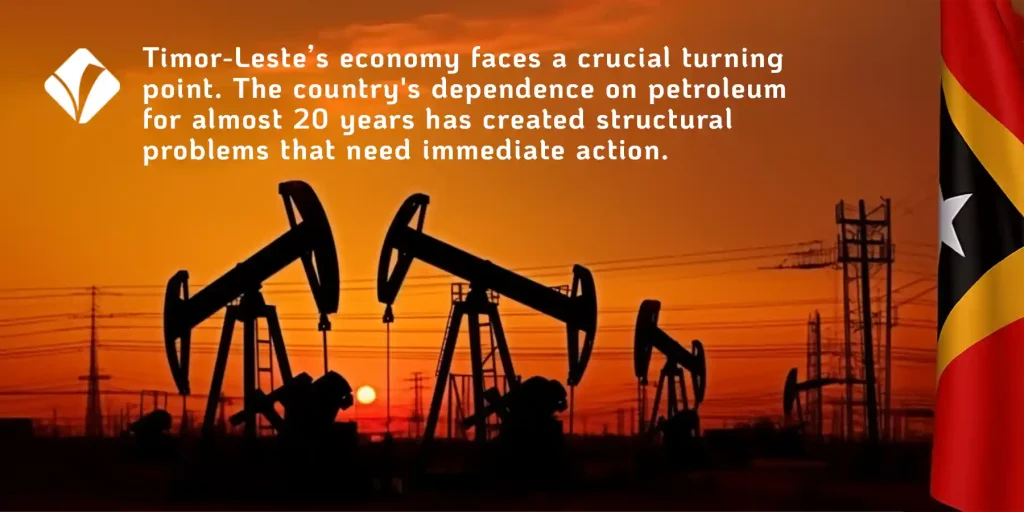
In short: Timor-Leste’s economy faces a critical crossroads as decades of petroleum dependence highlight the need for diversification & fiscal reform.
Timor-Leste’s economy faces a defining moment. The country’s Petroleum Fund provides more than 90% of government revenue. The nation reached a GDP of US$2.02 billion ($1,500 per capita) in 2022, yet a harsh reality looms ahead. Experts predict the fund could run dry by 2028. The country’s growth rate averaged 4.5% from 2008-2019, which remains nowhere near the East Asia Pacific region’s 7.45%. The COVID-19 pandemic hit the country harder than most nations. Timor-Leste’s economy shrank by 8.3% in 2020, making it one of the worst-affected countries worldwide.
The need to turn Timor-Leste’s economy sustainable becomes clear from the nation’s demographics and economic data. Young people dominate the population – 73% are under 35 years old. Poverty affects 42% of citizens, who barely manage to survive. The official unemployment rate shows 4.9%, but these numbers don’t tell the whole story about the job market’s real condition. The Central Bank has responded by setting three main priorities to diversify Timor-Leste’s economy. The bank knows that detailed governance reforms and capacity building programs are the foundations of progress. Over the years, Timor-Leste collected $22 billion from its oil and gas resources. Now, the last producing reserve nears emptiness and will yield less than $2 billion more. This situation demands immediate economic reshaping.
Understanding The Petroleum Aspect of Timor-Leste’s economy
Timor-Leste has depended on oil money to accelerate its economic growth since gaining independence in 2002. The country set up its Petroleum Fund in 2005. This 18-year old fund manages oil and gas wealth that seemed to guarantee the young nation’s future. The heavy reliance on oil revenue now threatens its long-term stability.
Petroleum Fund Withdrawals vs. Sustainable Income
The Petroleum Fund follows a crucial rule called Estimated Sustainable Income (ESI). This standard lets the government take out 3% of oil wealth each year. The percentage should keep the fund’s main value intact for future generations. The government has taken out more money than this limit allows. Since 2009, withdrawals have sometimes doubled the sustainable amount.
The numbers tell a concerning story. From 2018 to 2021, yearly withdrawals averaged $1.1 billion. The sustainable amount should have been $544 million. The fund’s value keeps dropping faster because of these excess withdrawals. Economic forecasts paint a grim picture – the fund could run dry in 10-15 years. This creates a massive challenge for future governments.
The fund’s total value stood at $18.99 billion in 2019. This might sound impressive, but it equals just 8.9 times the yearly state budget. The fund won’t last long without major policy changes or new money sources. The ratio keeps falling as withdrawals grow bigger than investment returns.
Bayu-Undan Revenue Decline and Investment Risks
A produção do campo de Bayu-Undan caiu drasticamente desde o seu pico em 2011. Este ativo petrolífero-chave trouxe mais de 90% do dinheiro do petróleo de Timor-Leste.
People often talk about the Greater Sunrise field as the next big oil asset. Development faces many uncertainties and political issues. Production won’t start until at least 2026, even in the best case. The project needs huge upfront investments – possibly $12 billion. This means significant revenue will take even longer to arrive.
The fund’s investment approach brings its own challenges. US Treasury bonds made up most investments at first. Now, 40% goes into stocks to chase higher returns. This move toward riskier investments means more ups and downs in performance. The COVID-19 pandemic in 2020 showed this clearly when the fund lost substantial value before bouncing back.
Crescimento da Despesa Pública (2008–2016)
Government spending in Timor-Leste grew at remarkable rates from 2008 to 2016. The total jumped from $603 million to $1.6 billion – a 165% increase in eight years. The country paid for this massive increase by taking more money from the Petroleum Fund rather than collecting more domestic revenue.
Looking at where the money went raises red flags. Infrastructure spending took up nearly 30% of the budget in 2011. By 2016, regular expenses like salaries, goods, services, and public transfers ate up most of the budget. Transfers and subsidies jumped from $85.3 million to over $475 million between 2008 and 2016 – a 457% increase that created lasting financial obligations.
The productive sectors got nowhere near enough funding. Agriculture employs about 60% of people but received less than 2% of the national budget. Tourism and manufacturing together got less than 5% of spending, though these sectors could create lasting jobs and growth.
The Resource Curse and Rentier State Dynamics
Timor-Leste shows classic signs of what economists call the “resource curse” – a paradox where wealth from resources actually holds back development. The country’s institutional structure has been shaped by its dependence on petroleum, with external resource rents making up about 80% of state revenues. This dependence has created economic and political patterns that keep the country underdeveloped despite its rich resources.
High Public Transfers and Low Private Investment
Public spending in Timor-Leste has shot up from just $52.50 million in 2002 to $2.20 billion in 2024. Between 2008-2016, total spending grew 12% yearly – double the rate of non-oil GDP growth. This money was mostly used for consumption instead of productive investments. The 2024 budget shows this clearly, as public transfers take up 41.8% ($929.20 million) of total allocations.
While public transfers dominate, private investment stays low. Local businesses are small, informal, and struggle to compete. Many business owners point to political instability, corruption, and unreliable power supply as major roadblocks to growth. The country attracts very little foreign investment, and what comes in usually ties to government contracts rather than private sector opportunities. This creates a risky dependence on government spending to keep Timor-Leste’s economy moving.
The government and donors spent about $21.50 billion between 2000-2024 ($16,045 per person), but this massive spending hasn’t reduced poverty or created lasting economic growth. Timor-Leste’s economy actually shrank by 1.4% on average from 2017 to 2021.
Subsidy Culture and Political Patronage
The petroleum fund has changed how Timor-Leste’s government works. Systems based on patronage and obligation have taken root. This shows up in several ways:
- Public sector jobs used as political rewards
- Contratos públicos atribuídos a ligações políticas
- Big veterans’ pensions to keep political support
- Social transfers that create dependency
Veterans’ pensions tell this story well. These payments jumped from 1.2% of GDP in 2009 to over 4% by 2017. Monthly payments in 2014 ranged from $230 to $750 – huge sums in a country where 40% of people lived on less than $38 monthly. Other subsidy programs have grown similarly, with cash transfers eating up large chunks of the budget each year.
This culture of subsidies matches typical behavior in rentier states, where governments hand out resource money to keep political peace instead of investing in growth. Tax collection stays minimal as a result, with domestic revenues at less than 12% of GDP. This weakens the accountability that usually comes from taxation.
Crowding Out of Productive Sectors
Government spending in Timor-Leste runs between 80-120% of GDP, pushing out productive economic activities. The big public sector pulls talent away from private business and drives up wage expectations. High government spending mostly goes to imports rather than local production, causing inflation that makes local goods and services less competitive.
Each dollar of public spending in Timor-Leste generates only $0.10 in economic activity – nowhere near the theoretical $4.00 multiplier. This poor performance happens because the money mostly buys imports instead of boosting local production. Public administration and construction benefit directly from government spending, while farming and manufacturing lag behind despite their potential to create lasting jobs.
Health and education, which should be the foundations for long-term growth, get much less money than in similar countries. Education receives just 7-10% of government spending (compared to 16% average for lower-middle income countries), while health spending dropped as low as 1.27% in 2007 (versus 5.07% regional average).
O país necessita de reformas profundas na forma como gasta o dinheiro público e como governa para se libertar destes padrões da maldição dos recursos. Sem resolver estes problemas sistémicos, os esforços para diversificar a economia de Timor-Leste não funcionarão bem, independentemente das soluções técnicas que tentemos em setores específicos.
Sectoral Underperformance in Economic Diversification Efforts
Attempts to broader Timor-Leste’s economy show poor performance in many productive sectors. This weakness stems from years of low investment and too much spending on public administration. The government’s Strategic Development Plan 2011-2030 saw agriculture, tourism, and manufacturing as the foundations of sustainable growth. The actual investment patterns paint a different picture.
Agriculture: 1.5% Growth vs. 9.3% in Public Admin
O setor agrícola de Timor-Leste apresenta um enigma preocupante. A indústria representa quase 20% do PIB não petrolífero e emprega 60% da população. O PIB agrícola real em 2021 caiu abaixo do seu pico de 2012. Os números parecem ainda piores quando contabilizamos a inflação e o crescimento populacional. O PIB real per capita da agricultura caiu quase 20% na última década.
Public administration now takes up over 30% of non-oil GDP, which shows a stark difference. The government spent USD 3.6 billion on capital development between 2008-2020. Only USD 48.2 million (1.3%) went to agriculture. Investment hit its peak in 2014-2015 but kept falling after that, which shows little support for the sector.
Looking at specific crops tells the same story. Timor-Leste’s main agricultural products – coffee, maize, and rice – saw yearly drops of 8.4%, 3.4%, and 10.6% over ten years. Animal production offers a bright spot, growing from USD 20 million in 2010 to almost USD 70 million by 2020.
Tourism: 74,800 Visitors in 2019 to Near-Zero in 2020
Tourism showed promise as a way to broaden Timor-Leste’s economy before COVID-19 hit. Timor-Leste welcomed 38,074 leisure travelers in 2019, bringing in USD 23.2 million. The data shows 30% came for holidays, while 54% visited friends and family. Most tourists stayed in Dili (65%), Atauro (33%), Baucau (19%), and Liquica (19%).
Os visitantes deram feedback maioritariamente positivo:
- 92% rated safety and security as good
- 89% rated hospitality and customer service as good
- Only 46% thought infrastructure was good
The National Tourism Policy aims to attract 200,000 yearly tourists by 2030. Poor infrastructure makes this goal hard to reach. Out of USD 3.6 billion spent on development between 2011-2020, tourism got just USD 8.2 million (0.2%).
A COVID-19 afetou duramente o setor do turismo em crescimento. O número de visitantes caiu para quase zero em 2020. O país lidou bem com a pandemia, registando apenas 30 casos na primeira vaga. Este sucesso poderá ajudar na recuperação, especialmente tendo em conta que os turistas australianos representaram 48% dos visitantes em 2019.
Manufacturing: <2% of GDP Despite 6.5% Growth
Manufacturing remains tiny in the country, adding less than 2% to GDP. The sector grew by 6.5% but barely helped broaden Timor-Leste’s economy. The 2024 outlook confirms “the manufacturing industry improved slightly compared to last year, but its effect on growth in 2024 stayed limited, showing ongoing stagnation”.
Several issues explain this weakness. Local companies rarely reach global markets – only 4.76% of firms had international quality certifications in 2015. Foreign investment remains low and mostly ties to government contracts instead of manufacturing growth. Even big investments like the Heineken factory created some jobs but didn’t help Timor-Leste’s economy much.
The services deficit got better by USD 51.9 million in 2024, reaching USD 275.1 million. This improvement came mostly from fewer manufacturing-related service imports. Non-oil exports grew by 21.7% in 2024 to USD 21 million, with coffee leading the way. These small gains don’t offset Timor-Leste’s heavy reliance on imports, which hit USD 923.2 million in 2024.
Timor-Leste’s Human Capital and Labor Market Gaps
Timor-Leste struggles with more than just economic diversity issues. The country’s human capital shortcomings hold back its growth prospects. These limitations create a difficult cycle – they stem from economic vulnerabilities while also making those same vulnerabilities worse.
Low Labor Force Participation Rate in Southeast Asia
The labor market in Timor-Leste shows worrying structural problems that set it apart from its neighbors. The labor force participation rate is just 46.9% – the lowest in Southeast Asia. Women’s participation lags even further at 40.6% compared to men at 53.6%. Young people aged 15-24 face the toughest situation with only 32.7% participating in the workforce.
The country’s formal job sector remains tiny. There are less than 60,000 formal jobs for a population of 1.3 million people. Government positions make up 42% of these formal jobs, creating an unhealthy reliance on public sector employment. The informal sector accounts for 71.2% of all jobs, which leads to lower productivity, limited social protection, and reduced tax revenue.
Os números tradicionais do desemprego não contam toda a história. Embora o desemprego oficial se situe em 5,1%, isto oculta um problema maior - 56,3% dos trabalhadores encontram-se em empregos vulneráveis sem acordos formais, remuneração adequada ou proteção social.
Job creation falls far short of what’s needed. From 2010-2019, only 4,000 formal jobs were created each year while 18,000 new workers entered the market. This leaves a yearly gap of about 14,000 jobs.
Education System Fragmentation and Language Barriers
Timor-Leste’s educational outcomes reveal serious workforce development issues. Adult literacy reaches only 68%, with a stark divide between urban (84.7%) and rural areas (57.3%). The numbers paint a troubling picture – 43.6% of people have no formal education, and just 1.8% have finished university.
Language policy creates major hurdles in education. Portuguese serves as an official language alongside Tetum, but most teachers don’t speak Portuguese well. This affects learning quality deeply – 58% of first graders can’t read a single word in either language. Reading skills improve only slightly by third grade.
O governo gasta apenas 7,1% do seu orçamento em educação, o que fica muito abaixo dos níveis de despesa de países similares. Esta falta de investimento reflete-se na qualidade dos professores – apenas 12% dos professores cumprem os requisitos básicos de qualificação.
Health Indicators: Stunting and Malnutrition Rates
Poor health indicators limit the country’s productivity and economic potential. Malnutrition ranks as the most pressing issue, with 47.1% of children under five showing stunted growth – among the world’s highest rates. This affects both immediate healthcare costs and reduces lifetime earning potential through impaired cognitive development.
Healthcare faces ongoing resource shortages. The government allocates only 2.4% of spending to health, far below regional standards. Access to care varies widely – 74% of urban births receive skilled care compared to 25% in rural areas.
Life expectancy has reached 69.5 years but still lags behind neighboring countries. Maternal mortality remains high at 195 deaths per 100,000 live births, highlighting healthcare weaknesses that affect women most.
These gaps in human capital form major roadblocks to Timor-Leste’s economic growth. The country needs coordinated policies that tackle education, health, and job market barriers at the same time.
Institutional and Policy Reform Imperatives
Timor-Leste needs to reform its institutional frameworks and spending patterns to tackle its economic challenges. Reports from international financial institutions show key reforms that could shape the nation’s future beyond its reliance on petroleum.
Public Expenditure Review: Call for Spending Rationalization
The World Bank’s Public Expenditure Review (PER) points to poor public spending as a major roadblock to Timor-Leste’s growth. Public spending has reached high levels – since 2007- averaging over 80% of GDP but hasn’t led to economic growth. This gap shows how high spending leads to resource waste, big fiscal deficits, and slows economic growth.
The review recommends:
- Controlar despesas fixas antes que se tornem demasiado difíceis de gerir
- Using cost-benefit analysis when choosing projects
- Making public investment more efficient to fix the 54% efficiency gap 0- which is much higher than the 24% average in emerging markets
These problems could push Timor-Leste toward a fiscal cliff by 2035 without changes to current spending. Better public financial management could improve investment quality and help track adaptation spending, according to the IMF.
Necessidade de Reafetação Orçamental para Setores Produtivos
O orçamento atual mostra desequilíbrios claros que prejudicam os esforços para diversificar a economia de Timor-Leste. A maior parte do dinheiro público vai para as infraestruturas – estradas e eletricidade – enquanto o desenvolvimento humano e os setores produtivos ficam para trás. Apesar dos objetivos declarados, os principais setores de crescimento, como a agricultura, o turismo, o comércio e a indústria, recebem apenas 1% do total da despesa.
The 2024 General State Budget tries to fix these issues with its theme: “Building a bridge to tomorrow: investing in the productive sector and in social capital”. This budget gives $788.20 million to economic affairs, $467.10 million to social protection, $140.90 million to education, and $66.20 million to health. Past patterns show it’s still hard to match spending with development needs.
The country needs to shift resources to sectors that boost GDP directly. One way is to watch large transfer recipients more closely. Agriculture shows real promise – a 10% yearly growth could create more exports and reduce food imports.
Improving Regulatory Framework for Private Sector
Timor-Leste has made big regulatory changes to help private businesses grow. The Commercial Companies Law of 2017 makes it easier to start small and medium-sized businesses. This law removes old rules and helps improve Timor-Leste’s image with foreign institutions.
Esta lei faz parte de um pacote completo com a Lei de Arbitragem, Mediação e Conciliação, o Código de Recuperação e Insolvência e melhores serviços de registo comercial. Estas alterações visam criar “um ambiente favorável para atividades comerciais que funcionem bem e custem menos”.
The Chamber of Commerce and Industry of Timor-Leste (CCI-TL) sees more areas needing work. These include clear rules and regulations, fair competition through enforcement, and fighting corruption to build trust in Timor-Leste’s economy. Better access to finance through special credit schemes would help small businesses the most.
Take your skills to the next level with Risalat’s programs in Economic Governance, Public Financial Management, and Sustainable Development. Help shape Timor-Leste’s future and build lasting resilience.
Financial Sector Development and Digital Inclusion enhancing Timor-Leste’s economy
Digital innovation leads the push to transform Timor-Leste’s economy beyond petroleum dependency. The Banco Central de Timor-Leste (BCTL) has taken bold steps to develop a more available financial ecosystem. BCTL launched its Master Plan for Financial Sector Development in 2014 with a complete roadmap that extends to 2025.
BCTL’s Mobile Banking Initiative: Banku iha Ha’u Nia Bolsu
O BCTL introduziu o “Banku iha Ha’u Nia Bolsu” (Banco no Meu Bolso) para resolver o acesso limitado à banca nas zonas rurais. Este programa inovador de banca móvel ajuda as comunidades rurais a aceder a serviços de crédito e transações financeiras. O programa alinha-se com a terceira prioridade estratégica do BCTL, que se centra nos sistemas de pagamento digital em todo o país. Muitos cidadãos vivem em zonas remotas, longe dos bancos tradicionais, e esta solução móvel serve como uma ponte vital para uma maior participação financeira.
Expanding Credit Access for MSMEs
BCTL launched the Credit Guarantee System (CGS) for Small and Medium Enterprises in July 2019. The program tackles a major barrier to economic diversification – local businesses’ access to finance. The system shares credit risk between lending institutions and the guarantee mechanism. The State covers up to 70% of loans.
The CGS benefits small and medium enterprises that have 6-50 registered employees. These businesses must be Timorese-owned and operate in key sectors: agriculture, tourism, industry, manufacturing, and transport. BCTL created a digital online platform that runs all processes electronically. The program started with Banco Nacional de Comércio de Timor-Leste (BNCTL) as its only participating lender.
Digital Payment Systems for Rural Inclusion
Timor-Leste’s payment infrastructure has modernized rapidly with the National Switch System, known as P24. This system connects financial service providers and ensures secure transactions across the country.
E-wallet services have become successful digital financial tools. BCTL authorized Telemor Fintech to run an electronic money wallet service called “Mosan Service” in August 2018. The service built an impressive network of 718 branches serving 24,677 customers by late 2019. BNCTL has launched its own digital wallet “KOHE BNCTL”.
These digital financial services have created significant change. E-wallet agents and merchants now make up 65% of the country’s 6,508 financial service access points. Services have spread across administrative divisions, reaching all 14 municipalities, 67 administrative posts, and 94% of the country’s 452 sucos (villages).
Donor Engagement and International Partnerships for Strengthening Timor-Leste’s economy
International partnerships are crucial for Timor-Leste to move toward an eco-friendly economy beyond petroleum dependence. Foreign donors have committed substantial resources to fix critical infrastructure gaps, build human capital, and support institutional capacity in multiple sectors.
Apoio do Banco Mundial e do ADB para Infraestruturas
The Asian Development Bank (ADB) has become a vital multilateral partner to address infrastructure bottlenecks in Timor-Leste. ADB has committed 81 public sector loans, grants, and technical assistance totaling $766 million as of December 2024. The current sovereign portfolio has 14 loans and 1 grant worth $580.42 million. ADB’s traditional focus on transport infrastructure has expanded to include water, urban development, energy, agriculture, and rural development sectors.
ADB approved a $4 million grant to boost road transport connection in Ermera in October 2025. The project focuses on an 11-kilometer road corridor that connects rural communities to markets. ADB also provides transaction advisory services for public-private partnerships in solar power, unique identification systems, solid waste management, and carbon credit markets.
Australia’s Role in Health and Education Programs
Australia continues to be Timor-Leste’s largest development partner with detailed programs that address human development needs. The Australia Timor-Leste Partnership for Human Development (PHD) runs a 10-year program to strengthen government systems for primary healthcare and basic education. Australia supports clinical workforce development, infrastructure upgrades, family planning services, and digital stock management systems in the health sector.
Australia committed $10 million through Direct Budget Support to help design a performance-based finance program for maternal and child health outcomes in 2025-2026. The country’s educational assistance aims to improve literacy and numeracy through the ALMA program that supports professional development for school leaders and teachers. Australia has also pledged $47.8 million (2022-2028) through its Infrastructure Financing Facility for groundbreaking projects including Timor-Leste’s first undersea cable connection.
Investimentos da Iniciativa Cinturão e Rota da China no Porto de Tibar
China’s partnership with Timor-Leste reached a milestone with the Tibar Bay Port project’s inauguration in November 2022. China Harbor Engineering Company, a Chinese state-owned enterprise, constructed this first Public-Private Partnership in the country. The $280 million original phase is part of a total expected investment of $500 million over 30 years.
The port boosts Timor-Leste’s maritime connection in the Asia-Pacific region substantially and links the country to global trade markets. The port’s facilities include a 630-meter-long wharf with one 7,000-TEU berth and one 3,500-TEU berth. Once fully operational, it will handle up to one million containers. This strategic infrastructure investment places Timor-Leste within China’s Belt and Road Initiative and revolutionizes the country’s import-export capabilities for agricultural products, tourism, fisheries, and other industries.
Pathways to a Sustainable and Inclusive Economy
Timor-Leste necessita de investimento focado em setores promotores para alcançar um crescimento sustentável com os seus recursos petrolíferos. Novos dados revelam caminhos claros para este objetivo.
Investing in Agriculture and Food Security
O Relatório integrado de Agricultura, Alimentação e Nutrição de 2025 destaca nove intervenções de elevado retorno que poderiam melhorar significativamente a produtividade agrícola. Estas medidas poderiam aumentar os rendimentos de arroz, milho e horticultura em aproximadamente 60% e duplicar a produção de café. As alterações ajudariam 190.000 famílias a obter 133 milhões de dólares em lucros anuais, impulsionando simultaneamente as receitas do agroegócio em 14 milhões de dólares. Timor-Leste importa atualmente 60% dos seus alimentos, sendo que o arroz – o seu principal alimento básico – representa 45%. O setor agrícola do país emprega 66% dos agregados familiares, e os investimentos direcionados na criação moderna de gado, sistemas de irrigação e culturas de alto valor oferecem oportunidades significativas.
Eco-Tourism and Biodiversity as Growth Drivers for Timor-Leste’s economy
Timor-Leste’s location in the Coral Triangle makes it a biodiversity hotspot. The country hosts 76% of the world’s coral species and boasts one of the highest numbers of cetaceans globally – 25 species of whales and dolphins. Local eco-tourism projects have achieved remarkable success. One project has welcomed over 4,000 tourists from more than 140 countries. These initiatives provide steady income streams while protecting cultural heritage and natural environments.
Renewable Energy and Carbon Capture Potential
The Bayu-Undan Carbon Capture and Storage Project aims to convert a depleted gas field into a regional carbon storage hub capable of storing 10 million tons annually. This innovative $1.6 billion project could create substantial new revenue opportunities. Join Risalat’s specialized programs on Economic Governance, Public Financial Management, and Sustainable Development to strengthen capacity, drive innovation, and support Timor-Leste’s transition toward long-term resilience.
Ver

Know people who should read this? Become an Ambassador or write with Risalat.
Parceiros no sucesso dos projetos desde 2011: diagnósticos, apoio consultivo e aprendizagem aplicada para ministérios, organismos públicos e equipas de projeto.
Precisa de ajuda para pôr isto em prática?
Comece com um diagnóstico gratuito de 10 minutos ou fale com os nossos especialistas.