Factos essenciais
- Datas
- 15–19 fev. 2027 (5 dias)
- Local
- TBD, London, United Kingdom
- Preço por participante
- £3.950 (GBP)
- Pagamento
- Por fatura e transferência bancária
- Encerramento das inscrições
- 6 jan. 2027
- Formato
- 5-day short course: a practical capacity-building programme for government, NGO and project teams in London
- Certificado
- Certificado de conclusão
- Opção interna
- Realize-o para a sua equipa, nas datas que preferir
Nesta página 16 secções
Visão geral do programa
Economic analysis links technical work on a petroleum project to the decision to invest, and to the share of value that goes to the state. Upstream projects carry large up-front costs, long lead times, geological uncertainty and volatile prices, so the way cash flows, fiscal terms and risk are modelled has a direct effect on investment decisions and public revenue.
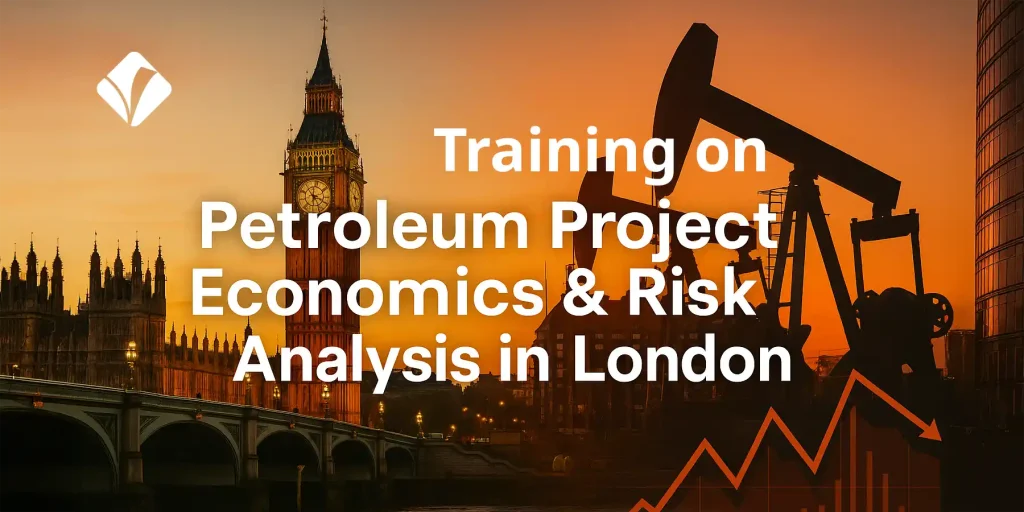
This five-day Petroleum Project Economics & Risk Analysis Training in London takes participants from cash flow fundamentals through fiscal regime modelling to probabilistic risk analysis. Participants build an integrated field development model in Excel, test it against different fiscal terms and price paths, and use decision trees and Monte Carlo simulation to judge risk.
The programme draws on current public tools and policy. The IMF’s Fiscal Analysis of Resource Industries (FARI) approach, a discounted cash flow method used to evaluate mining and petroleum fiscal regimes, provides the framework for comparing government take and investor returns. The UK’s own regime, where the Energy Profits Levy raised the headline rate on upstream profits to 78% from November 2024, offers a live example of how fiscal changes shift project value.
Energy transition risk is treated as a core modelling input, not an afterthought. Participants test projects against lower long-term prices, carbon costs and decommissioning obligations, so that investment cases and fiscal terms hold up under a range of demand scenarios.
The programme suits ministries, regulators and national oil companies as well as company and finance teams. Government participants focus on fiscal design and revenue forecasting; commercial participants focus on valuation and portfolio decisions; both work on the same models.
The Programme Strengthens Institutional Capability
- Terminologia da economia do petróleo e fases do ciclo de vida do projeto
- Pre-tax and post-tax cash flow modelling
- Depreciation, loss carry-forward and ring-fencing rules
- Inflation, nominal and real cash flows
- Time value of money and discount rate selection
- NPV, IRR, payback, profitability index and breakeven price
- Royalty and tax regimes
- Production sharing contracts, cost recovery and profit oil
- Resource rent taxes and windfall levies
- Government take, effective tax rates and progressivity
- Fiscal regime modelling with the IMF FARI approach
- Expected value and decision tree analysis
- Farm-in and farm-out evaluation
- Sensitivity and scenario analysis
- Monte Carlo simulation of reserves, costs and prices
- Energy transition and stranded asset risk
- Decommissioning cost estimation and provisions
- Investment decision papers for boards and ministries
The result is a team that can build, challenge and explain an economic model, and use it to support fair terms and sound investment decisions.
The Growing Importance of Petroleum Project Economics & Risk Analysis
Fiscal terms are changing more often. The UK raised the Energy Profits Levy to 38% from 1 November 2024, removed its main investment allowance and extended it to 31 March 2030. It has since confirmed that a permanent Oil and Gas Price Mechanism, charging 35% on revenues above $90 per barrel for oil and 90p per therm for gas in 2026/27, will follow once the levy ends. Investors and governments elsewhere are watching how such changes affect activity and revenue.
Cost and decommissioning data show why careful modelling matters. The North Sea Transition Authority reported average UKCS unit operating costs of £17.81 per barrel of oil equivalent in 2025, down from £19.60 in 2024, but estimates the remaining decommissioning bill at £43.4 billion, with a record £2.6 billion spent in 2025. Late-life economics, cessation of production and abandonment liabilities now weigh heavily on valuations.
For producer governments, the IMF recommends transparent cash flow modelling and domestic modelling capacity, noting in a 2024 working paper that comparing fiscal instruments on consistent cash flow metrics helps regime design and that carbon taxes interact with extractive fiscal regimes.
As organizações precisam cada vez mais de profissionais capazes de:
- Building transparent cash flow models from technical and cost inputs
- Seleção e justificação de taxas de desconto e pressupostos de preços
- Modelling royalty, tax and production sharing terms
- Cálculo da receita do governo e taxas efetivas de imposto
- Comparing fiscal regimes on consistent indicators
- Forecasting public revenue from petroleum projects
- Quantifying geological, cost, schedule and price uncertainty
- Using decision trees for exploration and appraisal choices
- Running Monte Carlo simulation and reading the outputs correctly
- Testar projetos sob cenários de transição e preço do carbono
- Estimating and provisioning for decommissioning
- Reviewing operator models and development plans critically
- Presenting results clearly to non-specialist decision-makers
Strong petroleum project economics systems help organisations:
- Make investment decisions that reflect risk
- Negotiate fairer and more stable fiscal terms
- Melhorar a exatidão das previsões de receitas e orçamentos
- Identify marginal projects and incentive needs early
- Avoid committing capital to assets at risk of stranding
- Plan for decommissioning liabilities
- Strengthen audit and parliamentary scrutiny of contracts
- Communicate trade-offs between state and investor returns
- Build consistent valuation practice across portfolios
Good models do not remove uncertainty, but they make assumptions visible, so that ministries, boards and lenders can see where value and risk sit.
Who Should Attend This Petroleum Project Economics Training?
Este programa destina-se a:
- Officials in ministries of petroleum, energy and finance
- Upstream regulators and licensing authorities
- Revenue authority staff dealing with extractive taxation
- National oil company planners and commercial teams
- Petroleum economists and project analysts
- Reservoir, petroleum and field engineers moving into economics
- Development planning and asset managers
- Financial analysts and corporate treasury staff
- Investment, banking and project finance professionals
- Internal and external auditors of oil and gas operations
- Accountants working on upstream joint ventures
- Contract negotiators and legal advisers
- Sovereign wealth and resource fund staff
- Staff of oversight bodies and parliamentary committees
- Consultants advising on extractive sector governance
No advanced finance background is required, but participants should be comfortable with Excel. Mixed teams of engineers, economists and finance staff benefit most.
Assinale o que a sua equipa precisa de ser capaz de fazer.
Petroleum Project Economics Training Objectives
Upon successful completion of this Petroleum Project Economics Training, participants will be able to:
- Use standard petroleum economics terms and concepts correctly
- Set up a pre-tax and post-tax cash flow for a field development
- Apply depreciation, loss carry-forward, inflation and sunk cost rules
- Calculate and interpret NPV, IRR, payback, profitability index and breakeven price
- Model royalty and tax, production sharing and resource rent regimes
- Measure government take and compare regimes using FARI-style indicators
- Apply expected value and decision tree analysis to exploration and farm-out decisions
- Realizar análises de sensibilidade, de cenários e de Monte Carlo
- Include carbon costs, transition scenarios and decommissioning in valuations
- Build an integrated Excel model of a typical oil field development
- Present an economic evaluation and recommendation to decision-makers
Each objective is practised in Excel during the week, so participants leave with working models rather than formulas on slides.
Conteúdo e estrutura do programa
- Petroleum economics terms and the project life cycle
- Exploration, appraisal, development, production and decommissioning phases
- Building a cash flow: revenue, capital and operating costs
- Métodos de depreciação e abatimentos de capital
- Loss carry-forward and ring-fencing
- Inflation and escalation assumptions
- Nominal versus real cash flow
- Time value of money and present value
- Discount factors and choosing a discount rate
- Net present value and its interpretation
- Internal rate of return and its pitfalls
- Payback period and maximum cash exposure
- Profitability index and capital rationing
- Breakeven price analysis
- Royalty and tax systems
- Contratos de partilha de produção: petróleo de custo, petróleo de lucro e repartições
- Resource rent taxes and R-factor mechanisms
- State participation and carried interests
- Windfall levies: the UK Energy Profits Levy and Oil and Gas Price Mechanism
- Government take, AETR and METR
- Progressivity and stability of fiscal terms
- Risco versus incerteza em projetos petrolíferos
- Expected monetary value
- Decision tree analysis for exploration and appraisal
- Value of information
- Farm-in and farm-out decisions
- Distribuições de probabilidade para reservas, custos e preços
- Sensitivity analysis and tornado charts
- Assembling an integrated economic model of a field development
- Model structure, checks and documentation
- Energy transition scenarios and long-term price decks
- Custos de carbono e intensidade de emissões nas avaliações
- Stranded asset risk and project resilience
- Late-life economics and cessation of production
- Decommissioning cost estimation and provisions
Conteúdo completo, dia a dia
Os cinco dias constroem um modelo integrado passo a passo, utilizado em seguida para análise fiscal e de risco.
- Day 1: cash flow fundamentals
- Day 2: economic indicators and investment decisions
- Day 3: petroleum fiscal regimes and government take
- Day 4: risk, uncertainty and Monte Carlo simulation
- Day 5: integrated field model, transition risk and capstone
Conteúdo completo, dia a dia
Primeiro Dia | Fundamentos de Fluxo de Caixa para Projetos de Petróleo
- Petroleum economics terms and the project life cycle
- Exploration, appraisal, development, production and decommissioning phases
- Building a cash flow: revenue, capital and operating costs
- Métodos de depreciação e abatimentos de capital
- Loss carry-forward and ring-fencing
- Inflation and escalation assumptions
- Nominal versus real cash flow
- Sunk costs and incremental thinking
- Project financing structures and their effect on cash flow
Workshop: First Field Cash Flow
Working in Excel, teams build a pre-tax annual cash flow for an offshore oil discovery using a given production profile, cost estimate and price deck. They switch between nominal and real terms, apply two depreciation methods and test the effect of a two-year cost overrun. The model becomes the base used throughout the week.
Second Day | Economic Indicators and Investment Decisions
- Time value of money and present value
- Discount factors and choosing a discount rate
- Net present value and its interpretation
- Internal rate of return and its pitfalls
- Payback period and maximum cash exposure
- Profitability index and capital rationing
- Breakeven price analysis
- Efeito do atraso do projeto no valor
- Incremental projects and phased developments
Workshop: Ranking Development Options
Teams compare three development concepts for the same field: a standalone platform, a subsea tie-back and a phased development. They calculate NPV, IRR, payback and breakeven price for each, test a delay to first oil and rank the options. Each team writes a one-page note explaining which indicator should drive the decision and why.
Third Day | Petroleum Fiscal Regimes and Government Take
- Royalty and tax systems
- Contratos de partilha de produção: petróleo de custo, petróleo de lucro e repartições
- Resource rent taxes and R-factor mechanisms
- State participation and carried interests
- Windfall levies: the UK Energy Profits Levy and Oil and Gas Price Mechanism
- Government take, AETR and METR
- Progressivity and stability of fiscal terms
- The IMF FARI approach to regime evaluation
- Revenue forecasting for budgets and resource funds
Case Study: Comparing Fiscal Regimes
Using the base field model, teams apply three regimes: a royalty and tax system, a production sharing contract and a UK-style ring-fenced regime with a windfall levy. Following the FARI approach, they compare investor NPV, government take and the timing of state revenue across price scenarios, then discuss which design balances investment incentives with a fair public share.
Fourth Day | Risk, Uncertainty and Probabilistic Analysis
- Risco versus incerteza em projetos petrolíferos
- Expected monetary value
- Decision tree analysis for exploration and appraisal
- Value of information
- Farm-in and farm-out decisions
- Distribuições de probabilidade para reservas, custos e preços
- Sensitivity analysis and tornado charts
- Simulação de Monte Carlo no Excel
- Reading P10, P50 and P90 outcomes
Workshop: Exploration Decision Tree and Simulation
Teams build a decision tree for an exploration licence with options to drill, farm out or relinquish, using chance of success and outcome values from their model. They then run a Monte Carlo simulation on reserves, capital cost and oil price to produce an NPV distribution, and decide whether the farm-out terms on offer are acceptable.
Fifth Day | Integrated Models and Transition Risk
- Assembling an integrated economic model of a field development
- Model structure, checks and documentation
- Energy transition scenarios and long-term price decks
- Custos de carbono e intensidade de emissões nas avaliações
- Stranded asset risk and project resilience
- Late-life economics and cessation of production
- Decommissioning cost estimation and provisions
- Presenting economic evaluations to boards and ministries
- Planeamento de ações pessoais
Exercício Prático: Avaliação Económica Completa
Teams complete an integrated evaluation of a field development under a chosen fiscal regime, including probabilistic results, a low-price transition scenario, a carbon cost and a decommissioning provision. They present a recommendation to a mock investment committee or ministry panel, defend their assumptions under questioning and record the main lessons for their own organisation.
Petroleum Project Economics Training Methodology
The programme is hands-on. Each concept is introduced briefly, then applied immediately in a shared Excel model, so that by the end of the week every participant has built and tested a complete evaluation.
O programa combina:
- Short expert briefings on concepts and methods
- Guided Excel modelling exercises
- A single field model developed across all five days
- Fiscal regime comparisons using published frameworks
- Decision tree and Monte Carlo simulation practice
- Case material from the UK and other producing countries
- Group discussions on policy and investment trade-offs
- Peer review of models and assumptions
- Trabalhos individuais com feedback do facilitador
- A mock investment committee or ministry panel
- Modelos e listas de verificação exemplares para uso posterior
Participants are invited to complete a short training needs assessment before the programme so that examples and fiscal regimes can be matched to their roles.
Visitas técnicas e programa no terreno
Where scheduling allows, the programme can include a technical visit or expert session in London linked to the week’s themes, for example with an energy sector organisation, a professional body or a specialist adviser working on upstream economics, regulation or decommissioning. Visits are confirmed with host organisations closer to the programme dates and are subject to their availability and access rules; when a visit cannot be arranged, an extended expert-led case session replaces it.
Resultados esperados
Após a conclusão desta Formação em Economia de Projetos Petrolíferos, os participantes serão capazes de:
- Build and audit a petroleum project cash flow model
- Select and defend the right economic indicators for a decision
- Model and compare common fiscal regimes
- Estimate government take and revenue timing
- Use decision trees and Monte Carlo simulation in practice
- Assess farm-in and farm-out terms
- Incluir riscos de transição, carbono e desativação nas avaliações
- Apresentar uma recomendação de investimento clara e baseada em evidências
Participants return with their completed model, templates and a set of checks they can apply to models prepared by operators, consultants or colleagues.
£3.950 por participante · fatura e transferência bancária · grupos de 5 ou mais pessoas beneficiam de desconto
Cinco ou mais participantes da mesma organização: peça a tarifa de grupo no pedido de fatura.
Ten or more: an in-house version for your institution may cost less per person. Ask for an in-house quote.
As inscrições encerram em 45 dias (6 Jan 2027)
Institutional Application of Petroleum Project Economics Training
Este programa ajuda as organizações a reforçar:
- Economic evaluation of field development plans
- Fiscal regime design and review
- Licensing round and contract negotiation preparation
- Petroleum revenue forecasting
- Avaliação de investimentos e alocação de capital
- Portfolio and farm-out decisions
- Risk management and probabilistic planning
- Transition and carbon risk assessment
- Decommissioning planning and provisioning
- Model governance and review standards
- Audit and oversight of petroleum agreements
Os participantes regressam com ferramentas práticas para melhorar:
- Modelo integrado de fluxo de caixa de campo
- Modelo de comparação de regimes fiscais
- Government take calculator
- Decision tree template
- Livro de exercícios de simulação de Monte Carlo
- Price and carbon scenario deck
- Model review checklist
- Investment recommendation paper format
Os ministérios e empresas que procuram uma revisão mais ampla das suas funções analíticas podem combinar o programa com uma avaliação de capacidade institucional.
Relevância regional e aplicação
Europa
A Plataforma Continental do Reino Unido é uma bacia madura onde as alterações fiscais, a queda da produção e a desativação dominam a economia. A Taxa sobre os Lucros Energéticos, o Mecanismo de Preço do Petróleo e Gás planeado e os dados de custos da NSTA fornecem um caso bem documentado para participantes de outras províncias maduras.
África
Several African producers and new entrants are negotiating or reviewing production sharing contracts and need to forecast revenue under uncertain prices. Cash flow modelling and FARI-style analysis help ministries test terms before signature and plan budgets realistically.
Médio Oriente
As empresas petrolíferas nacionais e os ministérios da região gerem grandes carteiras e parcerias com empresas internacionais. A análise probabilística, a hierarquização de carteiras e os cenários de transição apoiam o planejamento de investimentos de longo prazo e de diversificação.
Ásia
Producers in Central, South and Southeast Asia face declining mature fields alongside gas developments for domestic energy security. Economic evaluation of incremental projects, late-life fields and gas pricing is directly relevant.
América Latina
New offshore provinces and established producers both depend on fiscal terms that attract investment while protecting public revenue. Comparing regimes on consistent indicators helps governments and investors discuss terms on a shared basis.
Participants can use their own country’s fiscal terms in the Day 3 and Day 5 exercises, so the model they take home reflects their real regime.
Source: HM Treasury, Energy Profits Levy reforms 2024 (GOV.UK)
1. What is the combined headline tax rate on UK upstream oil and gas profits since November 2024?
HM Treasury's 2024 reforms combine 30% ring fence corporation tax, the 10% supplementary charge and a 38% Energy Profits Levy, giving 78%.
2. What does the IMF's FARI model mainly do?
O FMI descreve o FARI como um modelo de fluxo de caixa descontado baseado em Excel utilizado para avaliar regimes fiscais de mineração e petróleo, incluindo a taxa efetiva média de imposto.
3. Qual é a estimativa da NSTA relativa ao custo remanescente de descomissionamento da UKCS (atualização de 2026)?
The NSTA's 2026 decommissioning cost and performance update put the remaining programme at £43.4 billion, with £2.6 billion spent in 2025.
- Recolher
- Limpar
- Armazenar
- Analisar
- Decidir
Perfil do país anfitrião – Reino Unido
London is one of the world’s main centres for energy finance, commodity trading, legal and advisory services, which makes it a natural setting for a programme on petroleum project economics. Its universities, professional bodies and energy companies create a deep pool of expertise.
The UK is a useful benchmark because its upstream sector is mature, transparent and heavily documented. The North Sea Transition Authority publishes data on production, costs and decommissioning, including UKCS unit operating costs of £17.81 per barrel of oil equivalent and production efficiency of 76% in 2025, and a remaining decommissioning estimate of £43.4 billion. Recent fiscal changes, from the 78% headline rate to the planned price mechanism, show how policy affects project value.
London is served by several international airports with direct flights from most capitals. Visitors from many countries need a visa or, for eligible nationalities, an Electronic Travel Authorisation before travelling; participants should check current requirements on the UK government website. Risalat provides invitation letters and visa advice on request.
Petroleum Project Economics Training Deliverables
Participants receive full support before, during and after the programme, including the modelling tools built during the week.
Antes do programa
- Avaliação prévia dos participantes
- Petroleum Economics Readiness Assessment
- Petroleum Economics Resource Pack
- Materiais de leitura preparatória
- Apoio e aconselhamento gratuitos em matéria de vistos
Durante o programa
- Recolha no aeroporto e apoio de boas-vindas
- Accommodation with breakfast: 6 nights, check-in Sunday 14 February 2027, check-out Saturday 20 February 2027 (one night before and one night after the programme)
- Jantar de boas-vindas e networking
- Kit de formação Risalat (saco, garrafa, caneca, t-shirt, boné, capa de passaporte, canetas, bloco de notas, íman e porta-chaves)
- Comprehensive Petroleum Economics Training Manual
- Integrated Field Cash Flow Model (Excel)
- Fiscal Regime Comparison Template
- Calculadora de Participação do Estado
- Decision Tree Template
- Monte Carlo Simulation Workbook
- Workshops práticos e simulações
- Discussões de grupo e aprendizagem entre pares
- Almoço e pausas para café diários
- Acesso total às instalações do local de formação
- Mini tablet com materiais de aprendizagem digitais
- Visita de campo (quando aplicável)
- Passeio recreativo pela cidade
Depois do programa
- Certificado de Conclusão
- Prémio Risalat de Reconhecimento da Participação no Programa
- Materiais de referência pós-formação
- Lista de Verificação para Revisão de Modelos
- Price and Carbon Scenario Deck
- Apoio pós-formação e orientação de acompanhamento
- Relatório do programa
Ministries, regulators and companies that want this programme for their own teams, using their own fields and fiscal terms, can request a tailored in-house proposal.
Common Challenges in Petroleum Project Economics & Risk Analysis, And How This Training Helps
How can we check whether an operator’s economic model is reliable?
O 1.º e o 5.º dias cobrem a estrutura do modelo, as verificações de consistência e a documentação, e os participantes saem com uma lista de verificação de revisão do modelo.
How do we choose between NPV, IRR and other indicators when they disagree?
Day 2 explains what each indicator measures and when it misleads, using a ranking exercise on three development options.
How can a ministry tell whether proposed fiscal terms are fair?
Day 3 applies the FARI approach to compare government take, investor returns and revenue timing across regimes and price scenarios.
How do we forecast petroleum revenue for the budget when prices are volatile?
Day 3 and Day 4 combine fiscal modelling with price scenarios and simulation to give revenue ranges rather than single figures.
How should we decide whether to accept a farm-out offer?
Day 4 uses expected value and decision trees to value farm-out terms against drilling alone or relinquishing.
How do we include energy transition risk without guessing?
Day 5 tests projects against low-price and carbon cost scenarios and shows how to set out the assumptions transparently.
How do we account for decommissioning early enough?
Day 5 covers late-life economics and decommissioning estimates, using UK experience where the remaining bill is estimated at £43.4 billion.
Perguntas frequentes
Do I need a finance background to attend?
Não. O programa começa com as bases de fluxo de caixa. Os participantes devem estar à vontade com o Excel, uma vez que todos os exercícios são criados em folhas de cálculo.
Which fiscal regimes are covered?
Royalty and tax systems, production sharing contracts, resource rent and R-factor mechanisms, and windfall levies such as the UK Energy Profits Levy.
O programa é adequado para funcionários do governo?
Yes. Ministry, regulator and revenue authority staff use the same models to compare fiscal terms, estimate government take and forecast revenue.
Haverá uma visita ao local ou técnica?
Where scheduling allows, a technical visit or expert session is arranged; visits are confirmed with host organisations, and an extended case session is held if a visit is not possible.
Can we use our own country's terms in the exercises?
Yes. Participants can apply their own fiscal terms in the Day 3 and Day 5 exercises, and in-house versions can be built around an organisation's own fields.
Who Will Deliver This Programme
Each date is delivered by a team assigned from Risalat's expert network for this subject. For this programme we assign:
How we choose them: Experience in the region of the participants or comparable settings; Command of the financier rules that apply (World Bank, ADB, AfDB, EU, UN) where relevant; Delivery in English; other languages on request for in-house groups; No conflict of interest with participants' institutions.
Training courses in LondonOil and Gas training courses
Porquê Londres para este programa
Londres aproxima os participantes de organismos públicos, reguladores e organizações internacionais do Reino Unido para visitas de estudo.
O programa Petroleum Project Economics & Risk Analysis Training em Londres, em fevereiro de 2027, reúne autoridades e profissionais de toda a Europa, África, Oriente Médio e Ásia. As sessões combinam breves introduções, estudos de caso e trabalho em grupo com base nos arquivos dos próprios participantes, e as instituições da cidade podem ser incluídas como visita de estudo mediante solicitação.
Como chegar: Heathrow (LHR) e Gatwick (LGW).
Verifique se precisa de visto com o Verificador de Vistos gratuito e peça uma carta-convite depois de se inscrever.
Outros programas em Londres
Teams often travel here from Nigeria, Ghana, Sierra Leone, Liberia. Funding, visa letters and group rates are explained on each country page.
For teams and institutions
Bring your team
Teams that learn together apply more at work. Tell us how many people and how you would like to take part: we reply with a group quote within two working days.
Watch: this programme in short


More training courses in the United Kingdom · Todos os programas na Europa · Calendário de formação completo
Planear este programa num roteiro: porque importa, porque o aprovar, as datas a planear e a carreira que constrói.