关键信息
- 日期
- 2027年2月15–19日(5天)
- 地点
- TBD, London, United Kingdom
- 每位学员费用
- £3,950(英镑)
- 付款
- 通过发票和银行转账付款
- 报名截止
- 2027年1月6日
- 形式
- 5-day short course: a practical capacity-building programme for government, NGO and project teams in London
- 证书
- 结业证书
- 内训选项
- 按您的日期,为您的团队专场举办
本页内容16个部分
培训项目概述
Economic analysis links technical work on a petroleum project to the decision to invest, and to the share of value that goes to the state. Upstream projects carry large up-front costs, long lead times, geological uncertainty and volatile prices, so the way cash flows, fiscal terms and risk are modelled has a direct effect on investment decisions and public revenue.
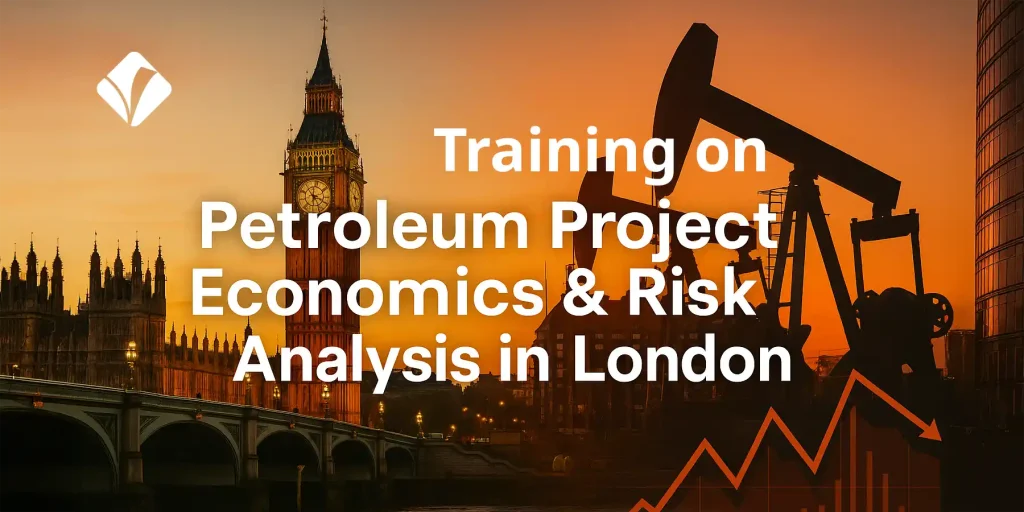
This five-day Petroleum Project Economics & Risk Analysis Training in London takes participants from cash flow fundamentals through fiscal regime modelling to probabilistic risk analysis. Participants build an integrated field development model in Excel, test it against different fiscal terms and price paths, and use decision trees and Monte Carlo simulation to judge risk.
The programme draws on current public tools and policy. The IMF’s Fiscal Analysis of Resource Industries (FARI) approach, a discounted cash flow method used to evaluate mining and petroleum fiscal regimes, provides the framework for comparing government take and investor returns. The UK’s own regime, where the Energy Profits Levy raised the headline rate on upstream profits to 78% from November 2024, offers a live example of how fiscal changes shift project value.
Energy transition risk is treated as a core modelling input, not an afterthought. Participants test projects against lower long-term prices, carbon costs and decommissioning obligations, so that investment cases and fiscal terms hold up under a range of demand scenarios.
The programme suits ministries, regulators and national oil companies as well as company and finance teams. Government participants focus on fiscal design and revenue forecasting; commercial participants focus on valuation and portfolio decisions; both work on the same models.
The Programme Strengthens Institutional Capability
- 石油经济学术语和项目生命周期阶段
- Pre-tax and post-tax cash flow modelling
- Depreciation, loss carry-forward and ring-fencing rules
- Inflation, nominal and real cash flows
- Time value of money and discount rate selection
- NPV, IRR, payback, profitability index and breakeven price
- Royalty and tax regimes
- Production sharing contracts, cost recovery and profit oil
- Resource rent taxes and windfall levies
- Government take, effective tax rates and progressivity
- Fiscal regime modelling with the IMF FARI approach
- Expected value and decision tree analysis
- Farm-in and farm-out evaluation
- Sensitivity and scenario analysis
- Monte Carlo simulation of reserves, costs and prices
- Energy transition and stranded asset risk
- Decommissioning cost estimation and provisions
- Investment decision papers for boards and ministries
The result is a team that can build, challenge and explain an economic model, and use it to support fair terms and sound investment decisions.
The Growing Importance of Petroleum Project Economics & Risk Analysis
Fiscal terms are changing more often. The UK raised the Energy Profits Levy to 38% from 1 November 2024, removed its main investment allowance and extended it to 31 March 2030. It has since confirmed that a permanent Oil and Gas Price Mechanism, charging 35% on revenues above $90 per barrel for oil and 90p per therm for gas in 2026/27, will follow once the levy ends. Investors and governments elsewhere are watching how such changes affect activity and revenue.
Cost and decommissioning data show why careful modelling matters. The North Sea Transition Authority reported average UKCS unit operating costs of £17.81 per barrel of oil equivalent in 2025, down from £19.60 in 2024, but estimates the remaining decommissioning bill at £43.4 billion, with a record £2.6 billion spent in 2025. Late-life economics, cessation of production and abandonment liabilities now weigh heavily on valuations.
For producer governments, the IMF recommends transparent cash flow modelling and domestic modelling capacity, noting in a 2024 working paper that comparing fiscal instruments on consistent cash flow metrics helps regime design and that carbon taxes interact with extractive fiscal regimes.
各机构日益需要具备以下能力的专业人员:
- Building transparent cash flow models from technical and cost inputs
- 选择和论证贴现率与价格假设
- Modelling royalty, tax and production sharing terms
- 计算政府收入和实际税率
- Comparing fiscal regimes on consistent indicators
- Forecasting public revenue from petroleum projects
- Quantifying geological, cost, schedule and price uncertainty
- Using decision trees for exploration and appraisal choices
- Running Monte Carlo simulation and reading the outputs correctly
- 在转型和碳价情景下测试项目
- Estimating and provisioning for decommissioning
- Reviewing operator models and development plans critically
- Presenting results clearly to non-specialist decision-makers
Strong petroleum project economics systems help organisations:
- Make investment decisions that reflect risk
- Negotiate fairer and more stable fiscal terms
- 提高收入预测和预算的准确性
- Identify marginal projects and incentive needs early
- Avoid committing capital to assets at risk of stranding
- Plan for decommissioning liabilities
- Strengthen audit and parliamentary scrutiny of contracts
- Communicate trade-offs between state and investor returns
- Build consistent valuation practice across portfolios
Good models do not remove uncertainty, but they make assumptions visible, so that ministries, boards and lenders can see where value and risk sit.
Who Should Attend This Petroleum Project Economics Training?
本培训项目适合:
- Officials in ministries of petroleum, energy and finance
- Upstream regulators and licensing authorities
- Revenue authority staff dealing with extractive taxation
- National oil company planners and commercial teams
- Petroleum economists and project analysts
- Reservoir, petroleum and field engineers moving into economics
- Development planning and asset managers
- Financial analysts and corporate treasury staff
- Investment, banking and project finance professionals
- Internal and external auditors of oil and gas operations
- Accountants working on upstream joint ventures
- Contract negotiators and legal advisers
- Sovereign wealth and resource fund staff
- Staff of oversight bodies and parliamentary committees
- Consultants advising on extractive sector governance
No advanced finance background is required, but participants should be comfortable with Excel. Mixed teams of engineers, economists and finance staff benefit most.
勾选您的团队需要具备的能力。
Petroleum Project Economics Training Objectives
Upon successful completion of this Petroleum Project Economics Training, participants will be able to:
- Use standard petroleum economics terms and concepts correctly
- Set up a pre-tax and post-tax cash flow for a field development
- Apply depreciation, loss carry-forward, inflation and sunk cost rules
- Calculate and interpret NPV, IRR, payback, profitability index and breakeven price
- Model royalty and tax, production sharing and resource rent regimes
- Measure government take and compare regimes using FARI-style indicators
- Apply expected value and decision tree analysis to exploration and farm-out decisions
- 开展敏感性分析、情景分析和蒙特卡洛分析
- Include carbon costs, transition scenarios and decommissioning in valuations
- Build an integrated Excel model of a typical oil field development
- Present an economic evaluation and recommendation to decision-makers
Each objective is practised in Excel during the week, so participants leave with working models rather than formulas on slides.
培训项目内容与结构
- Petroleum economics terms and the project life cycle
- Exploration, appraisal, development, production and decommissioning phases
- Building a cash flow: revenue, capital and operating costs
- 折旧方法与资本津贴
- Loss carry-forward and ring-fencing
- Inflation and escalation assumptions
- Nominal versus real cash flow
- Time value of money and present value
- Discount factors and choosing a discount rate
- Net present value and its interpretation
- Internal rate of return and its pitfalls
- Payback period and maximum cash exposure
- Profitability index and capital rationing
- Breakeven price analysis
- Royalty and tax systems
- 产量共享合同:成本油、利润油和分成
- Resource rent taxes and R-factor mechanisms
- State participation and carried interests
- Windfall levies: the UK Energy Profits Levy and Oil and Gas Price Mechanism
- Government take, AETR and METR
- Progressivity and stability of fiscal terms
- Risk versus uncertainty in petroleum projects
- Expected monetary value
- Decision tree analysis for exploration and appraisal
- Value of information
- Farm-in and farm-out decisions
- 储备、成本和价格的概率分布
- Sensitivity analysis and tornado charts
- Assembling an integrated economic model of a field development
- Model structure, checks and documentation
- Energy transition scenarios and long-term price decks
- 估值中的碳成本和排放强度
- Stranded asset risk and project resilience
- Late-life economics and cessation of production
- Decommissioning cost estimation and provisions
完整的每日课程内容
五天内逐步建立一个综合模型,然后将其用于财政和风险分析。
- Day 1: cash flow fundamentals
- Day 2: economic indicators and investment decisions
- Day 3: petroleum fiscal regimes and government take
- Day 4: risk, uncertainty and Monte Carlo simulation
- Day 5: integrated field model, transition risk and capstone
完整的每日课程内容
第一天 | 石油项目现金流基础
- Petroleum economics terms and the project life cycle
- Exploration, appraisal, development, production and decommissioning phases
- Building a cash flow: revenue, capital and operating costs
- 折旧方法与资本津贴
- Loss carry-forward and ring-fencing
- Inflation and escalation assumptions
- Nominal versus real cash flow
- Sunk costs and incremental thinking
- Project financing structures and their effect on cash flow
Workshop: First Field Cash Flow
Working in Excel, teams build a pre-tax annual cash flow for an offshore oil discovery using a given production profile, cost estimate and price deck. They switch between nominal and real terms, apply two depreciation methods and test the effect of a two-year cost overrun. The model becomes the base used throughout the week.
Second Day | Economic Indicators and Investment Decisions
- Time value of money and present value
- Discount factors and choosing a discount rate
- Net present value and its interpretation
- Internal rate of return and its pitfalls
- Payback period and maximum cash exposure
- Profitability index and capital rationing
- Breakeven price analysis
- 项目延迟对价值的影响
- Incremental projects and phased developments
Workshop: Ranking Development Options
Teams compare three development concepts for the same field: a standalone platform, a subsea tie-back and a phased development. They calculate NPV, IRR, payback and breakeven price for each, test a delay to first oil and rank the options. Each team writes a one-page note explaining which indicator should drive the decision and why.
Third Day | Petroleum Fiscal Regimes and Government Take
- Royalty and tax systems
- 产量共享合同:成本油、利润油和分成
- Resource rent taxes and R-factor mechanisms
- State participation and carried interests
- Windfall levies: the UK Energy Profits Levy and Oil and Gas Price Mechanism
- Government take, AETR and METR
- Progressivity and stability of fiscal terms
- The IMF FARI approach to regime evaluation
- Revenue forecasting for budgets and resource funds
Case Study: Comparing Fiscal Regimes
Using the base field model, teams apply three regimes: a royalty and tax system, a production sharing contract and a UK-style ring-fenced regime with a windfall levy. Following the FARI approach, they compare investor NPV, government take and the timing of state revenue across price scenarios, then discuss which design balances investment incentives with a fair public share.
Fourth Day | Risk, Uncertainty and Probabilistic Analysis
- Risk versus uncertainty in petroleum projects
- Expected monetary value
- Decision tree analysis for exploration and appraisal
- Value of information
- Farm-in and farm-out decisions
- 储备、成本和价格的概率分布
- Sensitivity analysis and tornado charts
- Excel中的蒙特卡洛模拟
- Reading P10, P50 and P90 outcomes
Workshop: Exploration Decision Tree and Simulation
Teams build a decision tree for an exploration licence with options to drill, farm out or relinquish, using chance of success and outcome values from their model. They then run a Monte Carlo simulation on reserves, capital cost and oil price to produce an NPV distribution, and decide whether the farm-out terms on offer are acceptable.
Fifth Day | Integrated Models and Transition Risk
- Assembling an integrated economic model of a field development
- Model structure, checks and documentation
- Energy transition scenarios and long-term price decks
- 估值中的碳成本和排放强度
- Stranded asset risk and project resilience
- Late-life economics and cessation of production
- Decommissioning cost estimation and provisions
- Presenting economic evaluations to boards and ministries
- 个人行动规划
综合练习:全面经济评估
Teams complete an integrated evaluation of a field development under a chosen fiscal regime, including probabilistic results, a low-price transition scenario, a carbon cost and a decommissioning provision. They present a recommendation to a mock investment committee or ministry panel, defend their assumptions under questioning and record the main lessons for their own organisation.
Petroleum Project Economics Training Methodology
The programme is hands-on. Each concept is introduced briefly, then applied immediately in a shared Excel model, so that by the end of the week every participant has built and tested a complete evaluation.
本培训项目融合了:
- Short expert briefings on concepts and methods
- Guided Excel modelling exercises
- A single field model developed across all five days
- Fiscal regime comparisons using published frameworks
- Decision tree and Monte Carlo simulation practice
- Case material from the UK and other producing countries
- Group discussions on policy and investment trade-offs
- Peer review of models and assumptions
- 包含辅导员反馈的个人作业
- A mock investment committee or ministry panel
- 供以后使用的模板和示范核对表
Participants are invited to complete a short training needs assessment before the programme so that examples and fiscal regimes can be matched to their roles.
技术参观与现场考察安排
Where scheduling allows, the programme can include a technical visit or expert session in London linked to the week’s themes, for example with an energy sector organisation, a professional body or a specialist adviser working on upstream economics, regulation or decommissioning. Visits are confirmed with host organisations closer to the programme dates and are subject to their availability and access rules; when a visit cannot be arranged, an extended expert-led case session replaces it.
预期成果
完成本石油项目经济学培训后,参与者将能够:
- Build and audit a petroleum project cash flow model
- Select and defend the right economic indicators for a decision
- Model and compare common fiscal regimes
- Estimate government take and revenue timing
- Use decision trees and Monte Carlo simulation in practice
- Assess farm-in and farm-out terms
- 将转型、碳和退役风险纳入估值
- 提出明确且基于证据的投资建议
Participants return with their completed model, templates and a set of checks they can apply to models prepared by operators, consultants or colleagues.
每位学员£3,950 · 发票与银行转账 · 5人及以上团体可享折扣
同一机构五人及以上:请在申请发票时索取团体价。
Ten or more: an in-house version for your institution may cost less per person. Ask for an in-house quote.
注册截止于 45天后 (2027年1月6日)
Institutional Application of Petroleum Project Economics Training
本培训项目帮助机构加强:
- Economic evaluation of field development plans
- Fiscal regime design and review
- Licensing round and contract negotiation preparation
- Petroleum revenue forecasting
- 投资评估与资本分配
- Portfolio and farm-out decisions
- Risk management and probabilistic planning
- Transition and carbon risk assessment
- Decommissioning planning and provisioning
- Model governance and review standards
- Audit and oversight of petroleum agreements
学员将带着实用工具回到工作岗位,以提升:
- 综合实地现金流模型
- 财政制度比较模板
- Government take calculator
- Decision tree template
- 蒙特卡洛模拟工作手册
- Price and carbon scenario deck
- Model review checklist
- Investment recommendation paper format
寻求对其分析功能进行更广泛审查的 ministries 和公司可以将该项目与机构能力评估相结合。
区域相关性与应用
欧洲
The UK Continental Shelf is a mature basin where fiscal changes, falling production and decommissioning dominate economics. The Energy Profits Levy, the planned Oil and Gas Price Mechanism and NSTA cost data provide a well-documented case for participants from other mature provinces.
非洲
Several African producers and new entrants are negotiating or reviewing production sharing contracts and need to forecast revenue under uncertain prices. Cash flow modelling and FARI-style analysis help ministries test terms before signature and plan budgets realistically.
中东
该地区的国家石油公司和部委管理着庞大的投资组合以及与国际公司的伙伴关系。概率分析、投资组合排名和转型情景支持长期投资和多元化规划。
亚洲
Producers in Central, South and Southeast Asia face declining mature fields alongside gas developments for domestic energy security. Economic evaluation of incremental projects, late-life fields and gas pricing is directly relevant.
拉丁美洲
New offshore provinces and established producers both depend on fiscal terms that attract investment while protecting public revenue. Comparing regimes on consistent indicators helps governments and investors discuss terms on a shared basis.
Participants can use their own country’s fiscal terms in the Day 3 and Day 5 exercises, so the model they take home reflects their real regime.
Source: HM Treasury, Energy Profits Levy reforms 2024 (GOV.UK)
1. What is the combined headline tax rate on UK upstream oil and gas profits since November 2024?
HM Treasury's 2024 reforms combine 30% ring fence corporation tax, the 10% supplementary charge and a 38% Energy Profits Levy, giving 78%.
2. What does the IMF's FARI model mainly do?
IMF将FARI描述为一种基于Excel的贴现现金流模型,用于评估矿业和石油财政体制,包括平均有效税率。
3. 英国北海过渡管理局(NSTA)对英国大陆架(UKCS)剩余退役成本的估计是多少(2026年更新)?
The NSTA's 2026 decommissioning cost and performance update put the remaining programme at £43.4 billion, with £2.6 billion spent in 2025.
- 收集
- 清洗
- 存储
- 分析
- 决策
东道国概况:英国
London is one of the world’s main centres for energy finance, commodity trading, legal and advisory services, which makes it a natural setting for a programme on petroleum project economics. Its universities, professional bodies and energy companies create a deep pool of expertise.
The UK is a useful benchmark because its upstream sector is mature, transparent and heavily documented. The North Sea Transition Authority publishes data on production, costs and decommissioning, including UKCS unit operating costs of £17.81 per barrel of oil equivalent and production efficiency of 76% in 2025, and a remaining decommissioning estimate of £43.4 billion. Recent fiscal changes, from the 78% headline rate to the planned price mechanism, show how policy affects project value.
London is served by several international airports with direct flights from most capitals. Visitors from many countries need a visa or, for eligible nationalities, an Electronic Travel Authorisation before travelling; participants should check current requirements on the UK government website. Risalat provides invitation letters and visa advice on request.
Petroleum Project Economics Training Deliverables
Participants receive full support before, during and after the programme, including the modelling tools built during the week.
培训开始前
- 学员课前评估
- Petroleum Economics Readiness Assessment
- Petroleum Economics Resource Pack
- 课前阅读资料
- 免费签证支持与咨询
培训期间
- 机场接机与欢迎协助
- Accommodation with breakfast: 6 nights, check-in Sunday 14 February 2027, check-out Saturday 20 February 2027 (one night before and one night after the programme)
- 欢迎交流晚宴
- Risalat培训礼包(背包、水瓶、马克杯、T恤、帽子、护照套、笔、笔记本、冰箱贴及钥匙扣)
- Comprehensive Petroleum Economics Training Manual
- Integrated Field Cash Flow Model (Excel)
- Fiscal Regime Comparison Template
- 政府收益计算器
- Decision Tree Template
- Monte Carlo Simulation Workbook
- 实践研讨与模拟演练
- 小组讨论与同伴学习
- 每日午餐与茶歇
- 全面使用培训场地设施
- 装有数字学习资料的迷你平板电脑
- 实地考察(如适用)
- 城市休闲观光
培训结束后
- 结业证书
- Risalat培训项目参与表彰奖
- 培训后参考资料
- 模型审查检查清单
- Price and Carbon Scenario Deck
- 培训后支持与跟进指导
- 培训项目报告
Ministries, regulators and companies that want this programme for their own teams, using their own fields and fiscal terms, can request a tailored in-house proposal.
Common Challenges in Petroleum Project Economics & Risk Analysis, And How This Training Helps
How can we check whether an operator’s economic model is reliable?
第1天和第5天涵盖模型结构、一致性检查和文档编写,参与者离开时将获得一份模型审查检查清单。
How do we choose between NPV, IRR and other indicators when they disagree?
Day 2 explains what each indicator measures and when it misleads, using a ranking exercise on three development options.
How can a ministry tell whether proposed fiscal terms are fair?
Day 3 applies the FARI approach to compare government take, investor returns and revenue timing across regimes and price scenarios.
价格波动时如何为预算预测石油收入?
Day 3 and Day 4 combine fiscal modelling with price scenarios and simulation to give revenue ranges rather than single figures.
How should we decide whether to accept a farm-out offer?
Day 4 uses expected value and decision trees to value farm-out terms against drilling alone or relinquishing.
How do we include energy transition risk without guessing?
Day 5 tests projects against low-price and carbon cost scenarios and shows how to set out the assumptions transparently.
How do we account for decommissioning early enough?
Day 5 covers late-life economics and decommissioning estimates, using UK experience where the remaining bill is estimated at £43.4 billion.
常见问题
Do I need a finance background to attend?
不。该课程从现金流基础知识讲起。参与者应熟练使用Excel,因为所有练习均在电子表格中进行。
Which fiscal regimes are covered?
Royalty and tax systems, production sharing contracts, resource rent and R-factor mechanisms, and windfall levies such as the UK Energy Profits Levy.
该项目适合政府官员吗?
Yes. Ministry, regulator and revenue authority staff use the same models to compare fiscal terms, estimate government take and forecast revenue.
会有实地考察或技术参观吗?
Where scheduling allows, a technical visit or expert session is arranged; visits are confirmed with host organisations, and an extended case session is held if a visit is not possible.
Can we use our own country's terms in the exercises?
Yes. Participants can apply their own fiscal terms in the Day 3 and Day 5 exercises, and in-house versions can be built around an organisation's own fields.
Who Will Deliver This Programme
Each date is delivered by a team assigned from Risalat's expert network for this subject. For this programme we assign:
How we choose them: Experience in the region of the participants or comparable settings; Command of the financier rules that apply (World Bank, ADB, AfDB, EU, UN) where relevant; Delivery in English; other languages on request for in-house groups; No conflict of interest with participants' institutions.
Training courses in LondonOil and Gas training courses
为何选择在伦敦举办本培训项目
在伦敦,学员可就近走访英国公共机构、监管部门和国际组织开展考察学习。
2027年2月在伦敦举办的石油项目经济学与风险分析培训项目汇集了来自欧洲、非洲、中东和亚洲的官员和专业人士。会议结合了简短发言、案例研究以及围绕参与者自身文件的分组讨论,经请求可安排参观该城市的机构。
交通: 希思罗机场(LHR)和盖特威克机场(LGW)。
使用免费的签证查询工具确认您是否需要签证,完成报名后即可申请邀请函。
伦敦的其他培训项目
Teams often travel here from Nigeria, Ghana, Sierra Leone, Liberia. Funding, visa letters and group rates are explained on each country page.
For teams and institutions
Bring your team
Teams that learn together apply more at work. Tell us how many people and how you would like to take part: we reply with a group quote within two working days.
Watch: this programme in short


More training courses in the United Kingdom · 欧洲所有培训项目 · 完整培训日历
在路线图中规划此项目:为什么重要、为什么要批准它、要计划的日期以及它所构建的职业生涯。