Ключевые факты
- Даты
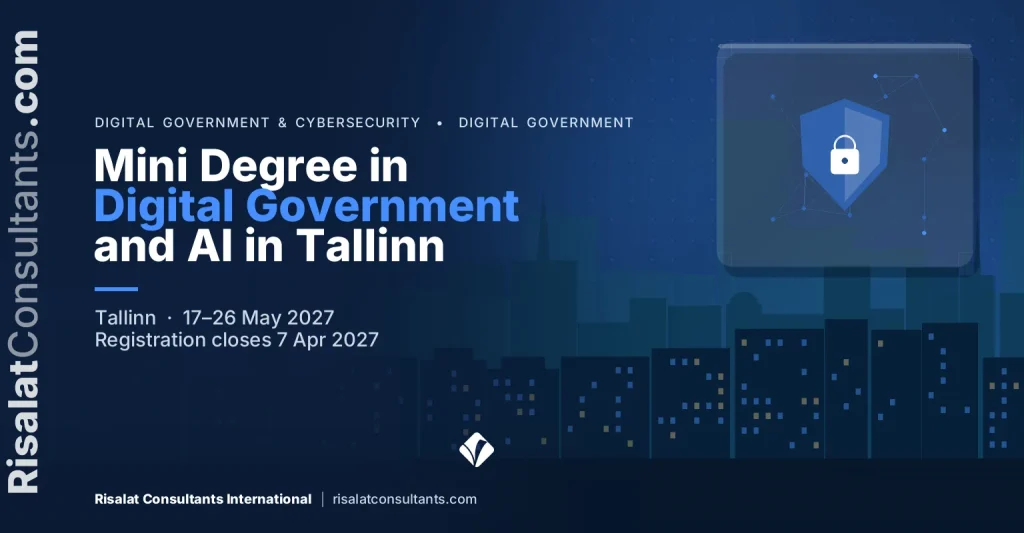
- 17–26 May 2027 (10 days)
- Где
- Таллин, Эстония
- Стоимость на одного участника
- 6 550 £ (GBP)
- Оплата
- По счету банковским переводом
- Регистрация закрывается
- 7 Apr 2027
- Формат
- 10-day intensive programme (mini degree): a practical capacity-building programme for government, NGO and project teams in Tallinn
- Сертификат
- Сертификат о прохождении
- Корпоративный формат
- Проведите ее для своей команды в удобные вам даты
On this page 17 sections
About this mini degree: a ten-day intensive programme that combines two related short courses into one complete track, with more practice and a capstone exercise. Participants receive a Risalat certificate of completion; a mini degree is a professional programme, not an academic degree.
Free self-check: the governance self-audit gives a quick check of governance, controls and accountability, in about 10 minutes.
Обзор программы
The Mini Degree in Digital Government and AI in Tallinn provides public sector leaders and project teams with an end to end programme covering modern digital transformation. Delivered over ten intensive days, the course integrates policy design, digital public infrastructure, data exchange models, and automated public administration. Participants examine how foundational registers, identity management, and interoperability platforms function together to deliver secure, citizen-centred public services, drawing directly on practical operational models established in Estonia and across Europe.
The curriculum combines two complementary areas of practice: strategic digital governance and the operational deployment of artificial intelligence. Rather than treating technical architecture and administrative policy in isolation, the programme addresses data governance, open standards, procurement integrity, cybersecurity baselines, and algorithmic transparency. Participants study internationally recognised approaches, including the European Interoperability Framework and OECD principles for trustworthy artificial intelligence, ensuring that institutional reforms remain legally sound, sustainable, technically resilient, and aligned with international standards.
Throughout the ten days, participants translate theoretical principles into direct operational tools through structured workshops, practical reviews, and collaborative exercises. The programme concludes with a rigorous capstone project where teams build actionable transformation plans addressing specific institutional challenges. Successful participants receive a professional Risalat certificate of completion confirming their mastery of the full project lifecycle, equipping them to steer public sector modernization and manage complex donor-funded digital interventions effectively.
Public sector institutions and donor-financed initiatives supported by multilateral development banks are shifting rapidly from piecemeal IT automation towards comprehensive, interoperable digital governance and automated decision-making. Fragmented implementation often leads to isolated databases, procurement failures, and serious data governance risks. Public sector teams now require the technical competence to direct the entire digital reform cycle internally. A unified ten-day programme enables officials to evaluate digital identity systems, govern automated algorithms, enforce security standards, and structure technical procurements cohesively, preventing expensive project delays and building resilient public administration systems.
Программа, которую Risalat Consultants International проводит в Таллине (Эстония), сочетает занятия под руководством экспертов, реальные кейсы и групповую работу, чтобы участники могли применять полученные знания в своей организации.
The Programme Strengthens Institutional Capability
- Digital transformation drivers: moving from departmental automation to integrated digital states
- Digital Public Infrastructure (DPI) architecture: identification, payments, and data exchange
- The European Interoperability Framework (EIF): legal, organisational, semantic, and technical layers
- Institutional governance models: coordinating central digital agencies, line ministries, and regulators
- Diagnostic workshop: assessing institutional digital maturity against international benchmarks
- Principles of distributed data architecture and the once-only principle in public administration
- Interoperability platforms: secure messaging protocols, API gateways, and the X-Road model
- Foundational registers: base registries for population, business, address, and land administration
- Цифровая стратегия и планирование трансформации
- Управление данными и их качество
- Анализ и визуализация данных
- Основы кибербезопасности и управление рисками
It is designed for directors and managers of digital transformation in central ministries and state agencies, project coordinators and specialists managing World Bank, ADB, AfDB, EU, or UN digital governance projects, senior government IT directors, enterprise architects, and technical team leads and others who want practical, current skills in digital government, data and technology.
The Growing Importance of Mini Degree in Digital Government and AI in Tallinn
Цифровые услуги, данные и новые технологии меняют то, как работают организации и как обслуживаются граждане. При грамотном подходе они делают услуги быстрее, дешевле и прозрачнее; при неудачном приводят к растрате средств и подвергают данные риску.
Организациям нужны люди, способные планировать цифровые изменения, ответственно управлять данными, защищать системы и использовать данные при принятии решений. Сегодня эти навыки ожидаются во всех функциях, а не только в ИТ.
Организациям все больше нужны специалисты, способные:
- Планировать цифровые инициативы, решающие реальные проблемы
- Управлять качеством, защитой и обменом данных
- Анализировать данные и наглядно их представлять
- Управлять киберрисками и технологическими рисками
- Вести людей через цифровые изменения
Сильные системы цифрового государства, данных и технологий помогают организациям:
- Предоставлять услуги быстрее и доступнее
- Эффективнее использовать данные при принятии решений
- Защищать системы и персональные данные
- Извлекать пользу из инвестиций в технологии
This Mini Degree in Digital Government and AI in Tallinn programme brings these elements together in a practical format, so that participants understand not only what good practice looks like but also how to introduce it in their own setting, with the people and resources they have.
Who Should Attend This Mini Degree in Digital Government and AI in Tallinn Training?
Программа предназначена для:
- Directors and managers of digital transformation in central ministries and state agencies
- Project coordinators and specialists managing World Bank, ADB, AfDB, EU, or UN digital governance projects
- Senior government IT directors, enterprise architects, and technical team leads
- Public sector policy advisors responsible for digital legislation, data protection, and AI strategy
- Procurement officers responsible for commissioning large-scale public software, cloud, and digital systems
- E-government agency specialists designing digital public services and citizen portals
- Data protection officers and governance specialists in regulatory and public bodies
- Public sector reform specialists from civil service commissions and modernization units
- Treasury and finance ministry officials overseeing public investments in technology infrastructure
- Руководители и специалисты в сфере ИКТ
- Руководители цифровой трансформации
- Аналитики данных и статистики
Программа подходит как опытным специалистам, так и тем, кто переходит к новым обязанностям. Приветствуются группы из разных организаций и стран, поскольку участники многому учатся на опыте друг друга.
Отметьте, что должна уметь ваша команда.
Mini Degree in Digital Government and AI in Tallinn Training Objectives
Upon successful completion of this Mini Degree in Digital Government and AI in Tallinn Training, participants will be able to:
- Design comprehensive digital government strategies aligned with national development objectives and international interoperability standards
- Establish robust data governance frameworks incorporating foundational registers, open data policies, and strict access controls
- Analyse digital public infrastructure components, including sovereign identity, trust services, and secure data exchange layers
- Evaluate artificial intelligence use cases for public service automation while mitigating algorithmic bias, privacy, and operational risks
- Apply international technical standards such as ISO/IEC 42001 and the European Interoperability Framework to institutional modernization projects
- Structure competitive, output-based procurement documents for digital systems, cloud hosting, and specialised software development
- Formulate an integrated, multi-year digital transformation roadmap and institutional action plan for immediate public sector deployment
- Объяснять основные тенденции в цифровом государстве и использовании данных
- Спланировать цифровую инициативу, увязанную с целями услуг
- Применять принципы управления данными и обеспечения их качества
Каждая цель отрабатывается в ходе программы на упражнениях, кейсах или в групповой работе, чтобы участники умели это делать, а не только описывать.
Содержание и структура программы
- Digital transformation drivers: moving from departmental automation to integrated digital states
- Digital Public Infrastructure (DPI) architecture: identification, payments, and data exchange
- The European Interoperability Framework (EIF): legal, organisational, semantic, and technical layers
- Institutional governance models: coordinating central digital agencies, line ministries, and regulators
- Diagnostic workshop: assessing institutional digital maturity against international benchmarks
- Principles of distributed data architecture and the once-only principle in public administration
- Interoperability platforms: secure messaging protocols, API gateways, and the X-Road model
- Foundational registers: base registries for population, business, address, and land administration
- Securing public sector data exchange: cryptography, timestamping, and mutual authentication
- Practical exercise: mapping cross-agency data flows for an integrated administrative service
- Electronic identification and trust services: eID architectures and the eIDAS regulation framework
- Digital signatures, mobile identity, and public key infrastructure (PKI) management
- Citizen portal design: life-event models, accessibility standards, and omnichannel delivery
- Legislative prerequisites for e-services: digital evidence, electronic records, and user consent
- Case laboratory: redesigning a high-volume public licensing process into an automated workflow
- Enterprise data management frameworks and metadata standardisation across public bodies
- Data classification, security baselines, and international standards (ISO/IEC 27001)
- Balancing open government data initiatives with personal data protection and national security
- Cyber hygiene, threat monitoring, and government computer emergency response teams (Gov-CERT)
- Scenario simulation: managing institutional data breaches and cross-border cyber incidents
- Demystifying AI for public administrators: machine learning, natural language processing, and predictive analytics
- High-impact public sector AI applications: tax compliance, automated eligibility, and urban planning
- Evaluating feasibility, technical debt, and total cost of ownership for government AI systems
- Developing a national or institutional AI strategy linked to broader public sector reform
- Practical audit: assessing organisational readiness and data availability for automated tooling
- Briefing on Tallinn digital ecosystem development and municipal service coordination
- Field visit to institutional technology demonstration facilities and operational testbeds
- Observation of automated urban infrastructure, public transport telemetry, and smart city services
- Review of digital business registries and electronic public interaction points
- Structured group debrief: documenting transferable practices for home country institutions
- Ethical principles for AI in public service: the OECD AI Principles and UNESCO recommendations
- Understanding and detecting algorithmic bias, unfair discrimination, and data distortion
- Algorithmic transparency, explainability, and the right to human review in administrative decisions
- Risk management frameworks for artificial intelligence in line with ISO/IEC 42001 standards
- Collaborative exercise: drafting an institutional algorithmic impact assessment (AIA) policy
- Procurement challenges in public technology projects: avoiding vendor lock-in and cost overruns
- Structuring terms of reference: functional requirements, open standards, and modular architecture
- Procurement models aligned with international development bank guidelines (World Bank, ADB, AfDB)
- Contracting for agile development, cloud services, and proprietary versus open-source software
- Hands-on clinic: reviewing technical evaluation criteria and service level agreements (SLAs)
- Managing institutional resistance and civil service adaptation to automated workflows
- Building digital competencies: continuous upskilling and modern talent retention strategies
- Citizen engagement, digital literacy, and ensuring inclusion for vulnerable populations
- Monitoring and evaluation: defining key performance indicators for digital project delivery
- Capstone preparation clinic: structured peer review of draft reform roadmaps
- Finalisation of team transformation blueprints and operational implementation schedules
- Team presentations: comprehensive digital government and AI action plans (Part 1)
- Team presentations: comprehensive digital government and AI action plans (Part 2)
- Expert panel appraisal, risk critique, and institutional feasibility assessment
- Programme synthesis, professional certificate conferral, and final operational commitments
Полное содержание по дням
Программа длится 10 дней. Каждый день сочетает выступления экспертов, практическую работу и завершающий практикум или кейс:
- First Day: Day 1: Strategic Foundations of Digital Government and Public Infrastructure
- Second Day: Day 2: Secure Data Exchange, Interoperability, and Foundational Registers
- Third Day: Day 3: Digital Identity, Trust Services, and Citizen-Centric E-Services
- Fourth Day: Day 4: Public Sector Data Governance, Classification, and Cyber Resilience
- Fifth Day: Day 5: Artificial Intelligence in Government: Concepts, Use Cases, and Strategy
- Sixth Day: Day 6: Study Tour and Field Observation: Digital Systems in Tallinn
- Seventh Day: Day 7: Applied Workshop: Ethical AI, Transparency, and Algorithmic Governance
- Eighth Day: Day 8: Technical Procurement and Vendor Management for Digital Systems
- Ninth Day: Day 9: Institutional Change Management, Digital Skills, and Implementation
- Tenth Day: Technical Visits, International Practice & Institutional Action Planning
Полное содержание по дням
First Day | Day 1: Strategic Foundations of Digital Government and Public Infrastructure
- Digital transformation drivers: moving from departmental automation to integrated digital states
- Digital Public Infrastructure (DPI) architecture: identification, payments, and data exchange
- The European Interoperability Framework (EIF): legal, organisational, semantic, and technical layers
- Institutional governance models: coordinating central digital agencies, line ministries, and regulators
- Diagnostic workshop: assessing institutional digital maturity against international benchmarks
Workshop: Day 1: Strategic Foundations of Digital Government and Public Infrastructure: Applying It to Your Institution
Работая в небольших группах, участники применяют методы дня к примерам из своих организаций и согласовывают практические дальнейшие шаги.
Second Day | Day 2: Secure Data Exchange, Interoperability, and Foundational Registers
- Principles of distributed data architecture and the once-only principle in public administration
- Interoperability platforms: secure messaging protocols, API gateways, and the X-Road model
- Foundational registers: base registries for population, business, address, and land administration
- Securing public sector data exchange: cryptography, timestamping, and mutual authentication
- Practical exercise: mapping cross-agency data flows for an integrated administrative service
Workshop: Day 2: Secure Data Exchange, Interoperability, and Foundational Registers: Applying It to Your Institution
Работая в небольших группах, участники применяют методы дня к примерам из своих организаций и согласовывают практические дальнейшие шаги.
Third Day | Day 3: Digital Identity, Trust Services, and Citizen-Centric E-Services
- Electronic identification and trust services: eID architectures and the eIDAS regulation framework
- Digital signatures, mobile identity, and public key infrastructure (PKI) management
- Citizen portal design: life-event models, accessibility standards, and omnichannel delivery
- Legislative prerequisites for e-services: digital evidence, electronic records, and user consent
- Case laboratory: redesigning a high-volume public licensing process into an automated workflow
Case Study: Day 3: Digital Identity, Trust Services, and Citizen-Centric E-Services in Practice
Участники анализируют реалистичный кейс, сравнивают принятые решения с передовой практикой и извлекают уроки, применимые в своих условиях.
Fourth Day | Day 4: Public Sector Data Governance, Classification, and Cyber Resilience
- Enterprise data management frameworks and metadata standardisation across public bodies
- Data classification, security baselines, and international standards (ISO/IEC 27001)
- Balancing open government data initiatives with personal data protection and national security
- Cyber hygiene, threat monitoring, and government computer emergency response teams (Gov-CERT)
- Scenario simulation: managing institutional data breaches and cross-border cyber incidents
Workshop: Day 4: Public Sector Data Governance, Classification, and Cyber Resilience: Applying It to Your Institution
Работая в небольших группах, участники применяют методы дня к примерам из своих организаций и согласовывают практические дальнейшие шаги.
Fifth Day | Day 5: Artificial Intelligence in Government: Concepts, Use Cases, and Strategy
- Demystifying AI for public administrators: machine learning, natural language processing, and predictive analytics
- High-impact public sector AI applications: tax compliance, automated eligibility, and urban planning
- Evaluating feasibility, technical debt, and total cost of ownership for government AI systems
- Developing a national or institutional AI strategy linked to broader public sector reform
- Practical audit: assessing organisational readiness and data availability for automated tooling
Workshop: Day 5: Artificial Intelligence in Government: Concepts, Use Cases, and Strategy: Applying It to Your Institution
Работая в небольших группах, участники применяют методы дня к примерам из своих организаций и согласовывают практические дальнейшие шаги.
Sixth Day | Day 6: Study Tour and Field Observation: Digital Systems in Tallinn
- Briefing on Tallinn digital ecosystem development and municipal service coordination
- Field visit to institutional technology demonstration facilities and operational testbeds
- Observation of automated urban infrastructure, public transport telemetry, and smart city services
- Review of digital business registries and electronic public interaction points
- Structured group debrief: documenting transferable practices for home country institutions
Case Study: Day 6: Study Tour and Field Observation: Digital Systems in Tallinn in Practice
Участники анализируют реалистичный кейс, сравнивают принятые решения с передовой практикой и извлекают уроки, применимые в своих условиях.
Seventh Day | Day 7: Applied Workshop: Ethical AI, Transparency, and Algorithmic Governance
- Ethical principles for AI in public service: the OECD AI Principles and UNESCO recommendations
- Understanding and detecting algorithmic bias, unfair discrimination, and data distortion
- Algorithmic transparency, explainability, and the right to human review in administrative decisions
- Risk management frameworks for artificial intelligence in line with ISO/IEC 42001 standards
- Collaborative exercise: drafting an institutional algorithmic impact assessment (AIA) policy
Workshop: Day 7: Applied Workshop: Ethical AI, Transparency, and Algorithmic Governance: Applying It to Your Institution
Работая в небольших группах, участники применяют методы дня к примерам из своих организаций и согласовывают практические дальнейшие шаги.
Eighth Day | Day 8: Technical Procurement and Vendor Management for Digital Systems
- Procurement challenges in public technology projects: avoiding vendor lock-in and cost overruns
- Structuring terms of reference: functional requirements, open standards, and modular architecture
- Procurement models aligned with international development bank guidelines (World Bank, ADB, AfDB)
- Contracting for agile development, cloud services, and proprietary versus open-source software
- Hands-on clinic: reviewing technical evaluation criteria and service level agreements (SLAs)
Workshop: Day 8: Technical Procurement and Vendor Management for Digital Systems: Applying It to Your Institution
Работая в небольших группах, участники применяют методы дня к примерам из своих организаций и согласовывают практические дальнейшие шаги.
Ninth Day | Day 9: Institutional Change Management, Digital Skills, and Implementation
- Managing institutional resistance and civil service adaptation to automated workflows
- Building digital competencies: continuous upskilling and modern talent retention strategies
- Citizen engagement, digital literacy, and ensuring inclusion for vulnerable populations
- Monitoring and evaluation: defining key performance indicators for digital project delivery
- Capstone preparation clinic: structured peer review of draft reform roadmaps
Case Study: Day 9: Institutional Change Management, Digital Skills, and Implementation in Practice
Участники анализируют реалистичный кейс, сравнивают принятые решения с передовой практикой и извлекают уроки, применимые в своих условиях.
Tenth Day | Technical Visits, International Practice & Institutional Action Planning
- Finalisation of team transformation blueprints and operational implementation schedules
- Team presentations: comprehensive digital government and AI action plans (Part 1)
- Team presentations: comprehensive digital government and AI action plans (Part 2)
- Expert panel appraisal, risk critique, and institutional feasibility assessment
- Programme synthesis, professional certificate conferral, and final operational commitments
Capstone Exercise: Mini Degree in Digital Government and AI in Tallinn Action Plan for Your Institution
Участники объединяют итоги недели в план действий для своей организации с приоритетами, ответственными и первыми шагами и представляют его коллегам и ведущим для обратной связи.
Mini Degree in Digital Government and AI in Tallinn Training Methodology
The training is delivered through an interactive executive format that balances policy principles with technical diagnostics and case-based analysis. Participants work on authentic institutional problems using official toolkits, regulatory frameworks, and architecture blueprints. Working sessions are supported by peer-to-peer critique, group problem-solving, and a dedicated field observation day in Tallinn. On the final day, participants apply what they have learned across the entire programme during an intensive capstone exercise, presenting an institutional action plan ready for implementation in their home organisations or donor-funded projects.
Программа сочетает:
- Занятия под руководством экспертов по актуальной практике
- Региональные и международные кейсы
- Групповая работа и практические упражнения
- Симуляции и ролевые игры, где это уместно
- Обсуждение собственных задач участников
- Обмен опытом между организациями и странами
- Технические визиты в организации и на объекты
- Ежедневная рефлексия и планирование действий
Перед программой короткая предварительная оценка помогает ведущим понять роль и приоритеты каждого участника, чтобы адаптировать примеры и упражнения к группе. Каждый день завершается короткой рефлексией, в ходе которой участники отмечают, что они применят в работе.
- Сбор
- Очистка
- Хранение
- Анализ
- Решение
Технические визиты и выездная программа
The programme includes visits to institutions, projects or sites in and around Tallinn where participants see current practice at first hand and meet the professionals responsible. Visits are confirmed with the host organisations before the programme and may change for operational reasons.
- Брифинги принимающих организаций об их подходах и результатах
- Экскурсии на объекты с сопровождением и временем для вопросов
- Структурированные заметки наблюдений по каждому визиту
- Групповое обсуждение, связывающее увиденное с организациями участников
Ожидаемые результаты
Upon completion of this Mini Degree in Digital Government and AI in Tallinn Training, participants will be able to:
- Navigate the full operational lifecycle of public digital transformation initiatives from policy design to procurement
- Construct institutional enterprise architectures using modern interoperability standards and foundational data registers
- Deploy automated decision-making and artificial intelligence tools responsibly using recognised risk management frameworks
- Formulate rigorous procurement specifications and service level agreements that prevent vendor lock-in and safeguard public assets
- Establish comprehensive administrative data governance, regulatory compliance, and cybersecurity baselines
- Deliver a bankable, context-specific digital reform action plan tailored to national priorities and international funding requirements
- Планировать цифровые инициативы, увязанные с целями услуг
- Применять принципы управления данными и обеспечения их качества
Участники уходят с личным планом действий и практическими инструментами, которые можно применять в своей организации с первой же недели после возвращения. Организации, направляющие нескольких участников, могут использовать программу, чтобы согласовать общие методы и шаблоны для разных команд: так улучшения легче закрепить.
£6,550 per participant · invoice and bank transfer · groups of 5 or more receive a discount
Пять и более участников от одной организации: укажите групповой тариф в запросе счета.
Ten or more: an in-house version for your institution may cost less per person. Ask for an in-house quote.
Registration closes in 136 days (7 Apr 2027)
Institutional Application of Mini Degree in Digital Government and AI in Tallinn Training
Программа помогает организациям укрепить:
- Цифровая стратегия
- Управление данными
- Решения на основе данных
- Кибербезопасность
- Управление технологиями
Участники возвращаются с практическими инструментами для улучшения:
- Реестры данных
- Панели показателей
- Реестры рисков
- Закупки технологий
- Планы изменений
Программа построена так, чтобы знания переходили из учебной аудитории в организацию. По возможности участники работают с собственными процессами и документами и уходят с планом действий, который их руководители могут рассмотреть и поддержать.
Региональная актуальность и применение
Европа
Европейские организации применяют цифровое государство, данные и технологии в рамках детально проработанной нормативной базы и программ реформ. Участники из Европы могут сравнить свою практику с опытом коллег из других регионов и проверить, как устоявшиеся методы работают в иных условиях.
Африка
По всей Африке министерства, ведомства и проектные команды, работающие в сфере цифрового государства, данных и технологий, все чаще действуют параллельно с программами, финансируемыми донорами, которые требуют четких систем и доказательной базы. Программа помогает участникам адаптировать передовую практику к своим организациям и имеющимся ресурсам.
Ближний Восток
На Ближнем Востоке национальные стратегии развития и планы диверсификации предъявляют растущие требования к цифровому государству, данным и технологиям. Участники изучают, как сформировать необходимый для этих планов потенциал в государственных органах и компаниях.
Азия
Организации в Азии сочетают быстрый рост с амбициозными программами модернизации. Участники из Азии могут поделиться опытом быстрого масштабирования систем и узнать о подходах, применяемых в других странах.
Тихоокеанский регион
Малые островные государства и страны Тихоокеанского региона сталкиваются с особыми ограничениями, связанными с размером, удаленностью и потенциалом. Программа предлагает практичные и соразмерные подходы к цифровому государству, данным и технологиям, подходящие для небольших организаций.
Проведение программы в Таллине (Эстония) позволяет участникам отвлечься от повседневной нагрузки и сравнить, как вопросы цифрового правительства, данных и технологий решаются в разных условиях. Эту же программу можно провести в корпоративном формате для одной организации, в ее стране или онлайн, с кейсами из ее текущей работы.
Профиль принимающей страны – Эстония
Tallinn provides an effective setting for training programmes focused on e-governance, public sector digitalisation, cybersecurity and modern administrative reform.
Обучение за пределами своей страны дает участникам время сосредоточиться, по-новому взглянуть на свою организацию и выстроить сеть контактов с коллегами из других стран.
Mini Degree in Digital Government and AI in Tallinn Training Deliverables
Участники получают поддержку до, во время и после программы, поэтому подготовка, обучение и последующее сопровождение складываются в единый непрерывный процесс.
До программы
- Предварительная оценка участников
- Mini Degree in Digital Government and AI in Tallinn Readiness Assessment
- Mini Degree in Digital Government and AI in Tallinn Resource Pack
- Материалы для предварительного чтения
- Бесплатная визовая поддержка и консультации
Во время программы
- Встреча в аэропорту и приветственное сопровождение
- Accommodation with breakfast: 11 nights, check-in Sunday 16 May 2027, check-out Thursday 27 May 2027 (one night before and one night after the programme)
- Приветственный ужин для нетворкинга
- Комплект участника Risalat (сумка, бутылка, кружка, футболка, кепка, обложка для паспорта, ручки, блокнот, магнит и брелок)
- Comprehensive Mini Degree in Digital Government and AI in Tallinn Training Manual
- Чек-лист цифровой зрелости
- Шаблон реестра данных
- Шаблон планирования панели показателей
- Реестр технологических рисков
- Практические семинары и симуляции
- Групповые дискуссии и обмен опытом
- Ежедневный обед и кофе-брейки
- Полный доступ к инфраструктуре места проведения
- Мини-планшет с цифровыми учебными материалами
- Выездной визит (при наличии)
- Развлекательная экскурсия по городу
После программы
- Сертификат о прохождении
- Награда Risalat за участие в программе
- Справочные материалы после обучения
- Самооценка управления данными
- Чек-лист анализа цифрового проекта
- Поддержка и консультации после обучения
- Отчет по программе
Institutions can also request a tailored in-house version of this programme, delivered at their premises or online. Request a proposal.
Common Challenges in Mini Degree in Digital Government and AI in Tallinn, And How This Training Helps
Как организациям планировать цифровые инициативы, решающие реальные проблемы?
The programme addresses this directly on the first day (Day 1: Strategic Foundations of Digital Government and Public Infrastructure), where participants practise the methods involved and adapt them to their own institution, then build it into their action plan.
Как организациям управлять качеством, защитой и обменом данных?
The programme addresses this directly on the second day (Day 2: Secure Data Exchange, Interoperability, and Foundational Registers), where participants practise the methods involved and adapt them to their own institution, then build it into their action plan.
Как организациям анализировать данные и наглядно их представлять?
The programme addresses this directly on the third day (Day 3: Digital Identity, Trust Services, and Citizen-Centric E-Services), where participants practise the methods involved and adapt them to their own institution, then build it into their action plan.
Как организациям управлять киберрисками и технологическими рисками?
The programme addresses this directly on the fourth day (Day 4: Public Sector Data Governance, Classification, and Cyber Resilience), where participants practise the methods involved and adapt them to their own institution, then build it into their action plan.
Как организациям вести людей через цифровые изменения?
The programme addresses this directly on the fifth day (Day 5: Artificial Intelligence in Government: Concepts, Use Cases, and Strategy), where participants practise the methods involved and adapt them to their own institution, then build it into their action plan.
Часто задаваемые вопросы
When and where does the Mini Degree in Digital Government and AI in Tallinn programme take place?
It runs from 17 May 2027 to 26 May 2027, in Tallinn, Estonia. The registration deadline is shown at the top of this page.
Кому стоит участвовать?
The programme is designed for directors and managers of digital transformation in central ministries and state agencies, project coordinators and specialists managing World Bank, ADB, AfDB, EU, or UN digital governance projects, senior government IT directors, enterprise architects, and technical team leads, public sector policy advisors responsible for digital legislation, data protection, and AI strategy, and others who want practical skills in digital government, data and technology.
Получу ли я сертификат?
Да. Участники, завершившие программу, получают сертификат о прохождении от Risalat Consultants International.
Можно ли провести эту программу только для нашей организации?
Да. Мы можем провести адаптированную корпоративную версию в вашей организации, в другом городе или онлайн на основе ваших собственных кейсов. Воспользуйтесь формой запроса предложения на этой странице.
Нужен ли мне опыт в области цифрового государства, данных и технологий?
Специальная подготовка не требуется, достаточно опыта работы в смежной должности. Короткая предварительная оценка помогает ведущим адаптировать занятия к группе.
Who Will Deliver This Programme
Each date is delivered by a team assigned from Risalat's expert network for this subject. For this programme we assign:
How we choose them: Experience in the region of the participants or comparable settings; Command of the financier rules that apply (World Bank, ADB, AfDB, EU, UN) where relevant; Delivery in English; other languages on request for in-house groups; No conflict of interest with participants' institutions.
Training courses in TallinnTechnology training courses
Почему эта программа проходит в Таллине
Таллин широко известен своим цифровым управлением и инновациями в государственном секторе. Приезжающие должностные лица могут ознакомиться с практическим применением в Брифинге-центре e-Estonia и пообщаться с национальными органами государственного управления. Город легко доступен регулярными рейсами, соединяющими его международный аэропорт с крупными европейскими транзитными узлами.
The Mini Degree in Digital Government and AI in Tallinn programme in May 2027 brings together officials and professionals from across Europe, Africa, the Middle East and Asia. Sessions combine short inputs, case studies and group work on participants' own files, and the city's institutions can be added as a study visit on request.
Как добраться: Таллинский аэропорт имени Леннарта Мери (TLL).
Узнайте, нужна ли вам виза, с помощью бесплатного сервиса «Проверка визы» и запросите приглашение после регистрации.
Та же тема в других городах
- Mini Degree in Climate Finance and Resilience in Copenhagen (Copenhagen)
- Mini Degree in Donor-Funded Project Management in Dubai (Dubai)
- Mini Degree in Monitoring, Evaluation and Learning in Bangkok (Bangkok)
- Mini Degree in Procurement and Contract Management in Dubai (Dubai)
- Mini Degree in Public Financial Management in London (London)
- Evaluating Training Impact (Kirkpatrick and Beyond) in Kigali (Kigali)
Другие программы в Таллине
- Integrating AI into Public Services: From Pilot to Scale Training in Tallinn
- Digital Health Insurance Platform Architecture and PMO Operations in Tallinn
- Управление данными, функциональная совместимость и цифровая общественная инфраструктура в Таллине
- Архитектуры взаимодействия и цифровая идентификация для порталов граждан в Таллинне
- Rural Broadband Network Rollout and Open-Access Telecoms in Tallinn
См. также: Управление ИИ для государственных учреждений · бесплатная оценка готовности к управлению ИИ · все программы
Free roadmap: Estonia Digital Government: a 12-month plan for your team
- ОЭСР (Организация экономического сотрудничества и развития) OECD
- Open Contracting Partnership Open Contracting Partnership
Для команд и организаций
Bring your team
Teams that learn together apply more at work. Tell us how many people and how you would like to take part: we reply with a group quote within two working days.
Watch: this programme in short


Другие даты и города для этой темы: учебные курсы по цифровому правительству и управлению данными (118 предстоящих дат).
Другие учебные курсы в Эстонии · Все программы в Европе · Полный календарь обучения
Запланировать эту программу в дорожной карте: почему это важно, зачем это утверждать, даты планирования и карьера, которую это создает.