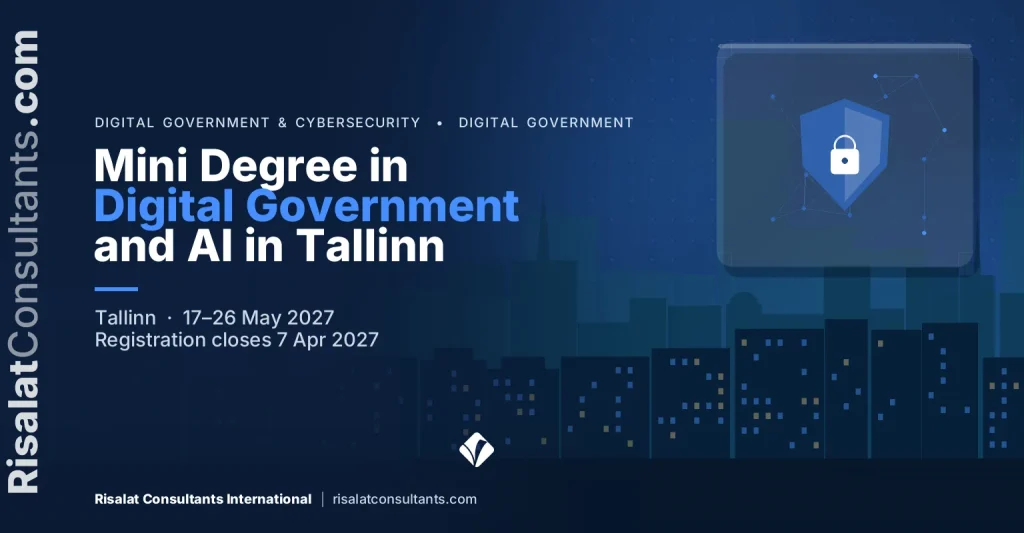
关键信息
- 日期
- 2027年5月17至26日(10天)
- 地点
- 爱沙尼亚塔林
- 每位学员费用
- £6,550(英镑)
- 付款
- 通过发票和银行转账付款
- 报名截止
- 7 Apr 2027
- 形式
- 10-day intensive programme (mini degree): a practical capacity-building programme for government, NGO and project teams in Tallinn
- 证书
- 结业证书
- 内训选项
- 按您的日期,为您的团队专场举办
本页内容17个部分
About this mini degree: a ten-day intensive programme that combines two related short courses into one complete track, with more practice and a capstone exercise. Participants receive a Risalat certificate of completion; a mini degree is a professional programme, not an academic degree.
Free self-check: the governance self-audit gives a quick check of governance, controls and accountability, in about 10 minutes.
培训项目概述
The Mini Degree in Digital Government and AI in Tallinn provides public sector leaders and project teams with an end to end programme covering modern digital transformation. Delivered over ten intensive days, the course integrates policy design, digital public infrastructure, data exchange models, and automated public administration. Participants examine how foundational registers, identity management, and interoperability platforms function together to deliver secure, citizen-centred public services, drawing directly on practical operational models established in Estonia and across Europe.
The curriculum combines two complementary areas of practice: strategic digital governance and the operational deployment of artificial intelligence. Rather than treating technical architecture and administrative policy in isolation, the programme addresses data governance, open standards, procurement integrity, cybersecurity baselines, and algorithmic transparency. Participants study internationally recognised approaches, including the European Interoperability Framework and OECD principles for trustworthy artificial intelligence, ensuring that institutional reforms remain legally sound, sustainable, technically resilient, and aligned with international standards.
Throughout the ten days, participants translate theoretical principles into direct operational tools through structured workshops, practical reviews, and collaborative exercises. The programme concludes with a rigorous capstone project where teams build actionable transformation plans addressing specific institutional challenges. Successful participants receive a professional Risalat certificate of completion confirming their mastery of the full project lifecycle, equipping them to steer public sector modernization and manage complex donor-funded digital interventions effectively.
Public sector institutions and donor-financed initiatives supported by multilateral development banks are shifting rapidly from piecemeal IT automation towards comprehensive, interoperable digital governance and automated decision-making. Fragmented implementation often leads to isolated databases, procurement failures, and serious data governance risks. Public sector teams now require the technical competence to direct the entire digital reform cycle internally. A unified ten-day programme enables officials to evaluate digital identity systems, govern automated algorithms, enforce security standards, and structure technical procurements cohesively, preventing expensive project delays and building resilient public administration systems.
本培训项目由Risalat Consultants International在爱沙尼亚塔林举办,结合专家主讲、真实案例与小组练习,帮助学员将所学应用于本单位工作。
The Programme Strengthens Institutional Capability
- Digital transformation drivers: moving from departmental automation to integrated digital states
- Digital Public Infrastructure (DPI) architecture: identification, payments, and data exchange
- The European Interoperability Framework (EIF): legal, organisational, semantic, and technical layers
- Institutional governance models: coordinating central digital agencies, line ministries, and regulators
- Diagnostic workshop: assessing institutional digital maturity against international benchmarks
- Principles of distributed data architecture and the once-only principle in public administration
- Interoperability platforms: secure messaging protocols, API gateways, and the X-Road model
- Foundational registers: base registries for population, business, address, and land administration
- 数字战略与转型规划
- 数据治理与数据质量
- 数据分析与可视化
- 网络安全基础与风险管理
It is designed for directors and managers of digital transformation in central ministries and state agencies, project coordinators and specialists managing World Bank, ADB, AfDB, EU, or UN digital governance projects, senior government IT directors, enterprise architects, and technical team leads and others who want practical, current skills in digital government, data and technology.
The Growing Importance of Mini Degree in Digital Government and AI in Tallinn
数字服务、数据和新技术正在改变机构的工作方式和服务公民的方式。做得好,服务将更快捷、更经济、更透明;做得不好,则会浪费资金并使数据面临风险。
机构需要能够规划数字化变革、负责任地管理数据、保护系统并在决策中运用数据证据的人才。如今,这些技能已是所有职能部门的普遍要求,而不仅限于IT部门。
各机构日益需要具备以下能力的专业人员:
- 规划切实解决问题的数字化举措
- 管理数据质量、保护与共享
- 分析数据并清晰呈现
- 管理网络与技术风险
- 带领员工完成数字化变革
健全的数字政府、数据与技术体系有助于机构:
- 提供更快捷、更便利的服务
- 在决策中更好地利用数据
- 保护系统和个人数据
- 从技术投资中获取价值
This Mini Degree in Digital Government and AI in Tallinn programme brings these elements together in a practical format, so that participants understand not only what good practice looks like but also how to introduce it in their own setting, with the people and resources they have.
Who Should Attend This Mini Degree in Digital Government and AI in Tallinn Training?
本培训项目适合:
- Directors and managers of digital transformation in central ministries and state agencies
- Project coordinators and specialists managing World Bank, ADB, AfDB, EU, or UN digital governance projects
- Senior government IT directors, enterprise architects, and technical team leads
- Public sector policy advisors responsible for digital legislation, data protection, and AI strategy
- Procurement officers responsible for commissioning large-scale public software, cloud, and digital systems
- E-government agency specialists designing digital public services and citizen portals
- Data protection officers and governance specialists in regulatory and public bodies
- Public sector reform specialists from civil service commissions and modernization units
- Treasury and finance ministry officials overseeing public investments in technology infrastructure
- 信息通信技术经理与官员
- 数字化转型负责人
- 数据分析师与统计人员
本培训项目既适合经验丰富的专业人员,也适合刚承担新职责的人员。我们鼓励来自不同机构和国家的学员组成混合小组,因为学员能从彼此的经验中获益良多。
勾选您的团队需要具备的能力。
Mini Degree in Digital Government and AI in Tallinn Training Objectives
Upon successful completion of this Mini Degree in Digital Government and AI in Tallinn Training, participants will be able to:
- Design comprehensive digital government strategies aligned with national development objectives and international interoperability standards
- Establish robust data governance frameworks incorporating foundational registers, open data policies, and strict access controls
- Analyse digital public infrastructure components, including sovereign identity, trust services, and secure data exchange layers
- Evaluate artificial intelligence use cases for public service automation while mitigating algorithmic bias, privacy, and operational risks
- Apply international technical standards such as ISO/IEC 42001 and the European Interoperability Framework to institutional modernization projects
- Structure competitive, output-based procurement documents for digital systems, cloud hosting, and specialised software development
- Formulate an integrated, multi-year digital transformation roadmap and institutional action plan for immediate public sector deployment
- 阐述数字政府与数据应用的主要趋势
- 规划与服务目标挂钩的数字化举措
- 运用数据治理和质量原则
每项目标都会在培训期间通过练习、案例或小组作业加以实践,使学员结业时不仅能够描述,更能够实际运用。
培训项目内容与结构
- Digital transformation drivers: moving from departmental automation to integrated digital states
- Digital Public Infrastructure (DPI) architecture: identification, payments, and data exchange
- The European Interoperability Framework (EIF): legal, organisational, semantic, and technical layers
- Institutional governance models: coordinating central digital agencies, line ministries, and regulators
- Diagnostic workshop: assessing institutional digital maturity against international benchmarks
- Principles of distributed data architecture and the once-only principle in public administration
- Interoperability platforms: secure messaging protocols, API gateways, and the X-Road model
- Foundational registers: base registries for population, business, address, and land administration
- Securing public sector data exchange: cryptography, timestamping, and mutual authentication
- Practical exercise: mapping cross-agency data flows for an integrated administrative service
- Electronic identification and trust services: eID architectures and the eIDAS regulation framework
- Digital signatures, mobile identity, and public key infrastructure (PKI) management
- Citizen portal design: life-event models, accessibility standards, and omnichannel delivery
- Legislative prerequisites for e-services: digital evidence, electronic records, and user consent
- Case laboratory: redesigning a high-volume public licensing process into an automated workflow
- Enterprise data management frameworks and metadata standardisation across public bodies
- Data classification, security baselines, and international standards (ISO/IEC 27001)
- Balancing open government data initiatives with personal data protection and national security
- Cyber hygiene, threat monitoring, and government computer emergency response teams (Gov-CERT)
- Scenario simulation: managing institutional data breaches and cross-border cyber incidents
- Demystifying AI for public administrators: machine learning, natural language processing, and predictive analytics
- High-impact public sector AI applications: tax compliance, automated eligibility, and urban planning
- Evaluating feasibility, technical debt, and total cost of ownership for government AI systems
- Developing a national or institutional AI strategy linked to broader public sector reform
- Practical audit: assessing organisational readiness and data availability for automated tooling
- Briefing on Tallinn digital ecosystem development and municipal service coordination
- Field visit to institutional technology demonstration facilities and operational testbeds
- Observation of automated urban infrastructure, public transport telemetry, and smart city services
- Review of digital business registries and electronic public interaction points
- Structured group debrief: documenting transferable practices for home country institutions
- Ethical principles for AI in public service: the OECD AI Principles and UNESCO recommendations
- Understanding and detecting algorithmic bias, unfair discrimination, and data distortion
- Algorithmic transparency, explainability, and the right to human review in administrative decisions
- Risk management frameworks for artificial intelligence in line with ISO/IEC 42001 standards
- Collaborative exercise: drafting an institutional algorithmic impact assessment (AIA) policy
- Procurement challenges in public technology projects: avoiding vendor lock-in and cost overruns
- Structuring terms of reference: functional requirements, open standards, and modular architecture
- Procurement models aligned with international development bank guidelines (World Bank, ADB, AfDB)
- Contracting for agile development, cloud services, and proprietary versus open-source software
- Hands-on clinic: reviewing technical evaluation criteria and service level agreements (SLAs)
- Managing institutional resistance and civil service adaptation to automated workflows
- Building digital competencies: continuous upskilling and modern talent retention strategies
- Citizen engagement, digital literacy, and ensuring inclusion for vulnerable populations
- Monitoring and evaluation: defining key performance indicators for digital project delivery
- Capstone preparation clinic: structured peer review of draft reform roadmaps
- Finalisation of team transformation blueprints and operational implementation schedules
- Team presentations: comprehensive digital government and AI action plans (Part 1)
- Team presentations: comprehensive digital government and AI action plans (Part 2)
- Expert panel appraisal, risk critique, and institutional feasibility assessment
- Programme synthesis, professional certificate conferral, and final operational commitments
完整的每日课程内容
本培训项目为期10天,每天都包括专家讲解、实践练习,并以研讨或案例研究收尾:
- First Day: Day 1: Strategic Foundations of Digital Government and Public Infrastructure
- Second Day: Day 2: Secure Data Exchange, Interoperability, and Foundational Registers
- Third Day: Day 3: Digital Identity, Trust Services, and Citizen-Centric E-Services
- Fourth Day: Day 4: Public Sector Data Governance, Classification, and Cyber Resilience
- Fifth Day: Day 5: Artificial Intelligence in Government: Concepts, Use Cases, and Strategy
- Sixth Day: Day 6: Study Tour and Field Observation: Digital Systems in Tallinn
- Seventh Day: Day 7: Applied Workshop: Ethical AI, Transparency, and Algorithmic Governance
- Eighth Day: Day 8: Technical Procurement and Vendor Management for Digital Systems
- Ninth Day: Day 9: Institutional Change Management, Digital Skills, and Implementation
- Tenth Day: Technical Visits, International Practice & Institutional Action Planning
完整的每日课程内容
First Day | Day 1: Strategic Foundations of Digital Government and Public Infrastructure
- Digital transformation drivers: moving from departmental automation to integrated digital states
- Digital Public Infrastructure (DPI) architecture: identification, payments, and data exchange
- The European Interoperability Framework (EIF): legal, organisational, semantic, and technical layers
- Institutional governance models: coordinating central digital agencies, line ministries, and regulators
- Diagnostic workshop: assessing institutional digital maturity against international benchmarks
Workshop: Day 1: Strategic Foundations of Digital Government and Public Infrastructure: Applying It to Your Institution
学员分成小组,将当天所学方法应用于本机构的实例,并商定切实可行的后续步骤。
Second Day | Day 2: Secure Data Exchange, Interoperability, and Foundational Registers
- Principles of distributed data architecture and the once-only principle in public administration
- Interoperability platforms: secure messaging protocols, API gateways, and the X-Road model
- Foundational registers: base registries for population, business, address, and land administration
- Securing public sector data exchange: cryptography, timestamping, and mutual authentication
- Practical exercise: mapping cross-agency data flows for an integrated administrative service
Workshop: Day 2: Secure Data Exchange, Interoperability, and Foundational Registers: Applying It to Your Institution
学员分成小组,将当天所学方法应用于本机构的实例,并商定切实可行的后续步骤。
Third Day | Day 3: Digital Identity, Trust Services, and Citizen-Centric E-Services
- Electronic identification and trust services: eID architectures and the eIDAS regulation framework
- Digital signatures, mobile identity, and public key infrastructure (PKI) management
- Citizen portal design: life-event models, accessibility standards, and omnichannel delivery
- Legislative prerequisites for e-services: digital evidence, electronic records, and user consent
- Case laboratory: redesigning a high-volume public licensing process into an automated workflow
Case Study: Day 3: Digital Identity, Trust Services, and Citizen-Centric E-Services in Practice
学员分析真实案例,将案例中的决策与良好实践进行比较,并总结出可在自身环境中运用的经验。
Fourth Day | Day 4: Public Sector Data Governance, Classification, and Cyber Resilience
- Enterprise data management frameworks and metadata standardisation across public bodies
- Data classification, security baselines, and international standards (ISO/IEC 27001)
- Balancing open government data initiatives with personal data protection and national security
- Cyber hygiene, threat monitoring, and government computer emergency response teams (Gov-CERT)
- Scenario simulation: managing institutional data breaches and cross-border cyber incidents
Workshop: Day 4: Public Sector Data Governance, Classification, and Cyber Resilience: Applying It to Your Institution
学员分成小组,将当天所学方法应用于本机构的实例,并商定切实可行的后续步骤。
Fifth Day | Day 5: Artificial Intelligence in Government: Concepts, Use Cases, and Strategy
- Demystifying AI for public administrators: machine learning, natural language processing, and predictive analytics
- High-impact public sector AI applications: tax compliance, automated eligibility, and urban planning
- Evaluating feasibility, technical debt, and total cost of ownership for government AI systems
- Developing a national or institutional AI strategy linked to broader public sector reform
- Practical audit: assessing organisational readiness and data availability for automated tooling
Workshop: Day 5: Artificial Intelligence in Government: Concepts, Use Cases, and Strategy: Applying It to Your Institution
学员分成小组,将当天所学方法应用于本机构的实例,并商定切实可行的后续步骤。
Sixth Day | Day 6: Study Tour and Field Observation: Digital Systems in Tallinn
- Briefing on Tallinn digital ecosystem development and municipal service coordination
- Field visit to institutional technology demonstration facilities and operational testbeds
- Observation of automated urban infrastructure, public transport telemetry, and smart city services
- Review of digital business registries and electronic public interaction points
- Structured group debrief: documenting transferable practices for home country institutions
Case Study: Day 6: Study Tour and Field Observation: Digital Systems in Tallinn in Practice
学员分析真实案例,将案例中的决策与良好实践进行比较,并总结出可在自身环境中运用的经验。
Seventh Day | Day 7: Applied Workshop: Ethical AI, Transparency, and Algorithmic Governance
- Ethical principles for AI in public service: the OECD AI Principles and UNESCO recommendations
- Understanding and detecting algorithmic bias, unfair discrimination, and data distortion
- Algorithmic transparency, explainability, and the right to human review in administrative decisions
- Risk management frameworks for artificial intelligence in line with ISO/IEC 42001 standards
- Collaborative exercise: drafting an institutional algorithmic impact assessment (AIA) policy
Workshop: Day 7: Applied Workshop: Ethical AI, Transparency, and Algorithmic Governance: Applying It to Your Institution
学员分成小组,将当天所学方法应用于本机构的实例,并商定切实可行的后续步骤。
Eighth Day | Day 8: Technical Procurement and Vendor Management for Digital Systems
- Procurement challenges in public technology projects: avoiding vendor lock-in and cost overruns
- Structuring terms of reference: functional requirements, open standards, and modular architecture
- Procurement models aligned with international development bank guidelines (World Bank, ADB, AfDB)
- Contracting for agile development, cloud services, and proprietary versus open-source software
- Hands-on clinic: reviewing technical evaluation criteria and service level agreements (SLAs)
Workshop: Day 8: Technical Procurement and Vendor Management for Digital Systems: Applying It to Your Institution
学员分成小组,将当天所学方法应用于本机构的实例,并商定切实可行的后续步骤。
Ninth Day | Day 9: Institutional Change Management, Digital Skills, and Implementation
- Managing institutional resistance and civil service adaptation to automated workflows
- Building digital competencies: continuous upskilling and modern talent retention strategies
- Citizen engagement, digital literacy, and ensuring inclusion for vulnerable populations
- Monitoring and evaluation: defining key performance indicators for digital project delivery
- Capstone preparation clinic: structured peer review of draft reform roadmaps
Case Study: Day 9: Institutional Change Management, Digital Skills, and Implementation in Practice
学员分析真实案例,将案例中的决策与良好实践进行比较,并总结出可在自身环境中运用的经验。
Tenth Day | Technical Visits, International Practice & Institutional Action Planning
- Finalisation of team transformation blueprints and operational implementation schedules
- Team presentations: comprehensive digital government and AI action plans (Part 1)
- Team presentations: comprehensive digital government and AI action plans (Part 2)
- Expert panel appraisal, risk critique, and institutional feasibility assessment
- Programme synthesis, professional certificate conferral, and final operational commitments
Capstone Exercise: Mini Degree in Digital Government and AI in Tallinn Action Plan for Your Institution
学员将一周所学整合为本机构的行动计划,明确优先事项、负责人和初步行动,并进行展示,听取同伴和讲师的反馈。
Mini Degree in Digital Government and AI in Tallinn Training Methodology
The training is delivered through an interactive executive format that balances policy principles with technical diagnostics and case-based analysis. Participants work on authentic institutional problems using official toolkits, regulatory frameworks, and architecture blueprints. Working sessions are supported by peer-to-peer critique, group problem-solving, and a dedicated field observation day in Tallinn. On the final day, participants apply what they have learned across the entire programme during an intensive capstone exercise, presenting an institutional action plan ready for implementation in their home organisations or donor-funded projects.
本培训项目融合了:
- 专家主讲当前实践
- 区域及国际案例研究
- 小组作业与实践练习
- 视情况安排模拟演练与角色扮演
- 探讨学员自身面临的挑战
- 跨机构、跨国家的同伴学习
- 对机构和现场的技术参观
- 每日反思与行动规划
培训开始前,简短的课前评估可帮助讲师了解每位学员的岗位职责和重点关注事项,以便根据学员群体调整案例和练习。每天结束时安排简短的反思环节,学员记录下将在工作中应用的内容。
- 收集
- 清洗
- 存储
- 分析
- 决策
技术参观与现场考察安排
The programme includes visits to institutions, projects or sites in and around Tallinn where participants see current practice at first hand and meet the professionals responsible. Visits are confirmed with the host organisations before the programme and may change for operational reasons.
- 东道机构介绍其做法与成果
- 有引导的现场参观,并留有提问时间
- 每次参观的结构化观察记录
- 小组复盘,将所见所闻与学员所在机构相联系
预期成果
Upon completion of this Mini Degree in Digital Government and AI in Tallinn Training, participants will be able to:
- Navigate the full operational lifecycle of public digital transformation initiatives from policy design to procurement
- Construct institutional enterprise architectures using modern interoperability standards and foundational data registers
- Deploy automated decision-making and artificial intelligence tools responsibly using recognised risk management frameworks
- Formulate rigorous procurement specifications and service level agreements that prevent vendor lock-in and safeguard public assets
- Establish comprehensive administrative data governance, regulatory compliance, and cybersecurity baselines
- Deliver a bankable, context-specific digital reform action plan tailored to national priorities and international funding requirements
- 规划与服务目标挂钩的数字化举措
- 运用数据治理和质量原则
学员结业时将获得个人行动计划和实用工具,回到工作岗位的第一周即可在机构中应用。派出多名学员的机构可借助本培训项目,在各团队之间统一方法和模板,使改进成果更易持续。
每位学员£6,550 · 通过发票和银行转账付款 · 5人及以上团体报名可享优惠
同一机构五人及以上:请在申请发票时索取团体价。
Ten or more: an in-house version for your institution may cost less per person. Ask for an in-house quote.
距离报名截止还有 136天(2027年4月7日)
Institutional Application of Mini Degree in Digital Government and AI in Tallinn Training
本培训项目帮助机构加强:
- 数字战略
- 数据治理
- 数据驱动的决策
- 网络安全
- 技术管理
学员将带着实用工具回到工作岗位,以提升:
- 数据清单
- 仪表板
- 风险登记册
- 技术采购
- 变革计划
本培训项目的设计旨在让学习成果从课堂延伸至机构。学员尽可能围绕自身的流程和文件开展练习,并在结业时带走一份可供其主管审阅和支持的行动计划。
区域相关性与应用
欧洲
欧洲机构在详尽的监管框架和改革议程下开展数字政府、数据与技术工作。来自欧洲的学员可以将自身实践与其他地区的同行进行比较,并检验成熟方法在不同条件下的适用性。
非洲
在整个非洲,从事数字政府、数据与技术工作的政府部委、机构和项目团队,越来越多地与捐助方资助的项目协同运作,而这些项目要求有清晰的制度和证据。本培训项目帮助学员将良好实践与其所在机构及可用资源相结合。
中东
在中东,国家发展战略和多元化计划对数字政府、数据与技术提出了越来越高的要求。学员将探讨如何在公共机构和企业内部建立实现这些计划所需的能力。
亚洲
亚洲各国的机构在快速发展的同时,推进着雄心勃勃的现代化计划。来自亚洲的学员可以分享快速扩展系统的经验,并借鉴其他地区的做法。
太平洋地区
小岛屿国家和太平洋国家在规模、距离和能力方面面临特殊制约。本培训项目重点介绍适合小型机构、务实且适度的数字政府、数据与技术方法。
本培训项目在爱沙尼亚塔林举办,使学员能够暂时摆脱日常工作压力,比较不同环境下数字政府、数据和技术的推进方式。本培训项目也可为单个机构在其本国或线上举办内训,并采用该机构当前工作中的案例。
东道国概况:爱沙尼亚
Tallinn provides an effective setting for training programmes focused on e-governance, public sector digitalisation, cybersecurity and modern administrative reform.
在本国以外学习,可让学员专心投入,以全新视角审视本机构,并有机会与其他国家的同行建立人脉网络。
Mini Degree in Digital Government and AI in Tallinn Training Deliverables
学员在培训前、培训中及培训后均可获得支持,使准备、学习与跟进形成连贯完整的体验。
培训开始前
- 学员课前评估
- Mini Degree in Digital Government and AI in Tallinn Readiness Assessment
- Mini Degree in Digital Government and AI in Tallinn Resource Pack
- 课前阅读资料
- 免费签证支持与咨询
培训期间
- 机场接机与欢迎协助
- Accommodation with breakfast: 11 nights, check-in Sunday 16 May 2027, check-out Thursday 27 May 2027 (one night before and one night after the programme)
- 欢迎交流晚宴
- Risalat培训礼包(背包、水瓶、马克杯、T恤、帽子、护照套、笔、笔记本、冰箱贴及钥匙扣)
- Comprehensive Mini Degree in Digital Government and AI in Tallinn Training Manual
- 数字化成熟度检查清单
- 数据清单模板
- 仪表板规划模板
- 技术风险登记册
- 实践研讨与模拟演练
- 小组讨论与同伴学习
- 每日午餐与茶歇
- 全面使用培训场地设施
- 装有数字学习资料的迷你平板电脑
- 实地考察(如适用)
- 城市休闲观光
培训结束后
- 结业证书
- Risalat培训项目参与表彰奖
- 培训后参考资料
- 数据治理自我评估
- 数字项目审查检查清单
- 培训后支持与跟进指导
- 培训项目报告
Institutions can also request a tailored in-house version of this programme, delivered at their premises or online. Request a proposal.
Common Challenges in Mini Degree in Digital Government and AI in Tallinn, And How This Training Helps
机构如何规划切实解决问题的数字化举措?
The programme addresses this directly on the first day (Day 1: Strategic Foundations of Digital Government and Public Infrastructure), where participants practise the methods involved and adapt them to their own institution, then build it into their action plan.
机构如何管理数据质量、保护与共享?
The programme addresses this directly on the second day (Day 2: Secure Data Exchange, Interoperability, and Foundational Registers), where participants practise the methods involved and adapt them to their own institution, then build it into their action plan.
机构如何分析数据并清晰呈现?
The programme addresses this directly on the third day (Day 3: Digital Identity, Trust Services, and Citizen-Centric E-Services), where participants practise the methods involved and adapt them to their own institution, then build it into their action plan.
机构如何管理网络与技术风险?
The programme addresses this directly on the fourth day (Day 4: Public Sector Data Governance, Classification, and Cyber Resilience), where participants practise the methods involved and adapt them to their own institution, then build it into their action plan.
机构如何带领员工完成数字化变革?
The programme addresses this directly on the fifth day (Day 5: Artificial Intelligence in Government: Concepts, Use Cases, and Strategy), where participants practise the methods involved and adapt them to their own institution, then build it into their action plan.
常见问题
When and where does the Mini Degree in Digital Government and AI in Tallinn programme take place?
It runs from 17 May 2027 to 26 May 2027, in Tallinn, Estonia. The registration deadline is shown at the top of this page.
谁应参加?
The programme is designed for directors and managers of digital transformation in central ministries and state agencies, project coordinators and specialists managing World Bank, ADB, AfDB, EU, or UN digital governance projects, senior government IT directors, enterprise architects, and technical team leads, public sector policy advisors responsible for digital legislation, data protection, and AI strategy, and others who want practical skills in digital government, data and technology.
我能获得证书吗?
能。完成本培训项目的学员将获得Risalat Consultants International颁发的结业证书。
本培训项目能否仅为我们机构单独举办?
可以。我们可以在贵机构所在地、其他城市或在线提供量身定制的内训版本,并围绕贵机构自身的案例设计内容。请使用本页面的方案建议书申请表。
我是否需要具备数字政府、数据和技术方面的经验?
除具备相关岗位经验外,无需其他专业背景。简短的课前评估可帮助讲师根据学员群体调整课程。
Who Will Deliver This Programme
Each date is delivered by a team assigned from Risalat's expert network for this subject. For this programme we assign:
How we choose them: Experience in the region of the participants or comparable settings; Command of the financier rules that apply (World Bank, ADB, AfDB, EU, UN) where relevant; Delivery in English; other languages on request for in-house groups; No conflict of interest with participants' institutions.
Training courses in TallinnTechnology training courses
为何选择在塔林举办本培训项目
塔林因数字治理和公共部门创新而广受认可。来访官员可以在e-Estonia简报中心观摩实际应用,并与国家公共行政机构进行交流。该城市交通便利,其国际机场有直飞欧洲主要中转枢纽的定期航班。
The Mini Degree in Digital Government and AI in Tallinn programme in May 2027 brings together officials and professionals from across Europe, Africa, the Middle East and Asia. Sessions combine short inputs, case studies and group work on participants' own files, and the city's institutions can be added as a study visit on request.
Getting there: Lennart Meri Tallinn Airport (TLL).
使用免费的签证查询工具确认您是否需要签证,完成报名后即可申请邀请函。
其他城市的同主题培训
- Mini Degree in Climate Finance and Resilience in Copenhagen (Copenhagen)
- Mini Degree in Donor-Funded Project Management in Dubai (Dubai)
- Mini Degree in Monitoring, Evaluation and Learning in Bangkok (Bangkok)
- Mini Degree in Procurement and Contract Management in Dubai (Dubai)
- Mini Degree in Public Financial Management in London (London)
- Evaluating Training Impact (Kirkpatrick and Beyond) in Kigali (Kigali)
塔林的其他培训项目
- Integrating AI into Public Services: From Pilot to Scale Training in Tallinn
- Digital Health Insurance Platform Architecture and PMO Operations in Tallinn
- 塔林的的数据治理、互操作性与数字公共基础设施
- 塔林公民门户的互操作性架构与数字身份
- Rural Broadband Network Rollout and Open-Access Telecoms in Tallinn
相关:公共机构人工智能治理 · 免费人工智能治理准备度评估 · 全部培训项目
Free roadmap: Estonia Digital Government: a 12-month plan for your team
- 经济合作与发展组织(OECD) OECD
- 开放合同伙伴关系(Open Contracting Partnership) 开放合同伙伴关系(Open Contracting Partnership)
For teams and institutions
Bring your team
Teams that learn together apply more at work. Tell us how many people and how you would like to take part: we reply with a group quote within two working days.
Watch: this programme in short


Other dates and cities for this subject: Digital Government and Data Governance training courses (118 upcoming dates).
爱沙尼亚更多培训课程 · 欧洲所有培训项目 · 完整培训日历
在路线图中规划此项目:为什么重要、为什么要批准它、要计划的日期以及它所构建的职业生涯。