

Key Takeaways
Customs modernization offers developing countries substantial economic gains, with potential benefits of USD 36 billion if trade facilitation levels reach halfway to East Asian standards. However, success requires comprehensive reform beyond technology implementation.
- Automation drives measurable results: Countries implementing customs automation see up to 50% reduction in processing times and 99.9% accuracy rates, with Ethiopia showing direct correlation between automation and revenue collection increases.
- Single window systems eliminate fragmentation: Electronic single windows connecting multiple agencies can reduce trade document processing from days to minutes, as demonstrated by Singapore’s 15-minute processing achievement.
- Risk-based targeting optimizes limited resources: Modern customs administrations use intelligence-led targeting to focus inspections on high-risk shipments while expediting compliant traders through Authorized Economic Operator programs.
- Institutional capacity determines sustainability: Technical investments fail without addressing human resources, change management, and corruption risks – successful reforms require political will and systematic governance improvements.
- Coordinated border management reduces costs: Integrating multiple border agencies and eliminating redundant procedures can cut trade costs by up to 14.3% according to WTO projections, directly impacting national competitiveness.
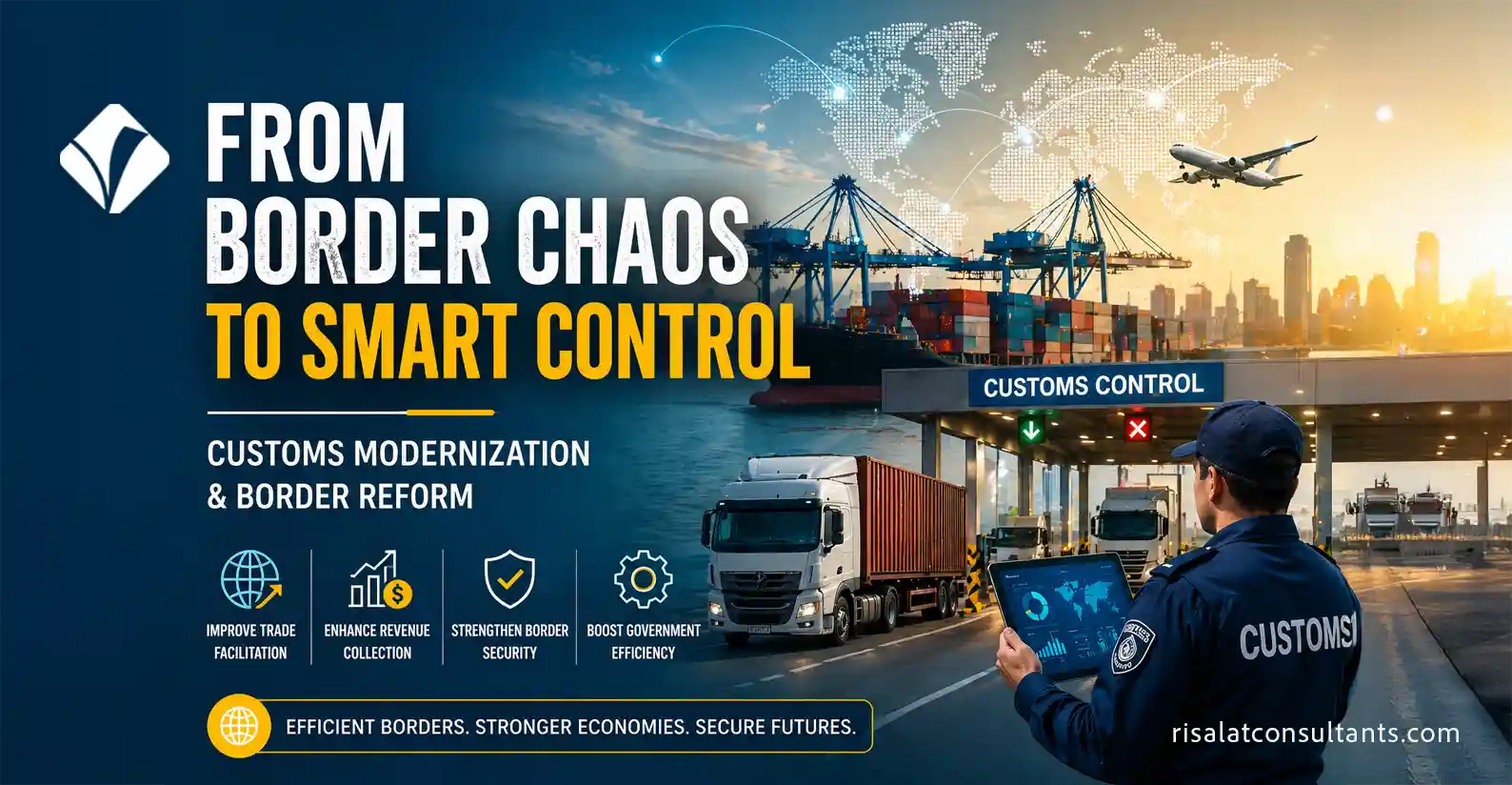
The evidence shows that countries achieving the greatest success combine technology with comprehensive institutional reform, treating customs transformation as a strategic governance priority rather than a technical upgrade. Many customs authorities still struggle with fragmented border agencies, manual clearance processes, revenue leakage, and weak interoperability. Customs reform and modernization has therefore become a strategic priority for ministries of finance and border management agencies seeking to strengthen revenue mobilization, improve trade facilitation, and enhance border security. This article examines the core elements of customs automation and border management reform, including practical implementation frameworks, governance strategies, and capacity-building approaches that public institutions can apply to achieve lasting transformation.
The Strategic Case for Customs Modernization and Border Management Reform
Why Customs Modernization Matters for Developing Countries
Customs administrations in developing economies face a fundamental challenge that their counterparts in advanced economies have largely resolved. Customs agencies in many developing countries function principally as tax-collecting entities, even as trade promotion gains recognition as vital to economic growth. Developed countries with limited dependence on import revenues focus on trade aid and border protection processes substantially, emphasizing import and export restrictions. This divergence creates strategic tension for ministries of finance in developing nations that must pursue revenue targets and trade competitiveness objectives at the same time.
The cost differential reveals the scale of this challenge. Trade activity costs in developing countries average 1.8 times higher than in developed countries. These costs arise not from tariff barriers but from nontariff measures such as inefficient customs procedures and inadequate infrastructure. Research demonstrates that NTMs can add 70 percent to the restrictiveness of tariffs alone, and countries that reduce customs barriers tend to enjoy both more diverse exports and greater export intensity.
Effect on Trade Competitiveness and Economic Growth
Empirical evidence establishes a direct link between customs efficiency and national competitiveness. Each additional day that goods are delayed before shipping reduces trade by more than one percent. Delays produce even sharper outcomes for time-sensitive goods, reducing trade by as much as 6 percent. A single day of delay equals about 70 kilometers of additional transport distance in terms of trade effect.
Port efficiency illustrates the tangible benefits of customs modernization. Durban, South Africa reduced dwell time from seven to four days through complete customs reform measures. This transformation demonstrates how customs quality and reputation contribute to port competitiveness and serve as platforms for growing international trade and logistics operations. Customs requirements and operational efficiency directly influence how ports compete for market share.
The World Trade Organization defines trade aid as simplification and harmonization of international trade procedures. Transaction costs decline when customs administrations apply controls more efficiently. The Revised Kyoto Convention provides the international standard to make customs regulatory procedures as efficient as possible.
Revenue Mobilization and Fiscal Sustainability
Customs administrations serve as critical revenue collection and public financial management systems in developing economies. Five countries participating in an IMF METAC webinar reported customs collecting between 31 percent in Jordan and 52 percent in Afghanistan of total tax collections, averaging 39 percent across participants.
Revenue collected by government provides the foundation needed for state authority. Public goods including education, defense, security, health care and infrastructure require government funding because insufficient profit incentives exist for private sector delivery. Customs contributes to economic competitiveness not only through aid but by collecting revenue needed for productivity-enhancing public investments.
Fiscal sustainability analysis assesses the financial effect of customs modernization on government budgets. The Customs General Administration revenues in Mongolia account for about 10 percent of GDP. The operating expenses funded from central budgets must balance against revenue generation capacity, creating fiscal sustainability risks when budget priorities lack clear definition or inflation adjustment.
Border Security and National Safety Concerns
Customs administrations perform social protection functions that extend beyond revenue and aid. Counter-terrorism regulations adopted after September 11, 2001 led to the WCO SAFE Framework implementation. Customs contributes to economic competitiveness by protecting national security and deterring cross-border trade in dangerous products.
Border management balances mobility and security interests. States face legitimate concerns about safeguarding national security while curbing transnational crimes including trafficking, smuggling and terrorism. Effective border management serves dual purposes, helping balance cross-border movements and migration management with security requirements. Customs aids emergency relief supply imports when disasters occur, supporting resilience and economic recovery.
Customs administrations actively curb counterfeit goods trade, which harms government revenue collection, intellectual property rights holders and consumers of fake medicines. Border security measures designed to alleviate national safety threats include physical, technological, legal and administrative actions that reduce risks from crime, disease, terrorism and violence originating beyond national borders.
Core Elements of Customs Reform and Modernization Programs
Successful customs modernization requires coordinated reforms across multiple dimensions. Countries that implement piecemeal changes without addressing structural weaknesses achieve limited results. The WTO Trade Facilitation Agreement provides a detailed blueprint, with full implementation projected to reduce trade costs by an average of 14.3 percent and increase global trade by up to USD 1 trillion annually.
Legislative and Regulatory Framework Updates
Legislative reform establishes the legal foundation for customs modernization. South Africa’s Customs and Excise Act rewrite took several years to complete and resulted in separate Customs Control and Customs Duty Bills designed to support international legislative requirements and keep pace with global trade trends. The European Union’s Union Customs Code entered into force in October 2013, with most substantive provisions applying from May 2016. These legislative updates give effect to the Revised Kyoto Convention and other binding international instruments while establishing sound frameworks that boost implementation of other legislative instruments relying on customs control.
The Revised Kyoto Convention promotes transparency, simplification, standardization, and harmonization of customs procedures through online publication of rules and regulations, optimized paperwork, electronic platforms for filing and clearance, and adoption of risk management tools. Cambodia adopted a Customs Law in June 2007 to conform with GATT/WTO Codes on Customs Valuation. A five-year Customs Reform and Modernization Strategy followed in January 2024 and focused on boosting trade facilitation, improving institutional capacity, strengthening compliance, and advancing IT systems.
Organizational Structure and Institutional Reform
Organizational approaches to customs vary substantially across countries. Some maintain customs as independent entities, while others integrate them with tax officials or armed forces. The European Union’s landmark 2026 reform established a decentralized EU Customs Authority to coordinate governance, analyze import and export data, and support risk management work of national customs authorities. This represents the greatest reform since the Customs Union’s creation in 1968.
Institutional reform addresses corruption risks inherent in customs operations. The relationship between officials and traders typically involves third-party brokers and adds exposure for corruption and another stakeholder layer during reform processes. Effective organizational changes improve ethics, decrease collusion between customs brokers and officials, and reduce discretionary powers.
Process Simplification and Procedure Harmonization
Process simplification removes redundancies that increase compliance costs. The WTO TFA requests harmonizing and standardizing trade procedures, reducing duplication and unnecessary inspections. This leads to more efficient shipping and lower carbon emissions. Data harmonization ensures information required by regulatory authorities remains simple, clear, and free of redundancies. Forms and electronic submissions should follow international standards, with similar information submitted only once.
Simplified procedures for authorized persons require minimal information at release time. Supplementary declarations containing normally required information follow. Cambodia’s single administrative document system and one-stop service mechanism allows only one inspection by an inter-ministerial joint body and streamlines procedures while reducing bureaucracy.
Trade Facilitation Measures and Standards
Trade facilitation has policies aimed at simplifying, modernizing, and harmonizing export, import, and transit processes. The WTO TFA has provisions covering transparency, advance rulings, customs cooperation, trade facilitation for goods in transit, and modern technology use. These measures reduce trade costs outside traditional market access tools such as tariffs.
Trust and check trader categories strengthen existing Authorized Economic Operator programs and allow compliant businesses to release goods without active customs intervention. Automated System for Customs Data operates at all international checkpoints in countries like Cambodia and facilitates procedures as part of one-stop service implementation.
Infrastructure and Physical Facility Requirements
Physical infrastructure determines customs operational capacity. Border police surveillance stations in many developing countries consist of buildings constructed in the 1960s through 1980s. These were originally designed for military purposes rather than contemporary border policing. Main deficiencies include inadequate room allocations, heating systems, thermal insulation, electric installations, and ergonomic conditions. Strategic plans for contemporary border policing require infrastructure development that meets operational implementation needs according to identified priorities.
Digital Transformation Through Customs Automation
Automation technologies are now a foundation of customs modernization and border management reform efforts worldwide.
Paper-based trade procedures that once dominated border clearance have given way to digital systems capable of processing declarations in minutes rather than days. This technological move extends beyond simple digitization to cover artificial intelligence, risk analytics, and integrated data platforms that connect customs authorities with traders, port operators, and regulatory agencies.
Automated Customs Systems and Platforms
The Automated System for Customs Data stands as the most widely deployed customs automation program globally. ASYCUDA has helped more than 100 economies speed up customs clearance, improve public revenues, reduce corruption, streamline humanitarian aid delivery, and curb illegal trade over a 40-year operational history.
ASYHUB provides integration capabilities that connect ASYCUDAWorld with external systems. This improves supply chain efficiency and information sharing between governments and businesses. The platform speeds up clearance of small parcels and catalyzes e-commerce growth through secure processing. Turkmenistan’s single window registered more than 5,000 users and processed over 20,000 submissions within eight months of launch. Georgia implemented a computerized transit system through ASYCUDA that positions the country to join the European Union Common Transit Convention.
The United States operates the Automated Commercial Environment as its centralized digital system for processing imports and exports. It functions as the country’s single window and connects U.S. Customs and Border Protection, partner government agencies, and the business community. Specialized applications address specific regulatory needs. The Automated System for Relief Consignments explores methods to accelerate emergency aid deliveries for crisis response. ASYCUDA eCITES provides automated support for permit applications related to international trade in endangered species. Sri Lanka recorded a 91% reduction in trade of CITES-protected species and a 65% cut in permit processing times between 2020 and 2023 using this system.
Benefits of Customs Automation for Trade and Revenue
Revenue collection improvements provide measurable evidence of automation benefits. Research in Ethiopia found a positive correlation between customs functions automation and revenue collection improvement at r=0.592, p<0.05. As Ethiopia Revenue and Customs Authority automated one customs function, revenue collection ability increased by KHR 8697.56.
Tanzania adopted ASYCUDA, the Tanzania Electronic Single Window System, and the Tanzania Customs Integrated System at the Port of Dar es Salaam and produced significant improvements. Survey data revealed that 90.4% of respondents agreed automated customs clearance systems improve operational efficiency, while 84.6% noted reductions in operational costs and improved stakeholder satisfaction. Furthermore, 88.4% of participants acknowledged that systems contributed to reduced clearance times and led to smoother cargo processing and reduced congestion.
Automation reduces customs processing time by up to 50%. Some processes achieve over 90% time savings according to McKinsey research. Manual data entry carries error rates between 1-4%, while automated systems achieve accuracy rates exceeding 99.9%. Companies that implemented automation reported 40% improvements in customs clearance speed.
Implementation Challenges in Resource-Constrained Environments
Field-level implementers express mixed satisfaction with current automation systems. Obstacles to successful implementation include taxpayer concerns about data safety and security, insufficient IT knowledge among both officials and taxpayers, lack of knowledge regarding common laws and regulations, dependency on mediator groups, limited promotional activities, resource constraints, user-unfriendly software and websites, and resistance from field level officials.
Tanzania faces challenges fully using automation potential despite recognized benefits. Limited empirical data exists to assess overall effectiveness of ASYCUDA, TeSWS, and TANCIS on trade metrics. Interoperability issues between different electronic customs platforms and lack of harmonization with trade partners limit efficiency gains. These challenges require concerted effort from government agencies and private sector stakeholders to address.
Data Management and Information Integration
Integration capabilities determine automation success. Leading customs platforms offer smooth integration with warehouse management systems and transport management systems via APIs or Electronic Data Interchange. This interconnectivity means that shipment and order data can be reused across platforms without duplication or manual transfer.
ASYCUDA provides Electronic Data Interchange between traders and customs using common standards such as XML. The system uses international codes and standards developed by ISO, WCO, and United Nations. These are configured to suit national characteristics of individual customs regimes, tariffs, and legislation, while also requiring strong data security and protection measures to ensure sensitive trade and government data is safeguarded.
Single Window Systems and Coordinated Border Management
Understanding Single Window Concepts and Architecture
Most developing economies struggle with a fundamental coordination challenge in border management. Single window systems address this issue. UN/CEFACT Recommendation 33 defines a single window as a facility that allows parties involved in trade and transport to lodge standardized information and documents with a single entry point.
Implementation follows three architectural models. The Single Authority approach designates one authority to receive information and spread it to other agencies. This authority sometimes coordinates physical inspections. The Single Automated System collects and distributes information through a platform that processes data and distributes it to concerned authorities. The Automated Information Transaction System permits traders to submit electronic declarations to various authorities through a single application.
Papua New Guinea’s blueprint connects 32 government agencies within one platform. Cambodia’s national single window links five inter-ministerial agencies. These include customs, commerce and health ministries. Single window systems evolve through five stages. They begin with paperless customs and expand to regulatory agencies. The systems then incorporate logistics communities and integrate financial services. They finally connect with other national systems for cross-border data exchange.
Benefits of Electronic Single Window Implementation
Measurable gains verify single window investments. Singapore reduced trade document processing from four days to 15 minutes after implementation. Thailand cut export time from 24 days in 2006 to 14 days in 2009. Procedural reforms and customs modernization supported single window development. Hong Kong estimates annual savings at HKD 210.52 billion from its automated information transaction system. Rwanda launched its electronic single window in 2012 with TradeMark East Africa partnership. This significantly improved service delivery and reduced customs clearance times.
Coordinated Border Management Frameworks
The World Customs Organization defines coordinated border management as a coordinated approach by border control agencies. Both domestic and international agencies seek greater efficiencies over managing trade and travel flows while maintaining compliance requirements. The objective balances trade facilitation and traveler clearance with secure borders.
The International Finance Corporation supported Malawi’s reform program. The program implemented a pilot coordinated border management model at Mwanza Border. Cross-border regulatory agencies reduced from 13 to 6. This increased operational efficiency and streamlined movement of goods.
Inter-Agency Coordination Mechanisms
Political will remains the prerequisite for efficient inter-agency cooperation. Agencies must review mission requirements, policies and procedures. This ensures compatibility and eliminates redundancies. The WTO TFA authorizes National Trade Facilitation Committees. These committees coordinate and encourage trade facilitation reforms including inter-agency cooperation. Canada’s Border Services Agency consolidated customs, immigration intelligence and inspection programs into one entity.
Overcoming Fragmentation Across Border Agencies
Traditions, prestige and unclear instructions make collaboration difficult. They undermine attempts to streamline procedures between authorities. Best practice shows that business cases for cooperation must be made clear to agencies. The ASEAN Single Window connects national systems across member states. This enables secure electronic exchange of certificates of origin and customs declarations.
Risk Management and Compliance in Modern Customs Administration
Risk management customs frameworks enable administrations to allocate limited inspection resources toward high-risk consignments while expediting low-risk trade. This selectivity approach replaces transaction-by-transaction documentation checks with intelligence-led targeting. It addresses a core challenge for resource-constrained customs authorities that cannot inspect every shipment at borders physically.
Risk-Based Selectivity and Targeting Systems
The WCO Cargo Targeting System delivers purpose-built risk assessment capability for maritime container and air cargo domains at no cost. The software gathers electronic manifest data and applies automated risk profiles to new manifests instantly. It alerts designated users to matching consignments. Cambodia’s General Department of Customs and Excise joined the UNODC-WCO Container Control Program in 2016. The program established Container Control Units and Air Cargo Control Units at major ports. Officers use risk analysis skills to profile high-risk consignments there.
Countries facing political or legal barriers to international collaboration can use the Global Travel Assessment System for independent vetting activities. GTAS allows governments to screen suspects before entry or departure. They can download it freely from a dedicated website.
Post Clearance Audit and Verification
Post-clearance audit changes customs control from purely transaction-based checks to detailed company-oriented reviews. The structured examination measures trader compliance after cargo release. It creates partnerships that help clearance for compliant operators. Jamaica Customs Agency conducts audits covering periods of two years for valuation and three years for compliance. Fraud investigations extend to seven years.
Trade Compliance Programs and Authorized Operators
Authorized Economic Operator programs create customs-to-business partnerships that secure supply chains while helping legitimate trade. AEO companies experience substantially fewer border examinations than regular traders. As of July 2018, 77 operational AEO programs existed around the world. Mutual recognition arrangements supported them and extended benefits at borders.
Reducing Corruption Risks Through Transparency
Corruption in customs creates major disincentives to trade expansion in developing countries. Three corruption types plague customs: routine corruption for normal processing, fraudulent corruption to reduce fiscal obligations, and criminal corruption permitting illegal operations. Rwanda and Georgia implemented detailed approaches that combined technical measures with broader social reforms. These included tax code simplification and one-stop windows backed by strict enforcement based on effective monitoring.
Building Institutional Capacity for Sustainable Reform
Institutional capacity determines whether customs modernization initiatives achieve sustainable outcomes or fade after the original implementation. Capacity building covers development or acquisition of skills, competencies, tools, processes, and resources needed to improve customs administrations’ ability to carry out functions and achieve objectives.
Human Resource Development and Training
Sound human resource management policies play a major role in fighting corruption in customs. Effective practices include providing sufficient salary and conditions to ensure decent living standards. They also recruit personnel with high integrity standards and ensure staff selection and promotion procedures are free of bias. Deploying rotation and relocation strategies removes opportunities for holding vulnerable positions long-term. Adequate professional training and instructional design approaches throughout careers are also provided. The WCO Master Trainer Program developed instructors in charge of human resource development at customs administrations in 21 African and 6 Pacific-Oceanian countries.
Leadership and Change Management
Change management appears critical over the course of reforms, as resistance is usually common. Successful change management efforts require building allies within and outside the institution and proceeding gradually. Customs organizations require effective tools to manage change processes. Organizations that differ in every conceivable way are applying change management, including organizational schemes, ownership, business, traditions, and culture.
Governance Reform and Integrity Programs
The WCO Revised Arusha Declaration contains 10 factors driving holistic and systemic changes in structures, policies, practices, and mindsets. The WCO Anti-Corruption and Integrity Promotion Program, launched in January 2019, wants to improve business and law-enforcement environments for cross-border trade. It helps make changes to operational and administrative contexts that restrict corrupt behavior and promote good governance. The Program has developed 13 customs operations-related risk tables, including enforcement, post-clearance audit, automation, and passenger control.
Performance Measurement and Monitoring Systems
Performance measurement underpins all modern customs administrations. Customs authorities benefit from evidence-based and strategic decision-making processes with relevant performance metrics, data, and analysis. The WCO Performance Measurement Mechanism covers common performance areas and expected outcomes. This enables benchmarking at regional and global level to improve customs performance in trade facilitation, revenue collection, enforcement, and organizational development. Members participate voluntarily and submit data through the platform every two years.
Financial Planning and Resource Mobilization
Resource mobilization strategies play critical roles in ensuring National Trade Facilitation Committees’ long-term success. Defining roles and responsibilities within the strategy, getting and allocating resources appropriately, and identifying and negotiating with the right donors are the phases involved. MCC provided nearly $335 million to improve tax and customs administration efficiency in Guatemala.
International Cooperation and Technical Assistance
U.S. Customs and Border Protection coordinates and presents over one hundred training programs to thousands of foreign participants each year. These target the full range of border control and operations including weapons of mass effect training, anti-narcotics, port security, integrity, and commercial operations. JICA signed a Memorandum of Cooperation with the World Customs Organization in 2015 for further development of customs administrations in developing countries through joint projects.
Conclusion
Modernizing customs systems offers developing countries a clear pathway to strengthen revenue collection, improve trade competitiveness, and enhance national security. However, technology alone is not enough. Sustainable results depend on coordinated reforms across legislation, institutional governance, inter-agency collaboration, risk management, and human capacity.
Countries that treat this transformation as a strategic governance priority rather than a standalone digital upgrade achieve stronger, more resilient outcomes. The most successful approaches combine automation with policy alignment, institutional accountability, and long-term capacity development.
Achieving lasting results requires more than new systems. It demands institutional strategy, leadership, and sustained implementation. Explore our executive training and capacity-building programs for customs authorities, ministries of finance, trade institutions, and public sector leaders working to improve trade facilitation, revenue mobilization, and border governance.
FAQs
Q1. What are the main goals of customs modernization and trade facilitation agreements?
Customs modernization aims to simplify and harmonize international trade procedures, reduce transaction costs, and improve border efficiency. The WTO Trade Facilitation Agreement, when fully implemented, is projected to reduce trade costs by an average of 14.3 percent and increase global trade by up to USD 1 trillion annually. Key objectives include faster customs clearance, enhanced revenue collection, reduced corruption opportunities, and improved supply chain efficiency through digital systems and streamlined procedures.
Q2. What is coordinated border management and how does it work?
Coordinated border management is a collaborative approach where border control agencies work together domestically and internationally to manage trade and travel flows more efficiently while maintaining compliance and security requirements. This cooperation occurs at three levels: local cooperation between officials on both sides of borders, bilateral cooperation between neighboring countries, and multinational cooperation across regions. The goal is to balance trade facilitation with border security by reducing agency redundancies and streamlining procedures.
Q3. What are the essential components of customs classification, valuation, and origin?
The three pillars of customs administration are classification, valuation, and origin. Classification involves determining the correct tariff code (HTS code) for imported goods, which affects duty rates and regulatory requirements. Valuation establishes the customs value of goods for duty calculation purposes. Origin determination identifies where products were manufactured or substantially transformed, which impacts preferential tariff treatment under trade agreements and compliance with country-of-origin regulations.
Q4. How do automated customs systems improve revenue collection and trade efficiency?
Automated customs systems like ASYCUDA have demonstrated significant benefits across more than 100 economies. Research shows automation can reduce customs processing time by up to 50%, with some processes achieving over 90% time savings. Automated systems achieve accuracy rates exceeding 99.9% compared to manual data entry error rates of 1-4%. Countries implementing automation have reported measurable revenue improvements, with studies showing positive correlations between customs automation and enhanced revenue collection capabilities.
Q5. What role does risk management play in modern customs administration?
Risk management enables customs authorities to allocate limited inspection resources toward high-risk consignments while expediting low-risk legitimate trade. This intelligence-led approach replaces transaction-by-transaction checks with automated risk profiling systems that analyze electronic data in real time. Authorized Economic Operator programs complement risk management by creating partnerships with compliant businesses, who experience significantly fewer border examinations. Post-clearance audits further support this system by shifting controls from purely transaction-based checks to comprehensive company-oriented reviews.
Partners in project success since 2011, diagnostics, advisory support and applied learning for ministries, public agencies and project teams.
Need help putting this into practice?
Start with a free 10-minute diagnostic or talk to our experts.
Leave a comment