

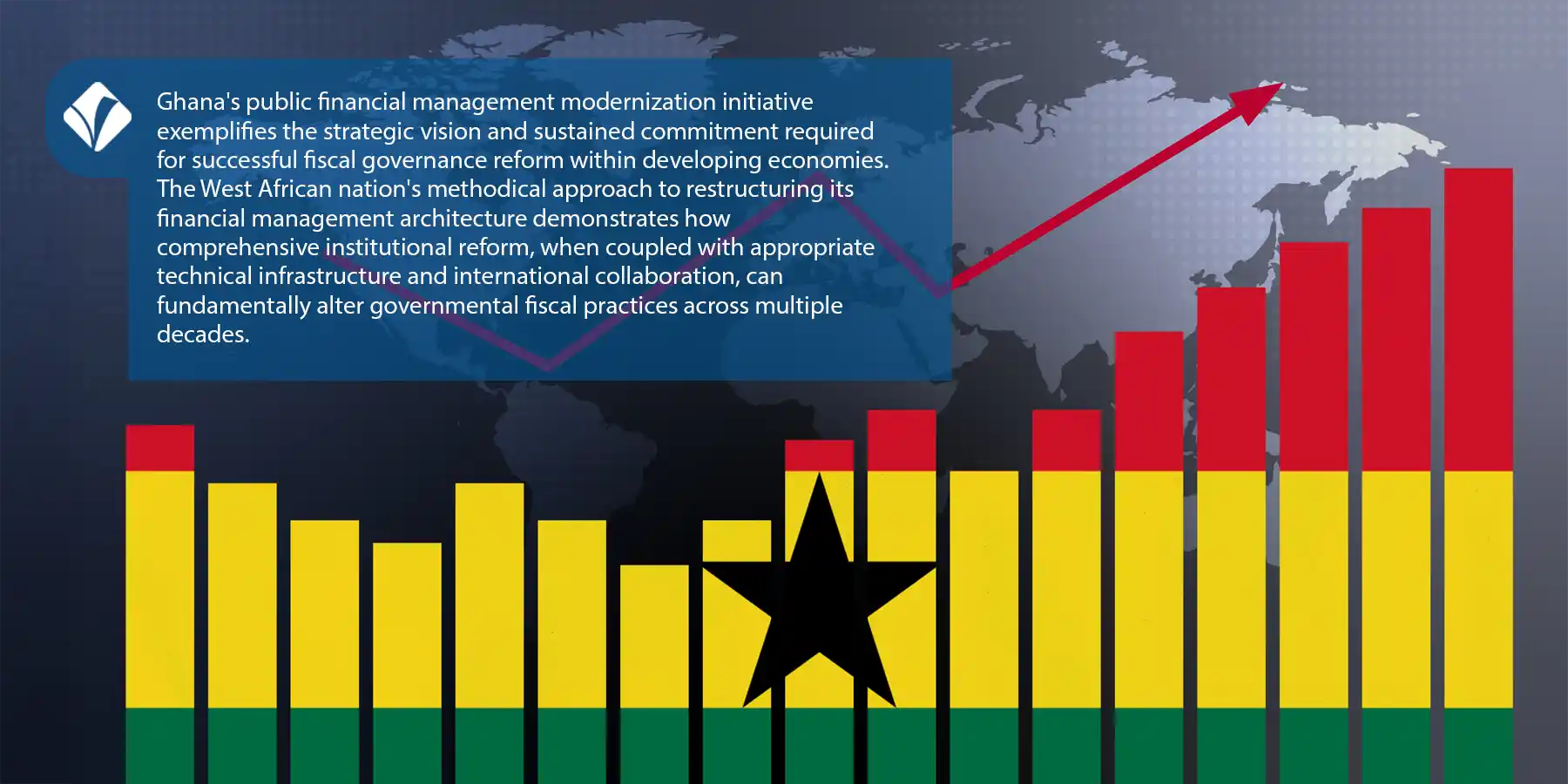
Ghana’s public financial management reform initiative stands as one of Sub-Saharan Africa’s most ambitious fiscal modernization endeavors. The West African nation has methodically restructured its public spending architecture over the past decade, transitioning from conventional input-focused mechanisms toward sophisticated, accountability-driven frameworks that prioritize measurable performance outcomes.
The evolution of public financial management within Ghana’s governmental structure reflects a series of strategic reform initiatives that have fundamentally redefined resource allocation methodologies, expenditure monitoring protocols, and public service delivery mechanisms. The enactment of the Public Financial Management Act (2016) constituted a watershed moment within Ghana’s fiscal reform trajectory, establishing robust legal foundations for enhanced fiscal responsibility protocols and sustainable debt management practices. The subsequent implementation of the Medium-Term Expenditure Framework (MTEF), coupled with performance-based budgeting methodologies, has created strategic alignment between public expenditure patterns and national development imperatives.
This examination delves into the evolutionary trajectory, implementation dynamics, and operational challenges characterizing Ghana’s public financial management modernization efforts. The analysis explores institutional frameworks catalyzing this modernization process, particularly the Ghana Integrated Financial Management Information System (GIFMIS), while assessing capacity building initiatives designed to strengthen financial governance mechanisms. Through systematic evaluation of reform strategies, implementation obstacles, and international partnership arrangements, this discourse provides comprehensive insights into Ghana’s sustained efforts toward establishing efficient, transparent, and results-oriented public financial management architecture.
Understanding Public Financial Management in Ghana
Public financial management constitutes the fundamental architecture of effective governance and fiscal stewardship within Ghana’s public sector framework. The evolution of Ghana’s public financial management practices has emerged as a central component of the nation’s economic development strategy, particularly as Ghana seeks to fortify fiscal discipline while enhancing service delivery mechanisms across governmental institutions.
What is public financial management?
Public financial management encompasses the systematic mechanisms through which public resources are collected, allocated, spent, and accounted for. This framework represents a comprehensive governance structure that oversees all governmental activities pertaining to financial resource management. PFM processes encompass the complete budget cycle, incorporating public procurement protocols, audit practices, and revenue collection systems.
The core of PFM involves sophisticated technical operations including macroeconomic forecasting, budget allocation methodologies, accounting procedures, and auditing functions. Within Ghana’s developing economy context, PFM functions as a cornerstone of sound financial governance. characterized by the government’s capacity to honor commitments while consistently achieving revenue and expenditure objectives.
Essential capabilities for effective PFM encompass:
- Strategic planning and expenditure forecasting
- Budget preparation and execution
- Monitoring and evaluation functions
- Revenue management and debt management
- Internal control and audit mechanisms
Why PFM matters for economic stability
The relationship between robust PFM practices and economic stability has gained particular prominence within Ghana’s development trajectory. Following the pandemic’s conclusion, governments globally have pursued fiscal policy normalization, with public debt and deficits declining from unprecedented levels amid elevated inflation and increased borrowing costs.
Effective financial management directly influences economic growth through government expenditures, revenue generation, and exchange rate management. Research spanning 2000-2019 established that these three variables maintain significant positive relationships with GDP growth in Ghana.
Furthermore, sound PFM enables governments to sustain fiscal discipline, thereby reducing debt vulnerabilities across extended periods. This approach creates essential fiscal space necessary for addressing future economic disruptions. Within Ghana’s context, where economic volatility has historically presented development challenges, robust PFM systems establish foundations for sustainable growth trajectories.
The structure of public sector budgeting in Ghana
Ghana’s budget cycle operates through a continuous process comparable to governmental systems worldwide, structured to address national development strategies while delivering essential services. This cycle encompasses four distinct phases: budget formulation, approval, implementation, and monitoring/evaluation.
Budget formulation within Ghana depends upon strategic policy priorities outlined in the National Medium Term Development Policy Framework, with Ministries, Departments, and Agencies (MDAs) coordinating their Medium Term Development Plans accordingly. The Ministry of Finance determines budget ceilings that establish resource parameters for each MDA’s programs and activities.
Budget approval responsibilities rest with Parliament for national budgets, while district assemblies maintain authority over Metropolitan, Municipal, and District Assembly (MMDA) budgets. Traditional practice schedules national budget approval for December, when Parliament conducts debates and passes the Budget Appropriation Bill.
The implementation phase converts budget frameworks into practical management instruments that guide MDAs and MMDAs toward achieving performance objectives. Subsequently, monitoring and evaluation processes assess how effectively budgeted resources accomplish sector development goals, thereby establishing accountability and transparency within public spending practices.
Contemporary reforms have transitioned Ghana from Activity-Based Budgeting toward Program-Based Budgeting, redirecting focus from merely monitoring inputs and outputs toward accomplishing measurable outcomes and demonstrable results. This transition signifies a fundamental shift in Ghana’s approach to public sector financial management.
The Evolution of Ghana’s public financial management Reforms
Ghana’s public financial management reform trajectory extends across more than two decades, constituting a sustained endeavor to strengthen transparency, accountability, and fiscal discipline within public expenditure frameworks.
From PUFMARP to the Ghana’s public financial management Act 2016
The genesis of Ghana’s public financial management reform initiative commenced with the Public Financial Management Reform Program (PUFMARP) in 1996. This ambitious program sought to modernize Ghana’s financial management architecture through the establishment of integrated financial management information systems, enhanced budget preparation methodologies, and strengthened expenditure management protocols.
PUFMARP’s extensive scope encountered significant implementation obstacles, necessitating the development of subsequent reform strategies. The Ministry of Finance responded in 2009 with the introduction of the Ghana Integrated Financial Management Information System (GIFMIS), designed to reinforce expenditure controls and enhance fiscal reporting capabilities within broader reform initiatives.
The enactment of the Public Financial Management Act (Act 921) in 2016 represented a defining moment within Ghana’s public financial management evolution. This comprehensive legislation consolidated disparate financial laws and regulations, creating a unified legal architecture for fiscal responsibility. The Act encompassed critical operational domains:
- Budget preparation and execution methodologies
- Cash management and treasury operational frameworks
- Public debt management protocols
- Fiscal risk assessment mechanisms
- Internal audit system structures
Ghana’s public financial management Act 2016 established the Controller and Accountant-General position, mandated to ensure public expenditure compliance with established financial regulatory frameworks.
The role of the Medium-Term Expenditure Framework (MTEF)
The Medium-Term Expenditure Framework emerged as a central component in Ghana’s budget methodology transformation throughout the reform process. Introduced during the late 1990s, MTEF expanded planning horizons from traditional annual cycles to three-year rolling frameworks.
MTEF establishes connections between policy priorities and resource allocation through:
- Developing realistic medium-term resource projections
- Aligning sectoral strategies with available resource envelopes
- Creating predictable budget allocation patterns for ministries and agencies
This framework has proven instrumental in strengthening fiscal discipline and enhancing budget credibility across Ghana’s public sector. The extended planning horizon enables improved project implementation while mitigating challenges associated with project abandonment due to annual budget variations.
Introduction of Program-Based Budgeting (PBB)
The transition toward Program-Based Budgeting represents among the most transformative shifts within Ghana’s public financial management architecture. This methodology superseded traditional line-item budgeting approaches that emphasized inputs over measurable outcomes.
PBB implementation in 2014 marked a fundamental reorientation in Ghana’s public expenditure allocation and evaluation processes. Rather than focusing solely on input and activity tracking, PBB creates direct linkages between funding mechanisms and quantifiable results. This system requires ministries to develop programs with defined objectives and performance indicators, facilitating enhanced performance assessment capabilities.
PBB advantages within Ghana’s operational context include:
- Enhanced transparency through improved spending justification processes
- Strengthened accountability via direct spending-outcome linkages
- Superior resource prioritization based on program effectiveness metrics
- Strategic decision-making enhancement in budget allocation processes
The progression from input-oriented to performance-based systems demonstrates Ghana’s dedication to value-for-money principles in public expenditure management. This transition has necessitated extensive capacity building initiatives across governmental institutions to cultivate technical expertise required for effective program design, monitoring, and evaluation processes.
The integration of these reform components, from the foundational PUFMARP initiative through Ghana’s public financial management Act 2016, MTEF implementation, and PBB adoption, demonstrates Ghana’s systematic approach toward developing responsive and results-oriented public financial management systems.
Key Tools Driving Modernization
The technical infrastructure underpinning Ghana’s public financial management modernization comprises several sophisticated, interconnected systems and standardized frameworks that collectively fortify transparency mechanisms and accountability protocols within public expenditure management.
Ghana Integrated Financial Management Information System (GIFMIS)
GIFMIS constitutes the cornerstone of Ghana’s digital financial management architecture, implemented during the early 2010s under the Public Financial Management Reform Program. This comprehensive system consolidates disparate public financial data across multiple governmental units, encompassing both central government entities and local administrative structures. The platform systematically monitors and aggregates financial transactions executed by or on behalf of governmental institutions, creating unified integration between budget execution protocols, accounting procedures, and financial reporting mechanisms.
Implementation proceeded through structured phases, progressively expanding coverage from central government agencies to Metropolitan, Municipal, and District Assemblies (MMDAs). The system’s initial focus centered on automating budgetary control mechanisms and eliminating financial irregularities within ministerial operations, subsequently incorporating supplementary modules encompassing payroll management, procurement oversight, and cash management functionalities to strengthen comprehensive financial supervision.
Adoption of IPSAS and accrual accounting
Ghana formally adopted accrual-based International Public Sector Accounting Standards (IPSAS) in 2014, establishing this framework as the foundation for preparing and presenting general purpose financial statements. The complete implementation timeline targeted 2023 completion, reinforcing PFM reform objectives and optimizing GIFMIS utilization capabilities. Ghana’s public financial management Act 2016 (Act 921) provides statutory authorization for accrual-based IPSAS financial reporting protocols.
IPSAS implementation yields substantial operational advantages:
- Enhanced quality and credibility of financial reporting documentation
- Strengthened accountability, transparency, and governance frameworks
- Superior financial information accessibility for strategic decision-making processes
- Standardized financial operations harmonization across public sector entities
Use of IMF’s Government Finance Statistics (GFS)
Ghana introduced a restructured Budget Classification and Chart of Accounts framework in 2012, based upon the IMF’s Government Finance Statistics 2001 framework . This classification methodology enables systematic mapping of aid resources to the Chart of Accounts, substantially improving budget transparency and reporting accuracy. The GFS framework has proven instrumental in standardizing financial reporting procedures and facilitating international comparability of public finance datasets.
Harmonized Chart of Accounts for MDAs and MMDAs
The harmonized Chart of Accounts (CoA) establishes a structured coding system that provides systematic frameworks for recording, classifying, and organizing budget data alongside accounting transactions. This comprehensive framework enables effective budgetary controls while offering multiple analytical perspectives of financial transaction patterns.
The CoA architecture encompasses eight distinct segments: Institution, Funding, Functional of Government (COFOG), Organizational, Program and Sub-program, Activity, Location, and Natural Accounts. Each segment fulfills specialized functions within the classification and tracking of public expenditures, ultimately supporting Ghana’s strategic transition toward performance-based financial management methodologies.
Challenges in Implementing Performance-Based Financial Management
Ghana’s ambitious public financial management reforms encounter substantial implementation obstacles that impede the complete realization of performance-based financial management across governmental institutions.
Inter-agency coordination and data sharing
Seamless coordination between government agencies constitutes a fundamental requirement for effective PFM reform implementation, yet this remains a persistent institutional challenge within Ghana’s administrative framework. Annual assessment reports consistently emphasize the critical need for enhanced communication and collaborative mechanisms between agencies. The ‘Heads of Agencies Committee,’ despite its institutional mandate, demonstrates limited effectiveness due to irregular meeting schedules that compromise sector leadership capabilities. This institutional fragmentation generates significant operational difficulties for the Ministry of Finance and Economic Planning (MoFEP) and Ministries, Departments, and Agencies (MDAs) when attempting to monitor budget policy objectives, as comprehensive spending visibility across sectors becomes increasingly complex to achieve.
Capacity constraints in financial management
Human and administrative capacity limitations present formidable obstacles, particularly within specialized technical domains such as macroeconomic forecasting and program-based budgeting implementation methodologies. Local government institutions frequently operate with insufficient human and administrative capacity for effective service delivery, creating vulnerability to corruption and patronage systems. This capacity deficit undermines
PFM reform initiatives that demand sophisticated technical competencies for successful implementation.
Build your institution’s financial governance capacity with our expert-led programs. Explore the Public Financial Management & Performance Budgeting Training.
Local government adoption and decentralization issues
Fiscal decentralization implementation encounters significant operational challenges across numerous Metropolitan, Municipal and District Assemblies (MMDAs). The practical application of fiscal decentralization demonstrates greater influence from political considerations than economic imperatives. Consequently, substantial percentages of MMDAs experience difficulties mobilizing adequate revenue streams to address citizen service demands, resulting in excessive dependence on intergovernmental transfer mechanisms. This dependency relationship adversely affects service delivery outcomes, as central government transfers frequently experience scheduling delays that impede development project implementation nationwide.
Legislative and regulatory bottlenecks
Budget credibility within Ghana’s fiscal framework exhibits persistent challenges, with aggregate expenditure outturn and revenue outturn indicators receiving unfavorable assessments in recent PEFA evaluations. The budget formulation process suffers from unrealistic ceiling allocations to MDAs, accompanied by restricted opportunities for essential budgetary adjustments. Political dynamics exert considerable influence on budget implementation processes, with documented evidence indicating “regularly large deviations between budget estimates and actual spending” across most government MDAs. Political transition periods often precipitate project abandonment scenarios, as “opposing parties rarely complete projects initiated under other administrations”. The absence of rigorous budget ceiling mechanisms has generated protracted budgeting processes requiring extensive MDA negotiations, diverting institutional resources and time from substantive policy implementation activities.
The Role of Donors and Capacity Building
International development partnerships have constituted a cornerstone of Ghana’s public financial management modernization trajectory, providing essential financial resources, specialized technical expertise, and systematic capacity building interventions that have accelerated reform implementation across governmental institutions.
World Bank and EU support for PFM reforms
The World Bank has established itself as a pivotal development partner within Ghana’s public financial management modernization landscape, approving a GHS 236.25m technical assistance project specifically designed to strengthen institutional capacity in domestic revenue mobilization. This strategic intervention encompasses multiple objectives: reducing Ghana’s debt burden, enhancing public investment management capabilities, and improving governance mechanisms within state-owned enterprises. The African Development Bank has complemented these efforts through a substantial GHS 885.16m loan facility aimed at strengthening comprehensive PFM practices. These multilateral partnerships have been further enriched through coordinated technical assistance provided by the European Union, working alongside the World Bank and Canadian International Development Agency (CIDA) to support Ghana’s reform strategy implementation.
Training programs and technical assistance
Technical assistance interventions have systematically addressed critical operational areas encompassing budget preparation protocols, execution mechanisms, fiscal reporting standards, accounting practices, cash management systems, debt management frameworks, revenue management processes, procurement procedures, and auditing methodologies. Parliamentary oversight capacity has received particular attention within these capacity building initiatives. The Public Financial Management Reform Project (PFMRP) has significantly enhanced the technical competencies of Parliament staff, particularly clerks serving the Finance and Public Accounts Committees, through structured interventions including:
- Analytical oversight report writing training programs
- Technical assistance delivered through mentorship and benchmarking initiatives
- Development of standardized templates for budget information requests
- Comprehensive guidelines for audit report review processes
Institutional strengthening through ICA and ICGFM
Build your institution’s financial governance capacity with our expert-led programs.
Local government institutional development has received parallel attention, with targeted projects supporting ten local governments in implementing optimal PFM practices through strategic, technical, and capacity building interventions covering budgeting reforms, financial reporting enhancement, revenue mobilization strategies, asset management protocols, and accountability mechanisms.
Monitoring and evaluation improvements
Ghana continues advancing its monitoring and evaluation capabilities through substantial human capital development investments. The 2025 national budget allocation of GH₵48 million will facilitate training for over 3,200 public financial officers in international financial management practices and digital tool utilization. These capacity building investments represent strategic efforts to sustain Ghana’s public financial management reform momentum through addressing human resource deficiencies identified during previous reform implementation phases.
Partners in project success since 2011, diagnostics, advisory support and applied learning for ministries, public agencies and project teams.
Need help putting this into practice?
Start with a free 10-minute diagnostic or talk to our experts.

Leave a comment