Key takeaways
- What the evidence and original article tell us. The original Risalat article identifies several useful building blocks, but an update must distinguish enduring principles from time-sensitive rankings, targets and technology claims.
- Planning and fiscal transfers. Planning and fiscal transfers requires more than a general policy commitment.
- Procurement and cash management. Procurement and cash management requires more than a general policy commitment.
- Service delivery verification. Service delivery verification requires more than a general policy commitment.
- Participation and equity. Participation and equity requires more than a general policy commitment.
In short: Uganda local government budget execution depends on timely releases, credible procurement, financial controls and verification of delivered services. Spending rates alone do not show whether communities benefited. The practical question is which institutional decisions, operating routines and safeguards are needed to produce results that can be independently checked.
What the evidence and original article tell us
Core concepts and what has changed
The original Risalat article identifies several useful building blocks, but an update must distinguish enduring principles from time-sensitive rankings, targets and technology claims. Historical examples can illustrate an approach; they should not be presented as proof that a current target was met. The source references below provide a starting point for checking contemporary policy and technical guidance.
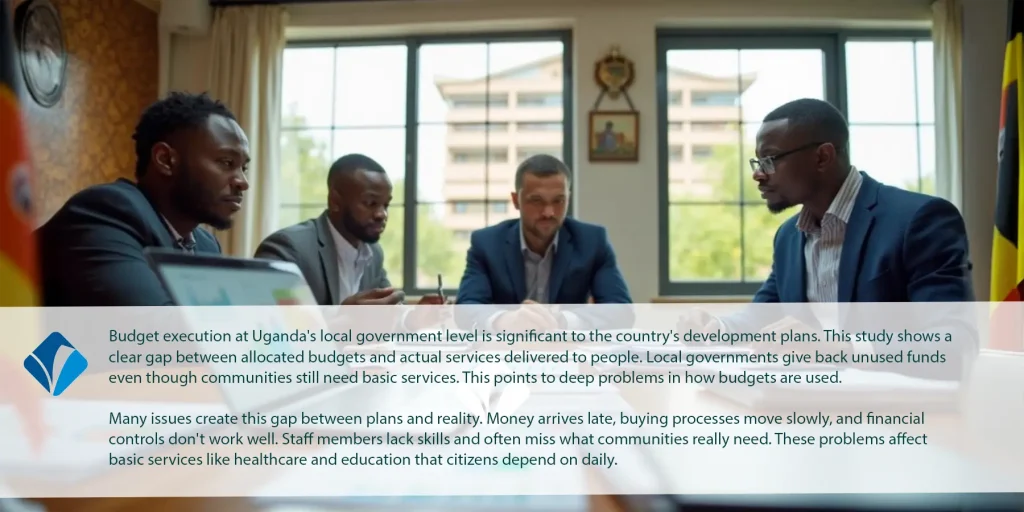
Budget allocation remains the biggest problem in Uganda’s local governments. The local authorities struggle with budget implementation, which hampers development and service delivery. The national Budget for FY 2022/2023 came with big dreams. Its theme aimed to “Full Monetization of Uganda’s Economy through Commercial Agriculture, Industrialization, Expanding and Broadening Services, Digital Transformation and Market Access”. Local implementation of these plans rarely meets expectations. Local governments have formal budget execution processes. These include long-term planning, annual formulation, parliamentary approval, implementation, and oversight. Yet many fail to deliver on their budget commitments because their staff lack proper training.
A fair, equitable, and transparent budget execution process should prevent corruption, waste, and poor service delivery. Uganda’s Budget Execution shows troubling gaps between money disbursed and services delivered. Budget allocation directly affects basic community services like healthcare and education. A newer study, published by Program-Based Budgeting System (PBS), revealed mixed results. PBS improved budget transparency and helped align with national goals. Still, many problems are systemic. These include poor capacity, late fund releases, and communities that barely participate. Poor implementation leads to planned misuse of public resources. This cuts spending on development and social safety nets. Only a small group of powerholders and their allies benefit from this system. This piece digs into Uganda’s local budget execution challenges and offers practical ways to close the gap between financial disbursement and service delivery.
Governance Foundations for Effective Budget Execution .
Define the decision before choosing the tool
For uganda local government budget execution: from funds to services, the first task is to define the decision that needs improvement. A useful problem statement names the service or process, the people affected, the current failure mode, and the evidence needed to show progress. This prevents a project from equating the purchase of software, equipment or consultancy services with a measurable public benefit.
Governance responsibilities
Establish a steering owner who can resolve conflicts across functions, a delivery manager who maintains the implementation record, and an independent assurance route for material risks. Define what each party may approve and how unresolved matters reach senior management. Without decision rights, committees can record problems repeatedly while implementation stalls.
Planning and fiscal transfers
Operational choices and trade-offs
Planning and fiscal transfers requires more than a general policy commitment. Leaders should identify the operational owner, required skills, minimum data quality and maintenance costs before selecting an intervention. A decision note should compare the status quo, a low-cost process change and a more substantial investment. The comparison should consider who benefits, who bears the cost, and which assumptions could invalidate the business case.
Where multiple agencies or contractors participate, specify how information and responsibilities pass between them. A shared register of decisions, dependencies and unresolved issues is often more useful than another dashboard. Governance arrangements should make it possible to identify the person authorised to accept a risk, release a payment or change a service standard.
Practical example and verification questions
Consider an agency piloting an improvement related to planning and fiscal transfers. Rather than deploying it across the organisation immediately, the team selects one service area, records the baseline, tests the intervention with staff and affected users, and logs each exception. It then checks whether performance improved without shifting the burden to another department or excluding people with limited access.
The project manager should ask: What is the measurable baseline? Which data can be independently verified? What would failure look like? What is the recurrent cost after external support ends? Who has authority to change the process? What safeguard protects affected people? Answers to these questions should appear in the business case and the monitoring plan.
A resilient governance foundation helps Uganda’s local governments execute their budgets successfully. The public financial management system needs reliable processes and principles that help mobilize, allocate, and use public resources. These basics transform budget documents into real services that citizens need.
Importance of transparency and accountability .
Procurement and contract design
Translate intended outcomes into testable requirements. Ask bidders to explain interoperability, accessibility, support, exit arrangements and the evidence they will provide at acceptance. Avoid specifying a proprietary product where functional requirements would allow competition. For complex procurements, evaluate whole-life cost and the institution’s ability to manage the contract.
Procurement and cash management
Operational choices and trade-offs
Procurement and cash management requires more than a general policy commitment. Leaders should identify the operational owner, required skills, minimum data quality and maintenance costs before selecting an intervention. A decision note should compare the status quo, a low-cost process change and a more substantial investment. The comparison should consider who benefits, who bears the cost, and which assumptions could invalidate the business case.
Where multiple agencies or contractors participate, specify how information and responsibilities pass between them. A shared register of decisions, dependencies and unresolved issues is often more useful than another dashboard. Governance arrangements should make it possible to identify the person authorised to accept a risk, release a payment or change a service standard.
Practical example and verification questions
Consider an agency piloting an improvement related to procurement and cash management. Rather than deploying it across the organisation immediately, the team selects one service area, records the baseline, tests the intervention with staff and affected users, and logs each exception. It then checks whether performance improved without shifting the burden to another department or excluding people with limited access.
The project manager should ask: What is the measurable baseline? Which data can be independently verified? What would failure look like? What is the recurrent cost after external support ends? Who has authority to change the process? What safeguard protects affected people? Answers to these questions should appear in the business case and the monitoring plan.
A practical checklist is to document the owner, budget, evidence source, control, escalation route and review date for every major action. If one of these is missing, the activity is not yet ready for scale. The checklist can be incorporated into existing management systems rather than introduced as a separate reporting burden.
Capacity and sustainability
Training should follow an assessment of tasks staff actually perform. A useful plan distinguishes awareness, specialist capability and supervisory responsibility. Staff need protected time to practise, clear operating procedures and access to support after a supplier or external consultant leaves. Record capability gains through observed work rather than attendance alone.
Service delivery verification
Operational choices and trade-offs
Service delivery verification requires more than a general policy commitment. Leaders should identify the operational owner, required skills, minimum data quality and maintenance costs before selecting an intervention. A decision note should compare the status quo, a low-cost process change and a more substantial investment. The comparison should consider who benefits, who bears the cost, and which assumptions could invalidate the business case.
Where multiple agencies or contractors participate, specify how information and responsibilities pass between them. A shared register of decisions, dependencies and unresolved issues is often more useful than another dashboard. Governance arrangements should make it possible to identify the person authorised to accept a risk, release a payment or change a service standard.
Practical example and verification questions
Consider an agency piloting an improvement related to service delivery verification. Rather than deploying it across the organisation immediately, the team selects one service area, records the baseline, tests the intervention with staff and affected users, and logs each exception. It then checks whether performance improved without shifting the burden to another department or excluding people with limited access.
The project manager should ask: What is the measurable baseline? Which data can be independently verified? What would failure look like? What is the recurrent cost after external support ends? Who has authority to change the process? What safeguard protects affected people? Answers to these questions should appear in the business case and the monitoring plan.
Monitoring and learning
Use a small set of indicators that answer management questions. Separate inputs, outputs, service outcomes and unintended consequences. Where attribution is difficult, explain the contribution of the intervention and competing explanations. Schedule reviews early enough to change course before the budget or contract is exhausted.
Participation and equity
Operational choices and trade-offs
Participation and equity requires more than a general policy commitment. Leaders should identify the operational owner, required skills, minimum data quality and maintenance costs before selecting an intervention. A decision note should compare the status quo, a low-cost process change and a more substantial investment. The comparison should consider who benefits, who bears the cost, and which assumptions could invalidate the business case.
Where multiple agencies or contractors participate, specify how information and responsibilities pass between them. A shared register of decisions, dependencies and unresolved issues is often more useful than another dashboard. Governance arrangements should make it possible to identify the person authorised to accept a risk, release a payment or change a service standard.
Practical example and verification questions
Consider an agency piloting an improvement related to participation and equity. Rather than deploying it across the organisation immediately, the team selects one service area, records the baseline, tests the intervention with staff and affected users, and logs each exception. It then checks whether performance improved without shifting the burden to another department or excluding people with limited access.
The project manager should ask: What is the measurable baseline? Which data can be independently verified? What would failure look like? What is the recurrent cost after external support ends? Who has authority to change the process? What safeguard protects affected people? Answers to these questions should appear in the business case and the monitoring plan.
Inclusion and complaints
Test the design with people who experience the greatest access barriers, including those with disabilities, limited connectivity or language needs. Maintain a workable offline route where services are essential. Explain how complaints are received, protected, investigated and used to improve service quality.
Application in public agencies and donor-funded projects
How ministries and implementing agencies should proceed
A ministry or project implementation unit should translate the strategy into a funded delivery plan with named owners. Start with a baseline, a small number of outcome indicators and an agreed reporting cycle. Check legal mandates, procurement thresholds, environmental and social obligations, data protection requirements and the conditions of the financing agreement before committing funds.
A useful implementation file contains a problem statement, options appraisal, stakeholder map, risk register, procurement plan, cost estimate, results framework and a schedule for management review. Evidence should distinguish activities completed from benefits actually experienced by service users.
Example: a 90-day improvement cycle
Days 1 to 30: interview frontline teams and users, verify the baseline, map the process and identify the main bottleneck. Days 31 to 60: test one proportionate intervention, document exceptions and track cost and service performance. Days 61 to 90: compare results with the baseline, publish lessons, assign corrective actions and decide whether to adapt, stop or expand the pilot. This is an illustrative management sequence, not a claim about a specific financed project.
Donor-financed teams should also ensure that monitoring evidence is accessible to the financier and independent reviewers, that complaints are handled safely, and that procurement and contract variations are traceable. Where people may be excluded, disaggregate results appropriately and provide non-digital access channels.
Risalat offers relevant tools through its <a href=”https://risalatconsultants.com/diagnostics/”>diagnostic centre</a> and can discuss tailored institutional support through the <a href=”https://risalatconsultants.com/request-proposal-form/”>proposal request form</a>.
What to check before scaling
Readiness checklist
- Confirm the public problem and establish a defensible baseline.
- Verify applicable legislation, policy, standards and funding conditions.
- Assess accessibility, distributional effects and safeguards.
- Cost implementation, maintenance, staff time and independent assurance.
- Assign accountable owners and a realistic monitoring schedule.
- Pilot, evaluate, correct and publish a decision on scale-up.
Evidence and limitations
The sources listed with this article are institutional starting points for checking the policy and technical context. The scenarios and checklists above are illustrative recommendations. They are not evidence that a particular country, ministry or project has adopted them. Historical claims in the original article, especially dated rankings and projections, should be checked against the latest primary data before they are reused.
Frequently Asked Questions
What is the main objective of uganda local government budget execution: from funds to services?
Uganda local government budget execution depends on timely releases, credible procurement, financial controls and verification of delivered services. Spending rates alone do not show whether communities benefited.
What should an organisation assess first?
Start with a documented problem, baseline, responsible owner, user needs, legal requirements and the cost of doing nothing.
How can managers judge whether a pilot worked?
Compare outcomes with a credible baseline, check unintended effects, verify costs and gather feedback from the people using the service.
What are the main implementation risks?
Common risks include poor data, unclear accountability, weak procurement, insufficient staff capability, exclusion and unfunded maintenance.
How does this apply to donor-funded projects?
Project teams should connect the intervention to approved results, procurement arrangements, safeguards, reporting obligations and independent verification.
- OECD (Organisation for Economic Co-operation and Development) OECD
- Open Contracting Partnership Open Contracting Partnership
- PEFA: Public Expenditure and Financial Accountability PEFA Secretariat
Know people who should read this? Become a Risalat Ambassador or write an article with Risalat under your own name.
Partners in project success since 2011, diagnostics, advisory support and applied learning for ministries, public agencies and project teams.
Need help putting this into practice?
Start with a free 10-minute diagnostic or talk to our experts.