Ключевые выводы
- Переосмысление образовательных пространств. Виртуальная реальность кардинально меняет работу современных образовательных пространств.
- Enhancing Collaborative Learning. VR in education opens new dimensions to collaboration.
- Доступность и инклюзивность. Виртуальная реальность в образовании изменила подход к созданию инклюзивных сред обучения.
- Measuring Educational Impact. VR in education does more than just deliver content – it lets us measure and analyze learning in ways we never could before.
- Образование, готовое к будущему. Заглядывая в будущее виртуальной реальности в образовании, мы видим революционные разработки, которые меняют наше представление об учебных пространствах.
Кратко: технологии виртуальной реальности в образовании преобразуют методы преподавания и обучения, предлагая возможности погружения за пределами классных комнат.
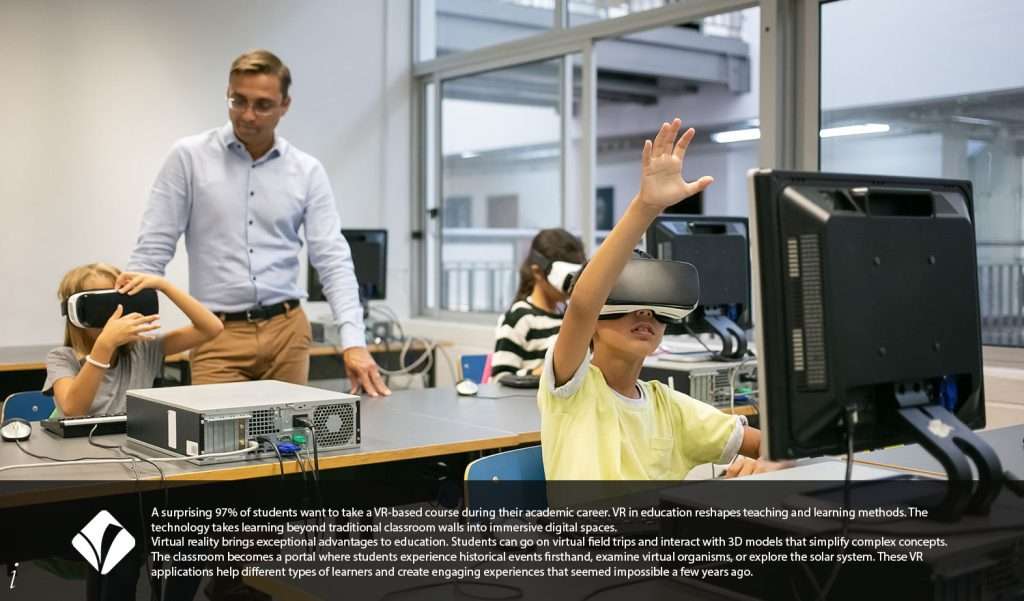
A surprising 97% of students want to take a VR-based course during their academic career. VR in education reshapes teaching and learning methods. The technology takes learning beyond traditional classroom walls into immersive digital spaces.
Virtual reality brings exceptional advantages to education. Students can go on virtual field trips and interact with 3D models that simplify complex concepts. The classroom becomes a portal where students experience historical events firsthand, examine virtual organisms, or explore the solar system. These VR applications help different types of learners and create engaging experiences that seemed impossible a few years ago.
Этот материал демонстрирует, как виртуальная реальность меняет динамику класса и приносит пользу как учащимся, так и преподавателям на успешных примерах из образовательной практики. Технология поддерживает доступность и создает осознанные возможности для обучения. Благодаря этим инновациям студенты лучше準備 (подготовлены) к будущему, ориентированному на технологии.
Переосмысление образовательных пространств
Virtual reality is radically altering how educational spaces work today. Let’s take a closer look at how VR creates learning environments that are way beyond the reach and influence of traditional classroom walls.
Beyond Physical Classroom Limitations
Наша работа с учебными заведениями показывает, что VR в образовательных технологиях беспрецедентным образом стирает географические и временные барьеры. Теперь учащиеся познают мир через опыт, что повышает уровень усвоения знаний на величину до 75%. Аудитории превратились в динамичные пространства, где студенты могут безопасно экспериментировать и учиться на ошибках без реальных рисков.
Creating Interactive Learning Environments
Традиционные методы обучения помогают студентам запомнить лишь 10% того, что они читают, в то время как они сохраняют 90% того, что переживают на собственном опыте. Виртуальная реальность в образовании создает среды, где учащиеся могут:
- Понимание сложных концепций с помощью 3D-моделей
- Безопасное проведение опасных экспериментов
- Learn hands-on without physical limits
- Get customized learning experiences
Virtual Field Trips and Simulations
Virtual field trips (VFTs) have become one of our most powerful tools in VR education. They work especially well because they cost less, take less time, and need minimal planning compared to traditional field trips. These virtual experiences combine various media like text, photographs, podcasts, and interactive simulations.
Виртуальные экскурсии уникальным образом обеспечивают доступ к удаленным или труднодоступным местам. Студенты могут исследовать исторические места, знакомиться с микромиром или путешествовать по космосу, оставаясь в контролируемой и безопасной образовательной среде.
Эти виртуальные пространства делают больше, чем просто визуализируют объекты. Внедрение виртуальной реальности в школах доказывает ее способность повышать успеваемость учащихся, причем результаты экзаменов растут до 20%. Симуляции с использованием виртуальной реальности в образовании позволяют учащимся проводить эксперименты и изучать научные концепции так, как традиционные условия просто не могут обеспечить.
Enhancing Collaborative Learning
VR in education opens new dimensions to collaboration. VR technology creates unique opportunities for students to work together, whatever their physical location.
Виртуальные групповые проекты
Virtual group projects let students work together in ways never seen before. To name just one example, students now work on virtual science experiments and develop vital teamwork skills while contributing different elements. Students from Harvard and Zhejiang University worked on an anthropological project about Egyptian hieroglyphics, which shows how VR eliminates geographical barriers.
Cross-Cultural Connections
Cross-cultural VR in education yields remarkable results. Research shows that immersive virtual reality experiences help students become more culturally sensitive and better at cross-cultural cooperation. VR-based lessons help students:
- Рассмотрение ситуаций с различных культурных точек зрения
- Развитие навыков самопознания и эмпатии
- Handle cross-cultural situations better
- Learn about culture both mentally and emotionally
Социальное обучение в виртуальной реальности
VR’s role in developing social competence shows great promise. A newer study, published in, shows that VR-assisted social competence education helps children develop social skills better than traditional learning methods. Students can practice social interactions in a safe, controlled environment and apply their learning to real-life situations.
VR creates realistic scenarios that feel authentic, which makes it perfect for social learning. Students experience a genuine sense of presence in virtual environments that improves their learning experience. This immersive quality helps develop important social skills, and studies show better social competencies and perceived social support.
VR in education technology creates opportunities for students to take part in meaningful shared experiences that traditional settings cannot offer. It helps build teamwork skills and cultural understanding that students need in today’s connected world.
Accessibility and Inclusion
VR in education has transformed the way we create inclusive learning environments. The technology brings unique advantages that help students with different learning needs and abilities.
Supporting Special Educational Needs
VR creates safe, controlled environments where students with disabilities can practice life skills. Students with autism benefit from VR simulations that help them handle sensory overload through distraction-free learning spaces. VR lets students practice job interviews and direct themselves through public spaces on their own. This builds vital life skills in a supportive setting.
Breaking Geographic Barriers
VR removes traditional education roadblocks. Virtual field trips are now available to everyone, no matter their physical, financial, or logistical limits. Here’s what we found:
- Студенты могут ощутить невозможное (исследование космоса, подводные экосистемы)
- Budget-friendly alternatives replace expensive field trips
- Every student gets the same learning opportunities
- Students explore dangerous environments safely
Customizable Learning Experiences
Виртуальная реальность хорошо адаптируется к учебным потребностям каждого студента. Преподаватели используют актуальный анализ данных для отслеживания успеваемости студентов и корректировки процесса обучения. Студенты учатся в собственном темпе и в удобном стиле, что создает индивидуальную образовательную траекторию.
VR in education works well because it engages multiple senses. Haptic feedback devices help visually impaired students interact with virtual objects. Students who struggle with attention find focused learning spaces that keep them involved while reducing distractions.
Special education programs show better social skills among students who use VR compared to traditional methods. Students practice scenarios repeatedly, and teachers adjust these based on individual progress. This creates consistent learning opportunities in a controlled setting.
Schools report that VR technology removes physical and cognitive barriers that once stymied learning experiences. Students now have equal access to educational content, whatever their physical abilities or location. This creates inclusive educational spaces that work for everyone.
Измерение влияния на образование
VR in education does more than just deliver content – it lets us measure and analyze learning in ways we never could before. Our work with VR technology has given us an explanation of how students learn and involve themselves with educational materials.
Аналитика обучения на основе данных
VR learning environments create massive amounts of educational data that helps us understand student learning patterns. Research shows learning value stands out as the strongest predictor of students’ behavioral intention to use VR technology. These environments give us a unique chance to collect and analyze student interactions, which helps us understand learning patterns at a deeper level.
Student Progress Tracking
Виртуальная реальность в образовании помогла многим создать полноценные системы отслеживания вовлеченности учащихся. Больше всего в платформах виртуальной реальности мне нравится их способность отслеживать:
- Продолжительность и частота взаимодействия со студентами
- Interactive element usage
- Help-seeking patterns
- Focus areas and attention spans
- Performance metrics across different tasks
The data reveals something exciting – there’s a strong positive correlation (0.525) between students’ concentration levels and their final performance scores. VR offers more precise tracking than traditional e-learning because students can’t multitask or get distracted by outside factors.
Пведенческая оценка
Behavioral assessments have shown interesting patterns in student interactions with VR environments. Research points to high-performing students showing distinct behavioral patterns, especially when they verify their ideas after problem-solving.
VR assessment stands out because it measures what students actually do rather than what they say, which paints a more accurate picture of their abilities. Our scoring metrics merge with game tasks naturally. This allows us to assess student performance without interrupting their learning experience.
The Health Point (HP) system we created now simulates ground consequences of decisions without putting students at risk, which gives valuable feedback about their practical skills and decision-making.
Future-Ready Education
Looking ahead at the future of virtual reality in education, we’re seeing groundbreaking developments that are reshaping how we think about learning spaces. Research and implementation experiences have revealed exciting possibilities that extend far beyond current applications.
Новые технологии виртуальной реальности
We’re witnessing significant advancements in VR technology that are making it more available and effective for educational purposes. Data shows that students using VR for learning achieve an average final test score of 85, compared to 78 in traditional in-person settings. These improvements are particularly notable in subjects requiring complex visualization and hands-on experience.
Integration with AI and Machine Learning
Сочетание технологий виртуальной и дополненной реальности открывает новые мощные возможности обучения. Мы выделили несколько ключевых аспектов:
- Ethical implications of AI chatbots in educational settings
- Need for proper instructor training and support
- Development of clear evaluation criteria
- Protection of student data privacy
We’ve observed that deep learning models are particularly effective when combined with VR technology, allowing us to create more intuitive and responsive learning environments. Our implementation shows that AI can analyze student interactions in real-time, providing personalized feedback and adjusting content delivery methods based on individual learning patterns.
Preparing for the Metaverse
We’re actively learning the educational potential of the metaverse, which represents the next rise of virtual learning environments. By implementing metaverse technologies, we’ve seen remarkable results at institutions like Japan’s N and S high schools, where more than 6,000 students are already learning in VR environments.
What makes this particularly exciting is the potential for breaking down traditional barriers. We’ve found that virtual environments can help students with specific challenges, such as those with agoraphobia and PTSD, who report feeling more comfortable participating in virtual classrooms.
Смотреть


Know people who should read this? Become an Ambassador or write with Risalat.
Партнеры в успехе проектов с 2011 года: диагностика, консультационная поддержка и прикладное обучение для министерств, государственных ведомств и проектных команд.
Нужна помощь, чтобы применить это на практике?
Начните с бесплатной 10-минутной диагностики или обратитесь к нашим экспертам.