Ideas clave
- Reimaginando los espacios educativos. La realidad virtual está alterando radicalmente cómo funcionan los espacios educativos hoy en día.
- Enhancing Collaborative Learning. VR in education opens new dimensions to collaboration.
- Accesibilidad e Inclusión. La realidad virtual en la educación ha transformado la forma en que creamos entornos de aprendizaje inclusivos.
- Measuring Educational Impact. VR in education does more than just deliver content – it lets us measure and analyze learning in ways we never could before.
- Educación preparada para el futuro. Mirando hacia el futuro de la realidad virtual en la educación, estamos viendo desarrollos revolucionarios que están transformando la forma en que concebimos los espacios de aprendizaje.
En resumen: La RV en la educación transforma los métodos de enseñanza y aprendizaje, ofreciendo experiencias inmersivas más allá de las paredes del aula.
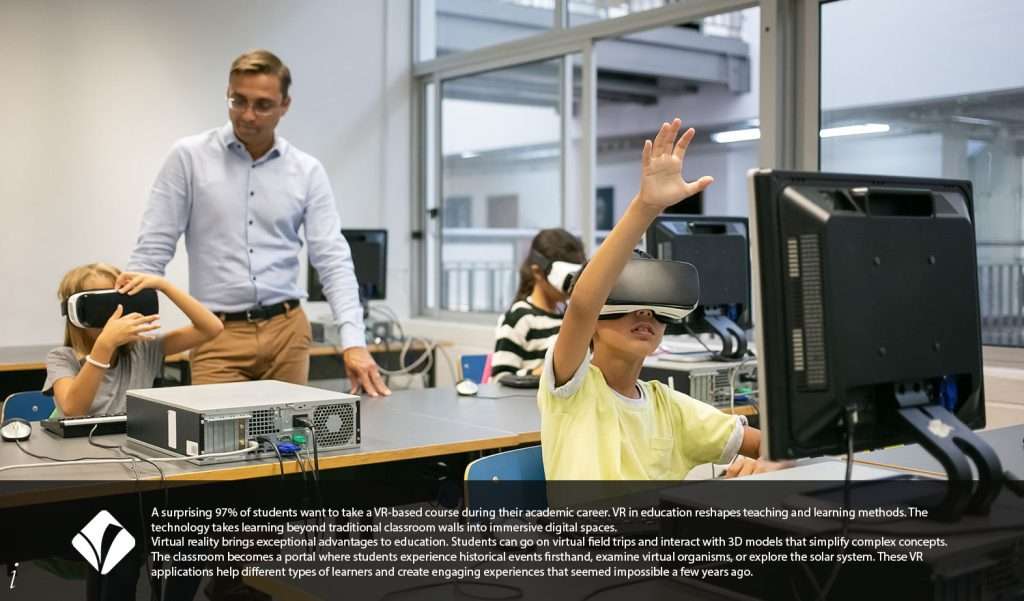
A surprising 97% of students want to take a VR-based course during their academic career. VR in education reshapes teaching and learning methods. The technology takes learning beyond traditional classroom walls into immersive digital spaces.
Virtual reality brings exceptional advantages to education. Students can go on virtual field trips and interact with 3D models that simplify complex concepts. The classroom becomes a portal where students experience historical events firsthand, examine virtual organisms, or explore the solar system. These VR applications help different types of learners and create engaging experiences that seemed impossible a few years ago.
Este artículo muestra cómo la realidad virtual cambia la dinámica del aula y beneficia tanto a los estudiantes como a los profesores a través de ejemplos reales exitosos en entornos educativos. La tecnología apoya la accesibilidad y crea oportunidades de aprendizaje informadas. Los estudiantes se preparan mejor para un futuro impulsado por la tecnología a través de estas innovaciones.
Reimaginando los espacios educativos
Virtual reality is radically altering how educational spaces work today. Let’s take a closer look at how VR creates learning environments that are way beyond the reach and influence of traditional classroom walls.
Beyond Physical Classroom Limitations
Our work with educational institutions shows that VR in education technology breaks down geographical and time barriers in unprecedented ways. Students learn through experience now, which increases knowledge retention by up to 75%. Classrooms have become dynamic spaces where students can experiment safely and learn from mistakes without real-life risks.
Creating Interactive Learning Environments
Los métodos de aprendizaje tradicional ayudan a los estudiantes a recordar solo el 10% de lo que leen, pero retienen el 90% de lo que experimentan. La realidad virtual en la educación crea entornos donde los estudiantes pueden:
- Comprender conceptos complejos a través de modelos 3D
- Realizar experimentos peligrosos de forma segura
- Learn hands-on without physical limits
- Get customized learning experiences
Virtual Field Trips and Simulations
Virtual field trips (VFTs) have become one of our most powerful tools in VR education. They work especially well because they cost less, take less time, and need minimal planning compared to traditional field trips. These virtual experiences combine various media like text, photographs, podcasts, and interactive simulations.
Las visitas virtuales brillan de manera única al proporcionar acceso a ubicaciones lejanas o inaccesibles. Los estudiantes pueden explorar sitios históricos, ver mundos microscópicos o viajar por el espacio exterior mientras permanecen en un entorno de aprendizaje controlado y seguro.
These virtual spaces do more than just show things. VR implementation in schools proves it can boost student performance, with exam scores rising up to 20%. VR in education simulations lets students conduct experiments and explore scientific concepts in ways that traditional settings simply cannot match.
Enhancing Collaborative Learning
VR in education opens new dimensions to collaboration. VR technology creates unique opportunities for students to work together, whatever their physical location.
Virtual Group Projects
Virtual group projects let students work together in ways never seen before. To name just one example, students now work on virtual science experiments and develop vital teamwork skills while contributing different elements. Students from Harvard and Zhejiang University worked on an anthropological project about Egyptian hieroglyphics, which shows how VR eliminates geographical barriers.
Cross-Cultural Connections
Cross-cultural VR in education yields remarkable results. Research shows that immersive virtual reality experiences help students become more culturally sensitive and better at cross-cultural cooperation. VR-based lessons help students:
- See situations from different cultural viewpoints
- Desarrollar la autoconciencia y habilidades de empatía
- Handle cross-cultural situations better
- Learn about culture both mentally and emotionally
Aprendizaje social en RV
VR’s role in developing social competence shows great promise. A newer study, published in, shows that VR-assisted social competence education helps children develop social skills better than traditional learning methods. Students can practice social interactions in a safe, controlled environment and apply their learning to real-life situations.
VR creates realistic scenarios that feel authentic, which makes it perfect for social learning. Students experience a genuine sense of presence in virtual environments that improves their learning experience. This immersive quality helps develop important social skills, and studies show better social competencies and perceived social support.
VR in education technology creates opportunities for students to take part in meaningful shared experiences that traditional settings cannot offer. It helps build teamwork skills and cultural understanding that students need in today’s connected world.
Accessibility and Inclusion
VR in education has transformed the way we create inclusive learning environments. The technology brings unique advantages that help students with different learning needs and abilities.
Supporting Special Educational Needs
VR creates safe, controlled environments where students with disabilities can practice life skills. Students with autism benefit from VR simulations that help them handle sensory overload through distraction-free learning spaces. VR lets students practice job interviews and direct themselves through public spaces on their own. This builds vital life skills in a supportive setting.
Breaking Geographic Barriers
VR removes traditional education roadblocks. Virtual field trips are now available to everyone, no matter their physical, financial, or logistical limits. Here’s what we found:
- Los estudiantes pueden experimentar lo imposible (exploración espacial, ecosistemas submarinos)
- Budget-friendly alternatives replace expensive field trips
- Every student gets the same learning opportunities
- Students explore dangerous environments safely
Customizable Learning Experiences
VR adapts well to each student’s learning needs. Teachers use up-to-the-minute data analysis to track student progress and adjust their teaching. Students learn at their own pace and style, which creates a customized educational journey.
VR in education works well because it engages multiple senses. Haptic feedback devices help visually impaired students interact with virtual objects. Students who struggle with attention find focused learning spaces that keep them involved while reducing distractions.
Special education programs show better social skills among students who use VR compared to traditional methods. Students practice scenarios repeatedly, and teachers adjust these based on individual progress. This creates consistent learning opportunities in a controlled setting.
Schools report that VR technology removes physical and cognitive barriers that once stymied learning experiences. Students now have equal access to educational content, whatever their physical abilities or location. This creates inclusive educational spaces that work for everyone.
Medición del impacto educativo
VR in education does more than just deliver content – it lets us measure and analyze learning in ways we never could before. Our work with VR technology has given us an explanation of how students learn and involve themselves with educational materials.
Data-Driven Learning Analytics
VR learning environments create massive amounts of educational data that helps us understand student learning patterns. Research shows learning value stands out as the strongest predictor of students’ behavioral intention to use VR technology. These environments give us a unique chance to collect and analyze student interactions, which helps us understand learning patterns at a deeper level.
Student Progress Tracking
La realidad virtual en la educación ha ayudado a muchos a construir sistemas de seguimiento completos que observan cómo interactúan los estudiantes. El tipo de cosas que me encantan de las plataformas de realidad virtual es su capacidad para rastrear:
- Duración y frecuencia de la participación de los estudiantes
- Interactive element usage
- Help-seeking patterns
- Focus areas and attention spans
- Performance metrics across different tasks
The data reveals something exciting – there’s a strong positive correlation (0.525) between students’ concentration levels and their final performance scores. VR offers more precise tracking than traditional e-learning because students can’t multitask or get distracted by outside factors.
Evaluación conductual
Behavioral assessments have shown interesting patterns in student interactions with VR environments. Research points to high-performing students showing distinct behavioral patterns, especially when they verify their ideas after problem-solving.
VR assessment stands out because it measures what students actually do rather than what they say, which paints a more accurate picture of their abilities. Our scoring metrics merge with game tasks naturally. This allows us to assess student performance without interrupting their learning experience.
The Health Point (HP) system we created now simulates ground consequences of decisions without putting students at risk, which gives valuable feedback about their practical skills and decision-making.
Future-Ready Education
Looking ahead at the future of virtual reality in education, we’re seeing groundbreaking developments that are reshaping how we think about learning spaces. Research and implementation experiences have revealed exciting possibilities that extend far beyond current applications.
Tecnologías de realidad virtual emergentes
We’re witnessing significant advancements in VR technology that are making it more available and effective for educational purposes. Data shows that students using VR for learning achieve an average final test score of 85, compared to 78 in traditional in-person settings. These improvements are particularly notable in subjects requiring complex visualization and hands-on experience.
Integration with AI and Machine Learning
La combinación de tecnologías de realidad virtual y realidad aumentada crea nuevas y potentes posibilidades de aprendizaje. Hemos identificado varias consideraciones clave:
- Ethical implications of AI chatbots in educational settings
- Need for proper instructor training and support
- Development of clear evaluation criteria
- Protection of student data privacy
We’ve observed that deep learning models are particularly effective when combined with VR technology, allowing us to create more intuitive and responsive learning environments. Our implementation shows that AI can analyze student interactions in real-time, providing personalized feedback and adjusting content delivery methods based on individual learning patterns.
Preparing for the Metaverse
We’re actively learning the educational potential of the metaverse, which represents the next rise of virtual learning environments. By implementing metaverse technologies, we’ve seen remarkable results at institutions like Japan’s N and S high schools, where more than 6,000 students are already learning in VR environments.
What makes this particularly exciting is the potential for breaking down traditional barriers. We’ve found that virtual environments can help students with specific challenges, such as those with agoraphobia and PTSD, who report feeling more comfortable participating in virtual classrooms.
Ver


Know people who should read this? Become an Ambassador or write with Risalat.
Socios para el éxito de los proyectos desde 2011: diagnósticos, asesoría y aprendizaje aplicado para ministerios, organismos públicos y equipos de proyecto.
¿Necesita ayuda para llevar esto a la práctica?
Empiece con un diagnóstico gratuito de 10 minutos o hable con nuestros expertos.