Programme Introduction
Macroeconomic forecasting has long been an essential tool for policymakers, investors, and business leaders to anticipate economic conditions and make informed decisions. However, the traditional models of forecasting have often been criticized for their limitations, including the inability to accurately predict economic downturns or the impact of unprecedented global events. The latest developments in Artificial Intelligence (AI) are set to revolutionize this field by enhancing the accuracy, efficiency, and scope of macroeconomic predictions.
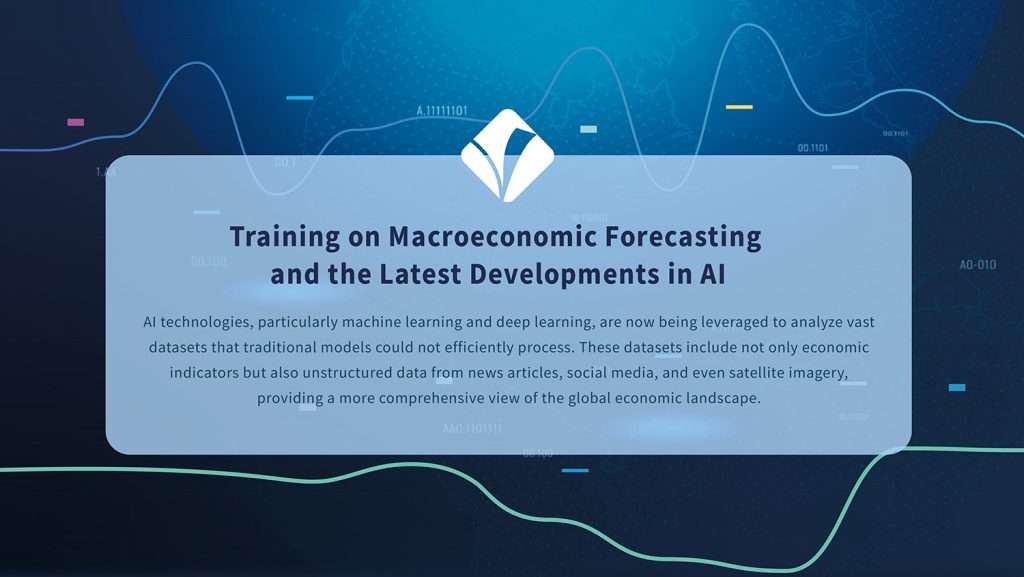
AI technologies, particularly machine learning and deep learning, are now being leveraged to analyze vast datasets that traditional models could not efficiently process. These datasets include not only economic indicators but also unstructured data from news articles, social media, and even satellite imagery, providing a more comprehensive view of the global economic landscape. By identifying patterns and correlations within this data, AI algorithms can forecast economic trends and potential disruptions with a higher degree of precision.
Moreover, AI-driven models are capable of continuous learning, meaning they can adapt to new information and changing conditions in real-time. This adaptability is crucial in today’s fast-paced and interconnected world, where economic dynamics are influenced by a complex web of factors. For instance, AI can quickly assess the potential macroeconomic impacts of sudden geopolitical events or shifts in consumer behavior, enabling more responsive policy-making and strategic planning.
Target Audience
This applied training programme would be highly beneficial for:
- Economists and financial analysts
- Data Scientists and AI specialists
- Business leaders
- Policy makers
- Academics and researchers
Programme Objectives
Upon the successful completion of this training programme, its delegates will be able to:
- Demonstrate a foundational understanding of key macroeconomic indicators
- Form a solid comprehension of AI and machine learning concepts applied to macroeconomic forecasting
- Understand how AI and ML can be applied to forecast macroeconomic variables and trends
- Build, train, and evaluate AI models for macroeconomic forecasting
- Develop and validate AI models using a variety of tools and platforms
- Interpret the outputs of AI models and effectively communicate the results to stakeholders
Programme Contents
First Day
- Introduction to AI, Machine Learning, and Data Science
- The role of AI in policy and governance
- High-Dimensional Modeling Techniques
- Impact of Big Data and Financial Analytics on Financial Services Sector
- Random Forests, Boosting, and Ensemble Techniques
- Mixed Frequency Data Analysis
Second Day
- Recent Advances in FAR and FAVAR Models
- Advanced Machine Learning for Forecasting
- DSGE Approach in a Data-Rich Environment
- Forecasting Models on Non-traditional or Alternative Data
- Methods for integrating and analyzing alternative data
- Practical application of neural networks in economic forecasting
Third Day
- Key Aspects of Big Data Strategy: Data, Identification, Learning techniques, Modelling, Tools, Capability & Adaptation
- Implementing Data Governance Standards
- Model Interpretability and Evaluation
- Organization of an Integrated Forecasting Process
- AI policy frameworks and guidelines
- AI-Powered decision support systems
Fourth Day
- Effective Big Data Strategy
- Big Data Projects Framework
- Acquiring Data from right sources
- Building human resource capabilities for Data Analytics; choosing the right talent pool
- High-dimensional regression: Autoencoder, Elastic Net, Lasso, Ridge, PCA
- Interpreting Machine Learning Predictions
Fifth Day
- Machine Learning Transparency and Documentation
- Cybersecurity
- Financial Services of Future
- Solving Finance Tasks through Big Data/Machine Learning
- Practical application of Python
- Implementation of a DSGE model in MATLAB
Programme Methodology
Methodology applied throughout this training is aligned with contemporary adult-learning principles and best practices. It focuses on the development of foundational skills for macroeconomic forecasting drawing on economic theory, statistical analysis, AI capabilities, and applied data science. Open presentation, group discussions, and scenario analysis are supplemented by individual assignments, lab work, and hands-on simulations.
£5,980 per participant · invoice and bank transfer · groups of 5 or more receive a discount
Five or more from one organisation: ask for the group rate on the invoice request.
Ten or more: an in-house version for your institution may cost less per person. Ask for an in-house quote.
Registration closes in 98 days (24 Jan 2027)
Host Country Profile
Hong Kong has been successful in embracing these technologies because of government support, regulatory support, fintech initiatives, AI adoption, tech infrastructure, skill development, international collaboration, cybersecurity and data privacy, and education and research collaboration.
Google has been a key partner in advancing Hong Kong’s economic development and growth with its digital innovations, especially its AI-powered products and solutions. Digitalization and AI adoption can also help to future-proof and fortify a vital pillar of Hong Kong’s economy – exports. Among various benefits, this can be done by creating new digital solutions that can be exported and by using AI technology to reduce the cost of accessing new overseas markets.