Programme Overview
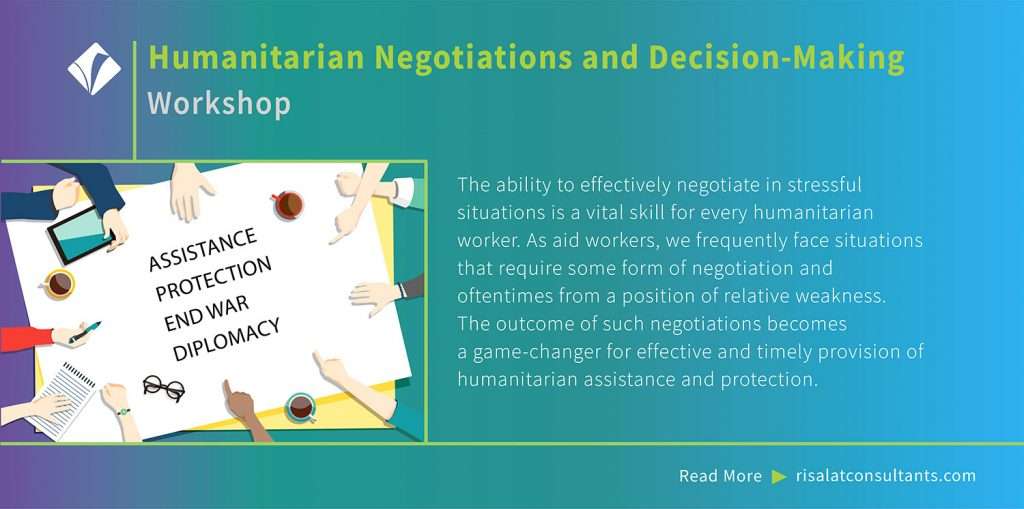
The ability to effectively negotiate in stressful situations is a vital skill for every humanitarian worker. As aid workers, we frequently face situations that require some form of negotiation and oftentimes from a position of relative weakness. The outcome of such negotiations becomes a game-changer for effective and timely provision of humanitarian assistance and protection. Volatile contexts, short time, and limited power to exert influence on the parties – these are the characteristics that make humanitarian negotiations unique.
Training on Humanitarian Negotiations and Decision-Making in Rotterdam, Netherlands has been designed to target the improvement in individual and organizational negotiation skills. We actively work to equip participants with a set of practical tools, methods, and skills that help them analyze the environment where the humanitarian negotiation takes place and build the strategy for achieving desired objectives.
Target Audience
This Training Programme is specifically aimed at humanitarian professionals that are involved in negotiations for access, assistance, and protection with government authorities, military personnel, armed groups, and civilians in conflict and emergency settings.
Tick what your team needs to be able to do.
Programme Objectives
Upon the successful completion of this Training Course, participants will be able to:
- Improve interpersonal, communication, and diplomatic skills
- Master advocacy tools and techniques
- Learn how to negotiate the best agreement from the position of relative weakness
- Lead and participate in negotiations in humanitarian and protection contexts
- Effectively analyze negotiating environment and build negotiation strategies under time-stress
- Comprehend the peculiarities of humanitarian negotiations with governments, military, armed groups, donors, and civilians
Programme Contents
- Understanding Humanitarian Negotiations and accompanying challenges
- Humanitarian Negotiations and International Humanitarian Law
- Different modes of Negotiation
- Characteristics of humanitarian engagement and negotiations with armed groups
- Characteristics of humanitarian negotiations with government authorities
- Humanitarian Negotiations with Donors
- Defining the motivation for negotiation
- Setting Negotiation Objectives
- Partners in humanitarian negotiations
- Interests, Position, and Power in humanitarian negotiations
- Stress and Time-Pressure in Humanitarian Negotiations
- Assessing Leverage
- Diplomacy in Humanitarian Negotiations
- Personal Negotiation Styles
- Face-to-face negotiation: Building relationship
- Managing cultural differences
- Language and Interpreters
- Airport Pickup & Welcome Assistance
- Accommodation with Breakfast for the full duration
- Welcome Dinner for networking and connecting with fellow Participants & the Risalat Team
- Risalat Training Kit, including: bag, water bottle, coffee mug, t-shirt, cap, passport cover, pens, notebook, magnet, keychain
- Lunch Provided Daily during training days
- Comprehensive Course Manual & Training Materials
Full day-by-day contents
First Day
- Understanding Humanitarian Negotiations and accompanying challenges
- Humanitarian Negotiations and International Humanitarian Law
- Different modes of Negotiation
- Characteristics of humanitarian engagement and negotiations with armed groups
- Characteristics of humanitarian negotiations with government authorities
- Humanitarian Negotiations with Donors
- Humanitarian Negotiations with Civilians
- Multi-Party Humanitarian Negotiations
Second Day
- Defining the motivation for negotiation
- Setting Negotiation Objectives
- Partners in humanitarian negotiations
- Interests, Position, and Power in humanitarian negotiations
- Stress and Time-Pressure in Humanitarian Negotiations
- Assessing Leverage
- Maximizing Compatibility and Leverage
- Selecting Start point and approach
- Selecting the right tactics and defining arguments
Third Day
- Diplomacy in Humanitarian Negotiations
- Personal Negotiation Styles
- Face-to-face negotiation:
- Building relationship
- Managing cultural differences
- Language and Interpreters
- Dealing with Failure in Negotiation
- Following through the negotiation
Fourth Day – Peer-to-peer workshop
The last day of the Training will entirely be dedicated to hands-on practice and knowledge exchange. Participants will be requested to prepare specific scenarios from their work experience and discuss the negotiation options with the team. The consultants shall also present multiple complex scenarios and ask the delegates to find solutions during the group work. Upon the completion of these activities, the group shall come up with some suggestions on best practices in humanitarian negotiations.
Programme Methodology
Humanitarian Negotiations and Decision-Making is a highly interactive Training in Holland with particular emphasis on knowledge exchange. The presenter shall use proven adult-learning techniques to facilitate the conversation between the delegates. Several case studies and scenarios will be discussed. The participants will have an opportunity to engage in real-life simulations where they can practice communication skills and work on personal negotiation styles.
Course Deliverables
Participants will enjoy a full-service experience that covers everything needed before, during, and after the programme:
Before the Programme
- Participant Pre-Assessment to ensure effective preparation
- Complimentary Visa Support & Advisory (E-visa applications are fully processed by our team)
During the Programme
- Airport Pickup & Welcome Assistance
- Accommodation with Breakfast for the full duration
- Welcome Dinner for networking and connecting with fellow Participants & the Risalat Team
- Risalat Training Kit, including: bag, water bottle, coffee mug, t-shirt, cap, passport cover, pens, notebook, magnet, keychain
- Lunch Provided Daily during training days
- Comprehensive Course Manual & Training Materials
- Project-Based Templates, Tools, and Worksheets
- Mini Pad / Tablet for convenient access to digital resources
- Digital Case Studies, Reading Packs & Reference Materials
- Access to Sample Datasets & Practical Exercises
- Field Visit (where applicable)
- Complimentary Refreshments & Full Training Venue Facilities
- Access to Online Learning Resources
- Entertaining City Tour
- Certificate of Completion
- Risalat Programme Participation Recognition Award
After the Programme
- Post-Training Support & Follow-Up Guidance
- Programme Report
£3,950 per participant · invoice and bank transfer · groups of 5 or more receive a discount
Five or more from one organisation: ask for the group rate on the invoice request.
Ten or more: an in-house version for your institution may cost less per person. Ask for an in-house quote.
Registration closes in 5 days (23 Oct 2026)