Key facts
- Dates
- 8–12 Feb 2027 (5 days)
- Where
- TBD, Amman, Jordan
- Fee per participant
- £4,560 (GBP)
- Payment
- By invoice and bank transfer
- Registration closes
- 30 Dec 2026
- Certificate
- Certificate of completion
- In-house option
- Run it for your team, on your dates
On this page 15 sections
Programme Overview
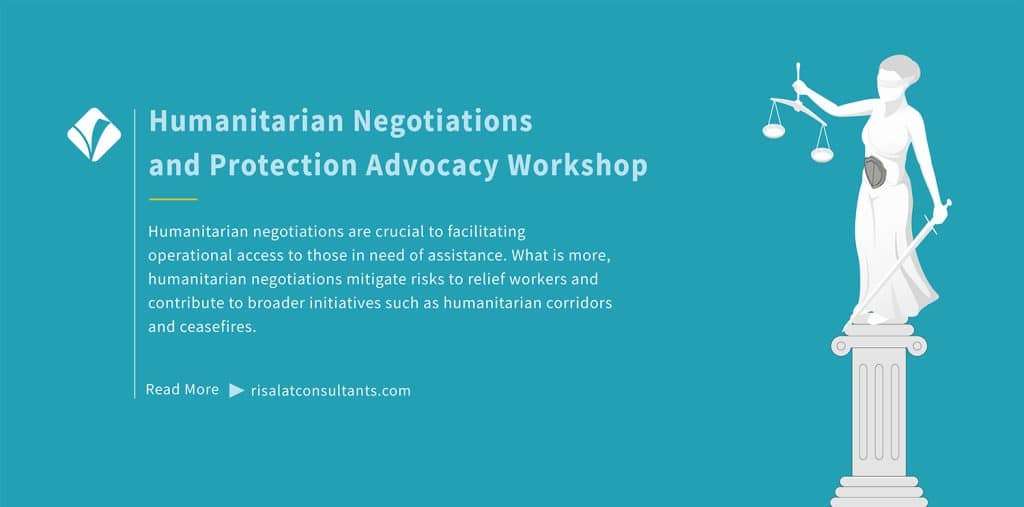
Contemporary humanitarian organizations work in an increasingly complex environment. Escalated armed conflicts, severe political instability, and natural and man-made disasters make daily operations extremely challenging. Worldwide nearly 60 million people live in the areas controlled by non-state armed groups, frequently with extreme access constraints. Thereby, humanitarian negotiations are crucial to facilitating operational access to those in need of assistance. What is more, humanitarian negotiations mitigate risks to relief workers and contribute to broader initiatives such as humanitarian corridors and ceasefires. This Training has exclusively been designed by Risalat to equip aid workers with the fundamental knowledge required for conducting effective Humanitarian Negotiations and Protection Advocacy (HNPA). It empowers delegates to facilitate collaboration, ethically approach humanitarian dilemmas, and advocate for the protection of the rights of affected populations.
Upon the successful completion of this Training Programme, its delegates are expected to: Host Country Profile Hosting large numbers of refugees, relief organizations in Jordan heavily rely on humanitarian negotiations to ensure the delivery of aid, protect vulnerable populations, and address the needs of affected communities. The country’s humanitarian community is very large and diverse with various actors operating including UN agencies, NGOs, regional organizations, refugee communities, CSOs, and the Jordanian government. They have accumulated substantial knowledge of humanitarian negotiations and protection advocacy both at national and international levels.
Delivered by Risalat Consultants International in Amman, Jordan, it combines expert-led sessions, real cases and group work, so that participants can apply what they learn in their own institution.
The Programme Strengthens Institutional Capability
- Understanding humanitarian negotiations
- Contextual analysis
- Conflict dynamics, power structures, and actors involved
- Risks and opportunities for negotiation
- The role of international humanitarian law in humanitarian negotiations
- Human rights and humanitarian negotiation
- A principled approach to negotiation
- Building trust and rapport with the parties to the conflict
- Strategic thinking and direction setting
- Leading and developing teams
- Decision making and problem solving
- Communication and influence
It is designed for directors and senior managers, heads of department and unit, middle managers and team leaders and others who want practical, current skills in leadership, management and communication.
The Growing Importance of Humanitarian Negotiations and Protection Advocacy
Institutions change faster than ever: new policies, technologies and expectations from citizens and partners. Leaders and managers who can set direction, build teams and manage change make the difference between plans and results.
Strong leadership is a set of practical skills: deciding, communicating, negotiating, developing people and leading change. These skills can be learnt and improved with practice and feedback.
Organisations increasingly require professionals capable of:
- Set clear direction and priorities
- Lead and motivate teams through change
- Communicate and negotiate effectively
- Manage performance fairly
- Make sound decisions under pressure
Strong leadership, management and communication systems help organisations:
- Turn strategies into results
- Build motivated, capable teams
- Manage change with less resistance
- Improve relations with partners and stakeholders
This Humanitarian Negotiations and Protection Advocacy programme brings these elements together in a practical format, so that participants understand not only what good practice looks like but also how to introduce it in their own setting, with the people and resources they have.
Who Should Attend This Humanitarian Negotiations and Protection Advocacy Training?
This programme is designed for:
- Directors and senior managers
- Heads of department and unit
- Middle managers and team leaders
- Project and programme managers
- HR and organisational development staff
- Staff preparing for leadership roles
- Women leaders and emerging leaders
- Board members
- NGO leaders
- Business owners and managers
The programme suits experienced professionals as well as those moving into new responsibilities. Groups that mix institutions and countries are encouraged, because participants learn a great deal from each other’s experience.
Tick what your team needs to be able to do.
Humanitarian Negotiations and Protection Advocacy Training Objectives
Upon successful completion of this Humanitarian Negotiations and Protection Advocacy Training, participants will be able to:
- Explain current approaches to leadership in public and private institutions
- Set direction and priorities for their team
- Lead, motivate and develop people
- Make decisions using structured methods
- Communicate clearly and influence others
- Negotiate and manage conflict
- Plan and lead change
- Manage performance fairly
- Prepare a personal leadership development plan
Each objective is practised during the programme through exercises, cases or group work, so that participants leave able to do it, not only to describe it.
Programme Contents and Structure
- Understanding humanitarian negotiations
- Contextual analysis
- Conflict dynamics, power structures, and actors involved
- Risks and opportunities for negotiation
- The role of international humanitarian law in humanitarian negotiations
- Human rights and humanitarian negotiation
- A principled approach to negotiation
- Building trust and rapport with the parties to the conflict
- Effective communication skills for humanitarian negotiations
- Active listening
- Understanding the importance and scope of protection advocacy
- Tools for vulnerability assessment
- Protection needs of different groups
- Developing advocacy objectives and messaging
- Advocacy techniques: lobbying, campaigning, media engagement
- Ethical considerations in protection advocacy
- Conflict sensitivity during humanitarian negotiation and protection advocacy
- The broader role of humanitarian negotiations in forming humanitarian corridors and contributing to a ceasefire
- Simulation/role play on the negotiation of access to affected populations.
- Analysis of humanitarian negotiation and protection advocacy success stories.
- Practical exercise on developing M&E framework for humanitarian negotiation and protection advocacy efforts.
- Panel discussion with guest speakers from partner humanitarian organizations engaged in humanitarian negotiations.
- Planning and leading change
- Managing resistance
- Personal effectiveness and wellbeing
- Sustaining results
- Personal leadership development plan
Full day-by-day contents
The programme runs over 5 days. Each day combines expert input, practical work and a closing workshop or case study:
- First Day: Understanding humanitarian negotiations, Contextual analysis
- Second Day: A principled approach
- Third Day: Developing advocacy objectives and messaging, Advocacy techniques
- Fourth Day: Practical application exercise
- Fifth Day: Leading change and action planning
Full day-by-day contents
First Day | Understanding humanitarian negotiations, Contextual analysis
- Understanding humanitarian negotiations
- Contextual analysis
- Conflict dynamics, power structures, and actors involved
- Risks and opportunities for negotiation
- The role of international humanitarian law in humanitarian negotiations
- Human rights and humanitarian negotiation
Workshop: Understanding humanitarian negotiations, Contextual analysis: Applying It to Your Institution
Working in small groups, participants apply the day's methods to examples from their own institutions and agree practical next steps.
Second Day | A principled approach
- A principled approach to negotiation
- Building trust and rapport with the parties to the conflict
- Effective communication skills for humanitarian negotiations
- Active listening
- Understanding the importance and scope of protection advocacy
- Tools for vulnerability assessment
- Protection needs of different groups
Workshop: A principled approach: Applying It to Your Institution
Working in small groups, participants apply the day's methods to examples from their own institutions and agree practical next steps.
Third Day | Developing advocacy objectives and messaging, Advocacy techniques
- Developing advocacy objectives and messaging
- Advocacy techniques: lobbying, campaigning, media engagement
- Ethical considerations in protection advocacy
- Conflict sensitivity during humanitarian negotiation and protection advocacy
- The broader role of humanitarian negotiations in forming humanitarian corridors and contributing to a ceasefire
Case Study: Developing advocacy objectives and messaging, Advocacy techniques in Practice
Participants analyse a realistic case, compare the choices made with good practice and draw lessons they can use in their own setting.
Fourth Day | Practical application exercise
- Simulation/role play on the negotiation of access to affected populations.
- Analysis of humanitarian negotiation and protection advocacy success stories.
- Practical exercise on developing M&E framework for humanitarian negotiation and protection advocacy efforts.
- Panel discussion with guest speakers from partner humanitarian organizations engaged in humanitarian negotiations.
Workshop: Practical application exercise: Applying It to Your Institution
Working in small groups, participants apply the day's methods to examples from their own institutions and agree practical next steps.
Fifth Day | Leading change and action planning
- Planning and leading change
- Managing resistance
- Personal effectiveness and wellbeing
- Sustaining results
- Personal leadership development plan
Capstone Exercise: Humanitarian Negotiations and Protection Advocacy Action Plan for Your Institution
Participants bring the week together in an action plan for their own institution, with priorities, owners and first steps, and present it for feedback from peers and facilitators.
Humanitarian Negotiations and Protection Advocacy Training Methodology
This Humanitarian Negotiations Training and Protection Advocacy Programme has been designed as a skills-building Training Course. It combines various interactive tools in line with adult learning principles and methodology. Open presentations are complemented by group assignments, case studies, role plays, scenario analysis, and panel discussions.
The programme combines:
- Expert-led sessions on current practice
- Regional and international case studies
- Group work and practical exercises
- Simulations and role plays where relevant
- Discussion of participants' own challenges
- Peer learning across institutions and countries
- Practical tools and templates to take back to work
- Daily reflection and action planning
Before the programme, a short pre-assessment helps the facilitators understand each participant’s role and priorities, so that examples and exercises can be adjusted to the group. Each day ends with a short reflection in which participants note what they will apply at work.
Expected Outcomes
Upon completion of this Humanitarian Negotiations and Protection Advocacy Training, participants will be able to:
- Humanitarian practitioners
- Humanitarian negotiators
- Advocates and activists
- Government representatives
- Members of donor organizations
- Community leaders
- CSOs/CBOs
- Set clear direction and priorities
Participants leave with a personal action plan and practical tools they can use in their institution from the first week back. Institutions that send several participants can use the programme to agree shared methods and templates across teams, which makes improvements easier to sustain.
£4,560 per participant · invoice and bank transfer · groups of 5 or more receive a discount
Five or more from one organisation: ask for the group rate on the invoice request.
Ten or more: an in-house version for your institution may cost less per person. Ask for an in-house quote.
Registration closes in 52 days (30 Dec 2026)
Institutional Application of Humanitarian Negotiations and Protection Advocacy Training
This programme supports organisations in strengthening:
- Leadership and management
- Team development
- Change management
- Communication
- Performance management
Participants return with practical tools to improve:
- Team plans
- Coaching
- Change plans
- Stakeholder communication
- Performance reviews
The programme is built so that learning moves from the classroom into the institution. Participants work on their own processes and documents where possible, and leave with an action plan that their managers can review and support.
Regional Relevance & Application
Europe
European institutions apply leadership, management and communication within detailed regulatory frameworks and reform agendas. Participants from Europe can compare their practice with colleagues from other regions and test how established methods work under different conditions.
Africa
Across Africa, ministries, agencies and project teams working in leadership, management and communication increasingly operate alongside donor-financed programmes that expect clear systems and evidence. The programme helps participants adapt good practice to the institutions and resources they work with.
Middle East
In the Middle East, national development strategies and diversification plans place growing demands on leadership, management and communication. Participants explore how to build the capability these plans need inside public bodies and companies.
Asia
Institutions across Asia combine rapid growth with ambitious modernisation programmes. Participants from Asia can share their experience of scaling systems quickly and learn from approaches used elsewhere.
Pacific
Small island and Pacific states face particular constraints of size, distance and capacity. The programme highlights practical, proportionate approaches to leadership, management and communication that suit smaller institutions.
Holding the programme in Amman, Jordan brings participants together away from their daily pressures, so they can compare how leadership, management and communication is handled in different settings. The same programme can also be delivered in-house for one institution, in its own country or online, with cases taken from its current work.
Host Country Profile – Jordan
Programmes, Workshops, Exposures, Training Courses in Amman, Jordan by Risalat Consultants International
Studying away from their own country gives participants time to focus, a fresh view of their own institution and the chance to build a network with colleagues from other countries.
The programme takes place at TBD.
Humanitarian Negotiations and Protection Advocacy Training Deliverables
Participants receive support before, during and after the programme, so that preparation, learning and follow-up form one continuous experience.
Before the Programme
- Participant Pre-Assessment
- Humanitarian Negotiations and Protection Advocacy Readiness Assessment
- Humanitarian Negotiations and Protection Advocacy Resource Pack
- Preparatory Reading Materials
- Complimentary Visa Support & Advisory
During the Programme
- Airport Pickup & Welcome Assistance
- Accommodation with Breakfast
- Welcome Networking Dinner
- Risalat Training Kit (Bag, Bottle, Mug, T-Shirt, Cap, Passport Cover, Pens, Notebook, Magnet & Keychain)
- Comprehensive Humanitarian Negotiations and Protection Advocacy Training Manual
- Leadership Self-Assessment
- Team Development Plan Template
- Change Plan Template
- Negotiation Preparation Sheet
- Practical Workshops & Simulations
- Group Discussions & Peer Learning
- Daily Lunch and Refreshments
- Full Access to Training Venue Facilities
- Mini Pad / Tablet with Digital Learning Materials
- Field Visit (where applicable)
- Entertaining City Tour
After the Programme
- Certificate of Completion
- Risalat Programme Participation Recognition Award
- Post-Training Reference Materials
- Personal Development Plan Template
- Coaching Conversation Guide
- Post-Training Support & Follow-Up Guidance
- Programme Report
Institutions can also request a tailored in-house version of this programme, delivered at their premises or online. Request a proposal.
Common Challenges in Humanitarian Negotiations and Protection Advocacy, And How This Training Helps
How can institutions set clear direction and priorities?
The programme addresses this directly on the first day (Understanding humanitarian negotiations, Contextual analysis), where participants practise the methods involved and adapt them to their own institution, then build it into their action plan.
How can institutions lead and motivate teams through change?
The programme addresses this directly on the second day (A principled approach), where participants practise the methods involved and adapt them to their own institution, then build it into their action plan.
How can institutions communicate and negotiate effectively?
The programme addresses this directly on the third day (Developing advocacy objectives and messaging, Advocacy techniques), where participants practise the methods involved and adapt them to their own institution, then build it into their action plan.
How can institutions manage performance fairly?
The programme addresses this directly on the fourth day (Practical application exercise), where participants practise the methods involved and adapt them to their own institution, then build it into their action plan.
How can institutions make sound decisions under pressure?
The programme addresses this directly on the fifth day (Leading change and action planning), where participants practise the methods involved and adapt them to their own institution, then build it into their action plan.
Frequently Asked Questions
When and where does the Humanitarian Negotiations and Protection Advocacy programme take place?
It runs from 8 Feb 2027 to 12 Feb 2027, in Amman, Jordan (TBD). The registration deadline is shown at the top of this page.
Who should attend?
The programme is designed for directors and senior managers, heads of department and unit, middle managers and team leaders, project and programme managers, and others who want practical skills in leadership, management and communication.
Will I receive a certificate?
Yes. Participants who complete the programme receive a Certificate of Completion from Risalat Consultants International.
Can this programme be delivered for our institution only?
Yes. We can deliver a tailored in-house version at your premises, in another city or online, built around your own cases. Use the proposal request on this page.
Do I need prior experience in leadership, management and communication?
No specialist background is required beyond experience in a related role. A short pre-assessment helps the facilitators adapt the sessions to the group.
Training courses in AmmanHumanitarians training courses
Why Amman for this programme
Amman is a calm base for Middle East delegations and humanitarian topics.
The Humanitarian Negotiations and Protection Advocacy Training programme in February 2027 brings together officials and professionals from across the Middle East region and beyond. Sessions combine short inputs, case studies and group work on participants' own files, and the city's institutions can be added as a study visit on request.
Getting there: Queen Alia (AMM).
Check whether you need a visa with the free Visa Checker, and ask for an invitation letter once you are registered.
The same topic in other cities
- International Humanitarian Law Training in Vancouver (Vancouver)
- Training on Humanitarian Negotiations and Decision-Making (Rotterdam)
- Humanitarian Cooperation and Diplomacy Training in Brussels (Brussels )
Other programmes in Amman
- Strategic Leadership for Senior Government Officials in Amman
- Digital Government and Citizen e-Services Training in Amman
- Social Protection and Cash Transfer Programmes Training in Amman
- Anti-Corruption, Integrity and Asset Declarations Training in Amman
- Humanitarian Logistics and Supply Chain Management Training in Amman
More training courses in Jordan · All programmes in Middle East · Full training calendar