حقائق رئيسية
- المواعيد
- 14–18 يونيو 2027 (5 أيام)
- المكان
- Kobe, Japan
- الرسوم لكل مشارك
- £2,600 (جنيه إسترليني)
- الدفع
- بالفاتورة والتحويل المصرفي
- إغلاق التسجيل
- 5 May 2027
- الصيغة
- 5-day short course: a practical capacity-building programme for government, NGO and project teams in Kobe
- الخيار المؤسسي
- نفّذه لفريقك، في المواعيد التي تناسبك
On this page 10 sections
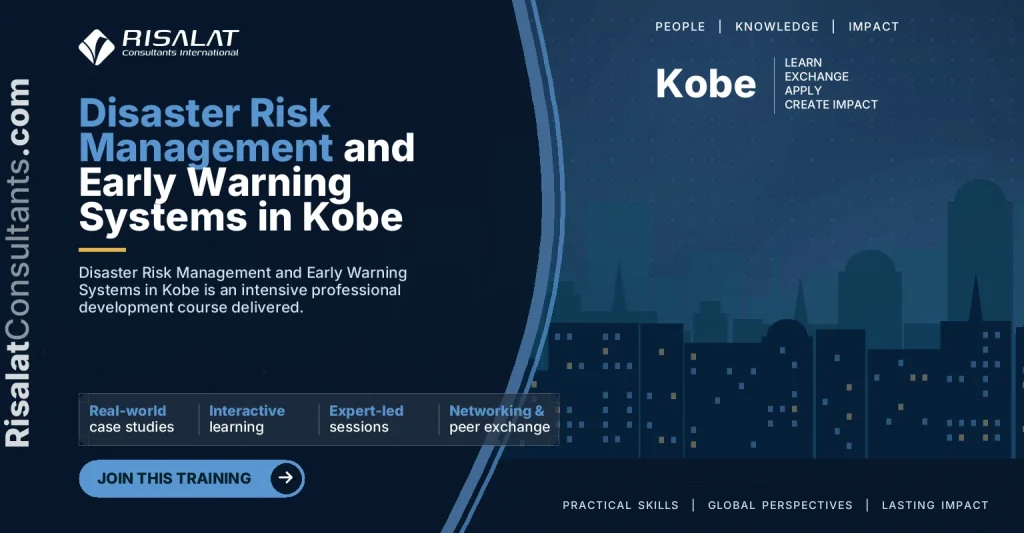
Disaster Risk Management and Early Warning Systems in Kobe
نظرة عامة على البرنامج
Disaster Risk Management and Early Warning Systems in Kobe is an intensive professional development course delivered by Risalat Consultants International. Held in Kobe, the global reference city for the Sendai Framework for Disaster Risk Reduction, this programme equips public sector leaders and project specialists with operational mechanisms to identify, reduce, and manage catastrophic hazards. Participants examine systemic risk reduction, emergency governance, and multi-hazard early warning architecture using practical models drawn directly from Japanese institutions and international standards.
Free self-check: the governance self-audit gives a quick check of governance, controls and accountability, in about 10 minutes.
The programme bridges high-level policy commitments with operational project implementation for donor-financed operations and national investment plans. Designed specifically around frameworks supported by the World Bank, Asian Development Bank, European Union, and United Nations agencies, the course investigates end-to-end early warning systems, resilient infrastructure design, and post-disaster recovery planning. Through technical briefings, analytical exercises, and local infrastructure reviews, delegates gain the competencies required to design and supervise high-integrity disaster management projects across hazard-prone regions.
Participants will analyse how institutional coordination, advanced hydrometeorological forecasting, and community-level action converge to minimise loss of life and economic disruption. By studying Kobe’s transformation since the 1995 Great Hanshin-Awaji Earthquake, the training offers transferable lessons in building back better, urban retrofitting, and cross-sectoral disaster finance. Delegates return to their sponsoring organisations equipped with concrete methods to assess vulnerabilities, strengthen early warning protocols, and maintain project performance under escalating climate and disaster pressures.
يعزز البرنامج القدرات المؤسسية في:
- Analysis of the Sendai Framework for Disaster Risk Reduction 2015-2030 and its four operational priorities
- Probabilistic risk assessment methods, hazard mapping, and exposure modelling for public assets
- Institutional governance arrangements, cross-ministerial coordination, and legal mandates for disaster management
- The Kobe recovery model: institutional mechanisms developed following the 1995 Great Hanshin-Awaji Earthquake
- Group diagnostic: evaluating baseline disaster risk governance within national institutional frameworks
- Architecture of end-to-end Multi-Hazard Early Warning Systems based on WMO standards and guidelines
- Hydrometeorological monitoring, satellite observation, and radar network integration for hazard tracking
- Forecasting, risk analytics, and standard operating procedures for triggering national emergency alerts
- تقييم المخاطر المناخية والبيئية
- التخطيط للتكيف والتخفيف
- الاستراتيجيات القطاعية للطاقة والمياه والأراضي
- تصميم المشاريع لتحقيق الأهداف المناخية والبيئية
Why this matters now
تحتاج المؤسسات بشكل متزايد إلى مهنيين قادرين على:
- تقييم المخاطر المناخية والبيئية على خدماتهم وأصولهم
- تصميم مشاريع تحقق الأهداف المناخية والبيئية
- إعداد مقترحات يمكن للجهات الممولة اعتمادها
- قياس النتائج والإبلاغ عنها بمصداقية
- العمل مع المجتمعات والشركاء عبر القطاعات
تساعد الأنظمة القوية في مجالات المناخ والبيئة والموارد الطبيعية المؤسسات على:
- حماية الخدمات والبنية التحتية من المخاطر المناخية
- الوصول إلى التمويل المناخي والبيئي
- الوفاء بالالتزامات الوطنية والدولية
- استخدام الموارد الطبيعية على نحو مستدام
من ينبغي له الحضور
صُمم هذا البرنامج من أجل:
- Officials from national disaster management agencies and civil defence organisations
- Project directors and procurement officers managing World Bank, ADB, EU, and UN disaster risk operations
- Technical specialists from national meteorological and hydrological services
- Planning and finance ministry officers responsible for disaster risk financing and contingent budgets
- Municipal engineers and urban planners leading resilient infrastructure programmes
- Environment, natural resources, and climate change ministry personnel
- Specialists from river basin authorities, irrigation departments, and coastal protection bodies
- Programme managers from regional intergovernmental bodies and development secretariats
- Emergency response coordinators and public safety operational planners
- موظفو شؤون تغير المناخ والبيئة
- موظفو قطاعات الطاقة والمياه والزراعة
- موظفو التخطيط والسياسات
حدّد ما يحتاج فريقك إلى القدرة على إنجازه.
أهداف البرنامج
بنهاية هذا البرنامج سيتمكن المشاركون من:
- Align national and sectoral risk strategies with the Sendai Framework for Disaster Risk Reduction 2015-2030
- Design end-to-end multi-hazard early warning systems that satisfy the four pillars of the Early Warnings for All initiative
- Formulate institutional contingency plans and standard operating procedures for catastrophic natural hazards
- Structure disaster risk financing mechanisms and contingent recovery portfolios in accordance with multilateral standards
- Integrate ISO 22301 business continuity principles into critical public infrastructure and essential civil services
- Evaluate structural and non-structural urban risk mitigation measures using technical site appraisal methodologies
- Establish community-based last-mile communication channels that ensure timely, inclusive, and actionable disaster alerts
- شرح التحديات المناخية والبيئية الرئيسية في قطاعهم
- تقييم المخاطر المناخية والبيئية على الخدمات والأصول
- التخطيط لتدابير التكيف والتخفيف
Training Structure & Contents
- Analysis of the Sendai Framework for Disaster Risk Reduction 2015-2030 and its four operational priorities
- Probabilistic risk assessment methods, hazard mapping, and exposure modelling for public assets
- Institutional governance arrangements, cross-ministerial coordination, and legal mandates for disaster management
- The Kobe recovery model: institutional mechanisms developed following the 1995 Great Hanshin-Awaji Earthquake
- Group diagnostic: evaluating baseline disaster risk governance within national institutional frameworks
- Workshop: Sendai Framework Implementation, Risk Assessment, and Risk Governance: Applying It to Your Institution
- Architecture of end-to-end Multi-Hazard Early Warning Systems based on WMO standards and guidelines
- Hydrometeorological monitoring, satellite observation, and radar network integration for hazard tracking
- Forecasting, risk analytics, and standard operating procedures for triggering national emergency alerts
- Last-mile warning dissemination protocols, Common Alerting Protocol standards, and telecom engagement
- Simulation exercise: drafting a multi-hazard operational alert protocol for an extreme climate event
- Workshop: Multi-Hazard Early Warning Systems and the Early Warnings for All Architecture: Applying It to Your Institution
- Structural mitigation approaches: seismic retrofitting, coastal seawalls, and river basin flood retention
- Nature-based solutions and non-structural measures for coastal protection and slope stabilisation
- Technical appraisal of Kobe urban disaster prevention facilities and redundant utility systems
- Applying ISO 31000 risk management and ISO 22301 continuity standards to public asset preservation
- Case study review: integrating resilience standards into donor-financed transport and water portfolios
- Case Study: Resilient Infrastructure, Urban Mitigation, and Japanese Engineering Practices in Practice
- Emergency logistics planning, evacuation centre management, and pre-positioned relief supply networks
- Inclusive disaster preparedness incorporating gender, disability, age, and indigenous local knowledge
- Community-Based Disaster Risk Reduction: lessons from Japanese volunteer organisations and neighbourhood groups
- Public communication, managing misinformation during crises, and joint media briefing strategies
- Operational planning exercise: establishing an evacuation and relief distribution chain for isolated islands or valleys
- Workshop: Disaster Preparedness, Evacuation Logistics, and Community-Centred Systems: Applying It to Your Institution
- Disaster risk financing instruments and contingent recovery portfolios
- Post-disaster recovery planning and build back better strategies
- Cross-sectoral disaster finance mechanisms aligned with multilateral standards
- Synthesising Sendai Framework targets and Early Warnings for All priorities
- Action planning: designing bankable disaster risk investment plans and institutional roadmaps
المحتوى الكامل يوماً بيوم
First Day | Sendai Framework Implementation, Risk Assessment, and Risk Governance
- Analysis of the Sendai Framework for Disaster Risk Reduction 2015-2030 and its four operational priorities
- Probabilistic risk assessment methods, hazard mapping, and exposure modelling for public assets
- Institutional governance arrangements, cross-ministerial coordination, and legal mandates for disaster management
- The Kobe recovery model: institutional mechanisms developed following the 1995 Great Hanshin-Awaji Earthquake
- Group diagnostic: evaluating baseline disaster risk governance within national institutional frameworks
- Workshop: Sendai Framework Implementation, Risk Assessment, and Risk Governance: Applying It to Your Institution
Second Day | Multi-Hazard Early Warning Systems and the Early Warnings for All Architecture
- Architecture of end-to-end Multi-Hazard Early Warning Systems based on WMO standards and guidelines
- Hydrometeorological monitoring, satellite observation, and radar network integration for hazard tracking
- Forecasting, risk analytics, and standard operating procedures for triggering national emergency alerts
- Last-mile warning dissemination protocols, Common Alerting Protocol standards, and telecom engagement
- Simulation exercise: drafting a multi-hazard operational alert protocol for an extreme climate event
- Workshop: Multi-Hazard Early Warning Systems and the Early Warnings for All Architecture: Applying It to Your Institution
Third Day | Resilient Infrastructure, Urban Mitigation, and Japanese Engineering Practices
- Structural mitigation approaches: seismic retrofitting, coastal seawalls, and river basin flood retention
- Nature-based solutions and non-structural measures for coastal protection and slope stabilisation
- Technical appraisal of Kobe urban disaster prevention facilities and redundant utility systems
- Applying ISO 31000 risk management and ISO 22301 continuity standards to public asset preservation
- Case study review: integrating resilience standards into donor-financed transport and water portfolios
- Case Study: Resilient Infrastructure, Urban Mitigation, and Japanese Engineering Practices in Practice
Fourth Day | Disaster Preparedness, Evacuation Logistics, and Community-Centred Systems
- Emergency logistics planning, evacuation centre management, and pre-positioned relief supply networks
- Inclusive disaster preparedness incorporating gender, disability, age, and indigenous local knowledge
- Community-Based Disaster Risk Reduction: lessons from Japanese volunteer organisations and neighbourhood groups
- Public communication, managing misinformation during crises, and joint media briefing strategies
- Operational planning exercise: establishing an evacuation and relief distribution chain for isolated islands or valleys
- Workshop: Disaster Preparedness, Evacuation Logistics, and Community-Centred Systems: Applying It to Your Institution
Fifth Day | Disaster Risk Financing, Build Back Better, and Project Action Planning
- Disaster risk financing instruments and contingent recovery portfolios
- Post-disaster recovery planning and build back better strategies
- Cross-sectoral disaster finance mechanisms aligned with multilateral standards
- Synthesising Sendai Framework targets and Early Warnings for All priorities
- Action planning: designing bankable disaster risk investment plans and institutional roadmaps
منهجية التدريب
Delivered by Risalat Consultants International in Kobe, Japan, the programme runs over 5 days and combines expert input, practical work, and a closing workshop or case study so that participants can apply what they learn in their own institution.
- Expert-led briefings and technical presentations
- Real-world case analyses and local infrastructure reviews
- Small-group institutional diagnostic exercises
- Simulation exercises and operational alert drafting
- Interactive workshops to formulate practical organisational next steps
- الصناديق
- الجهة
- المشروع
- النتائج
- القياس والإبلاغ والتحقق
النتائج المتوقعة
- Capabilities to align institutional strategies with the Sendai Framework 2015-2030
- Skills to design operational end-to-end multi-hazard early warning systems meeting international standards
- Competence in assessing climate, environmental, and disaster risks to public infrastructure
- Knowledge to formulate institutional contingency plans, alert protocols, and standard operating procedures
- Actionable methods for integrating resilient engineering practices and business continuity principles
- Preparation of bankable disaster risk investment plans and contingent recovery frameworks
£2,600 لكل مشارك · فاتورة وتحويل مصرفي · خصم للمجموعات المكوّنة من 5 مشاركين أو أكثر
خمسة مشاركين أو أكثر من مؤسسة واحدة: اطلبوا سعر المجموعة عند طلب الفاتورة.
Ten or more: an in-house version for your institution may cost less per person. Ask for an in-house quote.
يغلق باب التسجيل في 164 يوماً (5 مايو 2027)
الأهمية الإقليمية والتطبيق
Southeast Asian and Pacific island nations face compounding exposure to tropical cyclones, seismic activity, coastal inundation, and extreme monsoon variability. As development partners scale up financing for adaptation, governments must transition from ad hoc emergency relief to anticipatory, multi-hazard disaster risk management. Implementing the Sendai Framework targets and the United Nations Early Warnings for All initiative requires technical capacity to deliver robust hydrometeorological infrastructure, reliable last-mile communication, and bankable disaster risk investment plans that protect public assets and vulnerable populations.
Who Will Deliver This Programme
Each date is delivered by a team assigned from Risalat's expert network for this subject. For this programme we assign:
How we choose them: Experience in the region of the participants or comparable settings; Command of the financier rules that apply (World Bank, ADB, AfDB, EU, UN) where relevant; Delivery in English; other languages on request for in-house groups; No conflict of interest with participants' institutions.
Training courses in KobeClimate Change & Environment training courses
Why Kobe for this programme
Kobe is an established centre for disaster risk reduction, port logistics and biomedical research. Visiting officials can examine the work of the Asian Disaster Reduction Center, the Port of Kobe and the Kobe Biomedical Innovation Cluster. The city is easily reached via domestic flights and Shinkansen high-speed rail connections from nearby international gateways.
The Disaster Risk Management and Early Warning Systems in Kobe programme in June 2027 brings together officials and professionals from across the Asia region and beyond. Sessions combine short inputs, case studies and group work on participants' own files, and the city's institutions can be added as a study visit on request.
Getting there: Kansai International (KIX).
تحقق مما إذا كنت بحاجة إلى تأشيرة عبر أداة التحقق من التأشيرة المجانية، واطلب خطاب دعوة بعد إتمام تسجيلك.
الموضوع نفسه في مدن أخرى
- Disaster Risk Management and Early Warning Systems in Nagoya (Nagoya)
- Disaster Risk Management and Early Warning Systems in Sapporo (Sapporo)
- Disaster Risk Management and Early Warning Systems in Fukuoka (Fukuoka)
- Disaster Risk Management and Early Warning Systems in Hiroshima (Hiroshima)
- Disaster Risk Management and Early Warning Systems in Sendai (Sendai)
- Disaster Risk Management and Early Warning Systems in Osaka (Osaka)
Free roadmap: Disaster Insurance on the Lookout of Modern Disaster Risk Management: a 12-month plan for your team
Is there disaster risk management training for government officials in Kobe in June 2027?
Can "Disaster Risk Management and Early Warning Systems in Kobe" be delivered in-house for one organisation?
ما البرامج الأخرى التي تقدّمها Risalat في مجال إدارة مخاطر الكوارث؟
كيف تسجّل المؤسسات وتسدّد الرسوم؟
للفرق والمؤسسات
Bring your team
Teams that learn together apply more at work. Tell us how many people and how you would like to take part: we reply with a group quote within two working days.
Watch: this programme in short
تواريخ ومدن أخرى لهذا الموضوع: دورات التدريب على إدارة مخاطر الكوارث والاستجابة للطوارئ (83 تاريخاً قادماً).
المزيد من الدورات التدريبية في اليابان · جميع البرامج في آسيا · تقويم التدريب الكامل
تخطيط هذا البرنامج في خارطة طريق: لماذا هو مهم، ولماذا يجب الموافقة عليه، والتواريخ المراد التخطيط لها، والمسار المهني الذي يبنيه.