حقائق رئيسية
- المواعيد
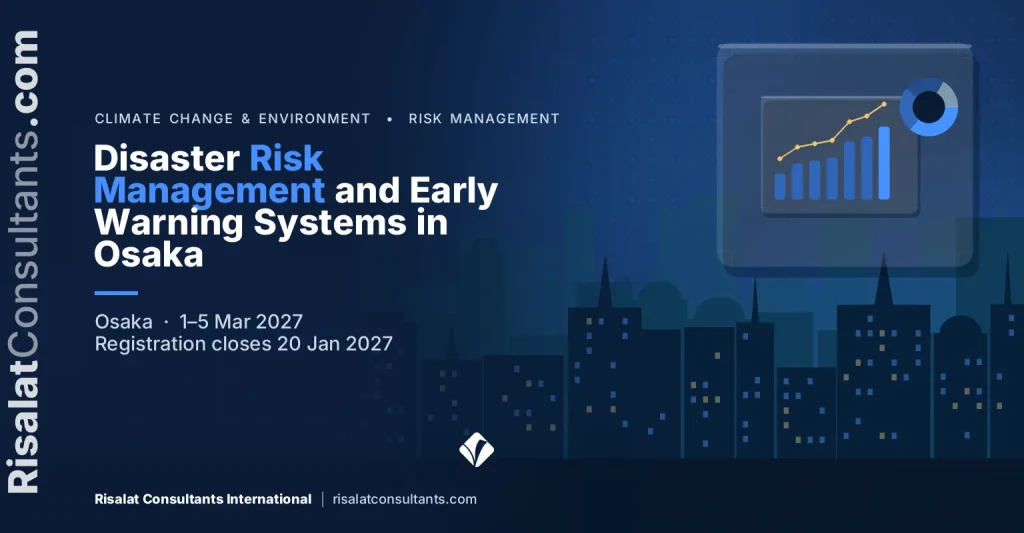
- 1–5 مارس 2027 (5 أيام)
- المكان
- Osaka, Japan
- الرسوم لكل مشارك
- £2,600 (جنيه إسترليني)
- الدفع
- بالفاتورة والتحويل المصرفي
- إغلاق التسجيل
- 20 يناير 2027
- الصيغة
- 5-day short course: a practical capacity-building programme for government, NGO and project teams in Osaka
- الخيار المؤسسي
- نفّذه لفريقك، في المواعيد التي تناسبك
On this page 10 sections
نظرة عامة على البرنامج
Disaster Risk Management and Early Warning Systems in Osaka provides public sector leaders and development practitioners with practical capabilities to build institutional resilience. Hosted in Osaka, a global centre for municipal disaster preparedness and flood engineering, this programme demonstrates how integrated urban defences and community protocols operate in practice. Participants review multi-hazard governance arrangements aligned with international standards, examining how major infrastructure and local contingency planning function together to safeguard vulnerable populations and critical socioeconomic assets against recurrent climatic and geophysical disruptions.
Free self-check: the governance self-audit gives a quick check of governance, controls and accountability, in about 10 minutes.
The curriculum addresses the operational demands of donor-financed investments, including initiatives funded by the World Bank, Asian Development Bank, European Union, and United Nations agencies. Participants examine Sendai Framework for Disaster Risk Reduction priorities, Common Alerting Protocol standards, and modern risk financing mechanisms. Through structured peer exchange and operational case reviews, the course demystifies the technical design, procurement, and deployment of end-to-end early warning systems, ensuring public investments deliver verifiable risk reduction, adhere to social safeguards, and sustain long-term operational viability across diverse regional contexts.
Focusing on the transition from risk assessment to actionable response, the training analyses institutional coordination between hydrometeorological agencies, emergency response authorities, and local administrative bodies. Delegates evaluate municipal monitoring networks in the Kansai region, exploring practical solutions for public alerting, multi-agency incident command, and resilient infrastructure maintenance. The course equips project implementation units and ministry staff with rigorous methods to draft actionable hazard management policies, monitor risk indicators systematically, and manage community-level preparedness plans that perform under extreme conditions.
يعزز البرنامج القدرات المؤسسية في:
- Analysis of Sendai Framework priorities and national legislative arrangements for risk governance
- Institutional roles: National disaster agencies, technical forecasting bodies, and local authorities
- Mainstreaming disaster risk screening into public sector investment and budget planning processes
- Case review of Kansai region municipal preparedness architecture and inter-agency coordination mechanisms
- Reviewing legal authorities, incident command structures, and compliance requirements during emergencies
- Methodologies for deterministic and probabilistic multi-hazard risk and vulnerability assessment
- Integration of hydrometeorological, seismic, and sea-level rise data into GIS hazard models
- Standardised infrastructure criticality assessments for floodplains and exposed coastal zones
- تقييم المخاطر المناخية والبيئية
- التخطيط للتكيف والتخفيف
- الاستراتيجيات القطاعية للطاقة والمياه والأراضي
- تصميم المشاريع لتحقيق الأهداف المناخية والبيئية
Why this matters now
تحتاج المؤسسات بشكل متزايد إلى مهنيين قادرين على:
- تقييم المخاطر المناخية والبيئية على خدماتهم وأصولهم
- تصميم مشاريع تحقق الأهداف المناخية والبيئية
- إعداد مقترحات يمكن للجهات الممولة اعتمادها
- قياس النتائج والإبلاغ عنها بمصداقية
- العمل مع المجتمعات والشركاء عبر القطاعات
تساعد الأنظمة القوية في مجالات المناخ والبيئة والموارد الطبيعية المؤسسات على:
- حماية الخدمات والبنية التحتية من المخاطر المناخية
- الوصول إلى التمويل المناخي والبيئي
- الوفاء بالالتزامات الوطنية والدولية
- استخدام الموارد الطبيعية على نحو مستدام
من ينبغي له الحضور
صُمم هذا البرنامج من أجل:
- Officials from national disaster risk reduction and management councils
- Staff from national hydrometeorological and geological hazard monitoring agencies
- Project directors and procurement specialists from World Bank and ADB financed project implementation units
- Municipal engineers and urban resilience planners from provincial and local authorities
- Policy specialists from ministries of environment, public works, and finance
- Disaster management programme managers from United Nations and regional intergovernmental bodies
- Infrastructure managers responsible for transport, water resources, and public utility continuity
- Climate change adaptation specialists and donor project monitoring officers
- Community-based disaster preparedness coordinators and emergency response directors
- موظفو شؤون تغير المناخ والبيئة
- موظفو قطاعات الطاقة والمياه والزراعة
- موظفو التخطيط والسياسات
حدّد ما يحتاج فريقك إلى القدرة على إنجازه.
أهداف البرنامج
بنهاية هذا البرنامج سيتمكن المشاركون من:
- Apply Sendai Framework for Disaster Risk Reduction priorities to national and municipal hazard mitigation frameworks
- Design end-to-end early warning architectures using Common Alerting Protocol standards for inclusive communication
- Evaluate multi-hazard risk assessment methodologies to inform public sector master planning and zoning regulations
- Structure donor-funded disaster risk management projects in compliance with multilateral development bank standards
- Develop multi-agency standard operating procedures to coordinate emergency operations centres and field personnel
- Incorporate nature-based solutions and grey infrastructure measures into comprehensive municipal flood control schemes
- Formulate post-disaster recovery and reconstruction strategies that integrate the principle of building back better
- شرح التحديات المناخية والبيئية الرئيسية في قطاعهم
- تقييم المخاطر المناخية والبيئية على الخدمات والأصول
- التخطيط لتدابير التكيف والتخفيف
Training Structure & Contents
- Analysis of Sendai Framework priorities and national legislative arrangements for risk governance
- Institutional roles: National disaster agencies, technical forecasting bodies, and local authorities
- Mainstreaming disaster risk screening into public sector investment and budget planning processes
- Case review of Kansai region municipal preparedness architecture and inter-agency coordination mechanisms
- Reviewing legal authorities, incident command structures, and compliance requirements during emergencies
- Workshop: Applying risk governance and Sendai Framework methods to participant institutions
- Methodologies for deterministic and probabilistic multi-hazard risk and vulnerability assessment
- Integration of hydrometeorological, seismic, and sea-level rise data into GIS hazard models
- Standardised infrastructure criticality assessments for floodplains and exposed coastal zones
- Community-based risk mapping: Combining local observational knowledge with scientific baseline data
- Formulating baseline risk registers to support project concept notes for international financiers
- Workshop: Applying risk identification, assessment, and mapping approaches to participant institutions
- Architecture of end-to-end early warning systems: From detection sensors to public response
- Implementation of the Common Alerting Protocol (CAP ITU-T X.1303) across multi-channel alert networks
- Review of Osaka municipal river monitoring, storm surge barriers, and automated runoff warning stations
- Last-mile alerting protocols: Addressing vulnerable groups, indigenous populations, and linguistic minorities
- Standard operating procedures for emergency public information broadcast and media coordination
- Case Study: Multi-hazard early warning systems and communication architecture in practice
- Engineering measures for urban flood containment: Underground retention reservoirs and discharge canals
- Complementing grey engineering with nature-based solutions, watershed protection, and coastal mangal buffers
- Operation and routine maintenance regimes for public sector disaster mitigation infrastructure
- Technical and fiduciary requirements for disaster management components funded by ADB and World Bank
- Asset management systems and emergency power continuity planning for life-line services
- Workshop: Applying resilient infrastructure and structural mitigation methods to participant institutions
- Development of municipal and sector-specific disaster contingency plans
- Multi-agency standard operating procedures for emergency operations centres and field personnel
- Community-based disaster preparedness frameworks and local response coordination
- Post-disaster recovery and reconstruction strategies aligned with building back better principles
- Action planning for institutional risk reduction and early warning deployment
المحتوى الكامل يوماً بيوم
First Day | Disaster Risk Governance and the Sendai Framework in Practice
- Analysis of Sendai Framework priorities and national legislative arrangements for risk governance
- Institutional roles: National disaster agencies, technical forecasting bodies, and local authorities
- Mainstreaming disaster risk screening into public sector investment and budget planning processes
- Case review of Kansai region municipal preparedness architecture and inter-agency coordination mechanisms
- Reviewing legal authorities, incident command structures, and compliance requirements during emergencies
- Workshop: Applying risk governance and Sendai Framework methods to participant institutions
Second Day | Hazard Identification, Risk Assessment, and Mapping
- Methodologies for deterministic and probabilistic multi-hazard risk and vulnerability assessment
- Integration of hydrometeorological, seismic, and sea-level rise data into GIS hazard models
- Standardised infrastructure criticality assessments for floodplains and exposed coastal zones
- Community-based risk mapping: Combining local observational knowledge with scientific baseline data
- Formulating baseline risk registers to support project concept notes for international financiers
- Workshop: Applying risk identification, assessment, and mapping approaches to participant institutions
Third Day | Multi-Hazard Early Warning Systems and Communication Architecture
- Architecture of end-to-end early warning systems: From detection sensors to public response
- Implementation of the Common Alerting Protocol (CAP ITU-T X.1303) across multi-channel alert networks
- Review of Osaka municipal river monitoring, storm surge barriers, and automated runoff warning stations
- Last-mile alerting protocols: Addressing vulnerable groups, indigenous populations, and linguistic minorities
- Standard operating procedures for emergency public information broadcast and media coordination
- Case Study: Multi-hazard early warning systems and communication architecture in practice
Fourth Day | Resilient Urban Infrastructure and Structural Risk Mitigation
- Engineering measures for urban flood containment: Underground retention reservoirs and discharge canals
- Complementing grey engineering with nature-based solutions, watershed protection, and coastal mangal buffers
- Operation and routine maintenance regimes for public sector disaster mitigation infrastructure
- Technical and fiduciary requirements for disaster management components funded by ADB and World Bank
- Asset management systems and emergency power continuity planning for life-line services
- Workshop: Applying resilient infrastructure and structural mitigation methods to participant institutions
Fifth Day | Emergency Preparedness, Contingency Planning, and Post-Disaster Recovery
- Development of municipal and sector-specific disaster contingency plans
- Multi-agency standard operating procedures for emergency operations centres and field personnel
- Community-based disaster preparedness frameworks and local response coordination
- Post-disaster recovery and reconstruction strategies aligned with building back better principles
- Action planning for institutional risk reduction and early warning deployment
منهجية التدريب
Delivered by Risalat Consultants International in Osaka, Japan, the course combines expert-led presentations, practical work, and case examinations so that participants can directly adapt concepts to their own organisational contexts.
- Expert-led instructional modules detailing international standards and technical requirements
- Review and analysis of real operational cases from the Kansai region and global settings
- Group exercises and practical workshops focused on institutional application
- Small-group problem solving and structured peer exchange
- Action-oriented planning sessions to establish clear next steps
- الصناديق
- الجهة
- المشروع
- النتائج
- القياس والإبلاغ والتحقق
النتائج المتوقعة
- Acquisition of practical capabilities to align institutional policies with the Sendai Framework
- Capacity to formulate baseline risk registers and carry out multi-hazard assessments
- Ability to plan and deploy end-to-end early warning architectures using Common Alerting Protocol standards
- Enhanced understanding of urban flood control measures, combining grey infrastructure and nature-based solutions
- Skills to establish multi-agency standard operating procedures for contingency planning and emergency operations
- Capability to design post-disaster recovery strategies incorporating building back better principles
- Proficiency in structuring disaster management proposals that meet donor and international finance standards
£2,600 لكل مشارك · فاتورة وتحويل مصرفي · خصم للمجموعات المكوّنة من 5 مشاركين أو أكثر
خمسة مشاركين أو أكثر من مؤسسة واحدة: اطلبوا سعر المجموعة عند طلب الفاتورة.
Ten or more: an in-house version for your institution may cost less per person. Ask for an in-house quote.
Registration closes in 59 days (20 Jan 2027)
الأهمية الإقليمية والتطبيق
Southeast Asian and Pacific island nations face intensifying tropical cyclones, coastal inundation, and riverine flooding that threaten critical infrastructure and economic stability. As governments accelerate investments under international climate finance and donor programmes, public institutions must modernise hydrometeorological networks and bridge the gap between technical forecasting and community action. Establishing standardised multi-hazard early warning systems aligned with the Sendai Framework is urgent to preserve development gains, prevent loss of life, and satisfy stringent donor accountability requirements.
Who Will Deliver This Programme
Each date is delivered by a team assigned from Risalat's expert network for this subject. For this programme we assign:
How we choose them: Experience in the region of the participants or comparable settings; Command of the financier rules that apply (World Bank, ADB, AfDB, EU, UN) where relevant; Delivery in English; other languages on request for in-house groups; No conflict of interest with participants' institutions.
Training courses in OsakaClimate Change & Environment training courses
Why Osaka for this programme
Osaka is a major economic centre in western Japan, offering access to prominent public sector agencies, transport hubs and commercial enterprises. Visiting delegations can examine advanced municipal infrastructure, port facilities and urban regeneration projects. The city is straightforward to reach internationally via direct flights and connects easily to Kyoto and Tokyo through the high-speed rail network.
The Disaster Risk Management and Early Warning Systems in Osaka programme in March 2027 brings together officials and professionals from across the Asia region and beyond. Sessions combine short inputs, case studies and group work on participants' own files, and the city's institutions can be added as a study visit on request.
Getting there: Kansai International (KIX).
تحقق مما إذا كنت بحاجة إلى تأشيرة عبر أداة التحقق من التأشيرة المجانية، واطلب خطاب دعوة بعد إتمام تسجيلك.
الموضوع نفسه في مدن أخرى
- Disaster Risk Management and Early Warning Systems in Nagoya (Nagoya)
- Disaster Risk Management and Early Warning Systems in Sapporo (Sapporo)
- Disaster Risk Management and Early Warning Systems in Fukuoka (Fukuoka)
- Disaster Risk Management and Early Warning Systems in Hiroshima (Hiroshima)
- Disaster Risk Management and Early Warning Systems in Sendai (Sendai)
- Disaster Risk Management and Early Warning Systems in Kobe (Kobe)
Free roadmap: Disaster Insurance on the Lookout of Modern Disaster Risk Management: a 12-month plan for your team
Is there disaster risk management training for government officials in Osaka in March 2027?
Can "Disaster Risk Management and Early Warning Systems in Osaka" be delivered in-house for one organisation?
ما البرامج الأخرى التي تقدّمها Risalat في مجال إدارة مخاطر الكوارث؟
كيف تسجّل المؤسسات وتسدّد الرسوم؟
للفرق والمؤسسات
Bring your team
Teams that learn together apply more at work. Tell us how many people and how you would like to take part: we reply with a group quote within two working days.
Watch: this programme in short
تواريخ ومدن أخرى لهذا الموضوع: دورات التدريب على إدارة مخاطر الكوارث والاستجابة للطوارئ (83 تاريخاً قادماً).
المزيد من الدورات التدريبية في اليابان · جميع البرامج في آسيا · تقويم التدريب الكامل
تخطيط هذا البرنامج في خارطة طريق: لماذا هو مهم، ولماذا يجب الموافقة عليه، والتواريخ المراد التخطيط لها، والمسار المهني الذي يبنيه.