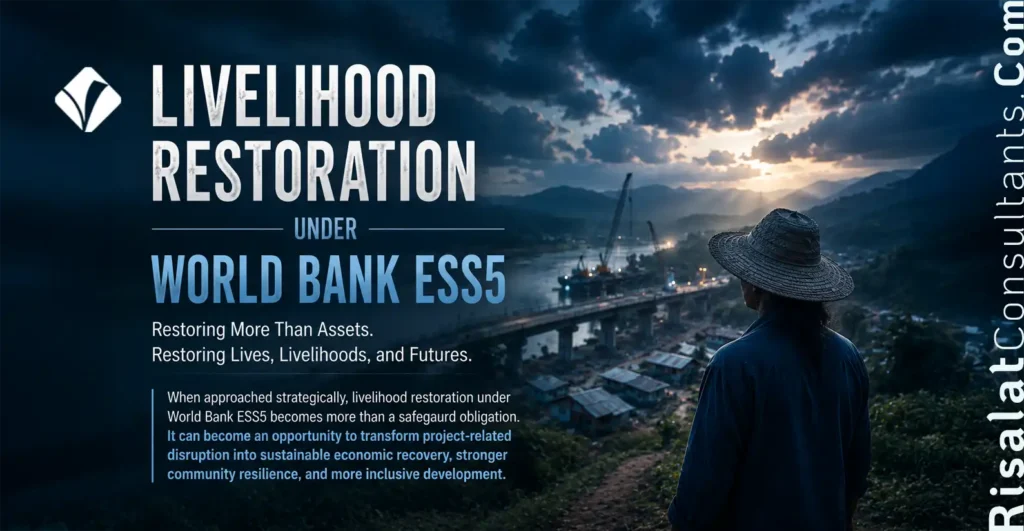
In short: Livelihood restoration under World Bank ESS5 explained, covering economic displacement, implementation, monitoring, and sustainable recovery.
Free self-check: the governance self-audit gives a quick check of governance, controls and accountability, in about 10 minutes.
أبرز الخلاصات
تُعد استعادة سبل العيش واحدة من أكثر المتطلبات تحدياً للتنفيذ بفعالية بموجب إطار العمل البيئي والاجتماعي للبنك الدولي. وفي حين يحظى التعويض عن الأصول المفقودة غالباً باهتمام كبير، فإن استعادة قدرة الناس على كسب دخل مستدام بعد النزف المرتبط بالمشاريع يظل تحدياً مستمراً عبر مشاريع البنية التحتية والتنمية في جميع أنحاء العالم.
- Compensation alone is not livelihood restoration – Paying for lost land, buildings, crops, or other assets does not automatically restore household income, employment, business activity, or long-term economic security.
- Early planning determines long-term success – Effective livelihood restoration begins during project preparation through robust socioeconomic surveys, livelihood analysis, market assessments, and meaningful stakeholder engagement.
- Institutional coordination is often the weakest link – Successful implementation may require collaboration among government agencies, project implementation units, contractors, local authorities, employers, financial institutions, service providers, and community organizations.
- Monitoring must measure outcomes, not simply activities – Delivering training, grants, agricultural inputs, or financial assistance is insufficient unless affected households demonstrate sustainable livelihood recovery.
- Livelihood restoration can become a development opportunity – When implemented effectively, livelihood restoration can strengthen resilience, improve employment opportunities, support local economies, and connect affected communities with benefits created by major infrastructure investments.
Without adequate institutional capacity, financing, community participation, and continuous monitoring, livelihood restoration programs risk becoming short-term compensation exercises rather than sustainable development interventions.
الحكومات التي تدمج استعادة سبل العيش في تنفيذ المشاريع الأوسع واستراتيجيات التنمية الاقتصادية المحلية تكون في وضع أفضل للحد من المخاطر الاجتماعية، وتعزيز مرونة المجتمع، وتحقيق نتائج مشاريع مستدامة.
مقدمة
Large infrastructure investments continue transforming transportation networks, energy systems, water infrastructure, urban development, and public services across developing and emerging economies.
في حين تولد هذه الاستثمارات فوائد اقتصادية واجتماعية كبيرة، فإنها يمكن أن تؤثر أيضاً على الأشخاص الذين تعطلت منازلهم، أو شركاتهم، أو أراضيهم الزراعية، أو عمالتهم، أو مصادر دخلهم الأخرى بسبب تنفيذ المشروع.
The World Bank’s Environmental and Social Standard 5 (ESS5) establishes requirements concerning land acquisition, restrictions on land use, and involuntary resettlement. Among the most important implementation challenges is livelihood restoration under World Bank ESS5, particularly where projects cause economic displacement.
Too often, project progress is measured by the completion of compensation payments rather than whether affected households actually recover their livelihoods and standards of living.
قد يحل التعويض محل قيمة الأصول المادية، ولكنه لا بالضرورة يستعيد شبكات العملاء، أو فرص العمل، أو الإنتاجية الزراعية، أو الوصول إلى الأسواق، أو العلاقات التجارية، أو المرونة الاقتصادية التي طورتها المجتمعات على مدى سنوات عديدة.
Many livelihood restoration programs consequently encounter difficulties after compensation has been completed. Skills training may be delivered without employment opportunities. Business grants may be provided without market access. Farmers may receive replacement land without adequate irrigation, infrastructure, inputs, or technical assistance. Monitoring may focus on activities completed rather than economic outcomes achieved.
مع توسع الاستثمار في البنية التحتية من خلال المشاريع الممولة من البنك الدولي، ينبغي بالتالي فهم استعادة سبل العيش ليس فقط كمتطلبات حماية، بل كعنصر هام للتنمية المستدامة، وإدارة المخاطر الاجتماعية، والتسليم الناجح للمشاريع.
This article examines the practical challenges surrounding livelihood restoration under World Bank ESS5 and explores how governments and project implementation units can move from compensation-focused approaches toward sustainable economic recovery.
Understanding Livelihood Restoration Under World Bank ESS5
What World Bank ESS5 Actually Requires
One common misconception surrounding involuntary resettlement is that compensation represents the primary objective.
In reality, compensation is only one part of a broader process.
World Bank ESS5 seeks to avoid involuntary resettlement where feasible. Where displacement cannot be avoided, projects are expected to minimize it, mitigate adverse social and economic impacts, and support affected people in improving or at least restoring their livelihoods and standards of living.
This represents an important shift from purely compensation-based approaches toward outcome-focused implementation.
In practical terms, successful ESS5 implementation requires project teams to look beyond whether compensation has been paid and consider more important questions:
- Have affected households recovered their livelihoods?
- Can displaced businesses operate sustainably?
- Have farmers regained productive capacity?
- Are affected workers able to access sustainable employment?
- Have vulnerable households recovered from project-related economic impacts?
- Are affected communities economically resilient after displacement?
These questions move livelihood restoration under World Bank ESS5 beyond administrative compliance and toward measurable socioeconomic recovery.
التعويض ليس استعادة سبل العيش
One of the most common mistakes in implementing livelihood restoration under World Bank ESS5 is assuming that compensation alone fulfills project obligations.
قد تحل التعويضات المالية محل قيمة الأصول المفقودة، لكنها نادراً ما تحل محل الأنظمة الاقتصادية التي تدعم الأسر المتضررة.
A family losing agricultural land does not simply lose property. It may lose irrigation infrastructure, established soil productivity, market relationships, location-specific knowledge, seasonal production patterns, and future income.
وبالمثل، قد تعوض إعادة توطين نشاط تجاري على جانب الطريق عن هيكل مادي مع فشلها في استعادة حركة الزبائن، علاقات الموردين، الرؤية التجارية، أو الوصول إلى سوقه الأصلي.
يساعد هذا التمييز في تفسير سبب نجاح المشاريع في استكمال التعويضات بينما تستمر الأسر المتضررة في المعاناة من التدهور الاقتصادي.
Livelihood restoration measures may therefore involve combinations of:
- أراضي بديلة منتجة؛
- agricultural extension and technical assistance;
- employment opportunities;
- vocational and skills development;
- business development support;
- access to finance;
- market linkages;
- financial literacy;
- المساعدة الانتقالية؛ و
- الدعم الفني المستمر.
The objective is not simply to replace what people lost. It is to enable affected people to rebuild sustainable livelihoods under their post-displacement economic conditions.
Physical and Economic Displacement Require Different Solutions
Projects sometimes concentrate heavily on households that physically relocate while giving less attention to people experiencing economic displacement.
However, economic displacement can occur even when a person never moves from their home.
Physical displacement generally involves relocation and may require replacement housing, infrastructure, services, and associated assistance.
Economic displacement can occur when people lose land, assets, access to resources, businesses, employment, customers, fishing areas, grazing routes, or other means of generating income because of project-related land acquisition or restrictions on land use.
يمكن أن تتضمن الأمثلة:
- farmers losing productive agricultural land;
- market vendors relocated from commercially valuable locations;
- small businesses affected by access restrictions;
- المجتمعات الساحلية التي تفقد إمكانية الوصول إلى مناطق صيد الأسماك؛
- pastoral communities losing access to grazing resources;
- العمال غير الرسمييون الذين يعتمدون على التجارة على جانب الطرق؛ و
- enterprises whose customers or supply chains are disrupted.
Each livelihood source presents different risks.
لا يمكن لحزمة تعويضات موحدة أن تعالج بشكل كافٍ مثل هذه الظروف الاقتصادية المتنوعة.
Why Livelihood Restoration Programs Fail
Despite extensive international experience with involuntary resettlement, many livelihood restoration programs struggle to achieve sustainable outcomes.
The problem is not necessarily the absence of policies or plans.
غالباً ما تظهر الإخفاقات أثناء تقييم خط الأساس، وتصميم البرنامج، والتنسيق المؤسسي، والتمويل، والتنفيذ، والمراقبة، والمتابعة.
تفسر عدة تحديات متكررة سبب قصر استعادة سبل العيش بموجب المعيار الخامس للبنك الدولي عن تحقيق النتائج المرجوة منها.
التعويض بدون تعافي اقتصادي
قد تساوي المشاريع دون قصد بين نجاح التعويض ونجاح استعادة سبل العيش.
Compensation may be completed, administrative records closed, and implementation targets reported while household income continues declining months or years afterward.
لا يمكن للتعويض النقدي أن يعيد تلقائياً:
- علاقات العملاء؛
- الإنتاجية الزراعية؛
- employment opportunities;
- supplier networks;
- local economic ecosystems;
- occupational skills; or
- business reputation.
Without complementary livelihood restoration measures, compensation may provide temporary financial relief without establishing a sustainable pathway toward economic recovery.
This is particularly important where affected households have limited experience managing large lump-sum payments or face debt, inflation, immediate household expenses, or limited investment opportunities.
Weak Socioeconomic Baselines
Effective livelihood restoration begins before displacement.
ومع ذلك، تجمع الدراسات الاجتماعية والاقتصادية أحياناً معلومات ديموغرافية وبيانات عن الأصول دون دراسة كافية لكيفية توليد الأسر للدخل بالفعل.
Important questions can remain unanswered:
- Which income sources are seasonal?
- How diversified are household livelihoods?
- Which household members generate income?
- Which businesses depend heavily on their current location?
- Which agricultural activities depend on particular land or water conditions?
- What informal economic activities may not appear in official records?
- Which households are least able to absorb economic shocks?
Without reliable baseline information, project teams may later struggle to determine whether livelihoods have actually been restored.
Monitoring then risks measuring activities because there is no meaningful economic baseline against which outcomes can be assessed.
Limited Community Participation
تعتمد برامج استعادة سبل العيش أحياناً على تدخلات قياسية بدلاً من الحلول المطورّة مع المجتمعات المتضررة.
Vocational training may be offered without considering labor-market demand.
Agricultural programs may ignore soil conditions, water availability, input costs, or market access.
Business grants may be distributed without understanding whether sufficient demand exists for the businesses being created.
Communities themselves possess valuable information about local markets, seasonal income patterns, employment opportunities, social networks, risks, and barriers.
Meaningful stakeholder engagement therefore improves not only community acceptance but also the economic quality of livelihood restoration interventions.
Short-Term Project Thinking
Infrastructure projects naturally operate within defined construction schedules.
تعافي سبل العيش لا يفعل ذلك.
A farming household may require several growing seasons before agricultural productivity stabilizes.
A relocated enterprise may need considerable time to rebuild its customer base.
A person completing vocational training may need months before securing sustainable employment.
Yet livelihood monitoring may weaken once compensation has been completed or construction nears completion.
يخلق هذا تناقضاً أساسياً بين تسليم البنية التحتية والتعافي الاجتماعي والاقتصادي.
Successful livelihood restoration under World Bank ESS5 therefore requires adequate implementation periods, adaptive management, monitoring, and institutional support beyond the immediate displacement process.
From Compensation to Sustainable Economic Recovery
التحدي المركزي ليس تحديد الأنشطة التي سيتم تنفيذها. بل هو تصميم مسار موثوق يمكن من خلاله للأشخاص المتضررين استعادة سبل عيشهم بشكل مستدام.
This requires understanding how livelihoods function before displacement, how project impacts will disrupt them, and which realistic economic opportunities will exist afterward.
A livelihood restoration program should therefore begin with the affected population and local economy rather than a predetermined list of interventions.
For agricultural households, project teams may need to examine land productivity, water availability, input costs, transportation, market access, extension services, and the time required for replacement land to become productive.
بالنسبة للشركات، قد يحتاج التحليل إلى مراعاة الموقع، وتدفقات العملاء، وعلاقات الموردين، رأس المال العامل، والتراخيص، المنافسة، الوصول إلى الأسواق، والظهور التجاري.
بالنسبة للعمال بأجر والعمال غير الرسميين، قد تشمل الأولويات مطابقة الوظائف، وتطوير المهارات، والشهادات، ووسائل النقل، رعاية الأطفال، أو الوصول إلى فرص العمل التي تولدها المشاريع.
Different households may therefore require substantially different restoration pathways.
Livelihood Restoration Must Reflect Economic Reality
One of the easiest mistakes is designing livelihood interventions around what a project can conveniently provide rather than what affected people can realistically sustain.
Training provides a good example.
A project may report that hundreds of affected people completed vocational training. But if there is little local demand for those skills, training completion does not necessarily translate into livelihood restoration.
The same principle applies to enterprise development.
إن تزويد العديد من الأسر بمنح لإنشاء أعمال مماثلة يمكن أن يخلق منافسة محلية مفرطة ويقلل في النهاية من جدوى كل مشروع.
Effective livelihood restoration therefore requires market assessment alongside socioeconomic assessment.
Project teams should understand where demand exists, which sectors are expanding, what employers require, what barriers prevent affected people from accessing opportunities, and whether proposed businesses can remain commercially viable after project support ends.
Institutional Coordination: The Hidden Implementation Challenge
Livelihood restoration rarely falls entirely within the responsibility of one organization.
A major infrastructure project may involve:
- a project implementation unit;
- sector ministries;
- local governments;
- land authorities;
- contractors;
- consultants;
- المؤسسات المالية؛
- training providers;
- agricultural agencies;
- employers;
- community organizations; and
- development partners.
Each institution may perform its assigned activity while the overall program still fails.
A training provider, for example, may successfully train affected people while nobody is responsible for connecting graduates with employers.
A contractor may have employment opportunities while no mechanism connects eligible project-affected people with those jobs.
قد توفر الوكالات الزراعية دعم الإرشاد بينما تفتقر الأرض البديلة إلى الري الموثوق.
قد يتم تووزيع منح الأعمال بينما يكافح رواد الأعمال للحصول على تراخيص التشغيل أو المساحة التجارية المناسبة.
لذلك تتطلب استعادة سبل العيش الناجحة بموجب المعيار الخامس للبيئة والاجتماع (ESS5) للبنك الدولي مسؤوليات مؤسسية محددة بوضوح، وآليات تنسيق، وموازنات، وجداول زمنية للتنفيذ، وإجراءات تصعيد، والمساءلة عن نتائج سبل العيش.
The Role of Project Implementation Units
بالنسبة للعديد من الاستثمارات الممولة من البنك الدولي، تحتل وحدة تنفيذ المشروع (PIU) موقع تنسيق حاسم.
The PIU requires sufficient environmental and social capacity to oversee implementation rather than treating the Livelihood Restoration Plan as primarily a document required for project approval.
Effective oversight may require:
- experienced environmental and social specialists;
- livelihood restoration expertise;
- clearly assigned responsibilities;
- implementation schedules linked to displacement;
- sufficient multi-year financing;
- التنسيق مع المقاولين والوكالات الحكومية؛
- accessible grievance mechanisms;
- socioeconomic monitoring systems; and
- mechanisms for identifying households whose livelihoods are not recovering.
حيثما تكون القدرات المؤسسية محدودة، يجب أن تبدأ المساعدة التقنية وتطوير القدرات قبل النزوح بدلاً من الظهور بعد نشوء مشاكل سبل العارضة.
تصميم تدابير استعادة سبل العيش التي تؤتي ثمارها
There is no universal livelihood restoration package.
Effective programs combine interventions according to the livelihoods, vulnerabilities, capabilities, and economic opportunities of affected people.
استعادة سبل العيش القائمة على الأراضي
حيث تعتمد الأسر بشكل أساسي على الزراعة، أو الثروة الحيوانية، أو مصايد الأسماك، أو الحراجة، أو غيرها من الأنشطة القائمة على الموارد الطبيعية، فإن استعادة القدرة الإنتاجية تعد أمراً مهمًا بشكل خاص.
Cash compensation alone can expose these households to substantial long-term livelihood risks.
Depending on the project context, interventions may include:
- أراضي بديلة منتجة؛
- irrigation;
- soil improvement;
- agricultural inputs;
- extension services;
- improved production techniques;
- دعم الثروة الحيوانية؛
- storage infrastructure;
- access roads;
- producer organizations; and
- stronger connections with agricultural markets.
The objective should be measurable productive recovery rather than simply distributing agricultural inputs.
Business and Enterprise Restoration
Small enterprises can be particularly vulnerable to economic displacement because much of their economic value may exist outside their physical assets.
الموقع، وحركة العملاء، وعلاقات الموردين، والسمعة، والتراخيص، ووصول السوق، رأس المال العامل يمكن أن يحددوا ما إذا كانت الشركة ستنجو من عملية الانتقال.
Business restoration may therefore require combinations of relocation assistance, transitional support, improved commercial locations, enterprise development services, access to finance, financial management support, equipment, formalization assistance, and connections with new markets.
Employment and Skills Development
يمكن لتنمية المهارات أن تدعم تعافي سبل العيش عندما ترتبط بالطلب الحقيقي على العمالة.
Infrastructure projects themselves may create employment through construction, operations, maintenance, logistics, transportation, administration, catering, security, and supply chains.
Where feasible and consistent with applicable requirements, livelihood programs can establish mechanisms that help affected people compete for or access appropriate opportunities.
However, training should respond to labor-market demand rather than course availability.
Programs should consider employer requirements, existing skills, barriers to employment, certification needs, and whether opportunities will remain viable after construction.
Vulnerable Groups Require More Than Equal Treatment
People who are disadvantaged or vulnerable may experience displacement differently and may require differentiated assistance.
منح الجميع دعماً متطابقاً لا يؤدي بالضرورة إلى نتائج عيش منصفة.
قد تواجه الأسر التي ترأسها نساء، وكبار السن، والأشخاص ذوو الإعاقة، والأسر التي لا تملك أراضي، والعمال غير الرسميين، والأسر شديدة الفقيرة، ومجتمعات الأقليات، والأسر شديدة الاعتماد على الموارد الطبيعية حواجز تتجاهلها التدخلات القياسية.
For example, offering identical vocational training to everyone may appear equitable while effectively excluding people who cannot travel, afford childcare, meet literacy requirements, or access formal employment.
Effective livelihood programs should therefore identify vulnerability during socioeconomic assessment and incorporate appropriate differentiated measures.
The objective is not merely equal participation.
It is ensuring that vulnerable households have a realistic opportunity to restore or improve their livelihoods and living standards.
رصد استعادة سبل العيش: الأنشطة ليست نتائج
Monitoring is one of the areas where otherwise well-designed programs can become weak.
Projects frequently report indicators such as:
- number of people trained;
- number of grants distributed;
- number of agricultural inputs provided;
- number of enterprises relocated; or
- عدد الأسر المستفيدة من المساعدة.
These indicators measure implementation progress.
They do not necessarily demonstrate livelihood restoration.
A participant can complete vocational training and remain unemployed.
يمكن للشركات المنقولة تلقي المعدات بينما تفقد جزءاً كبيراً من قاعدة عملائها.
يمكن للمزارع تلقي المدخلات الزراعية بينما يظل دخل الأسرة أقل من مستواه ما قبل الإزاحة.
Outcome monitoring should therefore examine whether sustainable economic recovery is occurring.
Relevant indicators may include:
- household income;
- income diversification;
- استقرار العمالة؛
- إيرادات الأعمال؛
- الإنتاجية الزراعية؛
- food security;
- ملكية الأصول الإنتاجية؛
- market access;
- household debt; and
- vulnerability and resilience.
These indicators should be assessed against credible baseline conditions and monitored over sufficient time to distinguish temporary improvement from sustainable recovery.
Identify Households That Are Not Recovering
Aggregate statistics can hide serious problems.
Average household income may appear to have recovered while particular groups continue experiencing substantial economic deterioration.
لذلك ينبغي أن تحدد أنظمة المراقبة الأسر التي تظل مسارات سبل عيشها دون الظروف الأساسية أو أهداف الاستعادة المتفق عليها.
Those households may require further assessment and corrective measures.
This transforms monitoring from a reporting exercise into an active management tool.
Livelihood Restoration Should Be Adaptive
Livelihood restoration plans should not be treated as static documents.
Markets change. Construction schedules shift. Replacement land may perform differently than anticipated. Enterprises may struggle after relocation. Training programs may produce lower employment rates than expected.
Effective programs establish mechanisms for identifying these problems and adjusting interventions.
Adaptive measures might involve changing training programs, introducing additional agricultural assistance, strengthening enterprise support, extending transitional measures, developing new market partnerships, or redirecting resources toward interventions producing stronger results.
Adaptive management is particularly important because livelihood recovery may continue well beyond the initial displacement period.
Grievance Mechanisms Can Reveal Livelihood Problems Early
A functioning grievance mechanism provides more than a means of resolving individual complaints.
يمكن أن يصبح أيضاً مصدراً مهماً لمعلومات الإدارة.
Repeated grievances concerning loss of customers, delayed replacement land, market access, contractor recruitment, agricultural productivity, or inadequate transitional assistance can reveal systemic problems before they become visible in formal monitoring reports.
Project teams should therefore analyze grievance patterns rather than simply counting how many complaints have been closed.
Recurring grievances may indicate that a livelihood intervention requires broader corrective action.
When Is Livelihood Restoration Actually Complete?
تعد إحدى أصعب المسائل التي تواجه الحكومات فرق المشاريع هي تحديد متى يتم تحقيق التزامات استعادة سبل العيش بشكل حقيقي.
Completion should not be defined merely by spending the livelihood restoration budget or delivering every activity contained in a plan.
The more important question is whether affected people have restored or improved their livelihoods and standards of living in accordance with project commitments and applicable ESS5 requirements.
هذا يتطلب أدلة موثوقة.
بناءً على حجم المشروع والمخاطر، قد يدرس تقييم الإنجاز ما يلي:
- socioeconomic monitoring results;
- household livelihood recovery;
- business sustainability;
- الإنتاجية الزراعية؛
- employment outcomes;
- نتائج الأسر المعوزة؛
- unresolved grievances; and
- outstanding corrective measures.
بالنسبة للمشاريع التي تنطوي على آثار إعادة إيواء كبيرة، يمكن لعمليات التدقيق اللاحقة أن توفر أدلة مهمة حول ما إذا كانت التدابير المخطط لها قد ترجمت إلى نتائج مستدامة.
Building Government Capacity for ESS5 Implementation
Many livelihood restoration difficulties ultimately reflect institutional capacity constraints rather than shortcomings in individual plans.
Government agencies may have extensive experience with land acquisition and compensation while having considerably less institutional experience with socioeconomic restoration, economic displacement, livelihood analysis, market assessment, stakeholder engagement, outcome monitoring, and adaptive management.
Building implementation capacity therefore requires more than occasional safeguards training.
Governments and PIUs can strengthen practical capabilities in:
- تصميم خط الأساس الاجتماعي والاقتصادي؛
- livelihood risk assessment;
- economic displacement analysis;
- Resettlement Action Plan implementation;
- تنفيذ خطة استعادة سبل العيش؛
- stakeholder engagement;
- livelihood program design;
- labor-market and value-chain assessment;
- monitoring and evaluation;
- grievance management;
- contractor coordination;
- vulnerable-group support; and
- practical implementation of the World Bank ESF.
Institutional capacity becomes particularly valuable where governments are implementing multiple infrastructure investments financed by international development institutions.
Systems, templates, monitoring approaches, lessons learned, and experienced personnel developed through one project can strengthen future investments across a broader national portfolio.
Turning Livelihood Restoration Into a Development Opportunity
برامج استعادة سبل العيش الأكثر كفاءة تفعل ما هو أكثر من مجرد تخفيف الآثار السلبية للمشروع.
They use infrastructure investment as an opportunity to strengthen local economic systems.
A major transport, water, energy, urban development, or other infrastructure project can generate new markets, employment, transportation connections, commercial activity, supply chains, and demand for local services.
Livelihood restoration can help connect affected communities with these opportunities.
Instead of asking only:
“How can the project replace what people lost?”
project leaders can ask a more ambitious question:
“How can affected communities participate in the economic opportunities the project itself creates?”
هذا يحول استعادة سبل العيش من مجرد ممارسة للتعويض إلى استراتيجية محتملة للتنمية الاقتصادية المحلية.
يمكنه تعزيز مرونة المجتمع، وتقليل المظالم، وتحسين العلاقات بين المشروع والمجتمع، وخلق فوائد تستمر بعد البناء.
A Practical Framework for Livelihood Restoration Under World Bank ESS5
يمكن التعامل مع استعادة سبل العيش بنجاح بموجب المعيار البيئي والاجتماعي الخامس (ESS5) للبنك الدولي كعملية مستمرة:
Understand → Avoid and Minimize → Plan → Restore → Monitor → Adapt → Verify
Understand – Establish robust socioeconomic baselines and determine how affected households actually generate their livelihoods.
التجنب والتقليل – تقليل النزوح البدني والاقتصادي من خلال تصميم المشروع كلما كان ذلك ممكناً.
التخطيط – تطوير تدابير سبل العيش بناءً على ظروف الأسر، والهشاشة، وظروف السوق، والفرص الاقتصادية الواقعية.
الاستعادة - تنفيذ تدخلات منسقة بتمويل كافٍ، ومساعدة تقنية، ومسؤولية مؤسسية، ومشاركة مجتمعية.
Monitor – Measure livelihood outcomes against baseline conditions rather than merely counting completed activities.
Adapt – Modify interventions when evidence shows that affected households are not recovering.
تحقق – حدد ما إذا كانت أهداف استعادة سبل العيش قد تحققت وما إذا كانت التدابير التصحيحية العالقة لا تزال ضرورية.
This approach places sustainable economic recovery rather than administrative completion at the center of livelihood restoration.
أسئلة جوهرية ينبغي أن يطرحها قادة الحكومات والمشاريع
Are affected households actually recovering their livelihoods, or has the project only completed compensation?
Compensation completion is an important administrative milestone, but livelihood restoration requires evidence that affected households can sustainably generate income and restore or improve their living standards.
Does the project have sufficient socioeconomic baseline data to demonstrate livelihood recovery?
Without reliable baseline information, project teams may be unable to determine whether household income, agricultural productivity, employment, businesses, and vulnerability have genuinely recovered.
هل التدخلات المعيشية مرتبطة بالأسواق الحقيقية وفرص العمل؟
Training, enterprise assistance, agricultural support, and other interventions should respond to demonstrated economic opportunities. Programs designed without adequate market analysis risk creating activities that cannot survive after project support ends.
من المسؤول عندما لا تعود سبل عيش الأسرة إلى وضعها الطبيعي؟
Institutional accountability should be clear. Monitoring should identify households experiencing continuing economic deterioration and enable investigation, corrective action, and additional assistance where required.
هل يتم دمج استعادة سبل العيش في تنفيذ المشاريع في وقت مبكر بما فيه الكفاية؟
Livelihood planning should begin during project preparation and before displacement occurs. Waiting until compensation or construction is underway can significantly reduce the range of viable restoration options.
هل يقيس المشروع استعادة سبل العيش أم مجرد نشاط التنفيذ؟
إن عدد الدورات التدريبية أو المنح أو الاستشارات أو الحزم الزراعية المقدمة لا يدل على تعافٍ مستدام. مؤشرات النتائج ضرورية لتحديد ما إذا كانت التدخلات تنجح بالفعل.
هل يمكن لبرنامج سبل العيش التكيف عندما يفشل التدخل الأصلي؟
Not every intervention will succeed as planned. Effective management requires evidence-based adjustments when businesses, agricultural programs, training initiatives, or employment measures fail to produce the expected outcomes.
الخلاصة
Livelihood restoration under World Bank ESS5 requires much more than compensation for affected assets.
It requires governments and project implementing agencies to understand how people earn their livelihoods, anticipate how displacement will affect those economic systems, design context-specific restoration measures, coordinate multiple institutions, provide adequate resources, and monitor whether sustainable recovery actually occurs.
The difference between a compliant plan and a successful livelihood restoration program is ultimately visible in household outcomes.
Have farmers regained productive capacity? Are relocated businesses commercially viable? Have affected workers secured sustainable employment? Are vulnerable households recovering? Have communities been connected to economic opportunities created by the project?
These are the questions that ultimately determine whether livelihood restoration has succeeded.
For governments managing major infrastructure and development portfolios, strengthening institutional capacity in ESS5, resettlement, economic displacement, stakeholder engagement, livelihood restoration, and outcome monitoring can also generate benefits far beyond an individual project.
It creates institutional knowledge and implementation capacity that can improve the preparation and delivery of future investments.
When approached strategically, livelihood restoration under World Bank ESS5 becomes more than a safeguard obligation. It can become an opportunity to transform project-related disruption into sustainable economic recovery, stronger community resilience, and more inclusive development.
Free roadmap: Hiring Consultants on Lao PDR World Bank Projects with QCBS: a 12-month plan for your team
شاهد
Know people who should read this? Become an Ambassador or write with Risalat.
شركاء في نجاح المشاريع منذ 2011، نقدم التشخيص والدعم الاستشاري والتعلم التطبيقي للوزارات والهيئات العامة وفرق المشاريع.
هل تحتاج إلى مساعدة في تطبيق ذلك عملياً؟
ابدأ بتشخيص مجاني مدته 10 دقائق أو تحدث إلى خبرائنا.