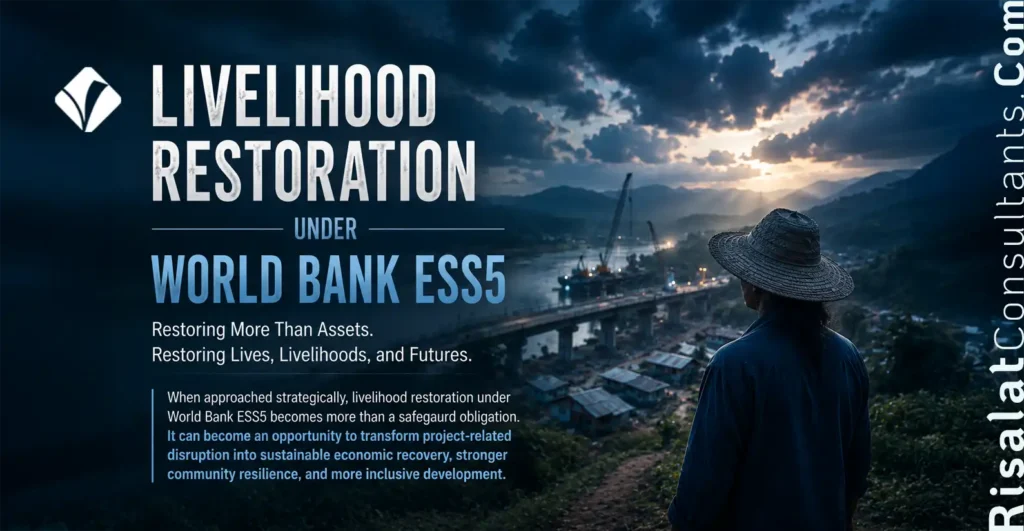
In short: Livelihood restoration under World Bank ESS5 explained, covering economic displacement, implementation, monitoring, and sustainable recovery.
Free self-check: the governance self-audit gives a quick check of governance, controls and accountability, in about 10 minutes.
要点总结
Livelihood restoration is one of the most challenging requirements to implement effectively under the World Bank Environmental and Social Framework (ESF). While compensation for lost assets often receives significant attention, restoring people’s ability to earn sustainable incomes after project-related displacement remains a persistent challenge across infrastructure and development projects worldwide.
- Compensation alone is not livelihood restoration – Paying for lost land, buildings, crops, or other assets does not automatically restore household income, employment, business activity, or long-term economic security.
- Early planning determines long-term success – Effective livelihood restoration begins during project preparation through robust socioeconomic surveys, livelihood analysis, market assessments, and meaningful stakeholder engagement.
- Institutional coordination is often the weakest link – Successful implementation may require collaboration among government agencies, project implementation units, contractors, local authorities, employers, financial institutions, service providers, and community organizations.
- Monitoring must measure outcomes, not simply activities – Delivering training, grants, agricultural inputs, or financial assistance is insufficient unless affected households demonstrate sustainable livelihood recovery.
- Livelihood restoration can become a development opportunity – When implemented effectively, livelihood restoration can strengthen resilience, improve employment opportunities, support local economies, and connect affected communities with benefits created by major infrastructure investments.
Without adequate institutional capacity, financing, community participation, and continuous monitoring, livelihood restoration programs risk becoming short-term compensation exercises rather than sustainable development interventions.
将生计恢复整合到更广泛的项目实施和地方经济发展战略中的政府,更有能力降低社会风险、增强社区韧性并实现可持续的项目成果。
引言
Large infrastructure investments continue transforming transportation networks, energy systems, water infrastructure, urban development, and public services across developing and emerging economies.
While these investments generate significant economic and social benefits, they can also affect people whose homes, businesses, agricultural land, employment, or other sources of income are disrupted by project implementation.
The World Bank’s Environmental and Social Standard 5 (ESS5) establishes requirements concerning land acquisition, restrictions on land use, and involuntary resettlement. Among the most important implementation challenges is livelihood restoration under World Bank ESS5, particularly where projects cause economic displacement.
Too often, project progress is measured by the completion of compensation payments rather than whether affected households actually recover their livelihoods and standards of living.
补偿可以替代实物资产的价值,但未必能恢复客户网络、就业机会、农业生产力、市场准入、业务关系,或社区历经多年建立的经济韧性。
Many livelihood restoration programs consequently encounter difficulties after compensation has been completed. Skills training may be delivered without employment opportunities. Business grants may be provided without market access. Farmers may receive replacement land without adequate irrigation, infrastructure, inputs, or technical assistance. Monitoring may focus on activities completed rather than economic outcomes achieved.
As infrastructure investment expands through World Bank-financed projects, livelihood restoration should therefore be understood not simply as a safeguard requirement, but as an important component of sustainable development, social risk management, and successful project delivery.
This article examines the practical challenges surrounding livelihood restoration under World Bank ESS5 and explores how governments and project implementation units can move from compensation-focused approaches toward sustainable economic recovery.
Understanding Livelihood Restoration Under World Bank ESS5
What World Bank ESS5 Actually Requires
One common misconception surrounding involuntary resettlement is that compensation represents the primary objective.
In reality, compensation is only one part of a broader process.
World Bank ESS5 seeks to avoid involuntary resettlement where feasible. Where displacement cannot be avoided, projects are expected to minimize it, mitigate adverse social and economic impacts, and support affected people in improving or at least restoring their livelihoods and standards of living.
This represents an important shift from purely compensation-based approaches toward outcome-focused implementation.
In practical terms, successful ESS5 implementation requires project teams to look beyond whether compensation has been paid and consider more important questions:
- Have affected households recovered their livelihoods?
- Can displaced businesses operate sustainably?
- Have farmers regained productive capacity?
- Are affected workers able to access sustainable employment?
- Have vulnerable households recovered from project-related economic impacts?
- Are affected communities economically resilient after displacement?
These questions move livelihood restoration under World Bank ESS5 beyond administrative compliance and toward measurable socioeconomic recovery.
Compensation is Not Livelihood Restoration
One of the most common mistakes in implementing livelihood restoration under World Bank ESS5 is assuming that compensation alone fulfills project obligations.
经济补偿可能会替代受损资产的价值,但它很少能替代支持受影响家庭的经济系统。
A family losing agricultural land does not simply lose property. It may lose irrigation infrastructure, established soil productivity, market relationships, location-specific knowledge, seasonal production patterns, and future income.
同理,搬迁路边企业可能补偿了实物建筑,却未能恢复客流量、供应商关系、商业曝光度或其对原有市场的准入。
这种区别有助于解释为什么项目可以成功完成补偿,而受影响的家庭却继续经历经济恶化。
Livelihood restoration measures may therefore involve combinations of:
- productive replacement land;
- agricultural extension and technical assistance;
- employment opportunities;
- vocational and skills development;
- business development support;
- access to finance;
- market linkages;
- financial literacy;
- 过渡期援助;以及
- 持续的技术支持。
The objective is not simply to replace what people lost. It is to enable affected people to rebuild sustainable livelihoods under their post-displacement economic conditions.
Physical and Economic Displacement Require Different Solutions
Projects sometimes concentrate heavily on households that physically relocate while giving less attention to people experiencing economic displacement.
However, economic displacement can occur even when a person never moves from their home.
Physical displacement generally involves relocation and may require replacement housing, infrastructure, services, and associated assistance.
Economic displacement can occur when people lose land, assets, access to resources, businesses, employment, customers, fishing areas, grazing routes, or other means of generating income because of project-related land acquisition or restrictions on land use.
示例可包括:
- farmers losing productive agricultural land;
- market vendors relocated from commercially valuable locations;
- small businesses affected by access restrictions;
- 捕鱼社区失去对捕鱼区的通行权;
- pastoral communities losing access to grazing resources;
- 依赖路边商业的非正规工人;以及
- enterprises whose customers or supply chains are disrupted.
Each livelihood source presents different risks.
标准化的薪酬方案无法充分解决如此多样化的经济状况。
Why Livelihood Restoration Programs Fail
Despite extensive international experience with involuntary resettlement, many livelihood restoration programs struggle to achieve sustainable outcomes.
The problem is not necessarily the absence of policies or plans.
基准评估、项目设计、机构协调、融资、实施、监测和后续跟进过程中经常会出现失败。
几个常见挑战解释了为什么世界银行ESS5标准下的生计恢复可能达不到预期成果。
Compensation Without Economic Recovery
项目可能会无意中将成功的补偿等同于成功恢复生计。
Compensation may be completed, administrative records closed, and implementation targets reported while household income continues declining months or years afterward.
现金补偿无法自动重现:
- customer relationships;
- agricultural productivity;
- employment opportunities;
- supplier networks;
- local economic ecosystems;
- occupational skills; or
- business reputation.
Without complementary livelihood restoration measures, compensation may provide temporary financial relief without establishing a sustainable pathway toward economic recovery.
This is particularly important where affected households have limited experience managing large lump-sum payments or face debt, inflation, immediate household expenses, or limited investment opportunities.
Weak Socioeconomic Baselines
Effective livelihood restoration begins before displacement.
然而,社会经济调查有时会收集人口和资产信息,而没有充分调查家庭实际是如何产生收入的。
Important questions can remain unanswered:
- Which income sources are seasonal?
- How diversified are household livelihoods?
- Which household members generate income?
- Which businesses depend heavily on their current location?
- Which agricultural activities depend on particular land or water conditions?
- What informal economic activities may not appear in official records?
- Which households are least able to absorb economic shocks?
Without reliable baseline information, project teams may later struggle to determine whether livelihoods have actually been restored.
Monitoring then risks measuring activities because there is no meaningful economic baseline against which outcomes can be assessed.
Limited Community Participation
Livelihood restoration programs sometimes rely on standardized interventions rather than solutions developed with affected communities.
Vocational training may be offered without considering labor-market demand.
Agricultural programs may ignore soil conditions, water availability, input costs, or market access.
Business grants may be distributed without understanding whether sufficient demand exists for the businesses being created.
Communities themselves possess valuable information about local markets, seasonal income patterns, employment opportunities, social networks, risks, and barriers.
Meaningful stakeholder engagement therefore improves not only community acceptance but also the economic quality of livelihood restoration interventions.
Short-Term Project Thinking
Infrastructure projects naturally operate within defined construction schedules.
生计恢复则不然。
A farming household may require several growing seasons before agricultural productivity stabilizes.
A relocated enterprise may need considerable time to rebuild its customer base.
A person completing vocational training may need months before securing sustainable employment.
Yet livelihood monitoring may weaken once compensation has been completed or construction nears completion.
这导致了基础设施交付与社会经济恢复之间根本性的不匹配。
Successful livelihood restoration under World Bank ESS5 therefore requires adequate implementation periods, adaptive management, monitoring, and institutional support beyond the immediate displacement process.
From Compensation to Sustainable Economic Recovery
核心挑战不是确定要实施的活动,而是设计一个可信的途径,让受影响的人能够可持续地恢复其生计。
This requires understanding how livelihoods function before displacement, how project impacts will disrupt them, and which realistic economic opportunities will exist afterward.
A livelihood restoration program should therefore begin with the affected population and local economy rather than a predetermined list of interventions.
For agricultural households, project teams may need to examine land productivity, water availability, input costs, transportation, market access, extension services, and the time required for replacement land to become productive.
For businesses, analysis may need to consider location, customer flows, supplier relationships, working capital, licensing, competition, market access, and commercial visibility.
对于工薪阶层和非正规就业人员,重点可能包括就业匹配、技能开发、认证、交通、育儿或获取项目产生的就业机会。
Different households may therefore require substantially different restoration pathways.
Livelihood Restoration Must Reflect Economic Reality
One of the easiest mistakes is designing livelihood interventions around what a project can conveniently provide rather than what affected people can realistically sustain.
Training provides a good example.
A project may report that hundreds of affected people completed vocational training. But if there is little local demand for those skills, training completion does not necessarily translate into livelihood restoration.
The same principle applies to enterprise development.
Providing many households with grants to establish similar businesses can create excessive local competition and ultimately reduce the viability of each enterprise.
Effective livelihood restoration therefore requires market assessment alongside socioeconomic assessment.
Project teams should understand where demand exists, which sectors are expanding, what employers require, what barriers prevent affected people from accessing opportunities, and whether proposed businesses can remain commercially viable after project support ends.
Institutional Coordination: The Hidden Implementation Challenge
Livelihood restoration rarely falls entirely within the responsibility of one organization.
A major infrastructure project may involve:
- a project implementation unit;
- sector ministries;
- local governments;
- land authorities;
- contractors;
- consultants;
- 金融机构;
- training providers;
- agricultural agencies;
- employers;
- community organizations; and
- development partners.
Each institution may perform its assigned activity while the overall program still fails.
A training provider, for example, may successfully train affected people while nobody is responsible for connecting graduates with employers.
A contractor may have employment opportunities while no mechanism connects eligible project-affected people with those jobs.
在替代土地缺乏可靠灌溉的情况下,农业机构可能会提供推广支持。
在创业者难以获得营业执照或合适的商业空间的同时,商业补助金可能会被发放。
因此,根据世界银行ESS5成功恢复生计需要明确定义的机构职责、协调机制、预算、实施时间表、升级程序以及生计成果的问责制。
The Role of Project Implementation Units
对于许多世界银行资助的投资项目而言,项目执行机构(PIU)占据了至关重要的协调地位。
The PIU requires sufficient environmental and social capacity to oversee implementation rather than treating the Livelihood Restoration Plan as primarily a document required for project approval.
Effective oversight may require:
- experienced environmental and social specialists;
- livelihood restoration expertise;
- clearly assigned responsibilities;
- implementation schedules linked to displacement;
- sufficient multi-year financing;
- 与承包商和政府机构进行协调;
- accessible grievance mechanisms;
- socioeconomic monitoring systems; and
- mechanisms for identifying households whose livelihoods are not recovering.
在机构能力有限的地方,技术援助与能力建设应在流离失所发生之前开始,而不是在生计问题出现之后。
设计行之有效的生计恢复措施
There is no universal livelihood restoration package.
Effective programs combine interventions according to the livelihoods, vulnerabilities, capabilities, and economic opportunities of affected people.
Land-Based Livelihood Restoration
如果家庭主要依靠农业、畜牧业、渔业、林业或其他基于自然资源的活动,恢复生产能力尤为重要。
Cash compensation alone can expose these households to substantial long-term livelihood risks.
Depending on the project context, interventions may include:
- productive replacement land;
- irrigation;
- soil improvement;
- agricultural inputs;
- extension services;
- improved production techniques;
- 畜牧业支持;
- storage infrastructure;
- access roads;
- producer organizations; and
- stronger connections with agricultural markets.
The objective should be measurable productive recovery rather than simply distributing agricultural inputs.
Business and Enterprise Restoration
Small enterprises can be particularly vulnerable to economic displacement because much of their economic value may exist outside their physical assets.
位置、客户流量、供应商关系、声誉、许可证、市场准入和营运资金可以决定企业搬迁后能否生存。
Business restoration may therefore require combinations of relocation assistance, transitional support, improved commercial locations, enterprise development services, access to finance, financial management support, equipment, formalization assistance, and connections with new markets.
Employment and Skills Development
Skills development can support livelihood recovery when it is connected to genuine labor demand.
Infrastructure projects themselves may create employment through construction, operations, maintenance, logistics, transportation, administration, catering, security, and supply chains.
Where feasible and consistent with applicable requirements, livelihood programs can establish mechanisms that help affected people compete for or access appropriate opportunities.
However, training should respond to labor-market demand rather than course availability.
Programs should consider employer requirements, existing skills, barriers to employment, certification needs, and whether opportunities will remain viable after construction.
Vulnerable Groups Require More Than Equal Treatment
People who are disadvantaged or vulnerable may experience displacement differently and may require differentiated assistance.
向所有人提供相同的支持不一定能产生公平的生计成果。
女性户主家庭、老年人、残疾人、无地家庭、非正规工人、极端贫困家庭、少数族裔社区以及严重依赖自然资源的家庭,可能会面临标准化干预所忽视的障碍。
For example, offering identical vocational training to everyone may appear equitable while effectively excluding people who cannot travel, afford childcare, meet literacy requirements, or access formal employment.
Effective livelihood programs should therefore identify vulnerability during socioeconomic assessment and incorporate appropriate differentiated measures.
The objective is not merely equal participation.
It is ensuring that vulnerable households have a realistic opportunity to restore or improve their livelihoods and living standards.
Monitoring Livelihood Restoration: Activities Are Not Outcomes
Monitoring is one of the areas where otherwise well-designed programs can become weak.
Projects frequently report indicators such as:
- number of people trained;
- number of grants distributed;
- number of agricultural inputs provided;
- number of enterprises relocated; or
- 接受援助的家庭数量。
These indicators measure implementation progress.
They do not necessarily demonstrate livelihood restoration.
参与者可能完成职业培训后仍然失业。
搬迁的企业可能会获得设备,同时失去大部分客户群。
A farmer can receive agricultural inputs while household income remains below its pre-displacement level.
Outcome monitoring should therefore examine whether sustainable economic recovery is occurring.
Relevant indicators may include:
- household income;
- income diversification;
- 就业稳定性;
- 商业收入;
- agricultural productivity;
- food security;
- 生产性资产所有权;
- market access;
- household debt; and
- vulnerability and resilience.
These indicators should be assessed against credible baseline conditions and monitored over sufficient time to distinguish temporary improvement from sustainable recovery.
Identify Households That Are Not Recovering
Aggregate statistics can hide serious problems.
Average household income may appear to have recovered while particular groups continue experiencing substantial economic deterioration.
因此,监测系统应识别出其生计轨迹仍低于基线条件或商定恢复目标的家庭。
Those households may require further assessment and corrective measures.
This transforms monitoring from a reporting exercise into an active management tool.
Livelihood Restoration Should Be Adaptive
Livelihood restoration plans should not be treated as static documents.
Markets change. Construction schedules shift. Replacement land may perform differently than anticipated. Enterprises may struggle after relocation. Training programs may produce lower employment rates than expected.
Effective programs establish mechanisms for identifying these problems and adjusting interventions.
Adaptive measures might involve changing training programs, introducing additional agricultural assistance, strengthening enterprise support, extending transitional measures, developing new market partnerships, or redirecting resources toward interventions producing stronger results.
Adaptive management is particularly important because livelihood recovery may continue well beyond the initial displacement period.
Grievance Mechanisms Can Reveal Livelihood Problems Early
A functioning grievance mechanism provides more than a means of resolving individual complaints.
它也可以成为管理信息的重要来源。
Repeated grievances concerning loss of customers, delayed replacement land, market access, contractor recruitment, agricultural productivity, or inadequate transitional assistance can reveal systemic problems before they become visible in formal monitoring reports.
Project teams should therefore analyze grievance patterns rather than simply counting how many complaints have been closed.
重复出现的申诉可能表明生计干预措施需要更广泛的纠正行动。
When Is Livelihood Restoration Actually Complete?
对于政府和项目团队而言,最困难的问题之一是确定生计恢复义务何时真正得以实现。
Completion should not be defined merely by spending the livelihood restoration budget or delivering every activity contained in a plan.
The more important question is whether affected people have restored or improved their livelihoods and standards of living in accordance with project commitments and applicable ESS5 requirements.
This requires credible evidence.
Depending on project scale and risk, completion assessment may examine:
- socioeconomic monitoring results;
- household livelihood recovery;
- business sustainability;
- agricultural productivity;
- employment outcomes;
- vulnerable household outcomes;
- unresolved grievances; and
- 出色的纠正措施。
对于涉及重大重新安置影响的项目,竣工审计可以提供重要的证据,证明计划的措施是否转化为可持续的成果。
Building Government Capacity for ESS5 Implementation
Many livelihood restoration difficulties ultimately reflect institutional capacity constraints rather than shortcomings in individual plans.
Government agencies may have extensive experience with land acquisition and compensation while having considerably less institutional experience with socioeconomic restoration, economic displacement, livelihood analysis, market assessment, stakeholder engagement, outcome monitoring, and adaptive management.
Building implementation capacity therefore requires more than occasional safeguards training.
Governments and PIUs can strengthen practical capabilities in:
- socioeconomic baseline design;
- livelihood risk assessment;
- economic displacement analysis;
- Resettlement Action Plan implementation;
- Livelihood Restoration Plan implementation;
- stakeholder engagement;
- livelihood program design;
- labor-market and value-chain assessment;
- monitoring and evaluation;
- grievance management;
- contractor coordination;
- vulnerable-group support; and
- practical implementation of the World Bank ESF.
Institutional capacity becomes particularly valuable where governments are implementing multiple infrastructure investments financed by international development institutions.
Systems, templates, monitoring approaches, lessons learned, and experienced personnel developed through one project can strengthen future investments across a broader national portfolio.
Turning Livelihood Restoration Into a Development Opportunity
最强有力的生计恢复计划不仅仅是减轻项目的负面影响。
They use infrastructure investment as an opportunity to strengthen local economic systems.
A major transport, water, energy, urban development, or other infrastructure project can generate new markets, employment, transportation connections, commercial activity, supply chains, and demand for local services.
Livelihood restoration can help connect affected communities with these opportunities.
Instead of asking only:
“How can the project replace what people lost?”
project leaders can ask a more ambitious question:
“How can affected communities participate in the economic opportunities the project itself creates?”
这把生计恢复从一项补偿工作转变为潜在的地方经济发展战略。
It can strengthen community resilience, reduce grievances, improve project-community relationships, and create benefits that continue after construction.
A Practical Framework for Livelihood Restoration Under World Bank ESS5
世界银行ESS5下的成功生计恢复可以作为持续的过程来处理:
Understand → Avoid and Minimize → Plan → Restore → Monitor → Adapt → Verify
Understand – Establish robust socioeconomic baselines and determine how affected households actually generate their livelihoods.
Avoid and Minimize – Reduce physical and economic displacement through project design wherever feasible.
Plan – Develop livelihood measures based on household circumstances, vulnerability, market conditions, and realistic economic opportunities.
Restore – Implement coordinated interventions with sufficient financing, technical assistance, institutional responsibility, and community participation.
Monitor – Measure livelihood outcomes against baseline conditions rather than merely counting completed activities.
Adapt – Modify interventions when evidence shows that affected households are not recovering.
核实:确定生计恢复目标是否已达成,以及是否仍需采取未完成的纠正措施。
This approach places sustainable economic recovery rather than administrative completion at the center of livelihood restoration.
政府和项目负责人应当提出的关键问题
Are affected households actually recovering their livelihoods, or has the project only completed compensation?
Compensation completion is an important administrative milestone, but livelihood restoration requires evidence that affected households can sustainably generate income and restore or improve their living standards.
Does the project have sufficient socioeconomic baseline data to demonstrate livelihood recovery?
Without reliable baseline information, project teams may be unable to determine whether household income, agricultural productivity, employment, businesses, and vulnerability have genuinely recovered.
生计干预措施是否与真实的市场和就业机会相连?
Training, enterprise assistance, agricultural support, and other interventions should respond to demonstrated economic opportunities. Programs designed without adequate market analysis risk creating activities that cannot survive after project support ends.
当家庭生计未能恢复时,谁来负责?
Institutional accountability should be clear. Monitoring should identify households experiencing continuing economic deterioration and enable investigation, corrective action, and additional assistance where required.
生计恢复是否足够早地融入了项目实施中?
Livelihood planning should begin during project preparation and before displacement occurs. Waiting until compensation or construction is underway can significantly reduce the range of viable restoration options.
该项目是在衡量生计恢复,还是仅仅在衡量实施活动?
交付的培训课程、赠款、咨询或农业方案的数量并不能证明可持续复苏。结果指标对于确定干预措施是否真正有效至关重要。
Can the livelihood program adapt when the original intervention fails?
Not every intervention will succeed as planned. Effective management requires evidence-based adjustments when businesses, agricultural programs, training initiatives, or employment measures fail to produce the expected outcomes.
结论
Livelihood restoration under World Bank ESS5 requires much more than compensation for affected assets.
It requires governments and project implementing agencies to understand how people earn their livelihoods, anticipate how displacement will affect those economic systems, design context-specific restoration measures, coordinate multiple institutions, provide adequate resources, and monitor whether sustainable recovery actually occurs.
The difference between a compliant plan and a successful livelihood restoration program is ultimately visible in household outcomes.
Have farmers regained productive capacity? Are relocated businesses commercially viable? Have affected workers secured sustainable employment? Are vulnerable households recovering? Have communities been connected to economic opportunities created by the project?
These are the questions that ultimately determine whether livelihood restoration has succeeded.
For governments managing major infrastructure and development portfolios, strengthening institutional capacity in ESS5, resettlement, economic displacement, stakeholder engagement, livelihood restoration, and outcome monitoring can also generate benefits far beyond an individual project.
It creates institutional knowledge and implementation capacity that can improve the preparation and delivery of future investments.
When approached strategically, livelihood restoration under World Bank ESS5 becomes more than a safeguard obligation. It can become an opportunity to transform project-related disruption into sustainable economic recovery, stronger community resilience, and more inclusive development.
Free roadmap: Hiring Consultants on Lao PDR World Bank Projects with QCBS: a 12-month plan for your team
观看
- 环境与社会框架(ESF) 世界银行
- IFC环境与社会可持续性绩效标准 IFC
Know people who should read this? Become an Ambassador or write with Risalat.
自2011年以来始终是项目成功的合作伙伴,为政府部委、公共机构和项目团队提供诊断评估、咨询支持与应用型学习。