关键信息
- 日期
- 2027年4月19–23日(5天)
- 地点
- 新加坡史蒂文斯诺富特酒店(Novotel Singapore On Stevens)
- 每位学员费用
- £3,850(英镑)
- 付款
- 通过发票和银行转账付款
- 报名截止
- 2027年1月31日
- 形式
- 5-day short course: a practical capacity-building programme for government, NGO and project teams in Singapore
- 证书
- 结业证书
- 内训选项
- 按您的日期,为您的团队专场举办
本页内容14个部分
培训项目概述
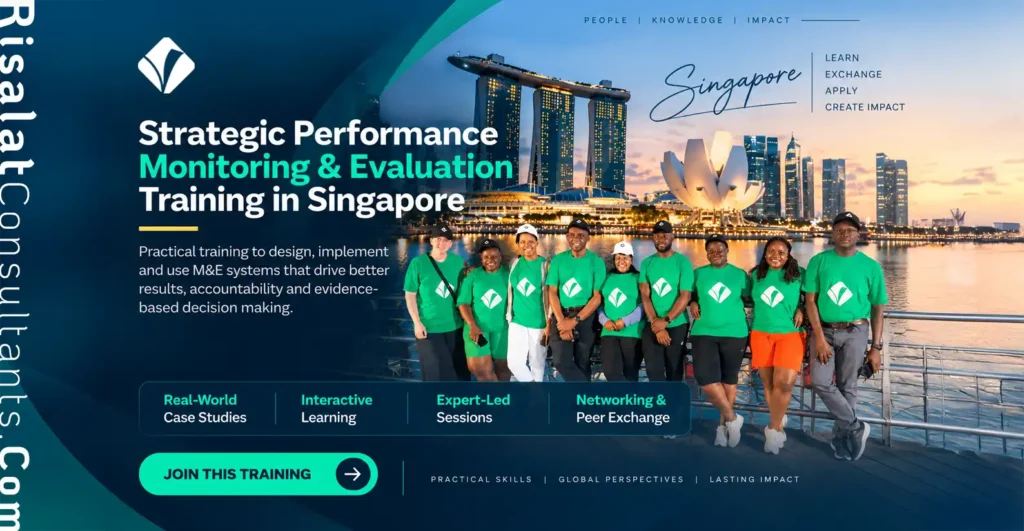
新加坡战略绩效监测与评估培训是一项面向公共机构、发展项目团队以及负责战略绩效监测与评估的组织的实操性专业项目。该课程通过操作示例、引导式分析和模板,将政策预期与日常决策联系起来。
Free self-check: the M&E and MEAL assessment gives a score for your monitoring, evaluation and learning system and the gaps to close first, in about 10 minutes.
公共项目越来越需要可辩护的结果框架、可靠的数据以及根据证据而非仅报告活动数量做出回应的管理决策。
该学习项目在新加坡举行。主办城市是进行结构化同伴学习和比较分析的场所;参加并不意味着得到任何公共机构的认可或获得受限制系统的权限。
Participants examine the complete institutional workflow, from identifying a problem and defining responsibilities to applying controls, monitoring performance and documenting improvements. They work on examples adapted to their own mandates, financing agreements and national rules.
Official guidance is treated as a starting point for professional judgement. Participants are asked to verify which legal provisions, project requirements and internal policies apply to their own organisation before using any template.
The Programme Strengthens Institutional Capability
- Applying results frameworks to real institutional work
- Applying indicator protocols to real institutional work
- Applying baseline design to real institutional work
- 将数据质量保证应用于实际机构工作
- Applying performance dashboards to real institutional work
- Applying evaluation questions to real institutional work
- 将适应性管理应用于实际机构工作
- Applying results reporting to real institutional work
- Documenting decisions involving results frameworks
- 记录涉及指标协议的决策
- 记录涉及基线设计的决策
- Documenting decisions involving data quality assurance
- Documenting decisions involving performance dashboards
- Documenting decisions involving evaluation questions
- 记录涉及适应性管理的决策
- Documenting decisions involving results reporting
- 明确角色、问责制和审批节点
- Planning corrective actions and tracking implementation
- Connecting technical decisions to measurable public outcomes
- Maintaining records suitable for internal review
Each participant develops an action-oriented working pack rather than a generic set of presentation notes.
- 投入
- 活动
- 产出
- 成果
- 影响
The Growing Importance of Strategic Performance Monitoring and Evaluation
公共项目越来越需要可辩护的结果框架、可靠的数据以及根据证据而非仅报告活动数量做出回应的管理决策。
实施团队通常跨政策、技术、采购和财务职能进行工作。如果没有商定的证据要求和升级途径,即使是精心设计的战略也很难始终如一地执行。
The programme therefore treats risk, inclusion, documentation and continuous improvement as linked management responsibilities rather than separate compliance exercises.
各机构日益需要具备以下能力的专业人员:
- Assessing results frameworks against organisational requirements
- Assessing indicator protocols against organisational requirements
- Assessing baseline design against organisational requirements
- Assessing data quality assurance against organisational requirements
- Assessing performance dashboards against organisational requirements
- Assessing evaluation questions against organisational requirements
- Assessing adaptive management against organisational requirements
- Assessing results reporting against organisational requirements
- Translating policy into operational decisions
- Communicating risks to senior management
- Checking the quality of supporting evidence
- Coordinating across institutional boundaries
Strong strategic performance monitoring and evaluation systems help organisations:
- Improve consistency in results frameworks
- Improve consistency in indicator protocols
- Improve consistency in baseline design
- Improve consistency in data quality assurance
- Improve consistency in performance dashboards
- Improve consistency in evaluation questions
- 确保审查决定可追溯
- 更早地对交付问题做出反应
- Build credible institutional learning
- Protect public resources and service quality
The practical emphasis is on choosing proportionate tools, establishing ownership and verifying results. A method is only useful when staff can apply it with the data, authority and resources actually available.
1. What is the best first step when improving results frameworks?
The course emphasises checking applicable guidance and assessing the institution’s existing results frameworks practice before selecting controls.
2. What is the best first step when improving indicator protocols?
The course emphasises checking applicable guidance and assessing the institution’s existing indicator protocols practice before selecting controls.
3. What is the best first step when improving baseline design?
The course emphasises checking applicable guidance and assessing the institution’s existing baseline design practice before selecting controls.
Who Should Attend This Strategic Performance Monitoring and Evaluation Training?
本培训项目适合:
- Programme directors and senior managers
- Government ministry and agency officers
- Project implementation unit managers
- Technical specialists and advisers
- Monitoring and evaluation officers
- 采购与合同经理
- 财务与合规官员
- Institutional capacity development staff
- 质量保证和审计官员
- 发展合作伙伴项目团队
- Regional and municipal government officers
- Non-governmental organisation programme leads
- Policy and planning specialists
- Data and reporting coordinators
- Consultants supporting public institutions
鼓励来自不同职能部门的参会者共同参加,以便在整个交付链条中检验决策和职责。
勾选您的团队需要具备的能力。
Strategic Performance Monitoring and Evaluation Training Objectives
Upon successful completion of this Strategic Performance Monitoring and Evaluation Training, participants will be able to:
- Explain the role of results frameworks in institutional performance
- Explain the role of indicator protocols in institutional performance
- Explain the role of baseline design in institutional performance
- Explain the role of data quality assurance in institutional performance
- Explain the role of performance dashboards in institutional performance
- Prepare a working template for evaluation questions
- 为适应性管理准备工作模板
- Prepare a working template for results reporting
- Assess implementation risks and propose proportionate controls
- Use evidence to prioritise corrective action
- Communicate findings to decision-makers
- Design a practical institutional improvement roadmap
Objectives are assessed through the daily practical tasks and the final applied action plan, not by attendance alone.
培训项目内容与结构
- Introduction to Project Management
- 项目生命周期
- Results Based Management in Projects
- Fundamentals of Strategic Performance Management
- Performance Review Tools
- Success Mapping & Goal Setting
- Defining Monitoring & Evaluation.
- Linking M&E to Project Life Cycle
- Baseline and End Line Studies
- Comparing Monitoring, Evaluation, Reviews and Audits
- Ethics and Standards of M&E
- Effective Approaches to M&E
- Minimizing Bias & Error in M&E Processes
- 项目与规划监测评估的6个步骤
- Determining the Key Project Stakeholders
- 项目利益相关者矩阵
- 确定监测与评估要求
- Planning for Data Collection
- 定量与定性数据收集技术
- Sampling Requirements
- Planning for Data Analysis, Utilization and Storage.
- Plan for M&E HR and capacity building
- Determine the extent of local and external participation
- Define the roles and responsibilities
- Prepare the M&E budget and itemize its needs
- 确定监测评估(M&E)成本和预算要求
- 数据管理标准
- Organizational issues in managing information and data.
- Monitoring and Evaluation Data Analysis and Interpretation
- Utilization-focused approach to evaluation
- Evaluation of advocacy activities and capacity building interventions
- Determining and presenting data outputs
- Consultative communications with stakeholders
- Preparing M&E report
- Developing the Project Performance Audit Report
完整的每日课程内容
The programme follows a progressive learning journey from diagnosis to implementation and institutional follow-up.
- First day: Strategic performance and results frameworks
- Second day: Indicators baselines and targets
- Third day: Data quality and monitoring systems
- Fourth day: Evaluation and management learning
- Fifth day: Performance dashboards and improvement plans
完整的每日课程内容
First Day | Strategic performance and results frameworks
- Introduction to Project Management
- 项目生命周期
- Results Based Management in Projects
- Fundamentals of Strategic Performance Management
- Performance Review Tools
- Success Mapping & Goal Setting
- Defining Monitoring & Evaluation.
- Applying results frameworks to a realistic institutional case
Workshop: Strategic performance and results frameworks in practice
Participants use a fictional but realistic case dossier to work through strategic performance and results frameworks. They identify decision points, assign responsibilities, document the evidence needed for approval and produce a usable template. On the final day they combine their work into a sequenced institutional action plan with owners, milestones and review criteria.
Second Day | Indicators baselines and targets
- Linking M&E to Project Life Cycle
- Baseline and End Line Studies
- Comparing Monitoring, Evaluation, Reviews and Audits
- Ethics and Standards of M&E
- Effective Approaches to M&E
- Minimizing Bias & Error in M&E Processes
- 项目与规划监测评估的6个步骤
- Determining the Purpose & Scope of M&E System.
Workshop: Indicators baselines and targets in practice
Participants use a fictional but realistic case dossier to work through indicators baselines and targets. They identify decision points, assign responsibilities, document the evidence needed for approval and produce a usable template. On the final day they combine their work into a sequenced institutional action plan with owners, milestones and review criteria.
Third Day | Data quality and monitoring systems
- Determining the Key Project Stakeholders
- 项目利益相关者矩阵
- 确定监测与评估要求
- Planning for Data Collection
- 定量与定性数据收集技术
- Sampling Requirements
- Planning for Data Analysis, Utilization and Storage.
- Applying performance dashboards to a realistic institutional case
工作坊:实践中的数据质量与监测系统
Participants use a fictional but realistic case dossier to work through data quality and monitoring systems. They identify decision points, assign responsibilities, document the evidence needed for approval and produce a usable template. On the final day they combine their work into a sequenced institutional action plan with owners, milestones and review criteria.
Fourth Day | Evaluation and management learning
- Plan for M&E HR and capacity building
- Determine the extent of local and external participation
- Define the roles and responsibilities
- Prepare the M&E budget and itemize its needs
- 确定监测评估(M&E)成本和预算要求
- 数据管理标准
- Organizational issues in managing information and data.
- Applying adaptive management to a realistic institutional case
Workshop: Evaluation and management learning in practice
Participants use a fictional but realistic case dossier to work through evaluation and management learning. They identify decision points, assign responsibilities, document the evidence needed for approval and produce a usable template. On the final day they combine their work into a sequenced institutional action plan with owners, milestones and review criteria.
第五天 | 绩效仪表盘与改进计划
- Monitoring and Evaluation Data Analysis and Interpretation
- Utilization-focused approach to evaluation
- Evaluation of advocacy activities and capacity building interventions
- Determining and presenting data outputs
- Consultative communications with stakeholders
- Preparing M&E report
- Developing the Project Performance Audit Report
- 未来建议与经验教训
Capstone Exercise: Performance dashboards and improvement plans in practice
Participants use a fictional but realistic case dossier to work through performance dashboards and improvement plans. They identify decision points, assign responsibilities, document the evidence needed for approval and produce a usable template. On the final day they combine their work into a sequenced institutional action plan with owners, milestones and review criteria.
Strategic Performance Monitoring and Evaluation Training Methodology
The learning approach combines short technical explanations with practical exercises. Participants are encouraged to bring anonymised policies, templates or operational questions where disclosure is permitted.
本培训项目融合了:
- Facilitated technical briefings
- Participant needs assessment
- Document review using official guidance
- Small-group problem diagnosis
- Case-based decision exercises
- Template development workshops
- Peer review and feedback
- 基于角色的情景模拟
- Risk and control mapping
- Daily learning checks
- Facilitated action planning
- Post-session reflection
Case material distinguishes internationally recognised principles from requirements that depend on a particular country, donor agreement or organisational mandate.
The facilitator reviews learning needs at the outset and adjusts examples to participants’ functions without promising access to confidential project documents or third-party systems.
预期成果
Upon completion of this Strategic Performance Monitoring and Evaluation Training, participants will be able to:
- A practical checklist for results frameworks
- A practical checklist for indicator protocols
- A practical checklist for baseline design
- A practical checklist for data quality assurance
- A practical checklist for performance dashboards
- A practical checklist for evaluation questions
- A documented risk and escalation register
- A concise management briefing
- A 30, 60 and 90-day implementation roadmap
- An evidence and follow-up schedule
预期的成果是更强的组织能力。个人产出在成为批准的机构程序之前需要进行审查和调整。
每位学员£3,850 · 发票与银行转账 · 5人及以上团体可享折扣
同一机构五人及以上:请在申请发票时索取团体价。
Ten or more: an in-house version for your institution may cost less per person. Ask for an in-house quote.
注册截止于 70天后 (2027年1月31日)
Institutional Application of Strategic Performance Monitoring and Evaluation Training
本培训项目帮助机构加强:
- Governance and oversight of results frameworks
- Governance and oversight of indicator protocols
- Governance and oversight of baseline design
- Governance and oversight of data quality assurance
- Governance and oversight of performance dashboards
- Governance and oversight of evaluation questions
- Governance and oversight of adaptive management
- 结果报告的治理与监督
- Documented decision-making
- Internal coordination and escalation
- 保证与质量审查
- Staff capability development
学员将带着实用工具回到工作岗位,以提升:
- Results frameworks workflows
- Indicator protocols workflows
- Baseline design workflows
- Data quality assurance workflows
- Performance dashboards workflows
- 评估问题工作流
- Adaptive management workflows
- Results reporting workflows
- Management reporting
- Follow-up and accountability
Teams can adapt these tools for annual plans, project implementation manuals, internal controls and operational review meetings. For a broader organisational baseline, the <a href=”https://risalatconsultants.com/diagnostics/institutional-capacity-assessment/”>institutional capacity diagnostic</a> offers a structured starting point.
Regional Relevance & Application
Asia and the Pacific
Government and development teams across Asia and the Pacific can apply strategic performance monitoring and evaluation to multi-agency projects, local service delivery and donor reporting. Specific financing rules must be checked against each project agreement.
非洲
Public institutions and implementation units can use the course tools to improve implementation readiness, evidence quality and operational controls across geographically dispersed programmes.
欧洲和中亚
Participants can compare domestic procedures with relevant European and international guidance while keeping legal and contractual obligations distinct.
中东
Large infrastructure and public transformation programmes benefit from clear roles, contract controls, performance indicators and transparent management decisions.
Examples are selected to support cross-regional learning without assuming that one country’s legal or operational model can be transferred unchanged.
东道国概况:新加坡
Singapore is the host city for this international programme. Its role is to provide a setting for concentrated technical learning, peer exchange and comparative discussion among participating organisations.
The host setting in Singapore supports comparative discussion of institutional practice. The course relies on published international guidance rather than unverified claims about host institutions.
International participants should verify visa eligibility, entry rules and travel arrangements with the relevant authorities before departure. Risalat provides administrative visa guidance but cannot guarantee entry or visa issuance.
Strategic Performance Monitoring and Evaluation Training Deliverables
该项目包括在课程之前、期间和之后进行的协调学习和学员支持。
培训开始前
- 学员课前评估
- Strategic Performance Monitoring and Evaluation Readiness Assessment
- Strategic Performance Monitoring and Evaluation Resource Pack
- 课前阅读资料
- 免费签证支持与咨询
培训期间
- 机场接机与欢迎协助
- Accommodation with breakfast: 6 nights, check-in Sunday 18 April 2027, check-out Saturday 24 April 2027 (one night before and one night after the programme)
- 欢迎交流晚宴
- Risalat培训礼包(背包、水瓶、马克杯、T恤、帽子、护照套、笔、笔记本、冰箱贴及钥匙扣)
- Comprehensive Strategic Performance Monitoring and Evaluation Training Manual
- Results Frameworks Template
- Indicator Protocols Template
- Baseline Design Template
- Data Quality Assurance Template
- Performance Dashboards Template
- 实践研讨与模拟演练
- 小组讨论与同伴学习
- 每日午餐与茶歇
- 全面使用培训场地设施
- 装有数字学习资料的迷你平板电脑
- 实地考察(如适用)
- 城市休闲观光
培训结束后
- 结业证书
- Risalat培训项目参与表彰奖
- 培训后参考资料
- 结果框架行动检查表
- Indicator Protocols Review Template
- Institutional Action Plan
- 培训后支持与跟进指导
- 培训项目报告
Institutions requiring a tailored delivery can request an in-house programme proposal with cases and exercises aligned to their operating context.
Common Challenges in Strategic Performance Monitoring and Evaluation, And How This Training Helps
我们的组织如何在不增加不必要官僚作风的情况下改进结果框架?
The first day examines results frameworks through a practical exercise. Participants define the minimum evidence required, agree responsible officers, test exceptions and identify an improvement that can be introduced through existing decision-making processes.
我们的组织如何在不增加不必要官僚主义的情况下改进指标协议?
The first day examines indicator protocols through a practical exercise. Participants define the minimum evidence required, agree responsible officers, test exceptions and identify an improvement that can be introduced through existing decision-making processes.
How can our organisation improve baseline design without adding unnecessary bureaucracy?
第二天通过实践练习审视基线设计。参与者明确所需的最低证据、商定责任官员、测试例外情况并确定可以通过现有决策流程引入的改进。
How can our organisation improve data quality assurance without adding unnecessary bureaucracy?
The second day examines data quality assurance through a practical exercise. Participants define the minimum evidence required, agree responsible officers, test exceptions and identify an improvement that can be introduced through existing decision-making processes.
How can our organisation improve performance dashboards without adding unnecessary bureaucracy?
The third day examines performance dashboards through a practical exercise. Participants define the minimum evidence required, agree responsible officers, test exceptions and identify an improvement that can be introduced through existing decision-making processes.
How can our organisation improve evaluation questions without adding unnecessary bureaucracy?
The third day examines evaluation questions through a practical exercise. Participants define the minimum evidence required, agree responsible officers, test exceptions and identify an improvement that can be introduced through existing decision-making processes.
How can our organisation improve adaptive management without adding unnecessary bureaucracy?
The fourth day examines adaptive management through a practical exercise. Participants define the minimum evidence required, agree responsible officers, test exceptions and identify an improvement that can be introduced through existing decision-making processes.
How can our organisation improve results reporting without adding unnecessary bureaucracy?
The fourth day examines results reporting through a practical exercise. Participants define the minimum evidence required, agree responsible officers, test exceptions and identify an improvement that can be introduced through existing decision-making processes.
Explore further professional training categories or use the training needs assessment to prioritise staff development.
常见问题
Who should attend strategic performance monitoring and evaluation training?
Government officials, technical specialists, project implementation teams, managers and advisers with responsibilities relevant to the subject.
该项目是否包含实操练习?
Yes. Each day includes a structured exercise, and the final day produces a practical action plan.
Are donor rules and national requirements treated as identical?
No. The programme distinguishes international guidance from requirements specific to each agreement, regulator and institution.
参与者将获得模板和后续跟进材料吗?
Yes. Participants work with editable checklists, planning tools, reference materials and a programme report.
Is travel or a technical visit in Singapore guaranteed?
The programme is hosted in the stated city. External technical visits depend on host confirmation and may be replaced with an equivalent case exercise.
Who Will Deliver This Programme
Each date is delivered by a team assigned from Risalat's expert network for this subject. For this programme we assign:
How we choose them: Experience in the region of the participants or comparable settings; Command of the financier rules that apply (World Bank, ADB, AfDB, EU, UN) where relevant; Delivery in English; other languages on request for in-house groups; No conflict of interest with participants' institutions.
新加坡培训课程M&E & Performance Management training courses
For teams and institutions
Bring your team
Teams that learn together apply more at work. Tell us how many people and how you would like to take part: we reply with a group quote within two working days.
Watch: this programme in short


该主题的其他日期和城市:监测与评估培训课程(59 个即将到来的日期)。
在路线图中规划此项目:为什么重要、为什么要批准它、要计划的日期以及它所构建的职业生涯。