Points clés
- Dates
- 19–23 avr. 2027 (5 jours)
- Lieu
- Novotel Singapore On Stevens, Singapour
- Frais par participant
- 3 850 £ (GBP)
- Paiement
- Sur facture et par virement bancaire
- Clôture des inscriptions
- 31 janv. 2027
- Format
- 5-day short course: a practical capacity-building programme for government, NGO and project teams in Singapore
- Certificat
- Certificat de participation
- Option intra
- Organisez-le pour votre équipe, à vos dates
Sur cette page 14 sections
Présentation du programme
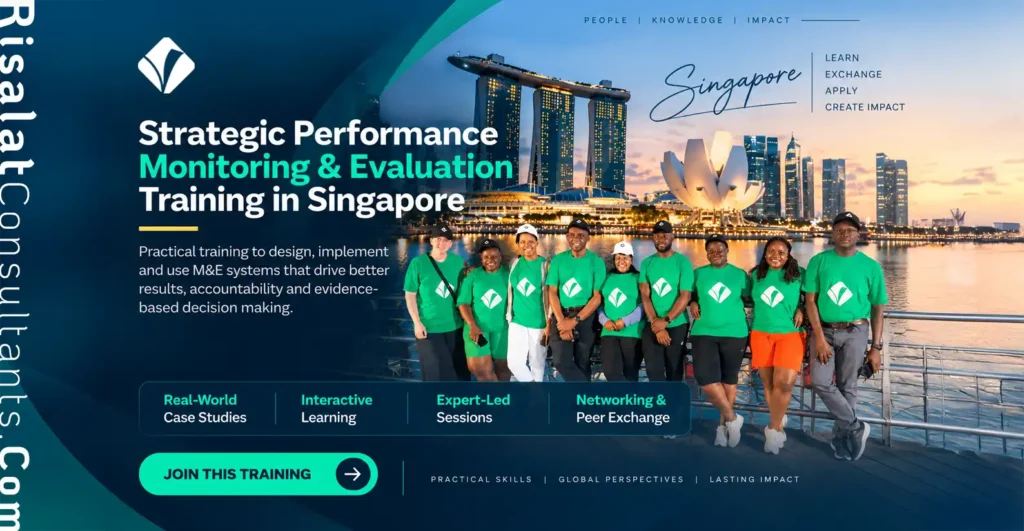
La formation sur le suivi et l'évaluation de la performance stratégique à Singapour est un programme professionnel axé sur la pratique destiné aux organismes publics, aux équipes de projets de développement et aux organisations responsables du suivi et de l'évaluation de la performance stratégique. Le cours utilise des exemples opérationnels, des analyses guidées et des modèles pour relier les attentes politiques aux décisions quotidiennes.
Free self-check: the M&E and MEAL assessment gives a score for your monitoring, evaluation and learning system and the gaps to close first, in about 10 minutes.
Public programmes increasingly require defensible results frameworks, reliable data and management decisions that respond to evidence rather than reporting activity counts alone.
The learning programme takes place in Singapore. The host city is a venue for structured peer learning and comparative analysis; participation does not imply endorsement by any public institution or access to restricted systems.
Participants examine the complete institutional workflow, from identifying a problem and defining responsibilities to applying controls, monitoring performance and documenting improvements. They work on examples adapted to their own mandates, financing agreements and national rules.
Les orientations officielles sont considérées comme un point de départ pour le jugement professionnel. Il est demandé aux participants de vérifier quelles dispositions juridiques, exigences de projet et politiques internes s'g appliquent à leur propre organisation avant d'utiliser un modèle.
The Programme Strengthens Institutional Capability
- Appliquer des cadres de résultats au travail institutionnel réel
- Applying indicator protocols to real institutional work
- Applying baseline design to real institutional work
- Application de l'assurance de la qualité des données au travail institutionnel réel
- Applying performance dashboards to real institutional work
- Applying evaluation questions to real institutional work
- Applying adaptive management to real institutional work
- Applying results reporting to real institutional work
- Documenting decisions involving results frameworks
- Documenting decisions involving indicator protocols
- Documenting decisions involving baseline design
- Documenting decisions involving data quality assurance
- Documenting decisions involving performance dashboards
- Documenting decisions involving evaluation questions
- Documenting decisions involving adaptive management
- Documenting decisions involving results reporting
- Identifying roles, accountabilities and approval points
- Planning corrective actions and tracking implementation
- Connecting technical decisions to measurable public outcomes
- Maintaining records suitable for internal review
Chaque participant élabore un dossier de travail orienté vers l'action plutôt qu'un ensemble générique de notes de présentation.
- Intrants
- Activités
- Produits
- Effets
- Impact
The Growing Importance of Strategic Performance Monitoring and Evaluation
Public programmes increasingly require defensible results frameworks, reliable data and management decisions that respond to evidence rather than reporting activity counts alone.
Les équipes de mise en œuvre travaillent souvent à travers des fonctions politiques, techniques, d'achats et financières. Sans exigences de preuve convenues et sans voies d'escalade, même une stratégie bien conçue peut être difficile à mettre en œuvre de manière cohérente.
Le programme traite donc le risque, l'inclusion, la documentation et l'amélioration continue comme des responsabilités de gestion liées plutôt que comme des exercices de conformité distincts.
Les organisations ont de plus en plus besoin de professionnels capables de :
- Assessing results frameworks against organisational requirements
- Assessing indicator protocols against organisational requirements
- Assessing baseline design against organisational requirements
- Assessing data quality assurance against organisational requirements
- Assessing performance dashboards against organisational requirements
- Assessing evaluation questions against organisational requirements
- Assessing adaptive management against organisational requirements
- Assessing results reporting against organisational requirements
- Translating policy into operational decisions
- Communicating risks to senior management
- Checking the quality of supporting evidence
- Coordinating across institutional boundaries
Strong strategic performance monitoring and evaluation systems help organisations:
- Improve consistency in results frameworks
- Improve consistency in indicator protocols
- Improve consistency in baseline design
- Améliorer la cohérence de l'assurance de la qualité des données
- Improve consistency in performance dashboards
- Improve consistency in evaluation questions
- Make review decisions traceable
- Respond earlier to delivery problems
- Build credible institutional learning
- Protect public resources and service quality
The practical emphasis is on choosing proportionate tools, establishing ownership and verifying results. A method is only useful when staff can apply it with the data, authority and resources actually available.
1. What is the best first step when improving results frameworks?
The course emphasises checking applicable guidance and assessing the institution’s existing results frameworks practice before selecting controls.
2. What is the best first step when improving indicator protocols?
The course emphasises checking applicable guidance and assessing the institution’s existing indicator protocols practice before selecting controls.
3. What is the best first step when improving baseline design?
The course emphasises checking applicable guidance and assessing the institution’s existing baseline design practice before selecting controls.
Who Should Attend This Strategic Performance Monitoring and Evaluation Training?
Ce programme s'adresse à :
- Programme directors and senior managers
- Government ministry and agency officers
- Project implementation unit managers
- Technical specialists and advisers
- Monitoring and evaluation officers
- Responsables de la passation des marchés et des contrats
- Responsables financiers et de la conformité
- Institutional capacity development staff
- Quality assurance and audit officers
- Development partner programme teams
- Regional and municipal government officers
- Non-governmental organisation programme leads
- Policy and planning specialists
- Data and reporting coordinators
- Consultants supporting public institutions
Participants from different functions are encouraged to attend together so that decisions and responsibilities can be tested across the whole delivery chain.
Cochez ce que votre équipe doit être capable de faire.
Strategic Performance Monitoring and Evaluation Training Objectives
Upon successful completion of this Strategic Performance Monitoring and Evaluation Training, participants will be able to:
- Explain the role of results frameworks in institutional performance
- Explain the role of indicator protocols in institutional performance
- Explain the role of baseline design in institutional performance
- Expliquer le rôle de l'assurance de la qualité des données dans la performance institutionnelle
- Explain the role of performance dashboards in institutional performance
- Prepare a working template for evaluation questions
- Prepare a working template for adaptive management
- Prepare a working template for results reporting
- Assess implementation risks and propose proportionate controls
- Use evidence to prioritise corrective action
- Communicate findings to decision-makers
- Design a practical institutional improvement roadmap
Objectives are assessed through the daily practical tasks and the final applied action plan, not by attendance alone.
Contenu et structure du programme
- Introduction to Project Management
- Cycle de vie du projet
- Results Based Management in Projects
- Fundamentals of Strategic Performance Management
- Performance Review Tools
- Success Mapping & Goal Setting
- Defining Monitoring & Evaluation.
- Linking M&E to Project Life Cycle
- Études de référence et finales
- Comparaison entre suivi, évaluation, examens et audits
- Ethics and Standards of M&E
- Effective Approaches to M&E
- Minimizing Bias & Error in M&E Processes
- 6 Steps of Project & Programme M&E
- Determining the Key Project Stakeholders
- Matrice des parties prenantes du projet
- Identifying M&E Requirements
- Planning for Data Collection
- Quantitative & Qualitative Data Gathering Techniques
- Sampling Requirements
- Planification de l'analyse, de l'utilisation et du stockage des données.
- Plan for M&E HR and capacity building
- Determine the extent of local and external participation
- Define the roles and responsibilities
- Prepare the M&E budget and itemize its needs
- Determine M&E costs and budget requirements
- Normes en matière de gestion des données
- Organizational issues in managing information and data.
- Monitoring and Evaluation Data Analysis and Interpretation
- Utilization-focused approach to evaluation
- Evaluation of advocacy activities and capacity building interventions
- Détermination et présentation des résultats de données
- Consultative communications with stakeholders
- Preparing M&E report
- Developing the Project Performance Audit Report
Contenu détaillé jour par jour
The programme follows a progressive learning journey from diagnosis to implementation and institutional follow-up.
- First day: Strategic performance and results frameworks
- Second day: Indicators baselines and targets
- Troisième jour : Qualité des données et systèmes de suivi
- Fourth day: Evaluation and management learning
- Fifth day: Performance dashboards and improvement plans
Contenu détaillé jour par jour
First Day | Strategic performance and results frameworks
- Introduction to Project Management
- Cycle de vie du projet
- Results Based Management in Projects
- Fundamentals of Strategic Performance Management
- Performance Review Tools
- Success Mapping & Goal Setting
- Defining Monitoring & Evaluation.
- Applying results frameworks to a realistic institutional case
Workshop: Strategic performance and results frameworks in practice
Participants use a fictional but realistic case dossier to work through strategic performance and results frameworks. They identify decision points, assign responsibilities, document the evidence needed for approval and produce a usable template. On the final day they combine their work into a sequenced institutional action plan with owners, milestones and review criteria.
Second Day | Indicators baselines and targets
- Linking M&E to Project Life Cycle
- Études de référence et finales
- Comparaison entre suivi, évaluation, examens et audits
- Ethics and Standards of M&E
- Effective Approaches to M&E
- Minimizing Bias & Error in M&E Processes
- 6 Steps of Project & Programme M&E
- Determining the Purpose & Scope of M&E System.
Workshop: Indicators baselines and targets in practice
Participants use a fictional but realistic case dossier to work through indicators baselines and targets. They identify decision points, assign responsibilities, document the evidence needed for approval and produce a usable template. On the final day they combine their work into a sequenced institutional action plan with owners, milestones and review criteria.
Third Day | Data quality and monitoring systems
- Determining the Key Project Stakeholders
- Matrice des parties prenantes du projet
- Identifying M&E Requirements
- Planning for Data Collection
- Quantitative & Qualitative Data Gathering Techniques
- Sampling Requirements
- Planification de l'analyse, de l'utilisation et du stockage des données.
- Applying performance dashboards to a realistic institutional case
Workshop: Data quality and monitoring systems in practice
Participants use a fictional but realistic case dossier to work through data quality and monitoring systems. They identify decision points, assign responsibilities, document the evidence needed for approval and produce a usable template. On the final day they combine their work into a sequenced institutional action plan with owners, milestones and review criteria.
Fourth Day | Evaluation and management learning
- Plan for M&E HR and capacity building
- Determine the extent of local and external participation
- Define the roles and responsibilities
- Prepare the M&E budget and itemize its needs
- Determine M&E costs and budget requirements
- Normes en matière de gestion des données
- Organizational issues in managing information and data.
- Applying adaptive management to a realistic institutional case
Workshop: Evaluation and management learning in practice
Participants use a fictional but realistic case dossier to work through evaluation and management learning. They identify decision points, assign responsibilities, document the evidence needed for approval and produce a usable template. On the final day they combine their work into a sequenced institutional action plan with owners, milestones and review criteria.
Cinquième jour | Tableaux de bord de performance et plans d'amélioration
- Monitoring and Evaluation Data Analysis and Interpretation
- Utilization-focused approach to evaluation
- Evaluation of advocacy activities and capacity building interventions
- Détermination et présentation des résultats de données
- Consultative communications with stakeholders
- Preparing M&E report
- Developing the Project Performance Audit Report
- Future recommendations and lessons learned
Capstone Exercise: Performance dashboards and improvement plans in practice
Participants use a fictional but realistic case dossier to work through performance dashboards and improvement plans. They identify decision points, assign responsibilities, document the evidence needed for approval and produce a usable template. On the final day they combine their work into a sequenced institutional action plan with owners, milestones and review criteria.
Strategic Performance Monitoring and Evaluation Training Methodology
The learning approach combines short technical explanations with practical exercises. Participants are encouraged to bring anonymised policies, templates or operational questions where disclosure is permitted.
Le programme associe :
- Facilitated technical briefings
- Évaluation des besoins des participants
- Document review using official guidance
- Small-group problem diagnosis
- Case-based decision exercises
- Template development workshops
- Peer review and feedback
- Role-based scenario simulations
- Risk and control mapping
- Daily learning checks
- Facilitated action planning
- Post-session reflection
Case material distinguishes internationally recognised principles from requirements that depend on a particular country, donor agreement or organisational mandate.
The facilitator reviews learning needs at the outset and adjusts examples to participants’ functions without promising access to confidential project documents or third-party systems.
Résultats attendus
Upon completion of this Strategic Performance Monitoring and Evaluation Training, participants will be able to:
- A practical checklist for results frameworks
- A practical checklist for indicator protocols
- A practical checklist for baseline design
- A practical checklist for data quality assurance
- A practical checklist for performance dashboards
- A practical checklist for evaluation questions
- A documented risk and escalation register
- A concise management briefing
- A 30, 60 and 90-day implementation roadmap
- An evidence and follow-up schedule
The intended outcome is stronger organisational capability. Individual outputs require review and adaptation before they become approved institutional procedures.
3 850 £ par participant · facture et virement bancaire · réduction pour les groupes de 5 personnes ou plus
Cinq personnes ou plus d'une même organisation : demandez le tarif de groupe lors de votre demande de facture.
Dix personnes ou plus : une version interne pour votre institution peut coûter moins cher par personne. Demander un devis pour une formation interne.
Registration closes in 69 days (31 Jan 2027)
Institutional Application of Strategic Performance Monitoring and Evaluation Training
Ce programme aide les organisations à renforcer :
- Governance and oversight of results frameworks
- Gouvernance et supervision des protocoles d'indicateurs
- Governance and oversight of baseline design
- Governance and oversight of data quality assurance
- Governance and oversight of performance dashboards
- Governance and oversight of evaluation questions
- Governance and oversight of adaptive management
- Governance and oversight of results reporting
- Documented decision-making
- Internal coordination and escalation
- Assurance and quality review
- Staff capability development
Les participants repartent avec des outils pratiques pour améliorer :
- Results frameworks workflows
- Indicator protocols workflows
- Baseline design workflows
- Data quality assurance workflows
- Performance dashboards workflows
- Evaluation questions workflows
- Adaptive management workflows
- Results reporting workflows
- Rapports de gestion
- Follow-up and accountability
Teams can adapt these tools for annual plans, project implementation manuals, internal controls and operational review meetings. For a broader organisational baseline, the <a href=”https://risalatconsultants.com/diagnostics/institutional-capacity-assessment/”>institutional capacity diagnostic</a> offers a structured starting point.
Regional Relevance & Application
Asie et Pacifique
Government and development teams across Asia and the Pacific can apply strategic performance monitoring and evaluation to multi-agency projects, local service delivery and donor reporting. Specific financing rules must be checked against each project agreement.
Afrique
Public institutions and implementation units can use the course tools to improve implementation readiness, evidence quality and operational controls across geographically dispersed programmes.
Europe et Asie centrale
Participants can compare domestic procedures with relevant European and international guidance while keeping legal and contractual obligations distinct.
Moyen-Orient
Large infrastructure and public transformation programmes benefit from clear roles, contract controls, performance indicators and transparent management decisions.
Examples are selected to support cross-regional learning without assuming that one country’s legal or operational model can be transferred unchanged.
Profil du pays d'accueil – Singapour
Singapore is the host city for this international programme. Its role is to provide a setting for concentrated technical learning, peer exchange and comparative discussion among participating organisations.
The host setting in Singapore supports comparative discussion of institutional practice. The course relies on published international guidance rather than unverified claims about host institutions.
International participants should verify visa eligibility, entry rules and travel arrangements with the relevant authorities before departure. Risalat provides administrative visa guidance but cannot guarantee entry or visa issuance.
Strategic Performance Monitoring and Evaluation Training Deliverables
The programme includes coordinated learning and participant support before, during and after the course.
Avant le programme
- Pré-évaluation des participants
- Strategic Performance Monitoring and Evaluation Readiness Assessment
- Strategic Performance Monitoring and Evaluation Resource Pack
- Lectures préparatoires
- Aide et conseils gratuits pour le visa
Pendant le programme
- Accueil à l'aéroport & assistance à l'arrivée
- Hébergement avec petit-déjeuner : 6 nuits, arrivée le dimanche 18 avril 2027, départ le samedi 24 avril 2027 (une nuit avant et une nuit après le programme)
- Dîner de bienvenue et de réseautage
- Kit de formation Risalat (sac, gourde, mug, t-shirt, casquette, protège-passeport, stylos, carnet, magnet & porte-clés)
- Comprehensive Strategic Performance Monitoring and Evaluation Training Manual
- Results Frameworks Template
- Indicator Protocols Template
- Baseline Design Template
- Data Quality Assurance Template
- Performance Dashboards Template
- Ateliers pratiques & simulations
- Discussions de groupe & apprentissage entre pairs
- Déjeuner et pauses-café quotidiens
- Accès complet aux installations du lieu de formation
- Mini tablette avec supports pédagogiques numériques
- Visite de terrain (le cas échéant)
- Visite récréative de la ville
Après le programme
- Certificat de participation
- Distinction Risalat de participation au programme
- Documents de référence après la formation
- Results Frameworks Action Checklist
- Indicator Protocols Review Template
- Plan d'action institutionnel
- Accompagnement après la formation & conseils de suivi
- Rapport du programme
Institutions requiring a tailored delivery can request an in-house programme proposal with cases and exercises aligned to their operating context.
Common Challenges in Strategic Performance Monitoring and Evaluation, And How This Training Helps
How can our organisation improve results frameworks without adding unnecessary bureaucracy?
The first day examines results frameworks through a practical exercise. Participants define the minimum evidence required, agree responsible officers, test exceptions and identify an improvement that can be introduced through existing decision-making processes.
How can our organisation improve indicator protocols without adding unnecessary bureaucracy?
Le premier jour examine les protocoles d'indicateurs à travers un exercice pratique. Les participants définissent les preuves minimales requises, conviennent des responsables, testent les exceptions et identifient une amélioration qui peut être introduite par le biais des processus de décision existants.
How can our organisation improve baseline design without adding unnecessary bureaucracy?
The second day examines baseline design through a practical exercise. Participants define the minimum evidence required, agree responsible officers, test exceptions and identify an improvement that can be introduced through existing decision-making processes.
How can our organisation improve data quality assurance without adding unnecessary bureaucracy?
The second day examines data quality assurance through a practical exercise. Participants define the minimum evidence required, agree responsible officers, test exceptions and identify an improvement that can be introduced through existing decision-making processes.
How can our organisation improve performance dashboards without adding unnecessary bureaucracy?
The third day examines performance dashboards through a practical exercise. Participants define the minimum evidence required, agree responsible officers, test exceptions and identify an improvement that can be introduced through existing decision-making processes.
How can our organisation improve evaluation questions without adding unnecessary bureaucracy?
The third day examines evaluation questions through a practical exercise. Participants define the minimum evidence required, agree responsible officers, test exceptions and identify an improvement that can be introduced through existing decision-making processes.
How can our organisation improve adaptive management without adding unnecessary bureaucracy?
The fourth day examines adaptive management through a practical exercise. Participants define the minimum evidence required, agree responsible officers, test exceptions and identify an improvement that can be introduced through existing decision-making processes.
How can our organisation improve results reporting without adding unnecessary bureaucracy?
The fourth day examines results reporting through a practical exercise. Participants define the minimum evidence required, agree responsible officers, test exceptions and identify an improvement that can be introduced through existing decision-making processes.
Explore further professional training categories or use the training needs assessment to prioritise staff development.
Questions fréquentes
Who should attend strategic performance monitoring and evaluation training?
Government officials, technical specialists, project implementation teams, managers and advisers with responsibilities relevant to the subject.
Does the programme include practical exercises?
Yes. Each day includes a structured exercise, and the final day produces a practical action plan.
Are donor rules and national requirements treated as identical?
No. The programme distinguishes international guidance from requirements specific to each agreement, regulator and institution.
Will participants receive templates and follow-up materials?
Yes. Participants work with editable checklists, planning tools, reference materials and a programme report.
Is travel or a technical visit in Singapore guaranteed?
The programme is hosted in the stated city. External technical visits depend on host confirmation and may be replaced with an equivalent case exercise.
Who Will Deliver This Programme
Each date is delivered by a team assigned from Risalat's expert network for this subject. For this programme we assign:
How we choose them: Experience in the region of the participants or comparable settings; Command of the financier rules that apply (World Bank, ADB, AfDB, EU, UN) where relevant; Delivery in English; other languages on request for in-house groups; No conflict of interest with participants' institutions.
Formations à SingapourM&E & Performance Management training courses
Pour les équipes et les institutions
Bring your team
Teams that learn together apply more at work. Tell us how many people and how you would like to take part: we reply with a group quote within two working days.
Watch: this programme in short



Other dates and cities for this subject: Monitoring and Evaluation training courses (59 upcoming dates).
Plus de formations à Singapour · Tous les programmes en Asie · Calendrier complet des formations
Plan this programme in a roadmap: why it matters, why to approve it, the dates to plan and the career it builds.