Datos clave
- Fechas
- 19–23 abr 2027 (5 días)
- Dónde
- Novotel Singapore On Stevens, Singapur
- Tarifa por participante
- 3.850 £ (GBP)
- Pago
- Mediante factura y transferencia bancaria
- Cierre de inscripciones
- 31 ene 2027
- Formato
- 5-day short course: a practical capacity-building programme for government, NGO and project teams in Singapore
- Certificado
- Certificado de finalización
- Opción interna
- Impártalo para su equipo, en sus fechas
En esta página 14 secciones
Descripción del programa
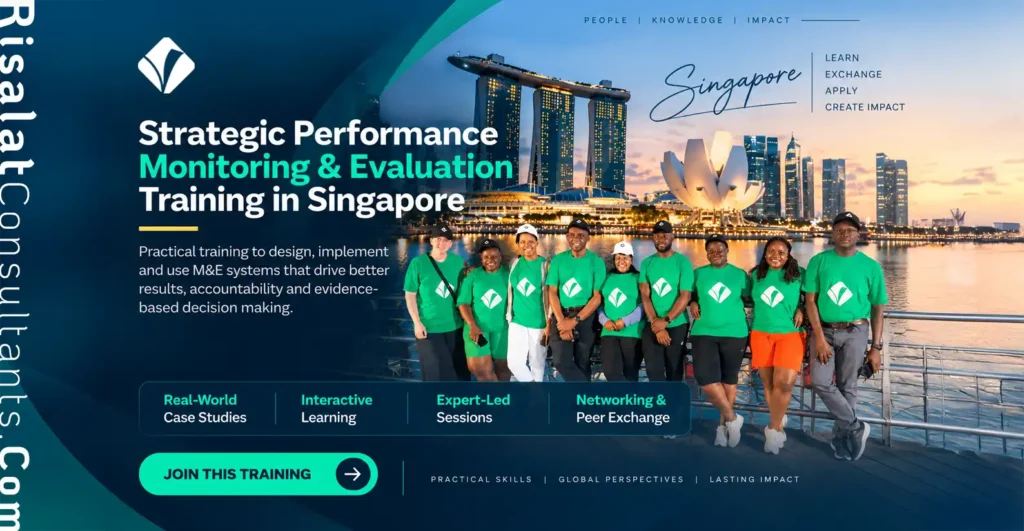
La capacitación en seguimiento y evaluación del desempeño estratégico en Singapur es un programa profesional basado en la práctica para agencias públicas, equipos de proyectos de desarrollo y organizaciones responsables del seguimiento y evaluación del desempeño estratégico. El curso utiliza ejemplos operativos, análisis guiados y plantillas para conectar las expectativas de las políticas con las decisiones diarias.
Free self-check: the M&E and MEAL assessment gives a score for your monitoring, evaluation and learning system and the gaps to close first, in about 10 minutes.
Los programas públicos requieren cada vez más marcos de resultados defendibles, datos fiables y decisiones de gestión que respondan a la evidencia en lugar de limitarse a contabilizar las actividades informadas.
El programa de aprendizaje se lleva a cabo en Singapur. La ciudad anfitriona es un lugar para el aprendizaje estructurado entre pares y el análisis comparativo; la participación no implica el respaldo de ninguna institución pública ni el acceso a sistemas restringidos.
Participants examine the complete institutional workflow, from identifying a problem and defining responsibilities to applying controls, monitoring performance and documenting improvements. They work on examples adapted to their own mandates, financing agreements and national rules.
Official guidance is treated as a starting point for professional judgement. Participants are asked to verify which legal provisions, project requirements and internal policies apply to their own organisation before using any template.
The Programme Strengthens Institutional Capability
- Applying results frameworks to real institutional work
- Applying indicator protocols to real institutional work
- Applying baseline design to real institutional work
- Aplicación de la garantía de calidad de datos al trabajo institucional real
- Applying performance dashboards to real institutional work
- Applying evaluation questions to real institutional work
- Aplicación de la gestión adaptativa al trabajo institucional real
- Applying results reporting to real institutional work
- Documenting decisions involving results frameworks
- Documentación de decisiones relacionadas con los protocolos de indicadores
- Documentación de decisiones relacionadas con el diseño de la línea de base
- Documenting decisions involving data quality assurance
- Documenting decisions involving performance dashboards
- Documenting decisions involving evaluation questions
- Documentación de decisiones que implican gestión adaptativa
- Documenting decisions involving results reporting
- Identificación de funciones, responsabilidades y puntos de aprobación
- Planning corrective actions and tracking implementation
- Connecting technical decisions to measurable public outcomes
- Maintaining records suitable for internal review
Each participant develops an action-oriented working pack rather than a generic set of presentation notes.
- Insumos
- Actividades
- Productos
- Efectos
- Impacto
The Growing Importance of Strategic Performance Monitoring and Evaluation
Los programas públicos requieren cada vez más marcos de resultados defendibles, datos fiables y decisiones de gestión que respondan a la evidencia en lugar de limitarse a contabilizar las actividades informadas.
Los equipos de implementación a menudo trabajan en funciones de políticas, técnicas, adquisiciones y finanzas. Sin requisitos de evidencia acordados y rutas de escalamiento, incluso una estrategia bien diseñada puede ser difícil de implementar de manera consistente.
The programme therefore treats risk, inclusion, documentation and continuous improvement as linked management responsibilities rather than separate compliance exercises.
Las organizaciones necesitan cada vez más profesionales capaces de:
- Assessing results frameworks against organisational requirements
- Assessing indicator protocols against organisational requirements
- Assessing baseline design against organisational requirements
- Assessing data quality assurance against organisational requirements
- Assessing performance dashboards against organisational requirements
- Assessing evaluation questions against organisational requirements
- Assessing adaptive management against organisational requirements
- Assessing results reporting against organisational requirements
- Translating policy into operational decisions
- Communicating risks to senior management
- Checking the quality of supporting evidence
- Coordinating across institutional boundaries
Strong strategic performance monitoring and evaluation systems help organisations:
- Improve consistency in results frameworks
- Improve consistency in indicator protocols
- Improve consistency in baseline design
- Improve consistency in data quality assurance
- Improve consistency in performance dashboards
- Improve consistency in evaluation questions
- Hacer que las decisiones de revisión sean rastreables
- Responder con mayor antelación a los problemas de entrega
- Build credible institutional learning
- Protect public resources and service quality
The practical emphasis is on choosing proportionate tools, establishing ownership and verifying results. A method is only useful when staff can apply it with the data, authority and resources actually available.
1. What is the best first step when improving results frameworks?
The course emphasises checking applicable guidance and assessing the institution’s existing results frameworks practice before selecting controls.
2. What is the best first step when improving indicator protocols?
The course emphasises checking applicable guidance and assessing the institution’s existing indicator protocols practice before selecting controls.
3. What is the best first step when improving baseline design?
The course emphasises checking applicable guidance and assessing the institution’s existing baseline design practice before selecting controls.
Who Should Attend This Strategic Performance Monitoring and Evaluation Training?
Este programa está dirigido a:
- Programme directors and senior managers
- Government ministry and agency officers
- Project implementation unit managers
- Technical specialists and advisers
- Monitoring and evaluation officers
- Responsables de contratación y de gestión de contratos
- Responsables de finanzas y de cumplimiento
- Institutional capacity development staff
- Oficiales de garantía de calidad y auditoría
- Equipos de programas de socios para el desarrollo
- Regional and municipal government officers
- Non-governmental organisation programme leads
- Policy and planning specialists
- Data and reporting coordinators
- Consultants supporting public institutions
Se alienta a los participantes de diferentes funciones a asistir juntos para que las decisiones y responsabilidades puedan probarse en toda la cadena de entrega.
Marque lo que su equipo necesita ser capaz de hacer.
Strategic Performance Monitoring and Evaluation Training Objectives
Upon successful completion of this Strategic Performance Monitoring and Evaluation Training, participants will be able to:
- Explain the role of results frameworks in institutional performance
- Explain the role of indicator protocols in institutional performance
- Explain the role of baseline design in institutional performance
- Explain the role of data quality assurance in institutional performance
- Explain the role of performance dashboards in institutional performance
- Prepare a working template for evaluation questions
- Preparar una plantilla de trabajo para la gestión adaptativa
- Prepare a working template for results reporting
- Assess implementation risks and propose proportionate controls
- Use evidence to prioritise corrective action
- Communicate findings to decision-makers
- Design a practical institutional improvement roadmap
Objectives are assessed through the daily practical tasks and the final applied action plan, not by attendance alone.
Contenido y estructura del programa
- Introduction to Project Management
- Ciclo de vida del proyecto
- Results Based Management in Projects
- Fundamentals of Strategic Performance Management
- Performance Review Tools
- Success Mapping & Goal Setting
- Defining Monitoring & Evaluation.
- Linking M&E to Project Life Cycle
- Baseline and End Line Studies
- Comparing Monitoring, Evaluation, Reviews and Audits
- Ethics and Standards of M&E
- Effective Approaches to M&E
- Minimizing Bias & Error in M&E Processes
- 6 pasos de seguimiento y evaluación de proyectos y programas
- Determining the Key Project Stakeholders
- Matriz de partes interesadas del proyecto
- Identificación de Requisitos de M&E
- Planning for Data Collection
- Técnicas de recopilación de datos cuantitativos y cualitativos
- Sampling Requirements
- Planning for Data Analysis, Utilization and Storage.
- Plan for M&E HR and capacity building
- Determine the extent of local and external participation
- Define the roles and responsibilities
- Prepare the M&E budget and itemize its needs
- Determinar los costos de MyE y los requisitos presupuestarios
- Estándares en la gestión de datos
- Organizational issues in managing information and data.
- Monitoring and Evaluation Data Analysis and Interpretation
- Utilization-focused approach to evaluation
- Evaluation of advocacy activities and capacity building interventions
- Determining and presenting data outputs
- Consultative communications with stakeholders
- Preparing M&E report
- Developing the Project Performance Audit Report
Contenido completo día a día
The programme follows a progressive learning journey from diagnosis to implementation and institutional follow-up.
- First day: Strategic performance and results frameworks
- Second day: Indicators baselines and targets
- Third day: Data quality and monitoring systems
- Fourth day: Evaluation and management learning
- Fifth day: Performance dashboards and improvement plans
Contenido completo día a día
First Day | Strategic performance and results frameworks
- Introduction to Project Management
- Ciclo de vida del proyecto
- Results Based Management in Projects
- Fundamentals of Strategic Performance Management
- Performance Review Tools
- Success Mapping & Goal Setting
- Defining Monitoring & Evaluation.
- Applying results frameworks to a realistic institutional case
Workshop: Strategic performance and results frameworks in practice
Participants use a fictional but realistic case dossier to work through strategic performance and results frameworks. They identify decision points, assign responsibilities, document the evidence needed for approval and produce a usable template. On the final day they combine their work into a sequenced institutional action plan with owners, milestones and review criteria.
Second Day | Indicators baselines and targets
- Linking M&E to Project Life Cycle
- Baseline and End Line Studies
- Comparing Monitoring, Evaluation, Reviews and Audits
- Ethics and Standards of M&E
- Effective Approaches to M&E
- Minimizing Bias & Error in M&E Processes
- 6 pasos de seguimiento y evaluación de proyectos y programas
- Determining the Purpose & Scope of M&E System.
Workshop: Indicators baselines and targets in practice
Participants use a fictional but realistic case dossier to work through indicators baselines and targets. They identify decision points, assign responsibilities, document the evidence needed for approval and produce a usable template. On the final day they combine their work into a sequenced institutional action plan with owners, milestones and review criteria.
Third Day | Data quality and monitoring systems
- Determining the Key Project Stakeholders
- Matriz de partes interesadas del proyecto
- Identificación de Requisitos de M&E
- Planning for Data Collection
- Técnicas de recopilación de datos cuantitativos y cualitativos
- Sampling Requirements
- Planning for Data Analysis, Utilization and Storage.
- Applying performance dashboards to a realistic institutional case
Taller: Calidad de datos y sistemas de monitoreo en la práctica
Participants use a fictional but realistic case dossier to work through data quality and monitoring systems. They identify decision points, assign responsibilities, document the evidence needed for approval and produce a usable template. On the final day they combine their work into a sequenced institutional action plan with owners, milestones and review criteria.
Fourth Day | Evaluation and management learning
- Plan for M&E HR and capacity building
- Determine the extent of local and external participation
- Define the roles and responsibilities
- Prepare the M&E budget and itemize its needs
- Determinar los costos de MyE y los requisitos presupuestarios
- Estándares en la gestión de datos
- Organizational issues in managing information and data.
- Applying adaptive management to a realistic institutional case
Workshop: Evaluation and management learning in practice
Participants use a fictional but realistic case dossier to work through evaluation and management learning. They identify decision points, assign responsibilities, document the evidence needed for approval and produce a usable template. On the final day they combine their work into a sequenced institutional action plan with owners, milestones and review criteria.
Quinto día | Paneles de rendimiento y planes de mejora
- Monitoring and Evaluation Data Analysis and Interpretation
- Utilization-focused approach to evaluation
- Evaluation of advocacy activities and capacity building interventions
- Determining and presenting data outputs
- Consultative communications with stakeholders
- Preparing M&E report
- Developing the Project Performance Audit Report
- Recomendaciones futuras y lecciones aprendidas
Capstone Exercise: Performance dashboards and improvement plans in practice
Participants use a fictional but realistic case dossier to work through performance dashboards and improvement plans. They identify decision points, assign responsibilities, document the evidence needed for approval and produce a usable template. On the final day they combine their work into a sequenced institutional action plan with owners, milestones and review criteria.
Strategic Performance Monitoring and Evaluation Training Methodology
The learning approach combines short technical explanations with practical exercises. Participants are encouraged to bring anonymised policies, templates or operational questions where disclosure is permitted.
El programa combina:
- Facilitated technical briefings
- Participant needs assessment
- Document review using official guidance
- Small-group problem diagnosis
- Case-based decision exercises
- Template development workshops
- Peer review and feedback
- Simulaciones de escenarios basados en roles
- Risk and control mapping
- Daily learning checks
- Facilitated action planning
- Post-session reflection
Case material distinguishes internationally recognised principles from requirements that depend on a particular country, donor agreement or organisational mandate.
The facilitator reviews learning needs at the outset and adjusts examples to participants’ functions without promising access to confidential project documents or third-party systems.
Resultados esperados
Upon completion of this Strategic Performance Monitoring and Evaluation Training, participants will be able to:
- A practical checklist for results frameworks
- A practical checklist for indicator protocols
- A practical checklist for baseline design
- A practical checklist for data quality assurance
- A practical checklist for performance dashboards
- A practical checklist for evaluation questions
- A documented risk and escalation register
- A concise management briefing
- A 30, 60 and 90-day implementation roadmap
- An evidence and follow-up schedule
El resultado previsto es una mayor capacidad organizacional. Los productos individuales requieren revisión y adaptación antes de convertirse en procedimientos institucionales aprobados.
3.850 £ por participante · factura y transferencia bancaria · los grupos de 5 o más personas reciben un descuento
Cinco o más personas de una misma organización: solicite la tarifa de grupo al pedir la factura.
Ten or more: an in-house version for your institution may cost less per person. Ask for an in-house quote.
La inscripción cierra en 70 días (31 ene 2027)
Institutional Application of Strategic Performance Monitoring and Evaluation Training
Este programa ayuda a las organizaciones a fortalecer:
- Governance and oversight of results frameworks
- Governance and oversight of indicator protocols
- Governance and oversight of baseline design
- Governance and oversight of data quality assurance
- Governance and oversight of performance dashboards
- Governance and oversight of evaluation questions
- Governance and oversight of adaptive management
- Gobernanza y supervisión de la presentación de informes de resultados
- Documented decision-making
- Internal coordination and escalation
- Garantía y revisión de calidad
- Staff capability development
Los participantes regresan con herramientas prácticas para mejorar:
- Results frameworks workflows
- Indicator protocols workflows
- Baseline design workflows
- Data quality assurance workflows
- Performance dashboards workflows
- Flujos de trabajo de las preguntas de evaluación
- Adaptive management workflows
- Results reporting workflows
- Management reporting
- Follow-up and accountability
Teams can adapt these tools for annual plans, project implementation manuals, internal controls and operational review meetings. For a broader organisational baseline, the <a href=”https://risalatconsultants.com/diagnostics/institutional-capacity-assessment/”>institutional capacity diagnostic</a> offers a structured starting point.
Regional Relevance & Application
Asia and the Pacific
Government and development teams across Asia and the Pacific can apply strategic performance monitoring and evaluation to multi-agency projects, local service delivery and donor reporting. Specific financing rules must be checked against each project agreement.
África
Public institutions and implementation units can use the course tools to improve implementation readiness, evidence quality and operational controls across geographically dispersed programmes.
Europa y Asia Central
Participants can compare domestic procedures with relevant European and international guidance while keeping legal and contractual obligations distinct.
Oriente Medio
Large infrastructure and public transformation programmes benefit from clear roles, contract controls, performance indicators and transparent management decisions.
Examples are selected to support cross-regional learning without assuming that one country’s legal or operational model can be transferred unchanged.
Perfil del país anfitrión: Singapur
Singapore is the host city for this international programme. Its role is to provide a setting for concentrated technical learning, peer exchange and comparative discussion among participating organisations.
The host setting in Singapore supports comparative discussion of institutional practice. The course relies on published international guidance rather than unverified claims about host institutions.
International participants should verify visa eligibility, entry rules and travel arrangements with the relevant authorities before departure. Risalat provides administrative visa guidance but cannot guarantee entry or visa issuance.
Strategic Performance Monitoring and Evaluation Training Deliverables
El programa incluye aprendizaje coordinado y apoyo a los participantes antes, durante y después del curso.
Antes del programa
- Evaluación previa del participante
- Strategic Performance Monitoring and Evaluation Readiness Assessment
- Strategic Performance Monitoring and Evaluation Resource Pack
- Materiales de lectura preparatoria
- Apoyo y asesoramiento gratuitos para el visado
Durante el programa
- Recogida en el aeropuerto y asistencia de bienvenida
- Accommodation with breakfast: 6 nights, check-in Sunday 18 April 2027, check-out Saturday 24 April 2027 (one night before and one night after the programme)
- Cena de bienvenida y networking
- Kit de formación de Risalat (bolsa, botella, taza, camiseta, gorra, funda de pasaporte, bolígrafos, cuaderno, imán y llavero)
- Comprehensive Strategic Performance Monitoring and Evaluation Training Manual
- Results Frameworks Template
- Indicator Protocols Template
- Baseline Design Template
- Data Quality Assurance Template
- Performance Dashboards Template
- Talleres prácticos y simulaciones
- Debates en grupo y aprendizaje entre pares
- Almuerzo y refrigerios diarios
- Acceso completo a las instalaciones de la sede de formación
- Mini Pad / tableta con materiales didácticos digitales
- Visita de campo (cuando proceda)
- Recorrido turístico por la ciudad
Después del programa
- Certificado de finalización
- Reconocimiento a la participación en programas de Risalat
- Materiales de consulta posteriores a la formación
- Lista de verificación de acciones para marcos de resultados
- Indicator Protocols Review Template
- Institutional Action Plan
- Apoyo posterior a la formación y orientación de seguimiento
- Informe del programa
Institutions requiring a tailored delivery can request an in-house programme proposal with cases and exercises aligned to their operating context.
Common Challenges in Strategic Performance Monitoring and Evaluation, And How This Training Helps
¿Cómo puede nuestra organización mejorar los marcos de resultados sin añadir burocracia innecesaria?
The first day examines results frameworks through a practical exercise. Participants define the minimum evidence required, agree responsible officers, test exceptions and identify an improvement that can be introduced through existing decision-making processes.
¿Cómo puede nuestra organización mejorar los protocolos de indicadores sin añadir burocracia innecesaria?
The first day examines indicator protocols through a practical exercise. Participants define the minimum evidence required, agree responsible officers, test exceptions and identify an improvement that can be introduced through existing decision-making processes.
How can our organisation improve baseline design without adding unnecessary bureaucracy?
El segundo día examina el diseño de la línea de base a través de un ejercicio práctico. Los participantes definen la evidencia mínima requerida, acuerdan los oficiales responsables, prueban las excepciones e identifican una mejora que se puede introducir a través de los procesos de toma de decisiones existentes.
How can our organisation improve data quality assurance without adding unnecessary bureaucracy?
The second day examines data quality assurance through a practical exercise. Participants define the minimum evidence required, agree responsible officers, test exceptions and identify an improvement that can be introduced through existing decision-making processes.
How can our organisation improve performance dashboards without adding unnecessary bureaucracy?
The third day examines performance dashboards through a practical exercise. Participants define the minimum evidence required, agree responsible officers, test exceptions and identify an improvement that can be introduced through existing decision-making processes.
How can our organisation improve evaluation questions without adding unnecessary bureaucracy?
The third day examines evaluation questions through a practical exercise. Participants define the minimum evidence required, agree responsible officers, test exceptions and identify an improvement that can be introduced through existing decision-making processes.
How can our organisation improve adaptive management without adding unnecessary bureaucracy?
The fourth day examines adaptive management through a practical exercise. Participants define the minimum evidence required, agree responsible officers, test exceptions and identify an improvement that can be introduced through existing decision-making processes.
How can our organisation improve results reporting without adding unnecessary bureaucracy?
The fourth day examines results reporting through a practical exercise. Participants define the minimum evidence required, agree responsible officers, test exceptions and identify an improvement that can be introduced through existing decision-making processes.
Explore further professional training categories or use the training needs assessment to prioritise staff development.
Preguntas frecuentes
Who should attend strategic performance monitoring and evaluation training?
Government officials, technical specialists, project implementation teams, managers and advisers with responsibilities relevant to the subject.
¿Incluye el programa ejercicios prácticos?
Yes. Each day includes a structured exercise, and the final day produces a practical action plan.
Are donor rules and national requirements treated as identical?
No. The programme distinguishes international guidance from requirements specific to each agreement, regulator and institution.
¿Recibirán los participantes plantillas y materiales de seguimiento?
Yes. Participants work with editable checklists, planning tools, reference materials and a programme report.
Is travel or a technical visit in Singapore guaranteed?
The programme is hosted in the stated city. External technical visits depend on host confirmation and may be replaced with an equivalent case exercise.
Who Will Deliver This Programme
Each date is delivered by a team assigned from Risalat's expert network for this subject. For this programme we assign:
How we choose them: Experience in the region of the participants or comparable settings; Command of the financier rules that apply (World Bank, ADB, AfDB, EU, UN) where relevant; Delivery in English; other languages on request for in-house groups; No conflict of interest with participants' institutions.
Cursos de formación en SingapurM&E & Performance Management training courses
For teams and institutions
Bring your team
Teams that learn together apply more at work. Tell us how many people and how you would like to take part: we reply with a group quote within two working days.
Watch: this programme in short


Otras fechas y ciudades para este tema: Cursos de capacitación en seguimiento y evaluación (59 próximas fechas).
Más cursos de formación en Singapur · Todos los programas en Asia · Calendario de formación completo
Planificar este programa en una hoja de ruta: por qué es importante, por qué aprobarlo, las fechas a planificar y la carrera que construye.