Ideas clave
- Systemic Weaknesses in Procurement Integrity Frameworks. Budget-friendly procurement systems need resilient integrity frameworks to stop corruption and ensure value for money.
- Institutional Capacity Gaps in Emerging Markets. Public sector organizations in emerging markets face a basic challenge with their procurement systems.
- Fallos en el ciclo de vida de las adquisiciones. Los marcos de adquisiciones enfrentan problemas de integridad en puntos clave de su ciclo de vida.
- Why Transparency Mechanisms Fail to Protect Procurement Integrity. Procurement integrity depends on transparency tools, but these tools often don’t deliver expected results.
In short: Paper-based procurement integrity frameworks fail when systemic gaps persist. Real reform requires structural change, not quick fixes.
Free self-check: the procurement maturity assessment gives 30 questions on planning, tendering, contract management, integrity and e-procurement, with a score per area, in about 10 minutes.
Public systems face their biggest problems with procurement integrity where secrecy fuels corruption. The Public Procurement Act of 2015 remains one of the most vital laws passed since Namibia’s independence. Many countries still find it hard to create working procurement frameworks despite such efforts. Bribes, favoritism, intentional overpricing, and procedure manipulation for personal benefit show how corruption affects procurement. These issues impact between 20-50 percent of government health expenditure on drug procurement alone.
Many countries have procurement systems that work well with simple organization and procedures. Yet they lack transparency and accountability needed to stop corruption. Uganda’s case proves this point. The country published almost 21,000 contracts in 2020 and 2021 using the Open Contracting Data Standard (OCDS). Still, public procurement governance faces implementation hurdles. Paper-based procurement ethics and integrity look strong but fail because of system weaknesses rather than individual wrongdoing. Namibia learned this lesson by 2010 when both state and civil society agreed that public procurement needed a complete overhaul.
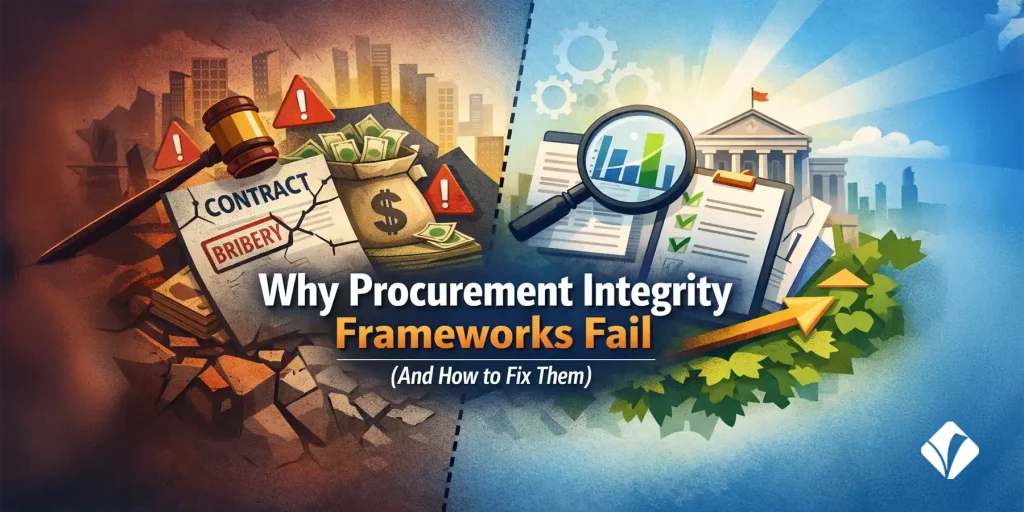
This piece explores why procurement integrity frameworks don’t work and presents practical solutions to strengthen them. We analyze system weaknesses, institutional gaps, and failed transparency mechanisms. Our evidence-based solutions can help reform government procurement systems, especially in emerging markets where ethical procurement drives development.
Systemic Weaknesses in Procurement Integrity Frameworks
Budget-friendly procurement systems need resilient integrity frameworks to stop corruption and ensure value for money. All the same, these frameworks have basic flaws that make them fail to work, no matter how good they look on paper.
Rendición de cuentas fragmentada en los sistemas de integridad de la contratación pública
Fragmented accountability stands out as one of the biggest problems in procurement frameworks. Studies show that corruption in public procurement eats up more than 50% of government budgets beyond what they spend on wages. UNODC estimates suggest that corruption swallows 10-25% of any public contract’s total value. These huge financial losses directly lead to poor service delivery and stymied development.
The procurement system splits up in several ways. The responsibility to oversee procurement scatters across many departments and agencies that barely talk to each other. Breaking up large contracts into smaller ones – known as contract fragmentation – makes decisions harder to track. This practice cuts down healthy competition and opens doors to corrupt dealings.
The political side of procurement creates its own accountability challenges. Procurement processes tie deeply into political and economic interests. Elites often use them to make huge profits or build power by giving benefits to their supporters. This system of patronage and profit-seeking further splits accountability and weakens integrity frameworks.
Lack of enforcement under the Procurement Integrity Act
The Procurement Integrity Act (PIA) clearly bans anyone from knowingly sharing or getting contractor bid information or source selection data before contract awards. The PIA offers a detailed framework of criminal, civil, and administrative penalties for violations. But its enforcement remains weak.
Someone reports a possible PIA violation, and contracting officers must figure out if it affects pending awards. The Head of Contracting Activity (HCA) then needs to review the case and decide what to do. These enforcement steps usually fail because:
- Los equipos de investigación carecen de recursos
- Las organizaciones dudan en castigar a los infractores
- Complex procedures slow down solutions
- Enforcement bodies lack independence
Courts regularly throw out procurement deals due to problems, but officials rarely face arrest or conviction for rigging tenders in some places. This lack of consequences seriously weakens the PIA’s power to stop violations.
Overreliance on formal compliance without practical oversight
Most procurement systems care too much about following rules on paper rather than watching what really happens. Review committees exist everywhere, but vague terms like “deemed significant” or “significant scope” make their job harder.
This focus on formalities creates a dangerous gap between written rules and real-world practices. To cite an instance, research on government auditing found it didn’t make any real difference in following procurement rules. Traditional oversight just isn’t changing behavior or making things better.
Emergency situations make everything worse. Romania saw negotiated procedures without publication jump to 40% of all procurement during the COVID-19 pandemic in 2020. Officials estimate irregularities cost €4.9 billion. Montenegro’s urgent procurement spending tripled compared to previous years. These emergency measures followed the rules on paper but left the door wide open for abuse and corruption.
Real oversight needs more than checking boxes. It demands proper evaluation of procurement results, including fair prices, contract performance, and value delivery – areas current frameworks often ignore.
Institutional Capacity Gaps in Emerging Markets
Public sector organizations in emerging markets face a basic challenge with their procurement systems. These systems look good on paper but don’t work in real life. Many organizations can’t put good procurement procedures to work even when they have the right framework.
Limited procurement training in public sector agencies
The lack of trained procurement professionals hurts the system’s integrity. A Country Procurement Assessment Report from Nigeria points to poor training at the core team as the biggest problem. The numbers paint a grim picture – in 2022, only 542 people were admitted to procurement-related fields in Nigerian universities.
Training programs run without proper planning instead of offering continuous learning opportunities. One study points out that “such ad hoc or occasional training is not a sustainable source of capacity development”. This creates knowledge gaps among procurement officials in:
- Comprensión de las leyes y normativas de adquisiciones
- Technical skills for e-procurement implementation
- Capacidades de negociación
- Financial and accounting expertise
Training curricula differ between centers in many countries. This leads to uneven skill development. The situation gets worse because there aren’t enough specialized training centers. Nigeria serves as a perfect example – just six training institutions must support over 5,000 government agencies at federal, state, and local levels.
Donor-funded procurement and local implementation challenges
Donor-led procurement reforms don’t achieve what they set out to do. These programs start with good intentions to reduce risks in funded activities. They focus on legal reforms, creating regulatory authorities, and simple training. Yet there’s “widespread consensus that such reform programs have not achieved the desired outcomes”.
Many donor initiatives miss the mark by thinking occasional training sessions can build procurement capacity. The truth is that “boosting procurement capacity implies a change in culture”. The core team often gets treated as project add-ons rather than key contributors who need real professional development.
Teams struggle to apply both donor and government procurement policies at the same time. This makes complex situations even harder. The World Bank found that countries with weaker procurement capacity face more problems and delays. Yet these same countries get less help to strengthen their systems.
Inadequate staffing of procurement management units
Understaffed procurement units create major bottlenecks. World Bank data shows that in fragile and conflict-affected countries, about half of procurement staff handle 10 or more projects at once. Western and Central Africa face an even tougher situation – staff there typically manage about 20 projects each.
Studies show a direct link between staff competency and procurement performance. One study revealed that 97.2% of respondents agreed that experienced and skilled personnel boost procurement performance. Understaffing leads to overwork, stress, and slower procurement processes.
Data from Tanzania shows that “in many PEs [Procurement Entities]… contract management performance is poor due to the reason of insufficient and underskilled staff in procurement unit”. At the end of the day, this means procurement laws, rules, and procedures don’t get applied properly, whatever their design quality.
Breakdowns Across the Procurement Lifecycle
Procurement frameworks face integrity issues at key points in their lifecycle. These problems follow specific patterns during pre-tender, tender, and post-tender phases of procurement.
Pre-tender stage: Needs assessment and specification manipulation
The procurement cycle starts with needs assessment, market analysis, and option appraisal. Large procurements make these activities more complex. Specialized teams handle needs assessment and option appraisal as separate inputs into the procurement cycle. Any mistakes in these early stages can put the entire procurement process at risk.
Poor needs assessment leads to outcomes that don’t help the intended beneficiaries. To cite an instance, infrastructure projects might leave out essential accessibility features for people with mobility issues. Rushed preliminary work, like mapping utilities for urban tunneling projects, often means finding new solutions after construction begins. This drives costs up and opens doors to corruption.
Tender stage: Bid rigging and opaque evaluation criteria
Bid-rigging schemes hurt procurement integrity substantially during the tender stage. Suppliers make secret agreements that limit competition and deny fair prices to customers. The most common types include:
- Bid rotation where firms take turns to submit the lowest bid
- Bid suppression when competitors avoid bidding or pull their bids out
- Cover pricing where bidders submit artificially high bids to distort price perception
Taxpayers lose money from these practices, and better competitors get left out. Red flags pop up when bids arrive at the same time, use similar words, show identical prices, or display unusual patterns like missing expected discounts.
Unclear evaluation criteria cause just as many problems. Organizations don’t deal very well with bias accusations or questions about improper evaluations when their bid evaluation process lacks clarity. Recent court cases show that mismatches between evaluation criteria in documents and actual scoring methods often lead to successful legal challenges. Strengthening evaluation integrity and supplier engagement requires well-trained procurement officers with strong negotiation and contract management capabilities, often developed through procurement and contract management negotiation training.
Post-tender stage: Contract amendments and weak monitoring
Contract changes and negotiations after tender awards can damage procurement integrity. Changes might be needed when conditions shift, but they need transparent management. Courts have made it clear that changes work only when modification possibilities are spelled out beforehand and don’t change the contract’s core purpose.
Contract supervision and monitoring remain weak spots in procurement. The core team often lacks enough people, and many don’t fully grasp contract requirements. Research shows procurement teams spend about 80% of their time pushing paper instead of watching over contracts.
Procurement integrity systems fail because they can’t handle breakdowns that happen during these three vital stages of the procurement lifecycle.
Why Transparency Mechanisms Fail to Protect Procurement Integrity
Procurement integrity depends on transparency tools, but these tools often don’t deliver expected results. Several roadblocks prevent these mechanisms from working well in procurement settings of all sizes.
Underutilization of e-procurement platforms
E-procurement systems should boost transparency, efficiency, and accountability, yet organizations rarely adopt them fully. Kenya’s public construction sector shows this clearly. Despite heavy investment, the implementation shows mere “symbolic adoption” – 80% of entities have registered but 48.6% of users never use these systems for daily work. Many organizations do bare minimum compliance while sticking to manual processes, which makes these platforms ineffective.
Existen obstáculos tanto técnicos como humanos. Las investigaciones muestran que el 65.7% de los usuarios enfrentan interrupciones frecuentes del sistema debido a cortes de energía, lo que los obliga a volver a los sistemas basados en papel. Además, el 57.1% de los usuarios afirma que carece de la capacitación adecuada sobre los sistemas de contratación electrónica. La historia de Uganda demuestra este punto: después de nueve años de trabajo, solo 36 de las 200 entidades gubernamentales planificadas utilizan el sistema de contratación electrónica por completo, alcanzando apenas el 18% del objetivo.
Falta de divulgación en tiempo real en los portales de adquisiciones
E-procurement systems create valuable data automatically, but governments find it hard to use this information well. Rwanda has widely adopted its procurement system, yet making sense of its data remains difficult, which limits the government’s ability to monitor how well the system works.
Interactive dashboards could show procurement metrics through customizable visuals that support immediate monitoring and early risk detection. However, slow implementation often makes systems outdated before they’re fully running.
Advanced data analytics are increasingly used to detect red flags, identify irregular procurement patterns, and expose corruption risks at scale, reinforcing the power of data analytics in uncovering fraud and corruption.
Civil society exclusion from procurement monitoring
External oversight plays a vital role in procurement integrity but remains underused. The OECD stresses the need to “equip civil society organizations, media and the wider public to examine public procurement”. Success stories exist – Mexico’s Social Witness Program has cut contract costs and attracted more bidders.
Limited public information restricts competition and makes it impossible for civil society groups to monitor contracts. Practical oversight approaches like integrity pacts, where independent monitors watch over procurement processes, have shown great results. Civil society must become part of procurement monitoring systems to make transparency work better.
Fixing the Framework: Practical Reforms That Work
Real-life procurement integrity frameworks need practical reforms that deal with systemic weaknesses through complete approaches. Fix procurement integrity at the system level. Partner with Risalat to strengthen capacity, oversight, and transparency in public procurement. These reforms are most effective when supported by structured capacity-building initiatives such as integrity and anti-corruption training in public procurement.
Institutional capacity building through targeted training
Construir capacidad institucional es fundamental para una reforma de adquisiciones eficaz. El conjunto de herramientas de evaluación de capacidad del Banco Europeo de Reconstrucción y Desarrollo (BERD) ofrece un enfoque innovador y flexible que funciona para clientes de diferentes tamaños y presupuestos. Esta herramienta de evaluación ofrece una imagen completa de la capacidad institucional y define planes de acción claros con estándares de cumplimiento. Más allá del cumplimiento, los profesionales de adquisiciones requieren cada vez más habilidades avanzadas en negociación, gestión de riesgos y abastecimiento estratégico, respaldadas a través de programas avanzados de contratación estratégica y gestión de contratos.
Capacity building should go beyond occasional workshops to create lasting professional development programs. The UNDP Capacity Assessment Framework looks at three key areas: points of entry (enabling environment, organizational, individual levels), core issues (institutional arrangements, leadership, knowledge, accountability), and functional capacities. Effective capacity development starts by identifying current capabilities and gaps to understand priorities for improvement.
Órganos independientes de supervisión de adquisiciones con poder de ejecución
Reliable procurement systems need independent oversight bodies with enough enforcement authority. Procurement boards should include private sector members to encourage competition, streamline processes, and boost accountability. These boards must have investigative powers and requirements to publish their findings.
Oversight mechanisms often struggle with inconsistent activity when governments change and face constant undue influence. Effective oversight bodies need formal processes, independent authority, and protection from political interference. Expert oversight institutions with specialized knowledge can supervise procurement agencies daily to ensure they comply with authorizations and mandates.
Estándar de Datos para las Contrataciones Abiertas (OCDS) para la transparencia en las adquisiciones
OCDS ofrece a los gobiernos un marco reconocido mundialmente para publicar datos de contratación de forma abierta. Más de 50 gobiernos nacionales y subnacionales de todo el mundo utilizan ya este estándar. Las diferentes jurisdicciones pueden compartir sus enfoques para supervisar y medir las mejoras, lo que crea mejores prácticas internacionales.
Governments spend about US$9.5 trillion through contracts each year. Making procurement data transparent offers huge benefits. We used OCDS to save time and money since much work in publishing and making procurement information available has already been done. A data support team provides detailed technical documentation. The G7, G20, and OCDS have made open contracting principles international best practices.
Protección de alertadores y mecanismos de resolución de reclamaciones
Los buenos mecanismos de protección de denunciantes ayudan a las personas a informar sobre problemas de contratación sin miedo. Las leyes de protección de denunciantes deben otorgar derechos claros y mantener la confidencialidad de la información. Los mecanismos formales de resolución de reclamaciones (GRM) permiten a las personas o grupos afectados resolver quejas relacionadas con las adquisiciones.
GRMs should offer multiple ways to file complaints through websites, phone, email, or mail with clear investigation processes. Grievance resolution works best with a multi-tier approach that starts locally and moves up when needed. Case tracking systems and clear timelines improve accountability. Cases involving sensitive issues like gender-based violence need survivor-centered and gender-sensitive investigation processes.
Ver


- Open Contracting Partnership Open Contracting Partnership
- OCDE (Organización para la Cooperación y el Desarrollo Económicos) OCDE
Know people who should read this? Become an Ambassador or write with Risalat.
Socios para el éxito de los proyectos desde 2011: diagnósticos, asesoría y aprendizaje aplicado para ministerios, organismos públicos y equipos de proyecto.
¿Necesita ayuda para llevar esto a la práctica?
Empiece con un diagnóstico gratuito de 10 minutos o hable con nuestros expertos.