In short: Livelihood restoration under World Bank ESS5 explained, covering economic displacement, implementation, monitoring, and sustainable recovery.
Free self-check: the governance self-audit gives a quick check of governance, controls and accountability, in about 10 minutes.
Ideas clave
Livelihood restoration is one of the most challenging requirements to implement effectively under the World Bank Environmental and Social Framework (ESF). While compensation for lost assets often receives significant attention, restoring people’s ability to earn sustainable incomes after project-related displacement remains a persistent challenge across infrastructure and development projects worldwide.
- Compensation alone is not livelihood restoration – Paying for lost land, buildings, crops, or other assets does not automatically restore household income, employment, business activity, or long-term economic security.
- Early planning determines long-term success – Effective livelihood restoration begins during project preparation through robust socioeconomic surveys, livelihood analysis, market assessments, and meaningful stakeholder engagement.
- Institutional coordination is often the weakest link – Successful implementation may require collaboration among government agencies, project implementation units, contractors, local authorities, employers, financial institutions, service providers, and community organizations.
- Monitoring must measure outcomes, not simply activities – Delivering training, grants, agricultural inputs, or financial assistance is insufficient unless affected households demonstrate sustainable livelihood recovery.
- Livelihood restoration can become a development opportunity – When implemented effectively, livelihood restoration can strengthen resilience, improve employment opportunities, support local economies, and connect affected communities with benefits created by major infrastructure investments.
Without adequate institutional capacity, financing, community participation, and continuous monitoring, livelihood restoration programs risk becoming short-term compensation exercises rather than sustainable development interventions.
Los gobiernos que integran la restauración de medios de vida en la implementación de proyectos más amplios y estrategias de desarrollo económico local están mejor posicionados para reducir los riesgos sociales, fortalecer la resiliencia comunitaria y lograr resultados de proyectos sostenibles.
Introducción
Large infrastructure investments continue transforming transportation networks, energy systems, water infrastructure, urban development, and public services across developing and emerging economies.
While these investments generate significant economic and social benefits, they can also affect people whose homes, businesses, agricultural land, employment, or other sources of income are disrupted by project implementation.
The World Bank’s Environmental and Social Standard 5 (ESS5) establishes requirements concerning land acquisition, restrictions on land use, and involuntary resettlement. Among the most important implementation challenges is livelihood restoration under World Bank ESS5, particularly where projects cause economic displacement.
Too often, project progress is measured by the completion of compensation payments rather than whether affected households actually recover their livelihoods and standards of living.
La compensación puede reemplazar el valor de un activo físico, pero no necesariamente restituye las redes de clientes, las oportunidades de empleo, la productividad agrícola, el acceso a los mercados, las relaciones comerciales o la resiliencia económica que las comunidades han desarrollado durante muchos años.
Many livelihood restoration programs consequently encounter difficulties after compensation has been completed. Skills training may be delivered without employment opportunities. Business grants may be provided without market access. Farmers may receive replacement land without adequate irrigation, infrastructure, inputs, or technical assistance. Monitoring may focus on activities completed rather than economic outcomes achieved.
As infrastructure investment expands through World Bank-financed projects, livelihood restoration should therefore be understood not simply as a safeguard requirement, but as an important component of sustainable development, social risk management, and successful project delivery.
This article examines the practical challenges surrounding livelihood restoration under World Bank ESS5 and explores how governments and project implementation units can move from compensation-focused approaches toward sustainable economic recovery.
Understanding Livelihood Restoration Under World Bank ESS5
What World Bank ESS5 Actually Requires
One common misconception surrounding involuntary resettlement is that compensation represents the primary objective.
In reality, compensation is only one part of a broader process.
World Bank ESS5 seeks to avoid involuntary resettlement where feasible. Where displacement cannot be avoided, projects are expected to minimize it, mitigate adverse social and economic impacts, and support affected people in improving or at least restoring their livelihoods and standards of living.
This represents an important shift from purely compensation-based approaches toward outcome-focused implementation.
In practical terms, successful ESS5 implementation requires project teams to look beyond whether compensation has been paid and consider more important questions:
- Have affected households recovered their livelihoods?
- Can displaced businesses operate sustainably?
- Have farmers regained productive capacity?
- Are affected workers able to access sustainable employment?
- Have vulnerable households recovered from project-related economic impacts?
- Are affected communities economically resilient after displacement?
These questions move livelihood restoration under World Bank ESS5 beyond administrative compliance and toward measurable socioeconomic recovery.
Compensation is Not Livelihood Restoration
One of the most common mistakes in implementing livelihood restoration under World Bank ESS5 is assuming that compensation alone fulfills project obligations.
La compensación financiera puede reemplazar el valor de los activos perdidos, pero rara vez reemplaza los sistemas económicos que sustentaban a los hogares afectados.
A family losing agricultural land does not simply lose property. It may lose irrigation infrastructure, established soil productivity, market relationships, location-specific knowledge, seasonal production patterns, and future income.
De igual modo, reubicar un negocio al borde de la carretera puede compensar una estructura física, pero no restaurar el tráfico de clientes, las relaciones con los proveedores, la visibilidad comercial o el acceso a su mercado original.
Esta distinción ayuda a explicar por qué los proyectos pueden completar la compensación con éxito mientras los hogares afectados continúan experimentando un deterioro económico.
Livelihood restoration measures may therefore involve combinations of:
- tierras de reemplazo productivas;
- agricultural extension and technical assistance;
- employment opportunities;
- vocational and skills development;
- business development support;
- access to finance;
- market linkages;
- financial literacy;
- asistencia transicional; y
- apoyo técnico continuo.
The objective is not simply to replace what people lost. It is to enable affected people to rebuild sustainable livelihoods under their post-displacement economic conditions.
Physical and Economic Displacement Require Different Solutions
Projects sometimes concentrate heavily on households that physically relocate while giving less attention to people experiencing economic displacement.
However, economic displacement can occur even when a person never moves from their home.
Physical displacement generally involves relocation and may require replacement housing, infrastructure, services, and associated assistance.
Economic displacement can occur when people lose land, assets, access to resources, businesses, employment, customers, fishing areas, grazing routes, or other means of generating income because of project-related land acquisition or restrictions on land use.
Los ejemplos pueden incluir:
- farmers losing productive agricultural land;
- market vendors relocated from commercially valuable locations;
- small businesses affected by access restrictions;
- comunidades pesqueras que pierden el acceso a las zonas de pesca;
- pastoral communities losing access to grazing resources;
- trabajadores informales dependientes del comercio callejero; y
- enterprises whose customers or supply chains are disrupted.
Each livelihood source presents different risks.
Un paquete de compensación estandarizado no puede abordar adecuadamente circunstancias económicas tan diversas.
Why Livelihood Restoration Programs Fail
Despite extensive international experience with involuntary resettlement, many livelihood restoration programs struggle to achieve sustainable outcomes.
The problem is not necessarily the absence of policies or plans.
Los fallos surgen con frecuencia durante la evaluación inicial, el diseño del programa, la coordinación institucional, la financiación, la implementación, el seguimiento y el seguimiento posterior.
Varios desafíos recurrentes explican por qué la restauración de medios de vida bajo la ESS5 del Banco Mundial puede no alcanzar los resultados previstos.
Compensation Without Economic Recovery
Los proyectos pueden equiparar involuntariamente la compensación exitosa con la restauración exitosa de los medios de vida.
Compensation may be completed, administrative records closed, and implementation targets reported while household income continues declining months or years afterward.
La compensación en efectivo no puede recrear automáticamente:
- relaciones con los clientes;
- productividad agrícola;
- employment opportunities;
- supplier networks;
- local economic ecosystems;
- occupational skills; or
- business reputation.
Without complementary livelihood restoration measures, compensation may provide temporary financial relief without establishing a sustainable pathway toward economic recovery.
This is particularly important where affected households have limited experience managing large lump-sum payments or face debt, inflation, immediate household expenses, or limited investment opportunities.
Weak Socioeconomic Baselines
Effective livelihood restoration begins before displacement.
Sin embargo, las encuestas socioeconómicas a veces recopilan información demográfica y de activos sin examinar adecuadamente cómo los hogares generan ingresos en la práctica.
Important questions can remain unanswered:
- Which income sources are seasonal?
- How diversified are household livelihoods?
- Which household members generate income?
- Which businesses depend heavily on their current location?
- Which agricultural activities depend on particular land or water conditions?
- What informal economic activities may not appear in official records?
- Which households are least able to absorb economic shocks?
Without reliable baseline information, project teams may later struggle to determine whether livelihoods have actually been restored.
Monitoring then risks measuring activities because there is no meaningful economic baseline against which outcomes can be assessed.
Limited Community Participation
Livelihood restoration programs sometimes rely on standardized interventions rather than solutions developed with affected communities.
Vocational training may be offered without considering labor-market demand.
Agricultural programs may ignore soil conditions, water availability, input costs, or market access.
Business grants may be distributed without understanding whether sufficient demand exists for the businesses being created.
Communities themselves possess valuable information about local markets, seasonal income patterns, employment opportunities, social networks, risks, and barriers.
Meaningful stakeholder engagement therefore improves not only community acceptance but also the economic quality of livelihood restoration interventions.
Short-Term Project Thinking
Infrastructure projects naturally operate within defined construction schedules.
La recuperación de los medios de vida no lo hace.
A farming household may require several growing seasons before agricultural productivity stabilizes.
A relocated enterprise may need considerable time to rebuild its customer base.
A person completing vocational training may need months before securing sustainable employment.
Yet livelihood monitoring may weaken once compensation has been completed or construction nears completion.
Esto crea una discrepancia fundamental entre la ejecución de la infraestructura y la recuperación socioeconómica.
Successful livelihood restoration under World Bank ESS5 therefore requires adequate implementation periods, adaptive management, monitoring, and institutional support beyond the immediate displacement process.
From Compensation to Sustainable Economic Recovery
El desafío central no es identificar actividades que realizar. Es diseñar una vía creíble a través de la cual las personas afectadas puedan recuperar sus medios de vida de manera sostenible.
This requires understanding how livelihoods function before displacement, how project impacts will disrupt them, and which realistic economic opportunities will exist afterward.
A livelihood restoration program should therefore begin with the affected population and local economy rather than a predetermined list of interventions.
For agricultural households, project teams may need to examine land productivity, water availability, input costs, transportation, market access, extension services, and the time required for replacement land to become productive.
For businesses, analysis may need to consider location, customer flows, supplier relationships, working capital, licensing, competition, market access, and commercial visibility.
Para los asalariados y los trabajadores informales, las prioridades pueden incluir la intermediación laboral, el desarrollo de habilidades, la certificación, el transporte, el cuidado infantil o el acceso a oportunidades de empleo generadas por proyectos.
Different households may therefore require substantially different restoration pathways.
Livelihood Restoration Must Reflect Economic Reality
One of the easiest mistakes is designing livelihood interventions around what a project can conveniently provide rather than what affected people can realistically sustain.
Training provides a good example.
A project may report that hundreds of affected people completed vocational training. But if there is little local demand for those skills, training completion does not necessarily translate into livelihood restoration.
The same principle applies to enterprise development.
Providing many households with grants to establish similar businesses can create excessive local competition and ultimately reduce the viability of each enterprise.
Effective livelihood restoration therefore requires market assessment alongside socioeconomic assessment.
Project teams should understand where demand exists, which sectors are expanding, what employers require, what barriers prevent affected people from accessing opportunities, and whether proposed businesses can remain commercially viable after project support ends.
Institutional Coordination: The Hidden Implementation Challenge
Livelihood restoration rarely falls entirely within the responsibility of one organization.
A major infrastructure project may involve:
- a project implementation unit;
- sector ministries;
- local governments;
- land authorities;
- contractors;
- consultants;
- instituciones financieras;
- training providers;
- agricultural agencies;
- employers;
- community organizations; and
- development partners.
Each institution may perform its assigned activity while the overall program still fails.
A training provider, for example, may successfully train affected people while nobody is responsible for connecting graduates with employers.
A contractor may have employment opportunities while no mechanism connects eligible project-affected people with those jobs.
Las agencias agrícolas pueden proporcionar apoyo de extensión mientras las tierras de reemplazo carecen de riego confiable.
Se pueden distribuir subvenciones empresariales mientras los emprendedores luchan por obtener permisos de funcionamiento o un espacio comercial adecuado.
Por lo tanto, la restauración exitosa de los medios de vida bajo la norma ESS5 del Banco Mundial requiere responsabilidades institucionales claramente definidas, mecanismos de coordinación, presupuestos, cronogramas de implementación, procedimientos de escalamiento y rendición de cuentas por los resultados en los medios de vida.
The Role of Project Implementation Units
Para muchas inversiones financiadas por el Banco Mundial, la Unidad de Implementación del Proyecto (UIP) ocupa una posición de coordinación fundamental.
The PIU requires sufficient environmental and social capacity to oversee implementation rather than treating the Livelihood Restoration Plan as primarily a document required for project approval.
Effective oversight may require:
- experienced environmental and social specialists;
- livelihood restoration expertise;
- clearly assigned responsibilities;
- implementation schedules linked to displacement;
- sufficient multi-year financing;
- coordinación con contratistas y organismos gubernamentales;
- accessible grievance mechanisms;
- socioeconomic monitoring systems; and
- mechanisms for identifying households whose livelihoods are not recovering.
Donde la capacidad institucional es limitada, la asistencia técnica y el desarrollo de capacidades deben comenzar antes del desplazamiento en lugar de después de que surjan problemas de medios de vida.
Diseño de medidas de restauración de medios de vida que funcionan
There is no universal livelihood restoration package.
Effective programs combine interventions according to the livelihoods, vulnerabilities, capabilities, and economic opportunities of affected people.
Land-Based Livelihood Restoration
Cuando los hogares dependen sustancialmente de la agricultura, la ganadería, la pesca, la silvicultura u otras actividades basadas en los recursos naturales, la restauración de la capacidad productiva es particularmente importante.
Cash compensation alone can expose these households to substantial long-term livelihood risks.
Depending on the project context, interventions may include:
- tierras de reemplazo productivas;
- irrigation;
- soil improvement;
- agricultural inputs;
- extension services;
- improved production techniques;
- apoyo ganadero;
- storage infrastructure;
- access roads;
- producer organizations; and
- stronger connections with agricultural markets.
The objective should be measurable productive recovery rather than simply distributing agricultural inputs.
Business and Enterprise Restoration
Small enterprises can be particularly vulnerable to economic displacement because much of their economic value may exist outside their physical assets.
La ubicación, el tráfico de clientes, las relaciones con los proveedores, la reputación, las licencias, el acceso al mercado y el capital de trabajo pueden determinar si una empresa sobrevive a una reubicación.
Business restoration may therefore require combinations of relocation assistance, transitional support, improved commercial locations, enterprise development services, access to finance, financial management support, equipment, formalization assistance, and connections with new markets.
Employment and Skills Development
Skills development can support livelihood recovery when it is connected to genuine labor demand.
Infrastructure projects themselves may create employment through construction, operations, maintenance, logistics, transportation, administration, catering, security, and supply chains.
Where feasible and consistent with applicable requirements, livelihood programs can establish mechanisms that help affected people compete for or access appropriate opportunities.
However, training should respond to labor-market demand rather than course availability.
Programs should consider employer requirements, existing skills, barriers to employment, certification needs, and whether opportunities will remain viable after construction.
Vulnerable Groups Require More Than Equal Treatment
People who are disadvantaged or vulnerable may experience displacement differently and may require differentiated assistance.
Proporcionar a todos el mismo apoyo no produce necesariamente resultados equitativos en los medios de subsistencia.
Los hogares encabezados por mujeres, las personas mayores, las personas con discapacidad, los hogares sin tierra, los trabajadores informales, las familias en extrema pobreza, las comunidades minoritarias y los hogares altamente dependientes de los recursos naturales pueden enfrentar barreras que las intervenciones estandarizadas pasan por alto.
For example, offering identical vocational training to everyone may appear equitable while effectively excluding people who cannot travel, afford childcare, meet literacy requirements, or access formal employment.
Effective livelihood programs should therefore identify vulnerability during socioeconomic assessment and incorporate appropriate differentiated measures.
The objective is not merely equal participation.
It is ensuring that vulnerable households have a realistic opportunity to restore or improve their livelihoods and living standards.
Monitoring Livelihood Restoration: Activities Are Not Outcomes
Monitoring is one of the areas where otherwise well-designed programs can become weak.
Projects frequently report indicators such as:
- number of people trained;
- number of grants distributed;
- number of agricultural inputs provided;
- number of enterprises relocated; or
- número de hogares que reciben asistencia.
These indicators measure implementation progress.
They do not necessarily demonstrate livelihood restoration.
Un participante puede completar la formación profesional y permanecer desempleado.
Un negocio reubicado puede recibir equipos mientras pierde gran parte de su base de clientes.
A farmer can receive agricultural inputs while household income remains below its pre-displacement level.
Outcome monitoring should therefore examine whether sustainable economic recovery is occurring.
Relevant indicators may include:
- household income;
- income diversification;
- estabilidad en el empleo;
- ingresos empresariales;
- productividad agrícola;
- food security;
- propiedad de activos productivos;
- market access;
- household debt; and
- vulnerability and resilience.
These indicators should be assessed against credible baseline conditions and monitored over sufficient time to distinguish temporary improvement from sustainable recovery.
Identify Households That Are Not Recovering
Aggregate statistics can hide serious problems.
Average household income may appear to have recovered while particular groups continue experiencing substantial economic deterioration.
Por lo tanto, los sistemas de monitoreo deben identificar a los hogares cuyas trayectorias de medios de vida se mantengan por debajo de las condiciones de referencia o de los objetivos de restauración acordados.
Those households may require further assessment and corrective measures.
This transforms monitoring from a reporting exercise into an active management tool.
Livelihood Restoration Should Be Adaptive
Livelihood restoration plans should not be treated as static documents.
Markets change. Construction schedules shift. Replacement land may perform differently than anticipated. Enterprises may struggle after relocation. Training programs may produce lower employment rates than expected.
Effective programs establish mechanisms for identifying these problems and adjusting interventions.
Adaptive measures might involve changing training programs, introducing additional agricultural assistance, strengthening enterprise support, extending transitional measures, developing new market partnerships, or redirecting resources toward interventions producing stronger results.
Adaptive management is particularly important because livelihood recovery may continue well beyond the initial displacement period.
Grievance Mechanisms Can Reveal Livelihood Problems Early
A functioning grievance mechanism provides more than a means of resolving individual complaints.
También puede convertirse en una fuente importante de información de gestión.
Repeated grievances concerning loss of customers, delayed replacement land, market access, contractor recruitment, agricultural productivity, or inadequate transitional assistance can reveal systemic problems before they become visible in formal monitoring reports.
Project teams should therefore analyze grievance patterns rather than simply counting how many complaints have been closed.
Las denuncias recurrentes pueden indicar que una intervención de medios de vida requiere una acción correctiva más amplia.
When Is Livelihood Restoration Actually Complete?
Una de las preguntas más difíciles para los gobiernos y los equipos de proyectos es determinar cuándo se han cumplido verdaderamente las obligaciones de restitución de medios de vida.
Completion should not be defined merely by spending the livelihood restoration budget or delivering every activity contained in a plan.
The more important question is whether affected people have restored or improved their livelihoods and standards of living in accordance with project commitments and applicable ESS5 requirements.
This requires credible evidence.
Depending on project scale and risk, completion assessment may examine:
- socioeconomic monitoring results;
- household livelihood recovery;
- business sustainability;
- productividad agrícola;
- employment outcomes;
- vulnerable household outcomes;
- unresolved grievances; and
- medidas correctivas sobresalientes.
Para proyectos que implican impactos de reasentamiento significativos, las auditorías de cierre pueden proporcionar evidencia importante sobre si las medidas planificadas se tradujeron en resultados sostenibles.
Building Government Capacity for ESS5 Implementation
Many livelihood restoration difficulties ultimately reflect institutional capacity constraints rather than shortcomings in individual plans.
Government agencies may have extensive experience with land acquisition and compensation while having considerably less institutional experience with socioeconomic restoration, economic displacement, livelihood analysis, market assessment, stakeholder engagement, outcome monitoring, and adaptive management.
Building implementation capacity therefore requires more than occasional safeguards training.
Governments and PIUs can strengthen practical capabilities in:
- socioeconomic baseline design;
- livelihood risk assessment;
- economic displacement analysis;
- Resettlement Action Plan implementation;
- Livelihood Restoration Plan implementation;
- stakeholder engagement;
- livelihood program design;
- labor-market and value-chain assessment;
- monitoring and evaluation;
- grievance management;
- contractor coordination;
- vulnerable-group support; and
- practical implementation of the World Bank ESF.
Institutional capacity becomes particularly valuable where governments are implementing multiple infrastructure investments financed by international development institutions.
Systems, templates, monitoring approaches, lessons learned, and experienced personnel developed through one project can strengthen future investments across a broader national portfolio.
Turning Livelihood Restoration Into a Development Opportunity
Los programas de restauración de medios de vida más sólidos hacen más que mitigar los impactos negativos de los proyectos.
They use infrastructure investment as an opportunity to strengthen local economic systems.
A major transport, water, energy, urban development, or other infrastructure project can generate new markets, employment, transportation connections, commercial activity, supply chains, and demand for local services.
Livelihood restoration can help connect affected communities with these opportunities.
Instead of asking only:
“How can the project replace what people lost?”
project leaders can ask a more ambitious question:
“How can affected communities participate in the economic opportunities the project itself creates?”
Esto transforma la restauración de medios de vida de un ejercicio de compensación en una posible estrategia de desarrollo económico local.
It can strengthen community resilience, reduce grievances, improve project-community relationships, and create benefits that continue after construction.
A Practical Framework for Livelihood Restoration Under World Bank ESS5
La restauración exitosa de medios de vida bajo la norma ESS5 del Banco Mundial puede abordarse como un proceso continuo:
Understand → Avoid and Minimize → Plan → Restore → Monitor → Adapt → Verify
Understand – Establish robust socioeconomic baselines and determine how affected households actually generate their livelihoods.
Avoid and Minimize – Reduce physical and economic displacement through project design wherever feasible.
Planificar: desarrollar medidas de medios de vida basadas en las circunstancias de los hogares, la vulnerabilidad, las condiciones del mercado y las oportunidades económicas realistas.
Restore – Implement coordinated interventions with sufficient financing, technical assistance, institutional responsibility, and community participation.
Monitor – Measure livelihood outcomes against baseline conditions rather than merely counting completed activities.
Adapt – Modify interventions when evidence shows that affected households are not recovering.
Verificar: establecer si se han logrado los objetivos de restauración de medios de vida y si siguen siendo necesarias medidas correctivas pendientes.
This approach places sustainable economic recovery rather than administrative completion at the center of livelihood restoration.
Preguntas críticas que deberían plantearse los responsables gubernamentales y de proyectos
Are affected households actually recovering their livelihoods, or has the project only completed compensation?
Compensation completion is an important administrative milestone, but livelihood restoration requires evidence that affected households can sustainably generate income and restore or improve their living standards.
Does the project have sufficient socioeconomic baseline data to demonstrate livelihood recovery?
Without reliable baseline information, project teams may be unable to determine whether household income, agricultural productivity, employment, businesses, and vulnerability have genuinely recovered.
¿Están las intervenciones de medios de vida conectadas a los mercados reales y a las oportunidades de empleo?
Training, enterprise assistance, agricultural support, and other interventions should respond to demonstrated economic opportunities. Programs designed without adequate market analysis risk creating activities that cannot survive after project support ends.
¿Quién es el responsable cuando el medio de vida de un hogar no se recupera?
Institutional accountability should be clear. Monitoring should identify households experiencing continuing economic deterioration and enable investigation, corrective action, and additional assistance where required.
¿Se integra la restauración de los medios de vida en la implementación del proyecto con suficiente antelación?
Livelihood planning should begin during project preparation and before displacement occurs. Waiting until compensation or construction is underway can significantly reduce the range of viable restoration options.
¿Está midiendo el proyecto la restauración de los medios de vida o meramente la actividad de ejecución?
El número de cursos de formación, subvenciones, consultas o paquetes agrícolas entregados no demuestra una recuperación sostenible. Los indicadores de resultado son esenciales para determinar si las intervenciones realmente funcionan.
Can the livelihood program adapt when the original intervention fails?
Not every intervention will succeed as planned. Effective management requires evidence-based adjustments when businesses, agricultural programs, training initiatives, or employment measures fail to produce the expected outcomes.
Conclusión
Livelihood restoration under World Bank ESS5 requires much more than compensation for affected assets.
It requires governments and project implementing agencies to understand how people earn their livelihoods, anticipate how displacement will affect those economic systems, design context-specific restoration measures, coordinate multiple institutions, provide adequate resources, and monitor whether sustainable recovery actually occurs.
The difference between a compliant plan and a successful livelihood restoration program is ultimately visible in household outcomes.
Have farmers regained productive capacity? Are relocated businesses commercially viable? Have affected workers secured sustainable employment? Are vulnerable households recovering? Have communities been connected to economic opportunities created by the project?
These are the questions that ultimately determine whether livelihood restoration has succeeded.
For governments managing major infrastructure and development portfolios, strengthening institutional capacity in ESS5, resettlement, economic displacement, stakeholder engagement, livelihood restoration, and outcome monitoring can also generate benefits far beyond an individual project.
It creates institutional knowledge and implementation capacity that can improve the preparation and delivery of future investments.
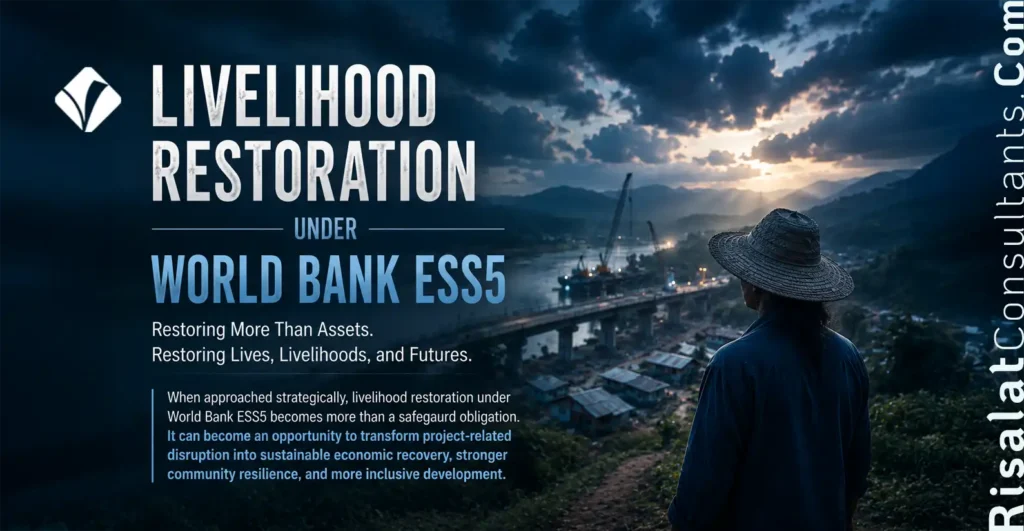
When approached strategically, livelihood restoration under World Bank ESS5 becomes more than a safeguard obligation. It can become an opportunity to transform project-related disruption into sustainable economic recovery, stronger community resilience, and more inclusive development.
Free roadmap: Hiring Consultants on Lao PDR World Bank Projects with QCBS: a 12-month plan for your team
Ver
Know people who should read this? Become an Ambassador or write with Risalat.
Socios para el éxito de los proyectos desde 2011: diagnósticos, asesoría y aprendizaje aplicado para ministerios, organismos públicos y equipos de proyecto.
¿Necesita ayuda para llevar esto a la práctica?
Empiece con un diagnóstico gratuito de 10 minutos o hable con nuestros expertos.