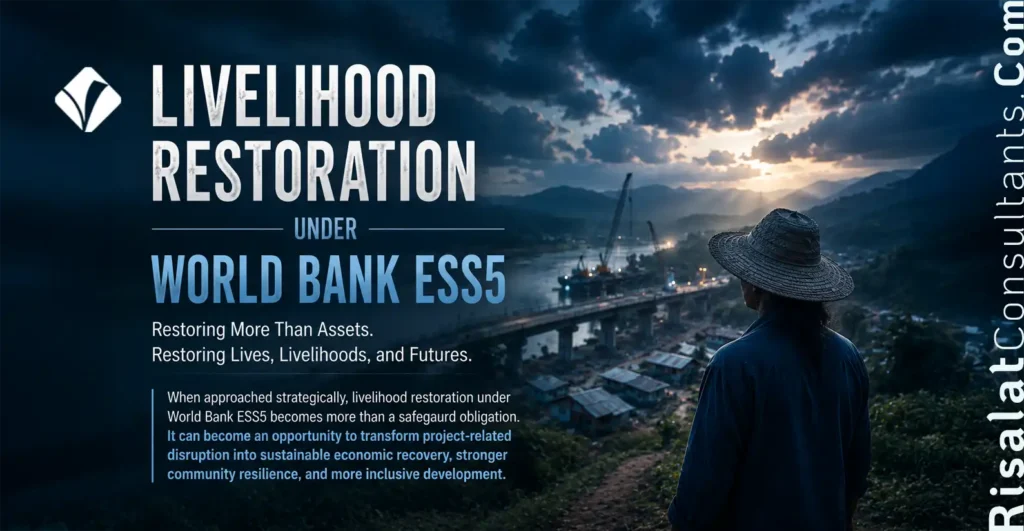
In short: Livelihood restoration under World Bank ESS5 explained, covering economic displacement, implementation, monitoring, and sustainable recovery.
Free self-check: the governance self-audit gives a quick check of governance, controls and accountability, in about 10 minutes.
Ключевые выводы
Восстановление средств к существованию является одним из наиболее сложных требований для эффективного выполнения в рамках Экологической и социальной рамочной программы Всемирного банка (ESF). Хотя компенсации за утраченные активы часто уделяется значительное внимание, восстановление способности людей зарабатывать устойчивые доходы после перемещения, связанного с проектами, остается постоянной проблемой в инфраструктурных и девелоперских проектах по всему миру.
- Compensation alone is not livelihood restoration – Paying for lost land, buildings, crops, or other assets does not automatically restore household income, employment, business activity, or long-term economic security.
- Early planning determines long-term success – Effective livelihood restoration begins during project preparation through robust socioeconomic surveys, livelihood analysis, market assessments, and meaningful stakeholder engagement.
- Institutional coordination is often the weakest link – Successful implementation may require collaboration among government agencies, project implementation units, contractors, local authorities, employers, financial institutions, service providers, and community organizations.
- Monitoring must measure outcomes, not simply activities – Delivering training, grants, agricultural inputs, or financial assistance is insufficient unless affected households demonstrate sustainable livelihood recovery.
- Livelihood restoration can become a development opportunity – When implemented effectively, livelihood restoration can strengthen resilience, improve employment opportunities, support local economies, and connect affected communities with benefits created by major infrastructure investments.
Without adequate institutional capacity, financing, community participation, and continuous monitoring, livelihood restoration programs risk becoming short-term compensation exercises rather than sustainable development interventions.
Правительства, которые интегрируют восстановление источников средств к существованию в более широкие стратегии реализации проектов и местного экономического развития, имеют больше возможностей для снижения социальных рисков, укрепления устойчивости общин и достижения устойчивых результатов проектов.
Введение
Large infrastructure investments continue transforming transportation networks, energy systems, water infrastructure, urban development, and public services across developing and emerging economies.
Хотя эти инвестиции приносят значительные экономические и социальные выгоды, они также могут затронуть людей, чьи дома, бизнес, сельскохозяйственные земли, занятость или другие источники дохода нарушаются в ходе реализации проекта.
The World Bank’s Environmental and Social Standard 5 (ESS5) establishes requirements concerning land acquisition, restrictions on land use, and involuntary resettlement. Among the most important implementation challenges is livelihood restoration under World Bank ESS5, particularly where projects cause economic displacement.
Too often, project progress is measured by the completion of compensation payments rather than whether affected households actually recover their livelihoods and standards of living.
Компенсация может возместить стоимость физического актива, но она не обязательно восстанавливает клиентские сети, возможности трудоустройства, продуктивность сельского хозяйства, доступ к рынку, деловые связи или экономическую устойчивость, которую общины развивали на протяжении многих лет.
Many livelihood restoration programs consequently encounter difficulties after compensation has been completed. Skills training may be delivered without employment opportunities. Business grants may be provided without market access. Farmers may receive replacement land without adequate irrigation, infrastructure, inputs, or technical assistance. Monitoring may focus on activities completed rather than economic outcomes achieved.
Поскольку инвестиции в инфраструктуру расширяются за счет проектов, финансируемых Всемирным банком, восстановление средств к существованию следует понимать не просто как требование защитных мер, а как важный компонент устойчивого развития, социального управления рисками и успешной реализации проектов.
This article examines the practical challenges surrounding livelihood restoration under World Bank ESS5 and explores how governments and project implementation units can move from compensation-focused approaches toward sustainable economic recovery.
Understanding Livelihood Restoration Under World Bank ESS5
What World Bank ESS5 Actually Requires
One common misconception surrounding involuntary resettlement is that compensation represents the primary objective.
In reality, compensation is only one part of a broader process.
World Bank ESS5 seeks to avoid involuntary resettlement where feasible. Where displacement cannot be avoided, projects are expected to minimize it, mitigate adverse social and economic impacts, and support affected people in improving or at least restoring their livelihoods and standards of living.
This represents an important shift from purely compensation-based approaches toward outcome-focused implementation.
In practical terms, successful ESS5 implementation requires project teams to look beyond whether compensation has been paid and consider more important questions:
- Have affected households recovered their livelihoods?
- Can displaced businesses operate sustainably?
- Have farmers regained productive capacity?
- Are affected workers able to access sustainable employment?
- Have vulnerable households recovered from project-related economic impacts?
- Are affected communities economically resilient after displacement?
These questions move livelihood restoration under World Bank ESS5 beyond administrative compliance and toward measurable socioeconomic recovery.
Компенсация не является восстановлением средств к существованию
One of the most common mistakes in implementing livelihood restoration under World Bank ESS5 is assuming that compensation alone fulfills project obligations.
Финансовая компенсация может возместить стоимость утраченных активов, но она редко восстанавливает экономические системы, которые поддерживали пострадавшие домохозяйства.
A family losing agricultural land does not simply lose property. It may lose irrigation infrastructure, established soil productivity, market relationships, location-specific knowledge, seasonal production patterns, and future income.
Аналогичным образом, перенос придорожного бизнеса может компенсировать затраты на физическое строение, но не восстановить клиентский поток, отношения с поставщиками, коммерческую видимость или доступ к исходному рынку.
Это различие помогает объяснить, почему проекты могут успешно завершать выплату компенсаций, в то время как пострадавшие домохозяйства продолжают сталкиваться с экономическим ухудшением.
Livelihood restoration measures may therefore involve combinations of:
- продуктивная земля взамен изымаемой;
- agricultural extension and technical assistance;
- employment opportunities;
- vocational and skills development;
- business development support;
- access to finance;
- market linkages;
- financial literacy;
- переходная помощь; и
- постоянная техническая поддержка.
The objective is not simply to replace what people lost. It is to enable affected people to rebuild sustainable livelihoods under their post-displacement economic conditions.
Physical and Economic Displacement Require Different Solutions
Projects sometimes concentrate heavily on households that physically relocate while giving less attention to people experiencing economic displacement.
However, economic displacement can occur even when a person never moves from their home.
Physical displacement generally involves relocation and may require replacement housing, infrastructure, services, and associated assistance.
Economic displacement can occur when people lose land, assets, access to resources, businesses, employment, customers, fishing areas, grazing routes, or other means of generating income because of project-related land acquisition or restrictions on land use.
Примеры могут включать:
- farmers losing productive agricultural land;
- market vendors relocated from commercially valuable locations;
- small businesses affected by access restrictions;
- рыболовецкие общины теряют доступ к местам рыбного промысла;
- pastoral communities losing access to grazing resources;
- неформальные работники, зависящие от уличной торговли; и
- enterprises whose customers or supply chains are disrupted.
Each livelihood source presents different risks.
Стандартизированный компенсационный пакет не может в полной мере учитывать столь разнообразные экономические условия.
Why Livelihood Restoration Programs Fail
Despite extensive international experience with involuntary resettlement, many livelihood restoration programs struggle to achieve sustainable outcomes.
The problem is not necessarily the absence of policies or plans.
Сбои часто возникают на этапе базовой оценки, разработки программ, институциональной координации, финансирования, реализации, мониторинга и последующей деятельности.
Существует ряд повторяющихся проблем, объясняющих, почему восстановление средств к существованию в рамках стандарта Всемирного банка ESS5 может не дать запланированных результатов.
Compensation Without Economic Recovery
Projects can unintentionally equate successful compensation with successful livelihood restoration.
Compensation may be completed, administrative records closed, and implementation targets reported while household income continues declining months or years afterward.
Денежная компенсация не может автоматически воссоздать:
- клиентские отношения;
- сельскохозяйственная производительность;
- employment opportunities;
- supplier networks;
- local economic ecosystems;
- occupational skills; or
- business reputation.
Without complementary livelihood restoration measures, compensation may provide temporary financial relief without establishing a sustainable pathway toward economic recovery.
This is particularly important where affected households have limited experience managing large lump-sum payments or face debt, inflation, immediate household expenses, or limited investment opportunities.
Weak Socioeconomic Baselines
Effective livelihood restoration begins before displacement.
Тем не менее, социально-экономические обследования иногда собирают демографические данные и данные об активах без должного анализа того, как домохозяйства фактически генерируют доход.
Important questions can remain unanswered:
- Which income sources are seasonal?
- How diversified are household livelihoods?
- Which household members generate income?
- Which businesses depend heavily on their current location?
- Which agricultural activities depend on particular land or water conditions?
- What informal economic activities may not appear in official records?
- Which households are least able to absorb economic shocks?
Without reliable baseline information, project teams may later struggle to determine whether livelihoods have actually been restored.
Monitoring then risks measuring activities because there is no meaningful economic baseline against which outcomes can be assessed.
Limited Community Participation
Программы восстановления средств к существованию иногда полагаются на стандартизированные меры, а не на решения, разработанные совместно с пострадавшими общинами.
Vocational training may be offered without considering labor-market demand.
Agricultural programs may ignore soil conditions, water availability, input costs, or market access.
Business grants may be distributed without understanding whether sufficient demand exists for the businesses being created.
Communities themselves possess valuable information about local markets, seasonal income patterns, employment opportunities, social networks, risks, and barriers.
Meaningful stakeholder engagement therefore improves not only community acceptance but also the economic quality of livelihood restoration interventions.
Short-Term Project Thinking
Infrastructure projects naturally operate within defined construction schedules.
Восстановление средств к существованию этого не делает.
A farming household may require several growing seasons before agricultural productivity stabilizes.
A relocated enterprise may need considerable time to rebuild its customer base.
A person completing vocational training may need months before securing sustainable employment.
Yet livelihood monitoring may weaken once compensation has been completed or construction nears completion.
Это создает фундаментальное несоответствие между поставкой инфраструктуры и социально-экономическим восстановлением.
Successful livelihood restoration under World Bank ESS5 therefore requires adequate implementation periods, adaptive management, monitoring, and institutional support beyond the immediate displacement process.
From Compensation to Sustainable Economic Recovery
Главная задача заключается не в определении мероприятий для реализации, а в разработке надежного пути, посредством которого пострадавшее население сможет устойчиво восстановить свои средства к существованию.
This requires understanding how livelihoods function before displacement, how project impacts will disrupt them, and which realistic economic opportunities will exist afterward.
A livelihood restoration program should therefore begin with the affected population and local economy rather than a predetermined list of interventions.
For agricultural households, project teams may need to examine land productivity, water availability, input costs, transportation, market access, extension services, and the time required for replacement land to become productive.
Для бизнеса анализ может потребовать учета местоположения, клиентских потоков, отношений с поставщиками, оборотного капитала, лицензирования, конкуренции, доступа к рынку и коммерческой видимости.
Для наемных работников и неформальных занятых приоритеты могут включать подбор работы, развитие навыков, сертификацию, транспорт, уход за детьми или доступ к возможностям трудоустройства, создаваемым в рамках проектов.
Different households may therefore require substantially different restoration pathways.
Livelihood Restoration Must Reflect Economic Reality
One of the easiest mistakes is designing livelihood interventions around what a project can conveniently provide rather than what affected people can realistically sustain.
Training provides a good example.
A project may report that hundreds of affected people completed vocational training. But if there is little local demand for those skills, training completion does not necessarily translate into livelihood restoration.
The same principle applies to enterprise development.
Предоставление многим домохозяйствам грантов на создание аналогичных предприятий может привести к чрезмерной местной конкуренции и в конечном итоге снизить жизнеспособность каждого предприятия.
Effective livelihood restoration therefore requires market assessment alongside socioeconomic assessment.
Project teams should understand where demand exists, which sectors are expanding, what employers require, what barriers prevent affected people from accessing opportunities, and whether proposed businesses can remain commercially viable after project support ends.
Institutional Coordination: The Hidden Implementation Challenge
Livelihood restoration rarely falls entirely within the responsibility of one organization.
A major infrastructure project may involve:
- a project implementation unit;
- sector ministries;
- local governments;
- land authorities;
- contractors;
- consultants;
- финансовые институты;
- training providers;
- agricultural agencies;
- employers;
- community organizations; and
- development partners.
Each institution may perform its assigned activity while the overall program still fails.
A training provider, for example, may successfully train affected people while nobody is responsible for connecting graduates with employers.
A contractor may have employment opportunities while no mechanism connects eligible project-affected people with those jobs.
Сельскохозяйственные ведомства могут оказывать консультативную поддержку, пока на заменяемом земельном участке отсутствует надежное орошение.
Гранты на развитие бизнеса могут выделяться в то время, когда предприниматели испытывают трудности с получением разрешений на эксплуатацию или подходящих коммерческих помещений.
Успешное восстановление средств к существованию в рамках стандарта ESS5 Всемирного банка требует четкого определения институциональных обязанностей, механизмов координации, бюджетов, графиков реализации, процедур эскалации и подотчетности за результаты в области средств к существованию.
The Role of Project Implementation Units
Для многих инвестиций, финансируемых Всемирным банком, Группа реализации проекта (ГРП) занимает ключевую координирующую позицию.
The PIU requires sufficient environmental and social capacity to oversee implementation rather than treating the Livelihood Restoration Plan as primarily a document required for project approval.
Effective oversight may require:
- experienced environmental and social specialists;
- livelihood restoration expertise;
- clearly assigned responsibilities;
- implementation schedules linked to displacement;
- sufficient multi-year financing;
- координация с подрядчиками и государственными ведомствами;
- accessible grievance mechanisms;
- socioeconomic monitoring systems; and
- mechanisms for identifying households whose livelihoods are not recovering.
Там, где институциональный потенциал ограничен, техническая помощь и развитие потенциала должны начинаться до перемещения, а не после возникновения проблем со средствами к существованию.
Разработка эффективных мер по восстановлению источников средств к существованию
There is no universal livelihood restoration package.
Effective programs combine interventions according to the livelihoods, vulnerabilities, capabilities, and economic opportunities of affected people.
Восстановление средств к существованию на базе земельных ресурсов
Там, где домохозяйства в значительной степени зависят от сельского хозяйства, животноводства, рыболовства, лесного хозяйства или другой деятельности, основанной на использовании природных ресурсов, восстановление производственного потенциала имеет особенно важное значение.
Cash compensation alone can expose these households to substantial long-term livelihood risks.
Depending on the project context, interventions may include:
- продуктивная земля взамен изымаемой;
- irrigation;
- soil improvement;
- agricultural inputs;
- extension services;
- improved production techniques;
- поддержка животноводства;
- storage infrastructure;
- access roads;
- producer organizations; and
- stronger connections with agricultural markets.
The objective should be measurable productive recovery rather than simply distributing agricultural inputs.
Business and Enterprise Restoration
Small enterprises can be particularly vulnerable to economic displacement because much of their economic value may exist outside their physical assets.
Местоположение, трафик клиентов, отношения с поставщиками, репутация, лицензии, доступ к рынку и оборотный капитал могут определить, выживет ли бизнес при переезде.
Business restoration may therefore require combinations of relocation assistance, transitional support, improved commercial locations, enterprise development services, access to finance, financial management support, equipment, formalization assistance, and connections with new markets.
Employment and Skills Development
Skills development can support livelihood recovery when it is connected to genuine labor demand.
Infrastructure projects themselves may create employment through construction, operations, maintenance, logistics, transportation, administration, catering, security, and supply chains.
Where feasible and consistent with applicable requirements, livelihood programs can establish mechanisms that help affected people compete for or access appropriate opportunities.
However, training should respond to labor-market demand rather than course availability.
Programs should consider employer requirements, existing skills, barriers to employment, certification needs, and whether opportunities will remain viable after construction.
Vulnerable Groups Require More Than Equal Treatment
People who are disadvantaged or vulnerable may experience displacement differently and may require differentiated assistance.
Предоставление всем одинаковой поддержки не обязательно приводит к равноправным результатам в отношении средств к существованию.
Домохозяйства во главе с женщинами, пожилые люди, лица с инвалидностью, безземельные домохозяйства, неформально занятые работники, крайне бедные семьи, общины меньшинств и домохозяйства, сильно зависящие от природных ресурсов, могут сталкиваться с барьерами, которые стандартизированные меры упускают из виду.
For example, offering identical vocational training to everyone may appear equitable while effectively excluding people who cannot travel, afford childcare, meet literacy requirements, or access formal employment.
Effective livelihood programs should therefore identify vulnerability during socioeconomic assessment and incorporate appropriate differentiated measures.
The objective is not merely equal participation.
It is ensuring that vulnerable households have a realistic opportunity to restore or improve their livelihoods and living standards.
Мониторинг восстановления средств к существованию: мероприятия не равны результатам
Monitoring is one of the areas where otherwise well-designed programs can become weak.
Projects frequently report indicators such as:
- number of people trained;
- number of grants distributed;
- number of agricultural inputs provided;
- number of enterprises relocated; or
- количество домохозяйств, получающих помощь.
These indicators measure implementation progress.
They do not necessarily demonstrate livelihood restoration.
Участник может пройти профессиональное обучение и остаться безработным.
Переехавший бизнес может получить оборудование, потеряв при этом значительную часть клиентской базы.
Фермер может получать сельскохозяйственные ресурсы, в то время как доход домохозяйства остается ниже уровня, предшествовавшего переселению.
Outcome monitoring should therefore examine whether sustainable economic recovery is occurring.
Relevant indicators may include:
- household income;
- income diversification;
- стабильность занятости;
- доход бизнеса;
- сельскохозяйственная производительность;
- food security;
- владение производительными активами;
- market access;
- household debt; and
- vulnerability and resilience.
These indicators should be assessed against credible baseline conditions and monitored over sufficient time to distinguish temporary improvement from sustainable recovery.
Identify Households That Are Not Recovering
Aggregate statistics can hide serious problems.
Average household income may appear to have recovered while particular groups continue experiencing substantial economic deterioration.
Системы мониторинга должны поэтому выявлять домохозяйства, траектории средств к существованию которых остаются ниже базовых условий или согласованных целей восстановления.
Those households may require further assessment and corrective measures.
This transforms monitoring from a reporting exercise into an active management tool.
Livelihood Restoration Should Be Adaptive
Livelihood restoration plans should not be treated as static documents.
Markets change. Construction schedules shift. Replacement land may perform differently than anticipated. Enterprises may struggle after relocation. Training programs may produce lower employment rates than expected.
Effective programs establish mechanisms for identifying these problems and adjusting interventions.
Adaptive measures might involve changing training programs, introducing additional agricultural assistance, strengthening enterprise support, extending transitional measures, developing new market partnerships, or redirecting resources toward interventions producing stronger results.
Adaptive management is particularly important because livelihood recovery may continue well beyond the initial displacement period.
Grievance Mechanisms Can Reveal Livelihood Problems Early
A functioning grievance mechanism provides more than a means of resolving individual complaints.
Это также может стать важным источником управленческой информации.
Repeated grievances concerning loss of customers, delayed replacement land, market access, contractor recruitment, agricultural productivity, or inadequate transitional assistance can reveal systemic problems before they become visible in formal monitoring reports.
Project teams should therefore analyze grievance patterns rather than simply counting how many complaints have been closed.
Повторяющиеся жалобы могут указывать на то, что мероприятие по средствам к существованию требует более широких корректирующих мер.
When Is Livelihood Restoration Actually Complete?
Один из самых сложных вопросов для правительств и проектных групп заключается в определении того, когда обязательства по восстановлению источников средств к существованию действительно выполнены.
Completion should not be defined merely by spending the livelihood restoration budget or delivering every activity contained in a plan.
The more important question is whether affected people have restored or improved their livelihoods and standards of living in accordance with project commitments and applicable ESS5 requirements.
This requires credible evidence.
В зависимости от масштаба и рисков проекта оценка завершения может включать:
- socioeconomic monitoring results;
- household livelihood recovery;
- business sustainability;
- сельскохозяйственная производительность;
- employment outcomes;
- благополучие уязвимых домохозяйств;
- unresolved grievances; and
- выдающиеся корректирующие меры.
Для проектов, связанных со значительными последствиями переселения, итоговые аудиты могут предоставить важные доказательства того, привели ли запланированные меры к устойчивым результатам.
Building Government Capacity for ESS5 Implementation
Many livelihood restoration difficulties ultimately reflect institutional capacity constraints rather than shortcomings in individual plans.
Government agencies may have extensive experience with land acquisition and compensation while having considerably less institutional experience with socioeconomic restoration, economic displacement, livelihood analysis, market assessment, stakeholder engagement, outcome monitoring, and adaptive management.
Building implementation capacity therefore requires more than occasional safeguards training.
Governments and PIUs can strengthen practical capabilities in:
- разработка социально-экономических исходных данных;
- livelihood risk assessment;
- economic displacement analysis;
- Resettlement Action Plan implementation;
- Реализация Плана восстановления средств к существованию;
- stakeholder engagement;
- livelihood program design;
- labor-market and value-chain assessment;
- monitoring and evaluation;
- grievance management;
- contractor coordination;
- vulnerable-group support; and
- practical implementation of the World Bank ESF.
Institutional capacity becomes particularly valuable where governments are implementing multiple infrastructure investments financed by international development institutions.
Systems, templates, monitoring approaches, lessons learned, and experienced personnel developed through one project can strengthen future investments across a broader national portfolio.
Turning Livelihood Restoration Into a Development Opportunity
Наиболее эффективные программы восстановления средств к существованию делают гораздо больше, чем просто смягчают негативные последствия проектов.
They use infrastructure investment as an opportunity to strengthen local economic systems.
A major transport, water, energy, urban development, or other infrastructure project can generate new markets, employment, transportation connections, commercial activity, supply chains, and demand for local services.
Livelihood restoration can help connect affected communities with these opportunities.
Instead of asking only:
“How can the project replace what people lost?”
project leaders can ask a more ambitious question:
“How can affected communities participate in the economic opportunities the project itself creates?”
Это превращает восстановление средств к существованию из процедуры компенсации в потенциальную стратегию местного экономического развития.
Это может повысить устойчивость общин, уменьшить количество жалоб, улучшить отношения между проектом и общиной, а также создать преимущества, которые сохранятся и после завершения строительства.
A Practical Framework for Livelihood Restoration Under World Bank ESS5
Успешное восстановление средств к существованию в рамках Стандарта Всемирного банка ESS5 может рассматриваться как непрерывный процесс:
Understand → Avoid and Minimize → Plan → Restore → Monitor → Adapt → Verify
Understand – Establish robust socioeconomic baselines and determine how affected households actually generate their livelihoods.
Избегать и минимизировать: сокращать физическое и экономическое переселение посредством проектирования проектов везде, где это возможно.
План: разработайте меры по обеспечению средствами к существованию на основе обстоятельств домохозяйств, уязвимости, рыночных условий и реалистичных экономических возможностей.
Восстановление – реализация скоординированных мер при достаточным финансировании, технической помощи, институциональной ответственности и участии общественности.
Monitor – Measure livelihood outcomes against baseline conditions rather than merely counting completed activities.
Adapt – Modify interventions when evidence shows that affected households are not recovering.
Проверка , установить, были ли достигнуты цели восстановления средств к существованию и необходимы ли дальнейшие корректирующие меры.
This approach places sustainable economic recovery rather than administrative completion at the center of livelihood restoration.
Ключевые вопросы, которые должны задавать руководители государственных органов и проектов
Are affected households actually recovering their livelihoods, or has the project only completed compensation?
Compensation completion is an important administrative milestone, but livelihood restoration requires evidence that affected households can sustainably generate income and restore or improve their living standards.
Does the project have sufficient socioeconomic baseline data to demonstrate livelihood recovery?
Without reliable baseline information, project teams may be unable to determine whether household income, agricultural productivity, employment, businesses, and vulnerability have genuinely recovered.
Связаны ли инициативы по обеспечению средствами к существованию с реальными рынками и возможностями трудоустройства?
Training, enterprise assistance, agricultural support, and other interventions should respond to demonstrated economic opportunities. Programs designed without adequate market analysis risk creating activities that cannot survive after project support ends.
Кто несет ответственность, когда средства к существованию домохозяйства не восстанавливаются?
Institutional accountability should be clear. Monitoring should identify households experiencing continuing economic deterioration and enable investigation, corrective action, and additional assistance where required.
Достаточно ли рано восстановление средств к существованию интегрируется в реализацию проекта?
Livelihood planning should begin during project preparation and before displacement occurs. Waiting until compensation or construction is underway can significantly reduce the range of viable restoration options.
Измеряет ли проект восстановление средств к существованию или просто деятельность по реализации?
Количество проведенных учебных курсов, грантов, консультаций или поставленных сельскохозяйственных пакетов не доказывает устойчивое восстановление. Показатели результатов имеют решающее значение для определения того, действительно ли вмешательства работают.
Может ли программа обеспечения средств к существованию адаптироваться в случае неудачи первоначального вмешательства?
Not every intervention will succeed as planned. Effective management requires evidence-based adjustments when businesses, agricultural programs, training initiatives, or employment measures fail to produce the expected outcomes.
Заключение
Livelihood restoration under World Bank ESS5 requires much more than compensation for affected assets.
It requires governments and project implementing agencies to understand how people earn their livelihoods, anticipate how displacement will affect those economic systems, design context-specific restoration measures, coordinate multiple institutions, provide adequate resources, and monitor whether sustainable recovery actually occurs.
The difference between a compliant plan and a successful livelihood restoration program is ultimately visible in household outcomes.
Have farmers regained productive capacity? Are relocated businesses commercially viable? Have affected workers secured sustainable employment? Are vulnerable households recovering? Have communities been connected to economic opportunities created by the project?
These are the questions that ultimately determine whether livelihood restoration has succeeded.
For governments managing major infrastructure and development portfolios, strengthening institutional capacity in ESS5, resettlement, economic displacement, stakeholder engagement, livelihood restoration, and outcome monitoring can also generate benefits far beyond an individual project.
It creates institutional knowledge and implementation capacity that can improve the preparation and delivery of future investments.
When approached strategically, livelihood restoration under World Bank ESS5 becomes more than a safeguard obligation. It can become an opportunity to transform project-related disruption into sustainable economic recovery, stronger community resilience, and more inclusive development.
Free roadmap: Hiring Consultants on Lao PDR World Bank Projects with QCBS: a 12-month plan for your team
Смотреть
Know people who should read this? Become an Ambassador or write with Risalat.
Партнеры в успехе проектов с 2011 года: диагностика, консультационная поддержка и прикладное обучение для министерств, государственных ведомств и проектных команд.
Нужна помощь, чтобы применить это на практике?
Начните с бесплатной 10-минутной диагностики или обратитесь к нашим экспертам.