Datos clave
- Fechas
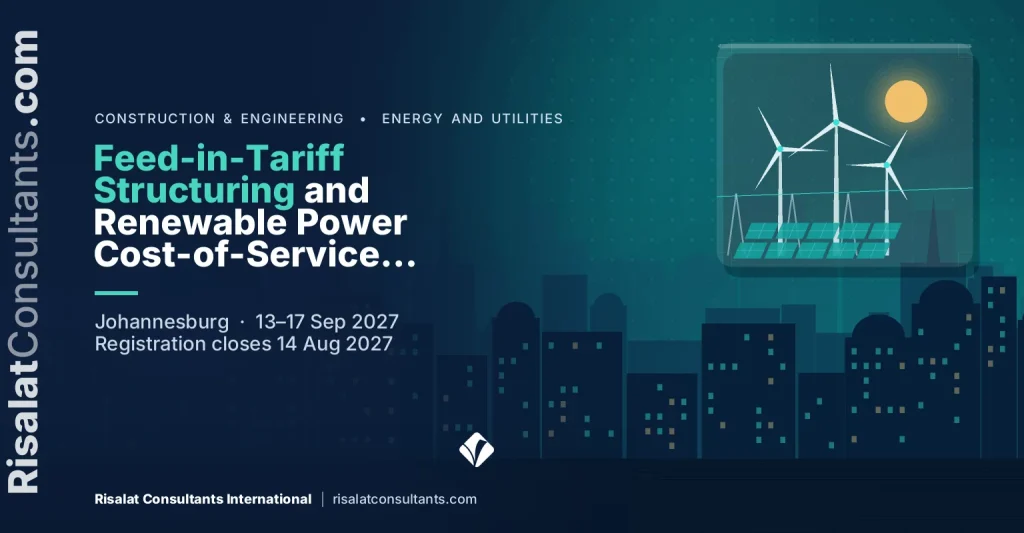
- 13–17 Sep 2027 (5 days)
- Dónde
- Johannesburg, South Africa
- Tarifa por participante
- 3.250 £ (GBP)
- Pago
- Mediante factura y transferencia bancaria
- Cierre de inscripciones
- 14 Aug 2027
- A quién va dirigido
- Energy economists and utility tariff analysts from public regulatory commissions; Macroeconomic regulators and fiscal analysts from ministries of e…
- Certificado
- Certificado de finalización
- Opción interna
- Impártalo para su equipo, en sus fechas
En esta página 11 secciones
Descripción del programa
This five-day professional training programme delivers rigorous competencies in feed-in-tariff design and cost-of-service financial modelling for grid-connected renewable energy installations above 50kW. Participants examine the economic principles governing clean energy remuneration, focusing on resource-specific tariff setting, avoided-cost methodologies, and long-term utility financial sustainability. Hosted in Johannesburg, the course equips regulatory and utility specialists to establish transparent, predictable commercial conditions that attract private infrastructure capital while safeguarding public electricity networks and downstream consumers.
Delegates engage directly with advanced tariff structuring tools, learning to calculate levelised cost of electricity benchmarks, debt service coverage ratios, and internal rate of return thresholds for independent power producers. The curriculum addresses the operational realities of unbundled and single-buyer power markets, showing how to balance utility revenue requirements against tariff impact constraints. Analytical sessions explore risk-allocation frameworks, balancing network integration costs, indexation against inflation and foreign exchange movements, and regulatory accounting treatments suited to sovereign and regional grid architectures.
By bridging macro-fiscal policy and project-level cash flow mechanics, this programme enables institutional analysts to conduct comprehensive cost-of-service studies and formulate defensible renewable energy tariffs. Participants review international standard practices, including grid code compliance requirements and standardised power purchase provisions, ensuring clean electricity procurement aligns with national development agendas. The practical exercises empower public sector professionals to negotiate power purchase arrangements effectively, maintain off-taker creditworthiness, and establish resilient regulatory frameworks for medium and utility-scale generation assets.
Public utilities and economic regulators face mounting pressure to accelerate clean energy procurement while maintaining systemic fiscal discipline and off-taker liquidity. This programme directly addresses regulatory and economic planning requirements for initiatives such as the Preparation of a Grid Code, Feed-in-Tariffs and Model Energy Supply Purchase Agreements for Renewable Energy Systems Greater than 50kW. As small island developing states and emerging economies modernise utility frameworks, technical teams require robust, transparent cost-of-service models to evaluate independent power producer tariffs, mitigate foreign exchange exposure, and protect end-user affordability without destabilising utility balance sheets.
Delivered by Risalat Consultants International in Johannesburg, South Africa, it combines expert-led sessions, real cases and group work, so that participants can apply what they learn in their own institution.
The Programme Strengthens Institutional Capability
- Economic rationale of feed-in-tariffs versus competitive auctions for systems above 50kW
- Overview of cost-of-service regulation and utility revenue-requirement concepts
- Avoided-cost calculation methodologies: energy, capacity, and transmission cost offset
- Integrating renewable energy targets with national economic and grid stability planning
- Institutional roles of economic regulators, system operators, and generation off-takers
- Determining levelised cost of electricity for solar photovoltaic, wind, and biomass technologies
- Capital expenditure, operational expenditure, and resource capacity factor estimation
- Weighted average cost of capital estimation for utility-scale clean infrastructure
- Evaluación de riesgos climáticos y ambientales
- Planificación de la adaptación y la mitigación
- Estrategias sectoriales para la energía, el agua y la tierra
- Diseño de proyectos para objetivos climáticos y ambientales
It is designed for energy economists and utility tariff analysts from public regulatory commissions, macroeconomic regulators and fiscal analysts from ministries of energy and finance, power system planning engineers evaluating medium to large-scale renewable generation and others who want practical, current skills in climate, environment and natural resources.
- Insumos
- Actividades
- Productos
- Efectos
- Impacto
The Growing Importance of Feed-in-Tariff Structuring and Renewable Power Cost-of-Service Modelling in Johannesburg
El cambio climático, la presión ambiental y la gestión de los recursos determinan hoy los planes nacionales, los presupuestos y las decisiones de inversión. Los financiadores esperan cada vez más que las consideraciones climáticas y ambientales se integren en los proyectos desde el principio.
Las instituciones capaces de planificar en función de los riesgos climáticos, gestionar bien los recursos naturales y preparar propuestas sólidas están en mejor posición para proteger los servicios y acceder a la financiación disponible para este trabajo.
Las organizaciones necesitan cada vez más profesionales capaces de:
- Evaluar los riesgos climáticos y ambientales para sus servicios y activos
- Diseñar proyectos que cumplan los objetivos climáticos y ambientales
- Preparar propuestas que los financiadores puedan aprobar
- Medir e informar los resultados de forma creíble
- Trabajar con comunidades y socios de distintos sectores
Unos sistemas sólidos de clima, medio ambiente y recursos naturales ayudan a las organizaciones a:
- Proteger los servicios y las infraestructuras frente a los riesgos climáticos
- Acceder a la financiación climática y ambiental
- Cumplir los compromisos nacionales e internacionales
- Utilizar los recursos naturales de forma sostenible
This Feed-in-Tariff Structuring and Renewable Power Cost-of-Service Modelling in Johannesburg programme brings these elements together in a practical format, so that participants understand not only what good practice looks like but also how to introduce it in their own setting, with the people and resources they have.
Who Should Attend This Feed-in-Tariff Structuring and Renewable Power Cost-of-Service Modelling in Johannesburg Training?
Este programa está dirigido a:
- Energy economists and utility tariff analysts from public regulatory commissions
- Macroeconomic regulators and fiscal analysts from ministries of energy and finance
- Power system planning engineers evaluating medium to large-scale renewable generation
- Commercial and financial managers from state-owned electricity utilities
- Legal and regulatory compliance officers handling independent power producer integration
- Project coordinators from sovereign renewable energy project implementation units
- Energy analysts working on programmes funded by the World Bank, AfDB, EU, or UN
- Investment appraisal officers assessing power purchase agreement off-take obligations
- Grid system operators managing economic dispatch and renewable connection policies
- Responsables de cambio climático y medio ambiente
- Personal de los sectores de energía, agua y agricultura
- Responsables de planificación y políticas
El programa es adecuado tanto para profesionales con experiencia como para quienes asumen nuevas responsabilidades. Se fomentan los grupos que mezclan instituciones y países, porque los participantes aprenden mucho de la experiencia de los demás.
Marque lo que su equipo necesita ser capaz de hacer.
Feed-in-Tariff Structuring and Renewable Power Cost-of-Service Modelling in Johannesburg Training Objectives
Upon successful completion of this Feed-in-Tariff Structuring and Renewable Power Cost-of-Service Modelling in Johannesburg Training, participants will be able to:
- Calculate levelised cost of electricity and system avoided costs for utility-scale renewable energy assets
- Formulate transparent feed-in-tariff structures using revenue-requirement and cost-of-service accounting frameworks
- Build financial models to assess independent power producer returns, debt service capacity, and utility off-taker risk
- Structure multi-currency tariff indexation mechanisms to manage inflation, foreign exchange, and interest rate volatility
- Align feed-in-tariff policies with technical grid code connection requirements for generation systems exceeding 50kW
- Evaluate the financial impacts of model energy supply and purchase agreements on utility balance sheet solvency
- Design regulatory review mechanisms and tariff degression pathways to reflect declining technology capital costs
- Explicar los principales desafíos climáticos y ambientales de su sector
- Evaluar los riesgos climáticos y ambientales para los servicios y los activos
- Planificar medidas de adaptación y mitigación
Cada objetivo se practica durante el programa mediante ejercicios, casos o trabajo en grupo, de modo que los participantes salgan siendo capaces de hacerlo, no solo de describirlo.
Contenido y estructura del programa
- Economic rationale of feed-in-tariffs versus competitive auctions for systems above 50kW
- Overview of cost-of-service regulation and utility revenue-requirement concepts
- Avoided-cost calculation methodologies: energy, capacity, and transmission cost offset
- Integrating renewable energy targets with national economic and grid stability planning
- Institutional roles of economic regulators, system operators, and generation off-takers
- Determining levelised cost of electricity for solar photovoltaic, wind, and biomass technologies
- Capital expenditure, operational expenditure, and resource capacity factor estimation
- Weighted average cost of capital estimation for utility-scale clean infrastructure
- Hands-on discounted cash flow modelling for independent power producer balance sheets
- Assessing return on equity expectations, debt sizing, and debt service coverage ratios
- Designing tiered and technology-differentiated tariff structures for systems greater than 50kW
- Utility cost-of-service allocation: distribution, transmission, and balancing ancillary services
- Evaluating off-taker balance sheet exposure and working capital requirements
- Structuring consumer tariff passthrough mechanisms and retail electricity bill impact analysis
- Managing systemic cross-subsidisation and public service obligation funding
- Formulating foreign exchange and inflation indexation adjustment formulas in tariffs
- Designing model energy supply and power purchase agreement commercial terms
- De-risking payment structures: sovereign guarantees, letters of credit, and escrow accounts
- Curtailment compensation rules and grid availability deemed-generation mechanics
- Grid code compliance conditions, interconnection boundaries, and performance warranties
- Establishing dynamic tariff degression schedules linked to global technology cost trends
- Conducting regulatory tariff filing evaluations and evidence-based public hearing processes
- Monitoring independent power producer operational performance and contract compliance
- Integrating feed-in-tariff programmes with multi-year tariff review frameworks
- Cap-stone presentation: Defending a complete renewable energy tariff and off-take model
Contenido completo día a día
El programa dura 5 días. Cada jornada combina aportaciones de expertos, trabajo práctico y un taller o estudio de caso de cierre:
- First Day: Day 1: Renewable Energy Policy, Economic Principles, and Tariff Architecture
- Second Day: Day 2: Cost-of-Service Modelling and Financial Evaluation Mechanics
- Third Day: Day 3: Feed-in-Tariff Structuring, Cost Allocation, and Utility Solvency
- Fourth Day: Day 4: Indexation, Macroeconomic Risks, and Commercial Agreement Structuring
- Fifth Day: Day 5: Regulatory Implementation, Tariff Degression, and Policy Review
Contenido completo día a día
First Day | Day 1: Renewable Energy Policy, Economic Principles, and Tariff Architecture
- Economic rationale of feed-in-tariffs versus competitive auctions for systems above 50kW
- Overview of cost-of-service regulation and utility revenue-requirement concepts
- Avoided-cost calculation methodologies: energy, capacity, and transmission cost offset
- Integrating renewable energy targets with national economic and grid stability planning
- Institutional roles of economic regulators, system operators, and generation off-takers
Workshop: Day 1: Renewable Energy Policy, Economic Principles, and Tariff Architecture: Applying It to Your Institution
Trabajando en grupos pequeños, los participantes aplican los métodos del día a ejemplos de sus propias instituciones y acuerdan los siguientes pasos prácticos.
Second Day | Day 2: Cost-of-Service Modelling and Financial Evaluation Mechanics
- Determining levelised cost of electricity for solar photovoltaic, wind, and biomass technologies
- Capital expenditure, operational expenditure, and resource capacity factor estimation
- Weighted average cost of capital estimation for utility-scale clean infrastructure
- Hands-on discounted cash flow modelling for independent power producer balance sheets
- Assessing return on equity expectations, debt sizing, and debt service coverage ratios
Workshop: Day 2: Cost-of-Service Modelling and Financial Evaluation Mechanics: Applying It to Your Institution
Trabajando en grupos pequeños, los participantes aplican los métodos del día a ejemplos de sus propias instituciones y acuerdan los siguientes pasos prácticos.
Third Day | Day 3: Feed-in-Tariff Structuring, Cost Allocation, and Utility Solvency
- Designing tiered and technology-differentiated tariff structures for systems greater than 50kW
- Utility cost-of-service allocation: distribution, transmission, and balancing ancillary services
- Evaluating off-taker balance sheet exposure and working capital requirements
- Structuring consumer tariff passthrough mechanisms and retail electricity bill impact analysis
- Managing systemic cross-subsidisation and public service obligation funding
Case Study: Day 3: Feed-in-Tariff Structuring, Cost Allocation, and Utility Solvency in Practice
Los participantes analizan un caso realista, comparan las decisiones tomadas con las buenas prácticas y extraen lecciones que pueden aplicar en su propio contexto.
Fourth Day | Day 4: Indexation, Macroeconomic Risks, and Commercial Agreement Structuring
- Formulating foreign exchange and inflation indexation adjustment formulas in tariffs
- Designing model energy supply and power purchase agreement commercial terms
- De-risking payment structures: sovereign guarantees, letters of credit, and escrow accounts
- Curtailment compensation rules and grid availability deemed-generation mechanics
- Grid code compliance conditions, interconnection boundaries, and performance warranties
Workshop: Day 4: Indexation, Macroeconomic Risks, and Commercial Agreement Structuring: Applying It to Your Institution
Trabajando en grupos pequeños, los participantes aplican los métodos del día a ejemplos de sus propias instituciones y acuerdan los siguientes pasos prácticos.
Fifth Day | Day 5: Regulatory Implementation, Tariff Degression, and Policy Review
- Establishing dynamic tariff degression schedules linked to global technology cost trends
- Conducting regulatory tariff filing evaluations and evidence-based public hearing processes
- Monitoring independent power producer operational performance and contract compliance
- Integrating feed-in-tariff programmes with multi-year tariff review frameworks
- Cap-stone presentation: Defending a complete renewable energy tariff and off-take model
Capstone Exercise: Feed-in-Tariff Structuring and Renewable Power Cost-of-Service Modelling in Johannesburg Action Plan for Your Institution
Los participantes integran lo aprendido durante la semana en un plan de acción para su propia institución, con prioridades, responsables y primeros pasos, y lo presentan para recibir comentarios de sus pares y de los facilitadores.
Feed-in-Tariff Structuring and Renewable Power Cost-of-Service Modelling in Johannesburg Training Methodology
The programme employs applied economic modelling, institutional policy analysis, and comparative review of utility regulation practices. Delegates construct dynamic financial spreadsheets, working through real-world technical data to simulate tariff methodologies, off-taker cash flows, and indexation scenarios. Interactive lectures alternate with practical workbook clinics, where participants test the sensitivities of debt coverage, foreign exchange movements, and revenue requirements. Peer-to-peer analytical reviews enable specialists to share regional regulatory challenges, examine contract documentation, and validate model outputs against international development finance standards.
El programa combina:
- Sesiones dirigidas por expertos sobre la práctica actual
- Estudios de caso regionales e internacionales
- Trabajo en grupo y ejercicios prácticos
- Simulaciones y juegos de rol cuando proceda
- Análisis de los desafíos propios de los participantes
- Aprendizaje entre pares de distintas instituciones y países
- Herramientas y plantillas prácticas para llevar al trabajo
- Reflexión diaria y planificación de acciones
Antes del programa, una breve evaluación previa ayuda a los facilitadores a comprender la función y las prioridades de cada participante, para adaptar los ejemplos y ejercicios al grupo. Cada jornada termina con una breve reflexión en la que los participantes anotan lo que aplicarán en su trabajo.
- Fondos
- Entidad
- Proyecto
- Resultados
- MRV
Resultados esperados
Upon completion of this Feed-in-Tariff Structuring and Renewable Power Cost-of-Service Modelling in Johannesburg Training, participants will be able to:
- Independent proficiency in constructing renewable energy cost-of-service and levelised cost financial models
- Capacity to evaluate and adjust feed-in-tariff structures to safeguard utility solvency and ratepayer affordability
- Ability to calculate system avoided costs to support regulatory filings and generation planning
- Competence in designing transparent tariff indexation formulas covering currency and inflation risk
- Skills to review and negotiate model energy supply purchase agreements for installations above 50kW
- Readiness to formulate dynamic tariff degression rules that reflect capital cost market movements
- Evaluar los riesgos climáticos y ambientales
- Planificar medidas de adaptación y mitigación
Los participantes se marchan con un plan de acción personal y herramientas prácticas que pueden utilizar en su institución desde la primera semana de regreso. Las instituciones que envían a varios participantes pueden aprovechar el programa para acordar métodos y plantillas comunes entre equipos, lo que facilita mantener las mejoras.
3.250 £ por participante · factura y transferencia bancaria · los grupos de 5 o más personas reciben un descuento
Cinco o más personas de una misma organización: solicite la tarifa de grupo al pedir la factura.
Ten or more: an in-house version for your institution may cost less per person. Ask for an in-house quote.
Registration closes in 270 days (14 Aug 2027)
Institutional Application of Feed-in-Tariff Structuring and Renewable Power Cost-of-Service Modelling in Johannesburg Training
Este programa ayuda a las organizaciones a fortalecer:
- Planificación climática y ambiental
- Diseño de proyectos
- Acceso a la financiación
- Medición de resultados
- Participación de las partes interesadas
Los participantes regresan con herramientas prácticas para mejorar:
- Evaluaciones de riesgos
- Notas conceptuales
- Marcos de resultados
- Sistemas de seguimiento
- Acuerdos de asociación
El programa está concebido para que el aprendizaje pase del aula a la institución. Siempre que es posible, los participantes trabajan con sus propios procesos y documentos, y se marchan con un plan de acción que sus responsables pueden revisar y respaldar.
Pertinencia y aplicación regionales
Europa
Las instituciones europeas trabajan en clima, medio ambiente y recursos naturales dentro de marcos normativos detallados y agendas de reforma. Los participantes de Europa pueden comparar su práctica con colegas de otras regiones y comprobar cómo funcionan los métodos consolidados en condiciones distintas.
África
En toda África, los ministerios, organismos y equipos de proyecto que trabajan en clima, medio ambiente y recursos naturales operan cada vez más junto a programas financiados por donantes que exigen sistemas claros y evidencias. El programa ayuda a los participantes a adaptar las buenas prácticas a las instituciones y los recursos con los que trabajan.
Oriente Medio
En Oriente Medio, las estrategias nacionales de desarrollo y los planes de diversificación imponen exigencias crecientes en materia de clima, medio ambiente y recursos naturales. Los participantes analizan cómo crear dentro de los organismos públicos y las empresas la capacidad que estos planes requieren.
Asia
Las instituciones de toda Asia combinan un rápido crecimiento con ambiciosos programas de modernización. Los participantes de Asia pueden compartir su experiencia en el escalamiento rápido de sistemas y conocer los enfoques utilizados en otros lugares.
Pacífico
Los pequeños Estados insulares y del Pacífico afrontan limitaciones particulares de tamaño, distancia y capacidad. El programa destaca enfoques prácticos y proporcionados en materia de clima, medio ambiente y recursos naturales adecuados para instituciones más pequeñas.
Holding the programme in Johannesburg, South Africa brings participants together away from their daily pressures, so they can compare how climate, environment and natural resources is handled in different settings. The same programme can also be delivered in-house for one institution, in its own country or online, with cases taken from its current work.
Host Country Profile – South Africa
Risalat Consultants International runs open-enrolment training programmes in Johannesburg, South Africa for officials, project teams and professionals from across the region. Dates, fees and what each programme covers are listed above, and any programme can also be delivered in-house for your institution.
Estudiar fuera de su país ofrece a los participantes tiempo para concentrarse, una mirada nueva sobre su propia institución y la oportunidad de crear una red con colegas de otros países.
Feed-in-Tariff Structuring and Renewable Power Cost-of-Service Modelling in Johannesburg Training Deliverables
Los participantes reciben apoyo antes, durante y después del programa, de modo que la preparación, el aprendizaje y el seguimiento formen una experiencia continua.
Antes del programa
- Evaluación previa del participante
- Feed-in-Tariff Structuring and Renewable Power Cost-of-Service Modelling in Johannesburg Readiness Assessment
- Feed-in-Tariff Structuring and Renewable Power Cost-of-Service Modelling in Johannesburg Resource Pack
- Materiales de lectura preparatoria
- Apoyo y asesoramiento gratuitos para el visado
Durante el programa
- Recogida en el aeropuerto y asistencia de bienvenida
- Accommodation with breakfast: 6 nights, check-in Sunday 12 September 2027, check-out Saturday 18 September 2027 (one night before and one night after the programme)
- Cena de bienvenida y networking
- Kit de formación de Risalat (bolsa, botella, taza, camiseta, gorra, funda de pasaporte, bolígrafos, cuaderno, imán y llavero)
- Comprehensive Feed-in-Tariff Structuring and Renewable Power Cost-of-Service Modelling in Johannesburg Training Manual
- Lista de verificación para la detección de riesgos climáticos
- Plantilla de evaluación de opciones
- Plantilla de nota conceptual
- Plantilla de medición de resultados
- Talleres prácticos y simulaciones
- Debates en grupo y aprendizaje entre pares
- Almuerzo y refrigerios diarios
- Acceso completo a las instalaciones de la sede de formación
- Mini Pad / tableta con materiales didácticos digitales
- Visita de campo (cuando proceda)
- Recorrido turístico por la ciudad
Después del programa
- Certificado de finalización
- Reconocimiento a la participación en programas de Risalat
- Materiales de consulta posteriores a la formación
- Lista de verificación de preparación para la financiación
- Plantilla de seguimiento y presentación de informes
- Apoyo posterior a la formación y orientación de seguimiento
- Informe del programa
Institutions can also request a tailored in-house version of this programme, delivered at their premises or online. Request a proposal.
Common Challenges in Feed-in-Tariff Structuring and Renewable Power Cost-of-Service Modelling in Johannesburg, And How This Training Helps
¿Cómo pueden las instituciones evaluar los riesgos climáticos y ambientales para sus servicios y activos?
The programme addresses this directly on the first day (Day 1: Renewable Energy Policy, Economic Principles, and Tariff Architecture), where participants practise the methods involved and adapt them to their own institution, then build it into their action plan.
¿Cómo pueden las instituciones diseñar proyectos que cumplan los objetivos climáticos y ambientales?
The programme addresses this directly on the second day (Day 2: Cost-of-Service Modelling and Financial Evaluation Mechanics), where participants practise the methods involved and adapt them to their own institution, then build it into their action plan.
¿Cómo pueden las instituciones preparar propuestas que los financiadores puedan aprobar?
The programme addresses this directly on the third day (Day 3: Feed-in-Tariff Structuring, Cost Allocation, and Utility Solvency), where participants practise the methods involved and adapt them to their own institution, then build it into their action plan.
¿Cómo pueden las instituciones medir e informar los resultados de forma creíble?
The programme addresses this directly on the fourth day (Day 4: Indexation, Macroeconomic Risks, and Commercial Agreement Structuring), where participants practise the methods involved and adapt them to their own institution, then build it into their action plan.
¿Cómo pueden las instituciones trabajar con comunidades y socios de distintos sectores?
The programme addresses this directly on the fifth day (Day 5: Regulatory Implementation, Tariff Degression, and Policy Review), where participants practise the methods involved and adapt them to their own institution, then build it into their action plan.
Preguntas frecuentes
When and where does the Feed-in-Tariff Structuring and Renewable Power Cost-of-Service Modelling in Johannesburg programme take place?
It runs from 13 Sep 2027 to 17 Sep 2027, in Johannesburg, South Africa. The registration deadline is shown at the top of this page.
¿Quién debería asistir?
The programme is designed for energy economists and utility tariff analysts from public regulatory commissions, macroeconomic regulators and fiscal analysts from ministries of energy and finance, power system planning engineers evaluating medium to large-scale renewable generation, commercial and financial managers from state-owned electricity utilities, and others who want practical skills in climate, environment and natural resources.
¿Recibiré un certificado?
Sí. Los participantes que completan el programa reciben un Certificado de finalización de Risalat Consultants International.
¿Puede impartirse este programa solo para nuestra institución?
Sí. Podemos impartir una versión interna a medida en sus instalaciones, en otra ciudad o en línea, construida en torno a sus propios casos. Utilice la solicitud de propuesta de esta página.
¿Necesito experiencia previa en clima, medio ambiente y recursos naturales?
No se requiere formación especializada más allá de la experiencia en un puesto afín. Una breve evaluación previa ayuda a los facilitadores a adaptar las sesiones al grupo.
Who Will Deliver This Programme
Each date is delivered by a team assigned from Risalat's expert network for this subject. For this programme we assign:
How we choose them: Experience in the region of the participants or comparable settings; Command of the financier rules that apply (World Bank, ADB, AfDB, EU, UN) where relevant; Delivery in English; other languages on request for in-house groups; No conflict of interest with participants' institutions.
Names and short CVs of the assigned experts are shared with registered participants and sponsoring organisations before the programme, on request. Are you an expert in this subject? Join our expert network.
Training courses in JohannesburgEnergy and Water training courses
Why Johannesburg for this programme
Johannesburg is Southern Africa's business centre with a wide flight network.
The Feed-in-Tariff Structuring and Renewable Power Cost-of-Service Modelling in Johannesburg programme in September 2027 brings together officials and professionals from across the Africa region and beyond. Sessions combine short inputs, case studies and group work on participants' own files, and the city's institutions can be added as a study visit on request.
Getting there: O. R. Tambo (JNB).
Compruebe si necesita visado con el Verificador de visados gratuito y solicite una carta de invitación una vez inscrito.
Other programmes in Johannesburg
- Runway Civil Works Supervision and Airfield Pavement Quality Control in Johannesburg
- HV Transmission Substation Modernisation and Dispatch Network Protection in Johannesburg
- Smallholder Irrigation Scheme Rehabilitation and Water User Association Setup in Johannesburg
- Supervisory Control and Data Acquisition (SCADA) in Water Systems in Johannesburg
- Independent Power Producer Procurement & Power Purchase Agreements in Johannesburg
Relacionado: Programas de financiación climática y energía · Preparación de propuestas de financiación climática gratuita · todos los programas
Teams often travel here from Rwanda, Zambia, Malawi, Zimbabwe, Mozambique, Botswana, Democratic Republic of the Congo, Angola. Funding, visa letters and group rates are explained on each country page.
For teams and institutions
Bring your team
Teams that learn together apply more at work. Tell us how many people and how you would like to take part: we reply with a group quote within two working days.
Other dates and cities for this subject: Energy, Power and Utility Management training courses (118 upcoming dates).
More training courses in South Africa · Todos los programas en África · Calendario de formación completo
Plan this programme in a roadmap: why it matters, why to approve it, the dates to plan and the career it builds.