关键信息
- 日期
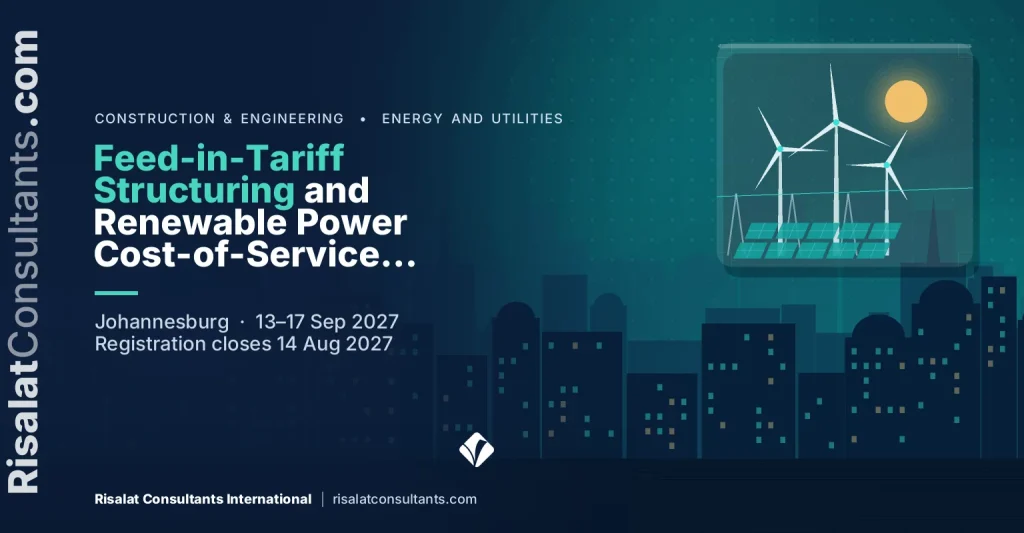
- 13–17 Sep 2027 (5 days)
- 地点
- Johannesburg, South Africa
- 每位学员费用
- £3,250(英镑)
- 付款
- 通过发票和银行转账付款
- 报名截止
- 14 Aug 2027
- 适用对象
- Energy economists and utility tariff analysts from public regulatory commissions; Macroeconomic regulators and fiscal analysts from ministries of e…
- 证书
- 结业证书
- 内训选项
- 按您的日期,为您的团队专场举办
本页内容11个部分
培训项目概述
This five-day professional training programme delivers rigorous competencies in feed-in-tariff design and cost-of-service financial modelling for grid-connected renewable energy installations above 50kW. Participants examine the economic principles governing clean energy remuneration, focusing on resource-specific tariff setting, avoided-cost methodologies, and long-term utility financial sustainability. Hosted in Johannesburg, the course equips regulatory and utility specialists to establish transparent, predictable commercial conditions that attract private infrastructure capital while safeguarding public electricity networks and downstream consumers.
Delegates engage directly with advanced tariff structuring tools, learning to calculate levelised cost of electricity benchmarks, debt service coverage ratios, and internal rate of return thresholds for independent power producers. The curriculum addresses the operational realities of unbundled and single-buyer power markets, showing how to balance utility revenue requirements against tariff impact constraints. Analytical sessions explore risk-allocation frameworks, balancing network integration costs, indexation against inflation and foreign exchange movements, and regulatory accounting treatments suited to sovereign and regional grid architectures.
By bridging macro-fiscal policy and project-level cash flow mechanics, this programme enables institutional analysts to conduct comprehensive cost-of-service studies and formulate defensible renewable energy tariffs. Participants review international standard practices, including grid code compliance requirements and standardised power purchase provisions, ensuring clean electricity procurement aligns with national development agendas. The practical exercises empower public sector professionals to negotiate power purchase arrangements effectively, maintain off-taker creditworthiness, and establish resilient regulatory frameworks for medium and utility-scale generation assets.
Public utilities and economic regulators face mounting pressure to accelerate clean energy procurement while maintaining systemic fiscal discipline and off-taker liquidity. This programme directly addresses regulatory and economic planning requirements for initiatives such as the Preparation of a Grid Code, Feed-in-Tariffs and Model Energy Supply Purchase Agreements for Renewable Energy Systems Greater than 50kW. As small island developing states and emerging economies modernise utility frameworks, technical teams require robust, transparent cost-of-service models to evaluate independent power producer tariffs, mitigate foreign exchange exposure, and protect end-user affordability without destabilising utility balance sheets.
Delivered by Risalat Consultants International in Johannesburg, South Africa, it combines expert-led sessions, real cases and group work, so that participants can apply what they learn in their own institution.
The Programme Strengthens Institutional Capability
- Economic rationale of feed-in-tariffs versus competitive auctions for systems above 50kW
- Overview of cost-of-service regulation and utility revenue-requirement concepts
- Avoided-cost calculation methodologies: energy, capacity, and transmission cost offset
- Integrating renewable energy targets with national economic and grid stability planning
- Institutional roles of economic regulators, system operators, and generation off-takers
- Determining levelised cost of electricity for solar photovoltaic, wind, and biomass technologies
- Capital expenditure, operational expenditure, and resource capacity factor estimation
- Weighted average cost of capital estimation for utility-scale clean infrastructure
- 气候与环境风险评估
- 适应与减缓规划
- 能源、水和土地领域的行业战略
- 面向气候与环境目标的项目设计
It is designed for energy economists and utility tariff analysts from public regulatory commissions, macroeconomic regulators and fiscal analysts from ministries of energy and finance, power system planning engineers evaluating medium to large-scale renewable generation and others who want practical, current skills in climate, environment and natural resources.
- 投入
- 活动
- 产出
- 成果
- 影响
The Growing Importance of Feed-in-Tariff Structuring and Renewable Power Cost-of-Service Modelling in Johannesburg
气候变化、环境压力和资源管理如今正影响着国家计划、预算和投资决策。出资方越来越期望项目从一开始就纳入气候与环境因素。
能够针对气候风险进行规划、妥善管理自然资源并编制合理提案的机构,更有能力保护公共服务,并获取这一领域的可用资金。
各机构日益需要具备以下能力的专业人员:
- 评估其服务和资产面临的气候与环境风险
- 设计符合气候与环境目标的项目
- 编制出资方能够批准的提案
- 可信地衡量和报告成果
- 与社区及跨部门合作伙伴协同工作
健全的气候、环境与自然资源体系有助于机构:
- 保护服务和基础设施免受气候风险影响
- 获取气候与环境资金
- 履行国家及国际承诺
- 可持续地利用自然资源
This Feed-in-Tariff Structuring and Renewable Power Cost-of-Service Modelling in Johannesburg programme brings these elements together in a practical format, so that participants understand not only what good practice looks like but also how to introduce it in their own setting, with the people and resources they have.
Who Should Attend This Feed-in-Tariff Structuring and Renewable Power Cost-of-Service Modelling in Johannesburg Training?
本培训项目适合:
- Energy economists and utility tariff analysts from public regulatory commissions
- Macroeconomic regulators and fiscal analysts from ministries of energy and finance
- Power system planning engineers evaluating medium to large-scale renewable generation
- Commercial and financial managers from state-owned electricity utilities
- Legal and regulatory compliance officers handling independent power producer integration
- Project coordinators from sovereign renewable energy project implementation units
- Energy analysts working on programmes funded by the World Bank, AfDB, EU, or UN
- Investment appraisal officers assessing power purchase agreement off-take obligations
- Grid system operators managing economic dispatch and renewable connection policies
- 气候变化与环境官员
- 能源、水和农业部门工作人员
- 规划与政策官员
本培训项目既适合经验丰富的专业人员,也适合刚承担新职责的人员。我们鼓励来自不同机构和国家的学员组成混合小组,因为学员能从彼此的经验中获益良多。
勾选您的团队需要具备的能力。
Feed-in-Tariff Structuring and Renewable Power Cost-of-Service Modelling in Johannesburg Training Objectives
Upon successful completion of this Feed-in-Tariff Structuring and Renewable Power Cost-of-Service Modelling in Johannesburg Training, participants will be able to:
- Calculate levelised cost of electricity and system avoided costs for utility-scale renewable energy assets
- Formulate transparent feed-in-tariff structures using revenue-requirement and cost-of-service accounting frameworks
- Build financial models to assess independent power producer returns, debt service capacity, and utility off-taker risk
- Structure multi-currency tariff indexation mechanisms to manage inflation, foreign exchange, and interest rate volatility
- Align feed-in-tariff policies with technical grid code connection requirements for generation systems exceeding 50kW
- Evaluate the financial impacts of model energy supply and purchase agreements on utility balance sheet solvency
- Design regulatory review mechanisms and tariff degression pathways to reflect declining technology capital costs
- 阐述本行业面临的主要气候与环境挑战
- 评估服务和资产面临的气候与环境风险
- 规划适应与减缓措施
每项目标都会在培训期间通过练习、案例或小组作业加以实践,使学员结业时不仅能够描述,更能够实际运用。
培训项目内容与结构
- Economic rationale of feed-in-tariffs versus competitive auctions for systems above 50kW
- Overview of cost-of-service regulation and utility revenue-requirement concepts
- Avoided-cost calculation methodologies: energy, capacity, and transmission cost offset
- Integrating renewable energy targets with national economic and grid stability planning
- Institutional roles of economic regulators, system operators, and generation off-takers
- Determining levelised cost of electricity for solar photovoltaic, wind, and biomass technologies
- Capital expenditure, operational expenditure, and resource capacity factor estimation
- Weighted average cost of capital estimation for utility-scale clean infrastructure
- Hands-on discounted cash flow modelling for independent power producer balance sheets
- Assessing return on equity expectations, debt sizing, and debt service coverage ratios
- Designing tiered and technology-differentiated tariff structures for systems greater than 50kW
- Utility cost-of-service allocation: distribution, transmission, and balancing ancillary services
- Evaluating off-taker balance sheet exposure and working capital requirements
- Structuring consumer tariff passthrough mechanisms and retail electricity bill impact analysis
- Managing systemic cross-subsidisation and public service obligation funding
- Formulating foreign exchange and inflation indexation adjustment formulas in tariffs
- Designing model energy supply and power purchase agreement commercial terms
- De-risking payment structures: sovereign guarantees, letters of credit, and escrow accounts
- Curtailment compensation rules and grid availability deemed-generation mechanics
- Grid code compliance conditions, interconnection boundaries, and performance warranties
- Establishing dynamic tariff degression schedules linked to global technology cost trends
- Conducting regulatory tariff filing evaluations and evidence-based public hearing processes
- Monitoring independent power producer operational performance and contract compliance
- Integrating feed-in-tariff programmes with multi-year tariff review frameworks
- Cap-stone presentation: Defending a complete renewable energy tariff and off-take model
完整的每日课程内容
本培训项目为期5天。每天均包含专家讲授、实践练习,并以研讨会或案例研究收尾:
- First Day: Day 1: Renewable Energy Policy, Economic Principles, and Tariff Architecture
- Second Day: Day 2: Cost-of-Service Modelling and Financial Evaluation Mechanics
- Third Day: Day 3: Feed-in-Tariff Structuring, Cost Allocation, and Utility Solvency
- Fourth Day: Day 4: Indexation, Macroeconomic Risks, and Commercial Agreement Structuring
- Fifth Day: Day 5: Regulatory Implementation, Tariff Degression, and Policy Review
完整的每日课程内容
First Day | Day 1: Renewable Energy Policy, Economic Principles, and Tariff Architecture
- Economic rationale of feed-in-tariffs versus competitive auctions for systems above 50kW
- Overview of cost-of-service regulation and utility revenue-requirement concepts
- Avoided-cost calculation methodologies: energy, capacity, and transmission cost offset
- Integrating renewable energy targets with national economic and grid stability planning
- Institutional roles of economic regulators, system operators, and generation off-takers
Workshop: Day 1: Renewable Energy Policy, Economic Principles, and Tariff Architecture: Applying It to Your Institution
学员分成小组,将当天所学方法应用于本机构的实例,并商定切实可行的后续步骤。
Second Day | Day 2: Cost-of-Service Modelling and Financial Evaluation Mechanics
- Determining levelised cost of electricity for solar photovoltaic, wind, and biomass technologies
- Capital expenditure, operational expenditure, and resource capacity factor estimation
- Weighted average cost of capital estimation for utility-scale clean infrastructure
- Hands-on discounted cash flow modelling for independent power producer balance sheets
- Assessing return on equity expectations, debt sizing, and debt service coverage ratios
Workshop: Day 2: Cost-of-Service Modelling and Financial Evaluation Mechanics: Applying It to Your Institution
学员分成小组,将当天所学方法应用于本机构的实例,并商定切实可行的后续步骤。
Third Day | Day 3: Feed-in-Tariff Structuring, Cost Allocation, and Utility Solvency
- Designing tiered and technology-differentiated tariff structures for systems greater than 50kW
- Utility cost-of-service allocation: distribution, transmission, and balancing ancillary services
- Evaluating off-taker balance sheet exposure and working capital requirements
- Structuring consumer tariff passthrough mechanisms and retail electricity bill impact analysis
- Managing systemic cross-subsidisation and public service obligation funding
Case Study: Day 3: Feed-in-Tariff Structuring, Cost Allocation, and Utility Solvency in Practice
学员分析真实案例,将案例中的决策与良好实践进行比较,并总结出可在自身环境中运用的经验。
Fourth Day | Day 4: Indexation, Macroeconomic Risks, and Commercial Agreement Structuring
- Formulating foreign exchange and inflation indexation adjustment formulas in tariffs
- Designing model energy supply and power purchase agreement commercial terms
- De-risking payment structures: sovereign guarantees, letters of credit, and escrow accounts
- Curtailment compensation rules and grid availability deemed-generation mechanics
- Grid code compliance conditions, interconnection boundaries, and performance warranties
Workshop: Day 4: Indexation, Macroeconomic Risks, and Commercial Agreement Structuring: Applying It to Your Institution
学员分成小组,将当天所学方法应用于本机构的实例,并商定切实可行的后续步骤。
Fifth Day | Day 5: Regulatory Implementation, Tariff Degression, and Policy Review
- Establishing dynamic tariff degression schedules linked to global technology cost trends
- Conducting regulatory tariff filing evaluations and evidence-based public hearing processes
- Monitoring independent power producer operational performance and contract compliance
- Integrating feed-in-tariff programmes with multi-year tariff review frameworks
- Cap-stone presentation: Defending a complete renewable energy tariff and off-take model
Capstone Exercise: Feed-in-Tariff Structuring and Renewable Power Cost-of-Service Modelling in Johannesburg Action Plan for Your Institution
学员将一周所学整合为本机构的行动计划,明确优先事项、负责人和初步行动,并进行展示,听取同伴和讲师的反馈。
Feed-in-Tariff Structuring and Renewable Power Cost-of-Service Modelling in Johannesburg Training Methodology
The programme employs applied economic modelling, institutional policy analysis, and comparative review of utility regulation practices. Delegates construct dynamic financial spreadsheets, working through real-world technical data to simulate tariff methodologies, off-taker cash flows, and indexation scenarios. Interactive lectures alternate with practical workbook clinics, where participants test the sensitivities of debt coverage, foreign exchange movements, and revenue requirements. Peer-to-peer analytical reviews enable specialists to share regional regulatory challenges, examine contract documentation, and validate model outputs against international development finance standards.
本培训项目融合了:
- 专家主讲当前实践
- 区域及国际案例研究
- 小组作业与实践练习
- 视情况安排模拟演练与角色扮演
- 探讨学员自身面临的挑战
- 跨机构、跨国家的同伴学习
- 可带回工作岗位的实用工具与模板
- 每日反思与行动规划
培训开始前,简短的课前评估可帮助讲师了解每位学员的岗位职责和重点关注事项,以便根据学员群体调整案例和练习。每天结束时安排简短的反思环节,学员记录下将在工作中应用的内容。
- 资金
- 实体
- 项目
- 结果
- MRV(监测、报告与核查)
预期成果
Upon completion of this Feed-in-Tariff Structuring and Renewable Power Cost-of-Service Modelling in Johannesburg Training, participants will be able to:
- Independent proficiency in constructing renewable energy cost-of-service and levelised cost financial models
- Capacity to evaluate and adjust feed-in-tariff structures to safeguard utility solvency and ratepayer affordability
- Ability to calculate system avoided costs to support regulatory filings and generation planning
- Competence in designing transparent tariff indexation formulas covering currency and inflation risk
- Skills to review and negotiate model energy supply purchase agreements for installations above 50kW
- Readiness to formulate dynamic tariff degression rules that reflect capital cost market movements
- 评估气候与环境风险
- 规划适应与减缓措施
学员结业时将获得个人行动计划和实用工具,回到工作岗位的第一周即可在机构中应用。派出多名学员的机构可借助本培训项目,在各团队之间统一方法和模板,使改进成果更易持续。
每位学员£3,250 · 发票与银行转账 · 5人及以上团体可享折扣
同一机构五人及以上:请在申请发票时索取团体价。
Ten or more: an in-house version for your institution may cost less per person. Ask for an in-house quote.
Registration closes in 270 days (14 Aug 2027)
Institutional Application of Feed-in-Tariff Structuring and Renewable Power Cost-of-Service Modelling in Johannesburg Training
本培训项目帮助机构加强:
- 气候与环境规划
- 项目设计
- 获取资金
- 成果衡量
- 利益相关方参与
学员将带着实用工具回到工作岗位,以提升:
- 风险评估
- 概念说明
- 成果框架
- 监测系统
- 伙伴关系安排
本培训项目的设计旨在让学习成果从课堂延伸至机构。学员尽可能围绕自身的流程和文件开展练习,并在结业时带走一份可供其主管审阅和支持的行动计划。
区域相关性与应用
欧洲
欧洲机构在详尽的监管框架和改革议程下开展气候、环境与自然资源工作。来自欧洲的学员可以将自身实践与其他地区的同行进行比较,并检验成熟方法在不同条件下的适用性。
非洲
在整个非洲,从事气候、环境与自然资源工作的政府部委、机构和项目团队,越来越多地与捐助方资助的项目协同运作,而这些项目要求有清晰的制度和证据。本培训项目帮助学员将良好实践与其所在机构及可用资源相结合。
中东
在中东,国家发展战略和多元化计划对气候、环境与自然资源管理提出了越来越高的要求。学员将探讨如何在公共机构和企业内部建立实现这些计划所需的能力。
亚洲
亚洲各国的机构在快速发展的同时,推进着雄心勃勃的现代化计划。来自亚洲的学员可以分享快速扩展系统的经验,并借鉴其他地区的做法。
太平洋地区
小岛屿国家和太平洋国家在规模、距离和能力方面面临特殊制约。本培训项目重点介绍适合小型机构、务实且适度的气候、环境与自然资源管理方法。
Holding the programme in Johannesburg, South Africa brings participants together away from their daily pressures, so they can compare how climate, environment and natural resources is handled in different settings. The same programme can also be delivered in-house for one institution, in its own country or online, with cases taken from its current work.
Host Country Profile – South Africa
Risalat Consultants International runs open-enrolment training programmes in Johannesburg, South Africa for officials, project teams and professionals from across the region. Dates, fees and what each programme covers are listed above, and any programme can also be delivered in-house for your institution.
在本国以外学习,可让学员专心投入,以全新视角审视本机构,并有机会与其他国家的同行建立人脉网络。
Feed-in-Tariff Structuring and Renewable Power Cost-of-Service Modelling in Johannesburg Training Deliverables
学员在培训前、培训中及培训后均可获得支持,使准备、学习与跟进形成连贯完整的体验。
培训开始前
- 学员课前评估
- Feed-in-Tariff Structuring and Renewable Power Cost-of-Service Modelling in Johannesburg Readiness Assessment
- Feed-in-Tariff Structuring and Renewable Power Cost-of-Service Modelling in Johannesburg Resource Pack
- 课前阅读资料
- 免费签证支持与咨询
培训期间
- 机场接机与欢迎协助
- Accommodation with breakfast: 6 nights, check-in Sunday 12 September 2027, check-out Saturday 18 September 2027 (one night before and one night after the programme)
- 欢迎交流晚宴
- Risalat培训礼包(背包、水瓶、马克杯、T恤、帽子、护照套、笔、笔记本、冰箱贴及钥匙扣)
- Comprehensive Feed-in-Tariff Structuring and Renewable Power Cost-of-Service Modelling in Johannesburg Training Manual
- 气候风险筛查检查清单
- 备选方案评估模板
- 概念说明模板
- 成果衡量模板
- 实践研讨与模拟演练
- 小组讨论与同伴学习
- 每日午餐与茶歇
- 全面使用培训场地设施
- 装有数字学习资料的迷你平板电脑
- 实地考察(如适用)
- 城市休闲观光
培训结束后
- 结业证书
- Risalat培训项目参与表彰奖
- 培训后参考资料
- 融资准备检查清单
- 监测与报告模板
- 培训后支持与跟进指导
- 培训项目报告
Institutions can also request a tailored in-house version of this programme, delivered at their premises or online. Request a proposal.
Common Challenges in Feed-in-Tariff Structuring and Renewable Power Cost-of-Service Modelling in Johannesburg, And How This Training Helps
机构如何评估其服务和资产面临的气候与环境风险?
The programme addresses this directly on the first day (Day 1: Renewable Energy Policy, Economic Principles, and Tariff Architecture), where participants practise the methods involved and adapt them to their own institution, then build it into their action plan.
机构如何设计符合气候与环境目标的项目?
The programme addresses this directly on the second day (Day 2: Cost-of-Service Modelling and Financial Evaluation Mechanics), where participants practise the methods involved and adapt them to their own institution, then build it into their action plan.
机构如何编制出资方能够批准的提案?
The programme addresses this directly on the third day (Day 3: Feed-in-Tariff Structuring, Cost Allocation, and Utility Solvency), where participants practise the methods involved and adapt them to their own institution, then build it into their action plan.
机构如何可信地衡量和报告成果?
The programme addresses this directly on the fourth day (Day 4: Indexation, Macroeconomic Risks, and Commercial Agreement Structuring), where participants practise the methods involved and adapt them to their own institution, then build it into their action plan.
机构如何与社区及跨部门合作伙伴协同工作?
The programme addresses this directly on the fifth day (Day 5: Regulatory Implementation, Tariff Degression, and Policy Review), where participants practise the methods involved and adapt them to their own institution, then build it into their action plan.
常见问题
When and where does the Feed-in-Tariff Structuring and Renewable Power Cost-of-Service Modelling in Johannesburg programme take place?
It runs from 13 Sep 2027 to 17 Sep 2027, in Johannesburg, South Africa. The registration deadline is shown at the top of this page.
谁应参加?
The programme is designed for energy economists and utility tariff analysts from public regulatory commissions, macroeconomic regulators and fiscal analysts from ministries of energy and finance, power system planning engineers evaluating medium to large-scale renewable generation, commercial and financial managers from state-owned electricity utilities, and others who want practical skills in climate, environment and natural resources.
我能获得证书吗?
能。完成本培训项目的学员将获得Risalat Consultants International颁发的结业证书。
本培训项目能否仅为我们机构单独举办?
可以。我们可以在贵机构所在地、其他城市或在线提供量身定制的内训版本,并围绕贵机构自身的案例设计内容。请使用本页面的方案建议书申请表。
我是否需要具备气候、环境和自然资源方面的经验?
除具备相关岗位经验外,无需其他专业背景。简短的课前评估可帮助讲师根据学员群体调整课程。
Who Will Deliver This Programme
Each date is delivered by a team assigned from Risalat's expert network for this subject. For this programme we assign:
How we choose them: Experience in the region of the participants or comparable settings; Command of the financier rules that apply (World Bank, ADB, AfDB, EU, UN) where relevant; Delivery in English; other languages on request for in-house groups; No conflict of interest with participants' institutions.
Names and short CVs of the assigned experts are shared with registered participants and sponsoring organisations before the programme, on request. Are you an expert in this subject? Join our expert network.
Training courses in JohannesburgEnergy and Water training courses
Why Johannesburg for this programme
Johannesburg is Southern Africa's business centre with a wide flight network.
The Feed-in-Tariff Structuring and Renewable Power Cost-of-Service Modelling in Johannesburg programme in September 2027 brings together officials and professionals from across the Africa region and beyond. Sessions combine short inputs, case studies and group work on participants' own files, and the city's institutions can be added as a study visit on request.
Getting there: O. R. Tambo (JNB).
使用免费的签证查询工具确认您是否需要签证,完成报名后即可申请邀请函。
Other programmes in Johannesburg
- Runway Civil Works Supervision and Airfield Pavement Quality Control in Johannesburg
- HV Transmission Substation Modernisation and Dispatch Network Protection in Johannesburg
- Smallholder Irrigation Scheme Rehabilitation and Water User Association Setup in Johannesburg
- Supervisory Control and Data Acquisition (SCADA) in Water Systems in Johannesburg
- Independent Power Producer Procurement & Power Purchase Agreements in Johannesburg
相关:气候融资与能源培训项目 · 免费气候融资提案准备度评估 · 全部培训项目
Teams often travel here from Rwanda, Zambia, Malawi, Zimbabwe, Mozambique, Botswana, Democratic Republic of the Congo, Angola. Funding, visa letters and group rates are explained on each country page.
- 《联合国气候变化框架公约》 UNFCCC
- 经济合作与发展组织(OECD) OECD
For teams and institutions
Bring your team
Teams that learn together apply more at work. Tell us how many people and how you would like to take part: we reply with a group quote within two working days.
Other dates and cities for this subject: Energy, Power and Utility Management training courses (118 upcoming dates).
More training courses in South Africa · 非洲所有培训项目 · 完整培训日历
Plan this programme in a roadmap: why it matters, why to approve it, the dates to plan and the career it builds.