Datos clave
- Fechas
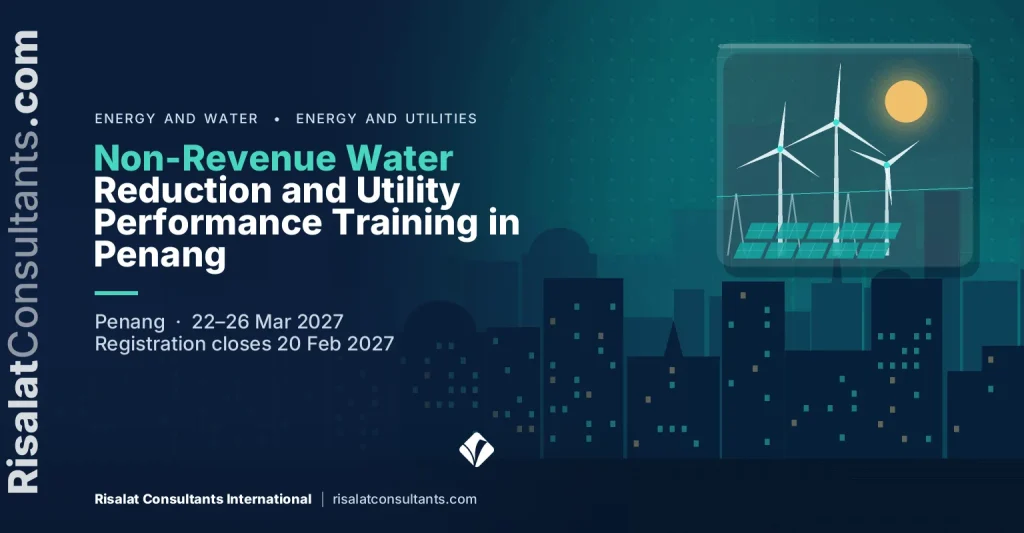
- 22–26 mar 2027 (5 días)
- Dónde
- Shared on registration, Penang, Malaysia
- Tarifa por participante
- 3.630 £ (GBP)
- Pago
- Mediante factura y transferencia bancaria
- Cierre de inscripciones
- 20 feb 2027
- Certificado
- Certificado de finalización
- Opción interna
- Impártalo para su equipo, en sus fechas
En esta página 14 secciones
Descripción del programa
New pipes and treatment plants do not by themselves deliver a reliable water service; the operator that runs them decides whether an investment lasts. Non-Revenue Water Reduction and Utility Performance Training in Penang is a five-day programme for the managers, engineers and finance staff who are responsible for those results in water utilities, line ministries and project implementation units.
The programme is designed first for teams working under the Kyrgyz Republic’s Water Supply and Sanitation Universal Access (WASUAP) Phase 1, approved by the World Bank on 18 April 2025 (P500620). The World Bank’s announcement describes US$121 million of Phase 1 financing from IDA, the Asian Infrastructure Investment Bank, the OPEC Fund and the Swiss Agency for Development and Cooperation, within a US$400 million multiphase envelope over about ten years; a May 2026 sector presentation shows a Phase 1 budget of US$200 million. The two sources differ, so both are given here.
That presentation is candid about the operating challenges. It lists low tariffs that are not linked to service quality, weak enforcement of the tariff calculation method, limited and insufficiently qualified staff, inefficient metering and a lack of performance monitoring among local water operators. It also allocates US$18 million to performance-based service improvement grants for district providers and US$4 million to a professional and vocational development line, which makes operator capability an explicit, financed objective of the programme.
The same pattern appears elsewhere. Moldova’s World Bank-financed Water Security and Sanitation Project reported 2024 non-revenue water of 54.5% in Comrat and 50.3% in Cahul, Albania’s sector modernisation operation started from a national figure of 64.4%, and Fiji is paying a contractor through a performance-based contract to bring losses in Greater Suva down to an average of 20%. Penang offers a useful contrast: its utility reported non-revenue water of 28.4% in 2025 against a national average of 34.3% in 2024, and it is working towards 25%.
Participants build a water balance, plan district metered areas, test billing controls, model tariffs and draft a performance improvement plan for their own utility.
The Programme Strengthens Institutional Capability
- IWA standard water balance and annual NRW reporting
- District metered area design, step testing and night-flow analysis
- Pressure management and active leakage control
- Customer and bulk meter accuracy, sizing and replacement cycles
- Detection and regularisation of illegal and unregistered connections
- Asset registers, condition assessment and preventive maintenance
- Tariff calculation, cost recovery and affordability safeguards
- Performance-based grants and their verification protocols
- Performance-based NRW contracts: baselines, payment rules and risk
- Regulatory KPIs, benchmarking and public reporting
- Workforce planning, succession and technical skills development
- Performance improvement plans with costed actions and owners
The result is a team that can explain its losses with numbers and show financiers how each grant improves performance.
The Growing Importance of Non-Revenue Water Reduction
Financiers increasingly tie water investment to operator performance. WASUAP’s performance-based component rewards district providers for operational efficiency and financial viability. Moldova’s project budgeted EUR 3.47 million for institutional capacity and utility performance, including performance improvement plans for its participating utilities, yet had spent only 11.1% of it by the end of 2025. Albania’s operation links disbursement to results and carries a US$6.3 million technical assistance and capacity component funded by Switzerland.
The cost of losses is large: Malaysia’s water regulator estimated that non-revenue water cost the country about RM 2.18 billion in 2022. Oman’s Nama Water Services awarded a 15-year operations contract in July 2026, reported at about RO 900 million, with 33 KPIs and an aim to cut losses from 34% to 11% by 2040 while Nama retains performance management.
Las organizaciones necesitan cada vez más profesionales capaces de:
- Producing a credible water balance with confidence limits
- Setting realistic, costed NRW reduction targets
- Designing and operating district metered areas
- Planning meter testing and replacement on economic grounds
- Cleaning billing data and finding unregistered customers
- Preparing tariff proposals that local councils and regulators accept
- Verifying results for performance-based grants
- Drafting and supervising performance-based NRW contracts
- Planning succession for an ageing technical workforce
Strong utility performance systems help organisations:
- Recover more revenue from water already produced
- Defer costly new sources and treatment capacity
- Extend supply hours and improve water quality
- Make the case for tariff adjustments with evidence
- Qualify for performance grants and results-based financing
- Keep donor-built schemes running after construction ends
- Retain skilled staff and transfer knowledge to new recruits
For many small and rural operators, the most pressing issue is people. Moldova’s latest semi-annual report notes that between 37% and 55% of staff in participating utilities are over 55, between 26% and 31% are already retired, and one person often holds three to five positions. Without succession planning, key skills leave with each retirement.
Who Should Attend This NRW and Utility Performance Training?
Este programa está dirigido a:
- Directors and deputy directors of water utilities and vodokanals
- Technical and operations managers
- NRW, leak detection and network engineers
- Metering, billing and customer service managers
- Finance managers and tariff analysts
- Staff of national water supply and sanitation departments
- Local self-government officials responsible for water tariffs and services
- Regulators and tariff authorities
- Project implementation unit coordinators and engineers
- Officers who verify performance-based grants
- Contract managers for performance-based NRW or operations contracts
- Consultants supporting utility performance improvement plans
Teams of two to four from the same utility gain most, because technical and finance staff can build one shared plan.
Marque lo que su equipo necesita ser capaz de hacer.
NRW and Utility Performance Training Objectives
Upon successful completion of this NRW and Utility Performance Training, participants will be able to:
- Prepare an IWA water balance and grade the reliability of its data
- Plan district metered areas and interpret minimum night flows
- Apply pressure management and active leakage control in priority zones
- Design a meter testing and replacement plan
- Reduce apparent losses through billing and customer data controls
- Build an asset register and an O&M plan for new schemes
- Calculate a cost-reflective tariff and link it to service standards
- Set up verification for performance-based grants
- Structure and supervise a performance-based NRW contract
- Draft a workforce and succession plan for critical technical roles
Each objective is practised on data that participants bring from their own utility.
Source: WASUAP Phase 1 presentation, May 2026 (Korea Green Growth Trust Fund / DDWSS), citing Government Resolution No. 330 of 12 June 2020.
1. How much does WASUAP Phase 1 in the Kyrgyz Republic allocate to professional and vocational development?
The May 2026 WASUAP presentation shows US$4 million for professional and vocational development and US$18 million for performance-based service improvement grants.
2. What non-revenue water level did Comrat's utility report for 2024 under Moldova's Water Security and Sanitation Project?
The project's seventh semi-annual report lists 2024 NRW of 54.5% for Comrat and 50.3% for Cahul.
3. What NRW level did Penang's water utility PBAPP report for 2025?
PBAPP reported NRW of 28.4% for 2025 against a national average of 34.3% in 2024, with a 2026 target of 25%.
Contenido y estructura del programa
- Why utilities lose water and revenue: the main causes
- The IWA standard water balance step by step
- System input volume: production metering and its errors
- Authorised consumption: billed, unbilled, metered and estimated
- Real losses, apparent losses and their cost to the utility
- Indicators: percentage, litres per connection per day and the infrastructure leakage index
- Data quality grading and confidence limits
- Leakage components: reported bursts, unreported leaks and background losses
- District metered area design, sizing and boundary valves
- Minimum night flow analysis and step testing
- Pressure management: zones, valves and service at critical points
- Active leakage control methods and equipment
- Pipe and service connection renewal priorities
- Intermittent supply and its effect on losses and assets
- Customer meter accuracy, class and sizing
- Meter testing, ageing and economic replacement cycles
- Bulk and production meter verification
- Customer census and GIS-linked customer databases
- Billing system controls and data errors
- Illegal and unregistered connections: detection and regularisation
- Collection efficiency, arrears and disconnection policy
- Full cost of service: operation, maintenance, renewal and debt
- Tariff methods, local approval and enforcement
- Linking tariffs to service quality and supply hours
- Affordability, social tariffs and targeted support
- O&M plans and budgets for newly built rural schemes
- Performance-based grants: indicators, verification and payment
- Performance-based NRW contracts: baseline, targets and payment rules
- The regulator’s role: licences, KPIs and benchmarking
- Malaysia’s SPAN model and lessons for other systems
- KPI sets for small and rural operators
- Reporting results to financiers and local councils
- Workforce profile analysis and critical roles
- Succession planning and knowledge transfer
- Vocational training partnerships and certification
Contenido completo día a día
The five days follow the path from measuring losses to managing the people and contracts that reduce them.
- Day 1: water balance and NRW baselines
- Day 2: real losses, DMAs and pressure management
- Day 3: metering, billing and commercial losses
- Day 4: tariffs, cost recovery and performance-based contracts
- Day 5: regulation, workforce and the performance improvement plan
Contenido completo día a día
First Day | Water Balance and NRW Baselines
- Why utilities lose water and revenue: the main causes
- The IWA standard water balance step by step
- System input volume: production metering and its errors
- Authorised consumption: billed, unbilled, metered and estimated
- Real losses, apparent losses and their cost to the utility
- Indicators: percentage, litres per connection per day and the infrastructure leakage index
- Data quality grading and confidence limits
- Setting a baseline that a financier can verify
Workshop: Building a First Water Balance
Working in utility teams, participants enter a year of production, billing and network data into a water balance template, grade each figure for reliability and calculate NRW in volume, value and per connection. Teams without full data use an anonymised small-town case, then list the measurements they must collect at home to make the baseline credible.
Second Day | Reducing Real Losses in the Network
- Leakage components: reported bursts, unreported leaks and background losses
- District metered area design, sizing and boundary valves
- Minimum night flow analysis and step testing
- Pressure management: zones, valves and service at critical points
- Active leakage control methods and equipment
- Pipe and service connection renewal priorities
- Intermittent supply and its effect on losses and assets
- Real-loss targets in the Fiji and Moldova projects
Workshop: Planning a District Metered Area
Using a network map and flow records, teams divide a supply zone into district metered areas, place inlet meters and boundary valves, and calculate night-flow leakage for each. They then propose a pressure management scheme, estimate water saved against cost, and identify which actions a utility could fund from its own budget or from a performance grant.
Third Day | Metering, Billing and Commercial Loss Control
- Customer meter accuracy, class and sizing
- Meter testing, ageing and economic replacement cycles
- Bulk and production meter verification
- Customer census and GIS-linked customer databases
- Billing system controls and data errors
- Illegal and unregistered connections: detection and regularisation
- Collection efficiency, arrears and disconnection policy
- Smart metering: when it pays and when it does not
Workshop: Apparent Loss Audit
Teams review a sample billing extract and meter register to find zero-consumption accounts, estimated bills, overdue meters and customers missing from the database. They quantify the revenue at stake, rank corrective actions by return, and draft a meter replacement plan that a utility director could approve within its current budget.
Fourth Day | Tariffs, Cost Recovery and Performance Contracts
- Full cost of service: operation, maintenance, renewal and debt
- Tariff methods, local approval and enforcement
- Linking tariffs to service quality and supply hours
- Affordability, social tariffs and targeted support
- O&M plans and budgets for newly built rural schemes
- Performance-based grants: indicators, verification and payment
- Performance-based NRW contracts: baseline, targets and payment rules
- Lessons from Fiji’s Greater Suva contract and Oman’s KPI-based model
Case Study: Designing a Performance-Based Grant
Participants take the WASUAP model of performance-based grants for district providers and design a one-year grant cycle for a small operator: eligibility rules, four to six indicators, baselines, verification sources and payment shares. Groups test the design against risks such as weak data, tariff decisions outside the utility’s control and staff turnover.
Fifth Day | Regulation, Workforce and Improvement Plans
- The regulator’s role: licences, KPIs and benchmarking
- Malaysia’s SPAN model and lessons for other systems
- KPI sets for small and rural operators
- Reporting results to financiers and local councils
- Workforce profile analysis and critical roles
- Succession planning and knowledge transfer
- Vocational training partnerships and certification
- Structure of a utility performance improvement plan
Capstone Exercise: Utility Performance Improvement Plan
Each team completes a 12-month performance improvement plan for its own utility or project: NRW baseline and target, priority loss reduction actions, metering and billing fixes, tariff and cost recovery steps, KPIs, workforce actions and a budget. Plans are presented to a panel acting as a financier and regulator, who question the evidence and feasibility.
NRW and Utility Performance Training Methodology
Short technical inputs are followed by exercises on real or anonymised utility data, and every team leaves with a draft plan.
El programa combina:
- Short expert presentations on each technical topic
- Water balance and DMA calculation exercises
- Billing and meter data analysis on sample datasets
- Case studies from World Bank and ADB-financed projects
- Tariff and cost recovery modelling in spreadsheets
- Group work on performance-based grant and contract design
- Peer exchange between utilities from different countries
- Benchmarking against Penang and Malaysian sector data
- Individual and team action planning
- A final capstone presentation with feedback
Participants bring a year of production, billing and staffing data where possible; Risalat treats it as confidential.
Visitas técnicas y programa en terreno
Where hosts agree, the programme includes a half-day technical visit in Penang, such as a water treatment or distribution facility, a network control function or a metering operation. Visits are requested before each session and are not guaranteed until the host agrees; otherwise a benchmarking session on published Penang and Malaysian data takes their place.
Resultados esperados
Upon completion of this NRW and Utility Performance Training, participants will be able to:
- Report NRW in a format that financiers and regulators accept
- Explain where their utility’s losses occur and what they cost
- Prioritise loss reduction actions by cost and water saved
- Improve meter accuracy and billing data quality
- Prepare evidence-based tariff proposals
- Meet the indicators of performance-based grants or contracts
- Plan staffing and succession for critical technical posts
- Present a costed performance improvement plan
These outcomes match what financiers track, such as NRW reduction, cost coverage and trained staff.
3.630 £ por participante · factura y transferencia bancaria · los grupos de 5 o más personas reciben un descuento
Cinco o más personas de una misma organización: solicite la tarifa de grupo al pedir la factura.
Diez o más: una versión interna para su institución puede costar menos por persona. Solicite un presupuesto para una formación interna.
Las inscripciones se cierran en 106 días (20 feb 2027)
Institutional Application of NRW and Utility Performance Training
Este programa ayuda a las organizaciones a fortalecer:
- Water balance reporting and data management
- Loss reduction strategies and annual targets
- Network zoning and pressure control
- Meter management and billing integrity
- Asset management and maintenance planning
- Tariff setting and cost recovery
- Performance-based grant administration
- Contract supervision for NRW and operations contracts
- Workforce planning and succession
- Performance improvement planning
Los participantes regresan con herramientas prácticas para mejorar:
- Annual water balance and NRW indicators
- DMA and pressure management planning
- Meter testing and replacement decisions
- Tariff and cost-of-service calculations
- Grant and contract verification
- KPI dashboards for management
- Staffing and succession plans
Organisations that want to understand their starting point before nominating staff can use Risalat’s free institutional capacity assessment, and project teams facing delays in utility components can run a project health check to identify where implementation is slowing.
Pertinencia y aplicación regionales
Asia Central
In the Kyrgyz Republic, 63% of communities have a water supply system and 363 villages still lack one, of which 258 are not yet covered by any project, according to the May 2026 WASUAP presentation. The same source lists low tariffs, weak enforcement of the tariff method by local governments, limited qualified staff, inefficient metering and missing performance monitoring. With US$18 million for performance-based service improvement grants and US$4 million for professional development, the programme needs district operators who can measure, report and improve their results.
Europa
Moldova’s Water Security and Sanitation Project had disbursed 9.1% of EUR 45.65 million by 31 December 2025, with a closing date of 31 January 2027. Its participating utilities reported 2024 NRW from 19.7% in Riscani to 54.5% in Comrat, and a workforce indicator stood at 33 against a target of 120. In Albania, the World Bank’s sector modernisation programme recorded NRW of 64.4%, collection efficiency of 75.5% and only 11 of 58 utilities recovering direct costs in 2019.
Middle East and North Africa
Jordan’s US$250 million Water Sector Efficiency Project, which aims to cut losses by 10 million cubic metres a year, was rated moderately unsatisfactory for implementation progress, with under 4% of the loan disbursed, as reported by Jordan News in December 2025 citing the World Bank’s mid-term review. In Tunisia, the World Bank’s US$208.5 million Potable Water Security and Resilience Project, approved in March 2026, finances 100,000 smart meters, network rehabilitation and the organisational modernisation of the national utility SONEDE.
Pacífico
Fiji’s ADB-financed Healthy Oceans and Water Security Improvement Project includes a performance-based NRW management contract valued at US$25.24 million, which The Fiji Times reports is aimed at an average NRW of 20% in the Greater Suva Area. In Solomon Islands, ADB’s urban water project records NRW of 61% in August 2023 against a 30% target, with progress off track.
Across these regions, capital investment is moving faster than operator capability, and the programme gives teams a shared method to close that gap.
- Insumos
- Actividades
- Productos
- Efectos
- Impacto
Perfil del país anfitrión: Malasia
Penang is a state in northern Peninsular Malaysia, with George Town as its historic centre. It offers business hotels and meeting facilities at lower cost than many Asian capitals and a multicultural setting with widely available halal food, which suits participants from Central Asia, the Middle East and Europe.
Penang is a practical benchmark for utility performance. Perbadanan Bekalan Air Pulau Pinang (PBAPP) reported NRW of 28.4% in 2025 against a national average of 34.3% in 2024, set a target of 25% for 2026, and serves more than 720,000 registered consumers. Its average domestic rate for the first 35 cubic metres a month is RM0.93 per cubic metre, and a tariff revision took effect on 1 July 2026 to fund new supply projects. Sector regulation sits with the National Water Services Commission (SPAN), which licenses operators in Peninsular Malaysia and Labuan, monitors their performance, advises on tariffs and NRW, and reviews business plans under the Water Services Industry Act 2006.
Penang International Airport has frequent connections to Kuala Lumpur. From Bishkek, participants usually travel through hubs such as Istanbul or Dubai to Kuala Lumpur, then take a short domestic flight. Visa rules for citizens of the Kyrgyz Republic and other countries change from time to time, so participants should confirm requirements with the Immigration Department of Malaysia or the nearest Malaysian embassy before booking; Risalat provides invitation and visa support letters.
NRW and Utility Performance Training Deliverables
Risalat supports participants before, during and after the programme so that they can focus on the work.
Antes del programa
- Evaluación previa del participante
- NRW and Utility Performance Readiness Assessment
- NRW and Utility Performance Resource Pack
- Materiales de lectura preparatoria
- Apoyo y asesoramiento gratuitos para el visado
Durante el programa
- Recogida en el aeropuerto y asistencia de bienvenida
- Alojamiento con desayuno
- Cena de bienvenida y networking
- Kit de formación de Risalat (bolsa, botella, taza, camiseta, gorra, funda de pasaporte, bolígrafos, cuaderno, imán y llavero)
- Comprehensive NRW and Utility Performance Training Manual
- IWA Water Balance Template
- DMA and Night-Flow Calculator
- Meter Replacement Planning Tool
- Billing Data Audit Checklist
- Tariff and Cost Recovery Model
- Performance-Based Grant Verification Template
- Talleres prácticos y simulaciones
- Debates en grupo y aprendizaje entre pares
- Almuerzo y refrigerios diarios
- Acceso completo a las instalaciones de la sede de formación
- Mini Pad / tableta con materiales didácticos digitales
- Visita de campo (cuando proceda)
- Recorrido turístico por la ciudad
Después del programa
- Certificado de finalización
- Reconocimiento a la participación en programas de Risalat
- Materiales de consulta posteriores a la formación
- Utility Performance Improvement Plan Template
- Workforce and Succession Planning Toolkit
- KPI Reporting Dashboard
- Apoyo posterior a la formación y orientación de seguimiento
- Informe del programa
Utilities, ministries and project units can request an in-house version built around their own data and indicators. Request a tailored proposal and Risalat will design it with your team.
Common Challenges in Non-Revenue Water Reduction, And How This Training Helps
How can we report NRW when our production and customer meters are unreliable?
The First Day shows how to build a water balance with graded data and confidence limits, so the utility can report an honest baseline now and improve it as metering improves.
How can we raise revenue without raising tariffs?
The Third Day focuses on apparent losses: meter accuracy, billing errors and unregistered connections. These often return revenue faster and more cheaply than new tariffs.
How do we convince local councils to approve a cost-reflective tariff?
The Fourth Day links tariff proposals to service standards and affordability safeguards, giving decision-makers evidence of what customers will receive in return.
How can a small operator qualify for performance-based grants?
The Fourth Day case study designs indicators, baselines and verification for a grant cycle modelled on WASUAP’s performance-based component, so teams know what evidence to keep.
How should we supervise a performance-based NRW contractor?
Sessions on the Fourth Day explain baselines, measurement rules and payment mechanisms, drawing on Fiji’s Greater Suva contract and Oman’s KPI-based model.
How do we keep skills when experienced staff retire?
The Fifth Day analyses workforce profiles, identifies critical roles and builds a succession and knowledge transfer plan, a response to the ageing workforce reported in Moldova and Albania.
How can we show financiers that our utility is improving?
The capstone performance improvement plan sets KPIs, targets and reporting routines that match the results indicators used in World Bank and ADB projects.
Preguntas frecuentes
Who is this non-revenue water training for?
Utility directors, technical, commercial and finance managers, NRW and metering engineers, regulators, local government tariff officers and project implementation unit staff working on water supply investments.
Is the programme relevant to the Kyrgyz WASUAP programme?
Yes. It is designed around the operator challenges listed for WASUAP Phase 1, including tariffs, metering, performance monitoring and staff skills, and around its performance-based grants and professional development line.
Why is the training held in Penang?
Penang's utility reported NRW of 28.4% in 2025, below the Malaysian average of 34.3% in 2024, and works under a national regulator, SPAN. It gives participants a working benchmark in an accessible, moderate-cost city.
Does the programme cover performance-based NRW contracts?
Yes. The Fourth Day covers baselines, measurement and payment rules for performance-based contracts and grants, using Fiji's Greater Suva contract and Oman's KPI-based model as references.
Can the training be delivered in-house?
Yes. Utilities, ministries and project units can request a tailored version built around their own data, indicators and staff through Risalat's proposal form.
Training courses in PenangEnergy and Water training courses
Why Penang for this programme
Penang, Malaysia, was chosen for this programme because it is easy to reach for the participants we expect and has suitable venues for practical, interactive training.
The Non-Revenue Water Reduction and Utility Performance Training in Penang programme in March 2027 brings together officials and professionals. Sessions combine short inputs, case studies and group work on participants' own files, and the city's institutions can be added as a study visit on request.
Compruebe si necesita visado con el Verificador de visados gratuito y solicite una carta de invitación una vez inscrito.
Más cursos de formación en Malasia · Todos los programas en Asia · Calendario de formación completo