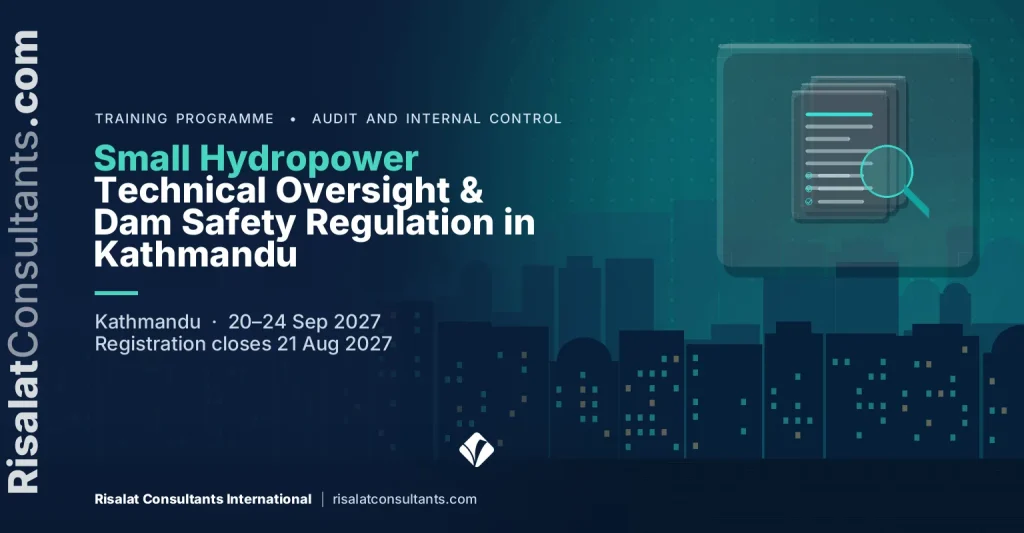
Datos clave
- Fechas
- 20–24 Sep 2027 (5 days)
- Dónde
- Katmandú, Nepal
- Tarifa por participante
- 2.350 £ (GBP)
- Pago
- Mediante factura y transferencia bancaria
- Cierre de inscripciones
- 21 Aug 2027
- Certificado
- Certificado de finalización
- Opción interna
- Impártalo para su equipo, en sus fechas
En esta página 14 secciones
Descripción del programa
Small hydropower schemes represent a vital component of renewable energy expansion across the Himalayan region, offering decentralised generation capacity for mountain communities and regional grids. However, operating run-of-river civil assets in steep, young geological formations presents acute operational and regulatory challenges. This programme addresses the engineering and institutional requirements necessary to maintain structural integrity, manage high sediment loads, and establish transparent regulatory mechanisms that align with international good practice across the asset lifecycle.
Delivered in Kathmandu, this five-day course provides technical professionals with structured methodologies for civil oversight and risk-informed dam safety surveillance. Participants examine engineering inspection regimes, geohazard monitoring, hydraulic structure maintenance, and environmental compliance frameworks. The curriculum bridges the gap between field-level asset inspection and statutory regulatory reporting, providing practitioners with practical workflows to evaluate civil works, identify structural vulnerabilities, and enforce compliance in challenging montane environments.
Through rigorous technical lectures, practical exercises, and comparative regulatory analysis, attendees develop capabilities tailored to the hydrological conditions of South Asia. The course draws directly upon international standards, including guidelines from the International Commission on Large Dams and multilateral environmental performance metrics. By engaging with realistic technical scenarios, public sector professionals enhance their readiness to oversee complex civil works, supervise private concessionaires, and protect river basin ecologies.
Steep river basins across the Himalayas are experiencing unprecedented infrastructure pressures, where climate variability, intense monsoon precipitation, and seismic hazards directly threaten run-of-river installations. Technical oversight teams under initiatives like the Sustainable Hydropower Development Project require updated operational tools to regulate civil works effectively and safeguard vulnerable river catchments. As public authorities modernise regulatory frameworks and concession agreements, robust technical competencies are urgently required to prevent asset failure, preserve river ecology, and satisfy international safeguard requirements across interconnected montane river systems.
Delivered by Risalat Consultants International in Kathmandu, Nepal, it combines expert-led sessions, real cases and group work, so that participants can apply what they learn in their own institution.
The Programme Strengthens Institutional Capability
- International Commission on Large Dams standards and safety categorisation for low-head and run-of-river structures
- Geological and geotechnical hazards in Himalayan river valleys: Slope instability, seismic loading, and foundation seepage
- Visual inspection protocols and structural surveillance workflows for concrete weirs and rockfill embankments
- Structural instrumentation networks: Selection, calibration, and data logging of piezometers, inclinometers, and settlement gauges
- Risk-informed surveillance: Setting safety performance indicators and defining inspection triggers for civil assets
- Himalayan sediment transport dynamics: Bedload characteristics, suspended silt concentrations, and quartz abrasiveness
- Hydraulic design assessment of desanding basins: Settling velocity, trap efficiency, and scour sluice configurations
- Sediment flushing operational regimes: Coordinated reservoir drawdown, hydraulic sluicing, and downstream impact control
- Evaluación de riesgos de fraude y registros de riesgos de fraude
- Diseño y prueba de los controles internos
- El modelo de las Tres Líneas y el papel de la supervisión
- Planificación, evidencia y documentación de la auditoría
It is designed for civil and hydraulic engineers responsible for small hydropower design review and site supervision, dam safety regulatory officers from national and regional energy directorates, river basin project officers managing integrated water resource infrastructure and others who want practical, current skills in fraud, audit and internal control.
The Growing Importance of Small Hydropower Technical Oversight & Dam Safety Regulation in Kathmandu
Se espera que los organismos públicos y los proyectos financiados por donantes demuestren que los fondos se utilizan para el fin previsto. Los auditores, los órganos de control y los financiadores miran cada vez más allá de los estados financieros, hacia los controles, los registros y los comportamientos que los sustentan.
Las debilidades de fraude y de control rara vez obedecen a un único fallo. Crecen donde las funciones no están claras, los registros están incompletos y no se da seguimiento a las señales de alerta. Los equipos que entienden cómo se produce el fraude y cómo lo detienen los controles protegen tanto a su institución como a las personas a las que sirve.
Las organizaciones necesitan cada vez más profesionales capaces de:
- Identificar y calificar los riesgos de fraude y de control en sus propios procesos
- Diseñar controles proporcionados y verificables
- Reunir y documentar evidencias de auditoría fiables
- Reconocer pronto las señales de alerta y escalarlas correctamente
- Convertir las observaciones en acciones prácticas y acordadas
Unos sistemas sólidos de prevención del fraude, auditoría y control interno ayudan a las organizaciones a:
- Reducir las pérdidas y los gastos no admisibles
- Superar las auditorías externas con menos observaciones
- Reforzar la confianza de los financiadores y la ciudadanía
- Responder a las denuncias de forma justa y documentada
This Small Hydropower Technical Oversight & Dam Safety Regulation in Kathmandu programme brings these elements together in a practical format, so that participants understand not only what good practice looks like but also how to introduce it in their own setting, with the people and resources they have.
Who Should Attend This Small Hydropower Technical Oversight & Dam Safety Regulation in Kathmandu Training?
Este programa está dirigido a:
- Civil and hydraulic engineers responsible for small hydropower design review and site supervision
- Dam safety regulatory officers from national and regional energy directorates
- River basin project officers managing integrated water resource infrastructure
- Technical specialists from power sector ministries and public generation utilities
- Environmental compliance officers overseeing aquatic and riparian safeguard measures
- Project management unit engineers executing multilateral-financed energy projects
- Licensing officers reviewing independent power producer concession agreements
- Surveillance and instrumentation technicians monitoring hydraulic structures
- Geotechnical and hydrometric specialists deployed in montane catchment areas
- Auditores internos y responsables de auditoría
- Gerentes financieros y contables
- Responsables de cumplimiento y riesgos
El programa es adecuado tanto para profesionales con experiencia como para quienes asumen nuevas responsabilidades. Se fomentan los grupos que mezclan instituciones y países, porque los participantes aprenden mucho de la experiencia de los demás.
Marque lo que su equipo necesita ser capaz de hacer.
Small Hydropower Technical Oversight & Dam Safety Regulation in Kathmandu Training Objectives
Upon successful completion of this Small Hydropower Technical Oversight & Dam Safety Regulation in Kathmandu Training, participants will be able to:
- Appraise structural safety surveillance protocols for run-of-river weirs and small dams using established international criteria
- Develop sedimentation management regimes to counter heavy sediment transport and mechanical abrasion in Himalayan river basins
- Execute comprehensive engineering inspection procedures for water intake works, headrace canals, forebays, and penstocks
- Formulate regulatory compliance mechanisms aligned with International Commission on Large Dams technical bulletins
- Establish downstream environmental monitoring regimes conforming to multilateral environmental and social safeguard standards
- Standardise statutory safety reporting templates and auditable compliance documentation for state regulatory authorities
- Draft emergency action and risk mitigation procedures for geotechnical hazards, seismic events, and flash floods
- Explicar cómo y por qué se produce el fraude, utilizando modelos reconocidos de riesgo de fraude
- Realizar una evaluación de riesgos de fraude y de control de un proceso real
- Vincular los controles con los riesgos mediante el modelo de las Tres Líneas
Cada objetivo se practica durante el programa mediante ejercicios, casos o trabajo en grupo, de modo que los participantes salgan siendo capaces de hacerlo, no solo de describirlo.
Contenido y estructura del programa
- International Commission on Large Dams standards and safety categorisation for low-head and run-of-river structures
- Geological and geotechnical hazards in Himalayan river valleys: Slope instability, seismic loading, and foundation seepage
- Visual inspection protocols and structural surveillance workflows for concrete weirs and rockfill embankments
- Structural instrumentation networks: Selection, calibration, and data logging of piezometers, inclinometers, and settlement gauges
- Risk-informed surveillance: Setting safety performance indicators and defining inspection triggers for civil assets
- Himalayan sediment transport dynamics: Bedload characteristics, suspended silt concentrations, and quartz abrasiveness
- Hydraulic design assessment of desanding basins: Settling velocity, trap efficiency, and scour sluice configurations
- Sediment flushing operational regimes: Coordinated reservoir drawdown, hydraulic sluicing, and downstream impact control
- Monitoring turbine component wear, mechanical degradation, and hydraulic structure abrasion from abrasive sediments
- Practical exercise: Calculating desanding basin efficiency curves and drafting seasonal sediment flushing schedules
- Day 3: Water Conveyance, Hydro-Mechanical Assets, and Civil Oversight & Dam Safety Regulation
- Inspection protocols for water conductor systems: Headrace canals, low-pressure tunnels, and surge tanks
- Forebay and penstock safety surveillance: Welded joint testing, pipe support stability, and anchor block displacement
- Hydro-mechanical asset oversight: Spillway gates, stoplogs, trash racks, and valve actuation systems
- Hydraulic transient analysis: Water hammer protection, surge dissipation, and pressure relief mechanism checks
- Non-destructive testing methods applied to aging concrete structures and exposed high-pressure steel conduits
- Multilateral development bank environmental frameworks: Biodiversity criteria and aquatic habitat protection
- Environmental flow (E-flow) regimes: Hydraulic verification, real-time release monitoring, and weir sensor integration
- Fish passage civil design appraisal: Pool-and-weir passes, vertical slot passes, and behavioural barrier performance
- Catchment management: Spoil disposal regulation, slope stabilising bioengineering, and muck management compliance
- Water quality surveillance: Turbidity limits, dissolved oxygen thresholds, and aquatic ecosystem health reporting
- Regulatory audit methodologies: Structuring independent engineering assessments and statutory technical reviews
- Emergency Action Plans (EAPs): Inundation area mapping, early warning dissemination, and emergency response hierarchies
- Standardised reporting: Drafting periodic dam safety reviews and non-conformance notices for public regulators
- Independent power producer oversight: Enforcing compliance milestones throughout commissioning and operation
- Capstone exercise: Production and review of a multi-disciplinary technical audit report for a run-of-river hydro scheme
Contenido completo día a día
El programa dura 5 días. Cada jornada combina aportaciones de expertos, trabajo práctico y un taller o estudio de caso de cierre:
- First Day: Day 1: Structural Integrity and Dam Safety Surveillance Frameworks
- Second Day: Day 2: Sedimentation Dynamics, Exclusion, and Flushing Hydraulics
- Third Day: Day 3: Water Conveyance, Hydro-Mechanical Assets, and Civil Oversight
- Fourth Day: Day 4: Environmental Monitoring Regimes and Catchment Safeguards
- Fifth Day: Day 5: Regulatory Compliance, Incident Response, and Statutory Reporting
Contenido completo día a día
First Day | Day 1: Structural Integrity and Dam Safety Surveillance Frameworks
- International Commission on Large Dams standards and safety categorisation for low-head and run-of-river structures
- Geological and geotechnical hazards in Himalayan river valleys: Slope instability, seismic loading, and foundation seepage
- Visual inspection protocols and structural surveillance workflows for concrete weirs and rockfill embankments
- Structural instrumentation networks: Selection, calibration, and data logging of piezometers, inclinometers, and settlement gauges
- Risk-informed surveillance: Setting safety performance indicators and defining inspection triggers for civil assets
Workshop: Day 1: Structural Integrity and Dam Safety Surveillance Frameworks: Applying It to Your Institution
Trabajando en grupos pequeños, los participantes aplican los métodos del día a ejemplos de sus propias instituciones y acuerdan los siguientes pasos prácticos.
Second Day | Day 2: Sedimentation Dynamics, Exclusion, and Flushing Hydraulics
- Himalayan sediment transport dynamics: Bedload characteristics, suspended silt concentrations, and quartz abrasiveness
- Hydraulic design assessment of desanding basins: Settling velocity, trap efficiency, and scour sluice configurations
- Sediment flushing operational regimes: Coordinated reservoir drawdown, hydraulic sluicing, and downstream impact control
- Monitoring turbine component wear, mechanical degradation, and hydraulic structure abrasion from abrasive sediments
- Practical exercise: Calculating desanding basin efficiency curves and drafting seasonal sediment flushing schedules
Workshop: Day 2: Sedimentation Dynamics, Exclusion, and Flushing Hydraulics: Applying It to Your Institution
Trabajando en grupos pequeños, los participantes aplican los métodos del día a ejemplos de sus propias instituciones y acuerdan los siguientes pasos prácticos.
Third Day | Day 3: Water Conveyance, Hydro-Mechanical Assets, and Civil Oversight & Dam Safety Regulation
- Inspection protocols for water conductor systems: Headrace canals, low-pressure tunnels, and surge tanks
- Forebay and penstock safety surveillance: Welded joint testing, pipe support stability, and anchor block displacement
- Hydro-mechanical asset oversight: Spillway gates, stoplogs, trash racks, and valve actuation systems
- Hydraulic transient analysis: Water hammer protection, surge dissipation, and pressure relief mechanism checks
- Non-destructive testing methods applied to aging concrete structures and exposed high-pressure steel conduits
Case Study: Day 3: Water Conveyance, Hydro-Mechanical Assets, and Civil Oversight in Practice
Los participantes analizan un caso realista, comparan las decisiones tomadas con las buenas prácticas y extraen lecciones que pueden aplicar en su propio contexto.
Fourth Day | Day 4: Environmental Monitoring Regimes and Catchment Safeguards
- Multilateral development bank environmental frameworks: Biodiversity criteria and aquatic habitat protection
- Environmental flow (E-flow) regimes: Hydraulic verification, real-time release monitoring, and weir sensor integration
- Fish passage civil design appraisal: Pool-and-weir passes, vertical slot passes, and behavioural barrier performance
- Catchment management: Spoil disposal regulation, slope stabilising bioengineering, and muck management compliance
- Water quality surveillance: Turbidity limits, dissolved oxygen thresholds, and aquatic ecosystem health reporting
Workshop: Day 4: Environmental Monitoring Regimes and Catchment Safeguards: Applying It to Your Institution
Trabajando en grupos pequeños, los participantes aplican los métodos del día a ejemplos de sus propias instituciones y acuerdan los siguientes pasos prácticos.
Fifth Day | Day 5: Regulatory Compliance, Incident Response, and Statutory Reporting
- Regulatory audit methodologies: Structuring independent engineering assessments and statutory technical reviews
- Emergency Action Plans (EAPs): Inundation area mapping, early warning dissemination, and emergency response hierarchies
- Standardised reporting: Drafting periodic dam safety reviews and non-conformance notices for public regulators
- Independent power producer oversight: Enforcing compliance milestones throughout commissioning and operation
- Capstone exercise: Production and review of a multi-disciplinary technical audit report for a run-of-river hydro scheme
Capstone Exercise: Small Hydropower Technical Oversight & Dam Safety Regulation in Kathmandu Action Plan for Your Institution
Los participantes integran lo aprendido durante la semana en un plan de acción para su propia institución, con prioridades, responsables y primeros pasos, y lo presentan para recibir comentarios de sus pares y de los facilitadores.
Small Hydropower Technical Oversight & Dam Safety Regulation in Kathmandu Training Methodology
The training employs adult learning principles through interactive technical lectures, rigorous case reviews, and collaborative problem-solving exercises. Participants evaluate real-world technical schematics, instrumentation data sets, and regulatory audit findings from operational run-of-river installations. Practical drafting sessions require attendees to design oversight protocols and compile surveillance dossiers directly applicable to their statutory duties. Facilitated peer discussions enable cross-border exchange on institutional practices, asset maintenance models, and compliance challenges across the mountain river basins of South Asia.
El programa combina:
- Sesiones dirigidas por expertos sobre la práctica actual
- Estudios de caso regionales e internacionales
- Trabajo en grupo y ejercicios prácticos
- Simulaciones y juegos de rol cuando proceda
- Análisis de los desafíos propios de los participantes
- Aprendizaje entre pares de distintas instituciones y países
- Herramientas y plantillas prácticas para llevar al trabajo
- Reflexión diaria y planificación de acciones
Antes del programa, una breve evaluación previa ayuda a los facilitadores a comprender la función y las prioridades de cada participante, para adaptar los ejemplos y ejercicios al grupo. Cada jornada termina con una breve reflexión en la que los participantes anotan lo que aplicarán en su trabajo.
- Transacción
- Registro
- Control
- Evidencia
- Opinión
Resultados esperados
Upon completion of this Small Hydropower Technical Oversight & Dam Safety Regulation in Kathmandu Training, participants will be able to:
- Implement structured dam safety surveillance procedures conforming to established international engineering standards
- Design practical sedimentation exclusion and flushing plans that mitigate structural damage and maintain intake capacity
- Conduct comprehensive physical inspections of run-of-river water conductors, hydro-mechanical gates, and penstocks
- Supervise environmental flow compliance and aquatic habitat safeguards in line with multilateral project covenants
- Issue authoritative regulatory non-conformance notices, safety audits, and statutory asset appraisal reports
- Develop site-specific Emergency Action Plans addressing flash floods, slope failures, and critical hydraulic asset blockages
- Evaluar los riesgos de fraude y de control en sus propios procesos
- Diseñar y probar controles proporcionados
Los participantes se marchan con un plan de acción personal y herramientas prácticas que pueden utilizar en su institución desde la primera semana de regreso. Las instituciones que envían a varios participantes pueden aprovechar el programa para acordar métodos y plantillas comunes entre equipos, lo que facilita mantener las mejoras.
2.350 £ por participante · factura y transferencia bancaria · descuento para grupos de 5 o más personas
Cinco o más personas de una misma organización: solicite la tarifa de grupo al pedir la factura.
Diez o más: una versión interna para su institución puede costar menos por persona. Solicite un presupuesto para una formación interna.
Registration closes in 282 days (21 Aug 2027)
Institutional Application of Small Hydropower Technical Oversight & Dam Safety Regulation in Kathmandu Training
Este programa ayuda a las organizaciones a fortalecer:
- Gestión de los riesgos de fraude y corrupción
- Marcos de control interno
- Mecanismos de auditoría y supervisión
- Seguimiento de las observaciones de auditoría
- Integridad y canales de denuncia
Los participantes regresan con herramientas prácticas para mejorar:
- Registros de riesgos y mapas de controles
- Planificación y pruebas de auditoría
- Evidencia y documentación
- Informes a la dirección y a los consejos
- Prevención de gastos no admisibles
El programa está concebido para que el aprendizaje pase del aula a la institución. Siempre que es posible, los participantes trabajan con sus propios procesos y documentos, y se marchan con un plan de acción que sus responsables pueden revisar y respaldar.
Pertinencia y aplicación regionales
Europa
Las instituciones europeas aplican la gestión del fraude, la auditoría y el control interno dentro de marcos normativos detallados y agendas de reforma. Los participantes de Europa pueden comparar su práctica con la de colegas de otras regiones y comprobar cómo funcionan los métodos consolidados en condiciones diferentes.
África
En toda África, los ministerios, organismos y equipos de proyecto que trabajan en fraude, auditoría y control interno operan cada vez más junto a programas financiados por donantes que exigen sistemas y evidencias claros. El programa ayuda a los participantes a adaptar las buenas prácticas a las instituciones y los recursos con los que trabajan.
Oriente Medio
En Oriente Medio, las estrategias nacionales de desarrollo y los planes de diversificación imponen exigencias crecientes en materia de fraude, auditoría y control interno. Los participantes estudian cómo desarrollar dentro de los organismos públicos y las empresas las capacidades que estos planes requieren.
Asia
Las instituciones de toda Asia combinan un rápido crecimiento con ambiciosos programas de modernización. Los participantes de Asia pueden compartir su experiencia en el escalamiento rápido de sistemas y conocer los enfoques utilizados en otros lugares.
Pacífico
Los pequeños Estados insulares y del Pacífico afrontan limitaciones particulares de tamaño, distancia y capacidad. El programa destaca enfoques prácticos y proporcionados en materia de fraude, auditoría y control interno, adecuados para instituciones más pequeñas.
Holding the programme in Kathmandu, Nepal brings participants together away from their daily pressures, so they can compare how fraud, audit and internal control is handled in different settings. The same programme can also be delivered in-house for one institution, in its own country or online, with cases taken from its current work.
Perfil del país anfitrión: Nepal
Programas, talleres, visitas técnicas y cursos de formación en Katmandú, Nepal, de Risalat Consultants International
Estudiar fuera de su país ofrece a los participantes tiempo para concentrarse, una mirada nueva sobre su propia institución y la oportunidad de crear una red con colegas de otros países.
Small Hydropower Technical Oversight & Dam Safety Regulation in Kathmandu Training Deliverables
Los participantes reciben apoyo antes, durante y después del programa, de modo que la preparación, el aprendizaje y el seguimiento formen una experiencia continua.
Antes del programa
- Evaluación previa del participante
- Small Hydropower Technical Oversight & Dam Safety Regulation in Kathmandu Readiness Assessment
- Small Hydropower Technical Oversight & Dam Safety Regulation in Kathmandu Resource Pack
- Materiales de lectura preparatoria
- Apoyo y asesoramiento gratuitos para el visado
Durante el programa
- Recogida en el aeropuerto y asistencia de bienvenida
- Alojamiento con desayuno
- Cena de bienvenida y networking
- Kit de formación de Risalat (bolsa, botella, taza, camiseta, gorra, funda de pasaporte, bolígrafos, cuaderno, imán y llavero)
- Comprehensive Small Hydropower Technical Oversight & Dam Safety Regulation in Kathmandu Training Manual
- Plantilla de registro de riesgos de fraude
- Matriz de mapeo de controles
- Lista de verificación de evidencias de auditoría
- Registro de seguimiento de observaciones
- Talleres prácticos y simulaciones
- Debates en grupo y aprendizaje entre pares
- Almuerzo y refrigerios diarios
- Acceso completo a las instalaciones de la sede de formación
- Mini Pad / tableta con materiales didácticos digitales
- Visita de campo (cuando proceda)
- Recorrido turístico por la ciudad
Después del programa
- Certificado de finalización
- Reconocimiento a la participación en programas de Risalat
- Materiales de consulta posteriores a la formación
- Guía de autoevaluación del riesgo de fraude
- Lista de verificación de pruebas de control
- Apoyo posterior a la formación y orientación de seguimiento
- Informe del programa
Las instituciones también pueden solicitar una versión interna de este programa adaptada a sus necesidades, impartida en sus instalaciones o en línea. Solicitar una propuesta.
Common Challenges in Small Hydropower Technical Oversight & Dam Safety Regulation in Kathmandu, And How This Training Helps
¿Cómo pueden las instituciones identificar y valorar los riesgos de fraude y de control en sus propios procesos?
The programme addresses this directly on the first day (Day 1: Structural Integrity and Dam Safety Surveillance Frameworks), where participants practise the methods involved and adapt them to their own institution, then build it into their action plan.
¿Cómo pueden las instituciones diseñar controles proporcionados y verificables?
The programme addresses this directly on the second day (Day 2: Sedimentation Dynamics, Exclusion, and Flushing Hydraulics), where participants practise the methods involved and adapt them to their own institution, then build it into their action plan.
¿Cómo pueden las instituciones reunir y documentar evidencias de auditoría fiables?
The programme addresses this directly on the third day (Day 3: Water Conveyance, Hydro-Mechanical Assets, and Civil Oversight), where participants practise the methods involved and adapt them to their own institution, then build it into their action plan.
¿Cómo pueden las instituciones detectar a tiempo las señales de alerta y escalarlas correctamente?
The programme addresses this directly on the fourth day (Day 4: Environmental Monitoring Regimes and Catchment Safeguards), where participants practise the methods involved and adapt them to their own institution, then build it into their action plan.
¿Cómo pueden las instituciones convertir las conclusiones en acciones prácticas y consensuadas?
The programme addresses this directly on the fifth day (Day 5: Regulatory Compliance, Incident Response, and Statutory Reporting), where participants practise the methods involved and adapt them to their own institution, then build it into their action plan.
Preguntas frecuentes
When and where does the Small Hydropower Technical Oversight & Dam Safety Regulation in Kathmandu programme take place?
It runs from 20 Sep 2027 to 24 Sep 2027, in Kathmandu, Nepal. The registration deadline is shown at the top of this page.
¿Quién debería asistir?
The programme is designed for civil and hydraulic engineers responsible for small hydropower design review and site supervision, dam safety regulatory officers from national and regional energy directorates, river basin project officers managing integrated water resource infrastructure, technical specialists from power sector ministries and public generation utilities, and others who want practical skills in fraud, audit and internal control.
¿Recibiré un certificado?
Sí. Los participantes que completan el programa reciben un Certificado de finalización de Risalat Consultants International.
¿Puede impartirse este programa solo para nuestra institución?
Sí. Podemos impartir una versión interna a medida en sus instalaciones, en otra ciudad o en línea, construida en torno a sus propios casos. Utilice la solicitud de propuesta de esta página.
¿Necesito experiencia previa en fraude, auditoría y control interno?
No se requiere formación especializada más allá de la experiencia en un puesto afín. Una breve evaluación previa ayuda a los facilitadores a adaptar las sesiones al grupo.
Who Will Deliver This Programme
Each date is delivered by a team assigned from Risalat's expert network for this subject. For this programme we assign:
How we choose them: Experience in the region of the participants or comparable settings; Command of the financier rules that apply (World Bank, ADB, AfDB, EU, UN) where relevant; Delivery in English; other languages on request for in-house groups; No conflict of interest with participants' institutions.
Names and short CVs of the assigned experts are shared with registered participants and sponsoring organisations before the programme, on request. Are you an expert in this subject? Join our expert network.
Training courses in KathmanduEnergy and Water training courses
Why Kathmandu for this programme
Kathmandu is the administrative and diplomatic centre of Nepal, hosting key government ministries, national agencies, and the secretariat of the South Asian Association for Regional Cooperation. Visiting officials can observe public sector initiatives, community development projects, and urban heritage conservation efforts. The city is accessible via direct international flights connecting South Asia, Southeast Asia, and the Middle East.
The Small Hydropower Technical Oversight & Dam Safety Regulation in Kathmandu programme in September 2027 brings together officials and professionals from across the Asia region and beyond. Sessions combine short inputs, case studies and group work on participants' own files, and the city's institutions can be added as a study visit on request.
Getting there: Tribhuvan International Airport (KTM).
Compruebe si necesita visado con el Verificador de visados gratuito y solicite una carta de invitación una vez inscrito.
El mismo tema en otras ciudades
- Hydro Plant Electro-Mechanical Refurbishment and Turbine Rehab in Tbilisi (Tbilisi)
- Mega Hydro Project Financing and Syndicate Debt Management in Vienna (Vienna)
- Hydropower Dam Safety, Operation and Environmental Flows in Geneva (Geneva)
- Dam Safety Surveillance and Hydromechanical Asset Management in Vienna (Vienna)
- Hydropower Construction Supervision & Dam Safety Engineering in Sydney (Sydney)
- Pumped Storage Hydropower Engineering & Grid Integration in Vienna (Vienna)
Other programmes in Kathmandu
For teams and institutions
Bring your team
Teams that learn together apply more at work. Tell us how many people and how you would like to take part: we reply with a group quote within two working days.
Other dates and cities for this subject: Energy, Power and Utility Management training courses (118 upcoming dates).
Más cursos de formación en Nepal · Todos los programas en Asia · Calendario de formación completo
Plan this programme in a roadmap: why it matters, why to approve it, the dates to plan and the career it builds.