Factos essenciais
- Datas
- 18–22 jan. 2027 (5 dias)
- Local
- Shared on registration, Dubai, United Arab Emirates
- Preço por participante
- £3.630 (GBP)
- Pagamento
- Por fatura e transferência bancária
- Encerramento das inscrições
- 9 dez. 2026
- Formato
- 5-day short course: a practical capacity-building programme for government, NGO and project teams in Dubai
- Certificado
- Certificado de conclusão
- Opção interna
- Realize-o para a sua equipa, nas datas que preferir
Nesta página 15 secções
Visão geral do programa
Electricity distribution companies sit at the point where a power sector either recovers its costs or passes them on to the national budget. Every unmetered connection, unread meter, uncollected bill and unreconciled power purchase invoice ends up as a shortfall that someone must finance. In Ghana and Zambia this question now shapes the fiscal position as much as the energy agenda.
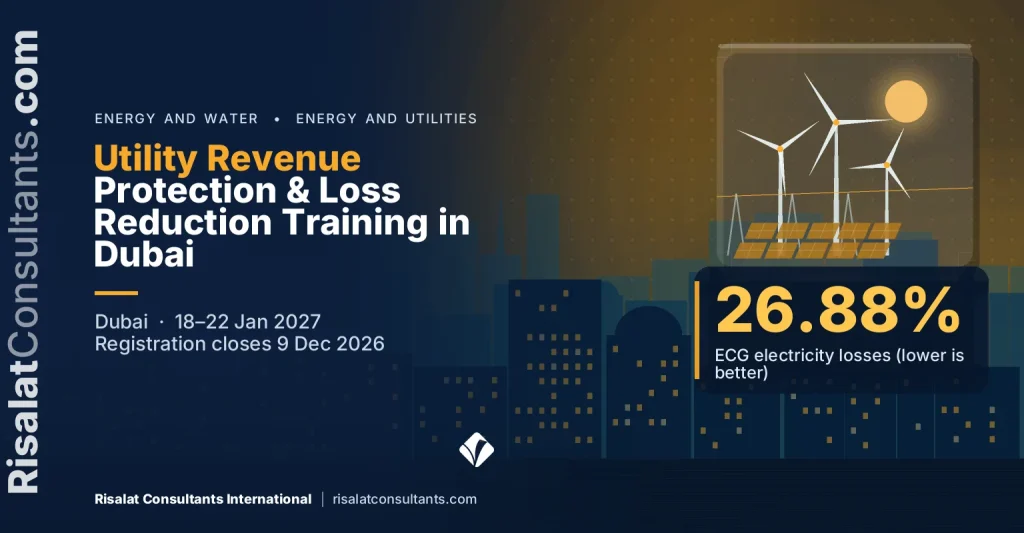
No Gana, o Relatório de Estado de Implementação e Resultados de junho de 2026 do Banco Mundial classificou o Programa para Resultados de Recuperação do Setor Energético do Gana como Insatisfatório. Regista perdas de eletricidade da ECG de 26,88% face a uma meta para dezembro de 2027 de 19,20%, perdas financeiras combinadas da ECG e NEDCo de cerca de 1,52 mil milhões de dólares americanos face a uma meta de 525 milhões de dólares americanos, e nenhum contador inteligente instalado ao abrigo do Programa até maio de 2026. na Zâmbia, a Atualização Económica da Zâmbia de maio de 2026 do Banco Mundial coloca a fragilidade financeira da ZESCO no centro do desafio elétrico e apelando a menores perdas no sistema, recolha mais forte e liquidação de atrasados.
This five-day programme, designed by Risalat Consultants International, works through the commercial and operational systems that close this gap: energy accounting from feeder to customer, metering and customer indexing, revenue protection, billing and collection, invoice management for independent power producers, and the reporting that results-based financiers verify before they disburse. Each day uses the indicators and disbursement-linked results of live programmes as working material, so participants practise on the type of targets their own institutions are measured against.
Dubai gives the group a working reference point. The Dubai Electricity and Water Authority (DEWA) reports transmission and distribution losses of 2%, which allows participants to compare practices, systems and governance, not just headline numbers.
O programa reforça a capacidade institucional em:
- Energy accounting and loss measurement at feeder, transformer and district level
- Separating technical and commercial losses and targeting each correctly
- Metering strategy, prepaid and smart meter roll-out, and meter data management
- Customer indexing and the quality of the customer information system
- Revenue protection, inspection and regularisation of irregular connections
- Billing accuracy, collection efficiency and arrears recovery, including public sector accounts
- Managing power purchase invoices and payment priorities across the value chain
- Tariff, subsidy and shortfall analysis for finance ministries and regulators
- Disbursement-linked indicators, verification and evidence for results-based financing
- Performance dashboards that link district results to company finances
- Coordination between utilities, finance ministries and regulators on approvals
The programme is designed for distribution utilities, transmission companies, energy ministries, finance ministries and regulators in Ghana, Zambia and neighbouring countries, and for teams in programme implementation units that manage World Bank, AfDB and other financed energy operations.
Why Utility Revenue Protection Matters Now
The Ghana Programme is a results-based operation: money is released when agreed results are verified. Its June 2026 report shows how quickly delays in one link of the chain affect everything else. ECG had implemented district energy accounting in 20% of districts against a 100% target, collection efficiency stood at 85% against 93%, and the report repeatedly cites the lack of Commitment Authorisations from the Ministry of Finance, new procurement directives and disbursement caps as reasons for delay. The World Bank noted at approval that the Government of Ghana transfers about 2% of GDP each year to cover the sector’s shortfall.
In Zambia, the World Bank-financed National Energy Advancement and Transformation Programme aims to improve the financial sustainability of the sector, and the Zambia Economic Update recommends implementing the Multi-Year Tariff Framework to reach cost-reflective tariffs by 2027, alongside lower losses and stronger collection. Both countries have also adopted national energy compacts under Mission 300, which tie new investment in access to a financially sound distribution sector.
As instituições precisam cada vez mais de profissionais capazes de:
- Build an energy balance that management trusts, from bulk supply point to customer bill
- Explain where losses occur and what each intervention will recover
- Conceber programas de contagem que melhorem a cobrança, e não apenas a contagem de contadores
- Prepare verifiable evidence for disbursement-linked results
- Manage invoices and payment priorities for power purchases in a transparent way
- Work with finance ministries on approvals and budget releases for programme activities
- Report sector finances clearly to boards, regulators and financiers
Uma capacidade sólida ajuda as instituições a:
- Reduce the shortfall that the national budget has to cover
- Liberte o financiamento baseado em resultados a tempo
- Improve customer service and confidence in bills
- Apoiar os reguladores com dados fiáveis de custos e perdas para decisões tarifárias
- Attract private investment into generation and access
- Recolher
- Limpar
- Armazenar
- Analisar
- Decidir
Who Should Attend This Utility Revenue Protection Training
Este programa destina-se a:
- Commercial, customer service and revenue protection managers of distribution utilities
- District and regional managers responsible for losses and collection
- Metering, meter data and customer information system managers
- Finance directors, treasury and credit control managers of utilities
- Programme implementation unit coordinators and M&E specialists on energy operations
- Energy ministry planning and sector finance officers
- Finance ministry officers responsible for energy sector transfers and fiscal risk
- Regulatory staff working on tariffs, performance standards and loss allowances
- Transmission company commercial and settlement staff
- Internal auditors and risk managers in power sector entities
Assinale o que a sua equipa precisa de ser capaz de fazer.
Objetivos do programa
No final deste programa, os participantes serão capazes de:
- Build and interpret an energy balance down to feeder and district level
- Separar as perdas técnicas e comerciais e escolher intervenções para cada uma
- Design a metering and customer indexing plan linked to revenue targets
- Run a revenue protection programme with clear inspection and regularisation rules
- Improve billing accuracy and collection, including arrears of public institutions
- Configurar controlos para verificação e pagamento de faturas de compra de energia
- Translate disbursement-linked indicators into work plans, data and evidence
- Anticipate approval and budget bottlenecks and agree a joint plan with the finance ministry
- Present utility performance and sector shortfall data to decision makers
- Preparar um plano de ação a 90 dias para a sua própria instituição
Utility Revenue Protection Training Structure & Contents
- The revenue chain from generation and power purchase to the customer bill
- How losses, collection gaps and below-cost tariffs combine into a sector shortfall
- Reading a results framework: losses, collection rate and cash recovery index
- Case study: the Ghana Energy Sector Recovery Programme and its 2027 targets
- Case study: ZESCO’s financial recovery in the Zambia Economic Update
- Group exercise: mapping the shortfall for a sample utility
- Building an energy balance at feeder, transformer and district level
- Perdas técnicas versus comerciais: métodos de medição e estimativa
- Metering strategy: prepaid, smart and bulk meters, and where each pays back
- Customer indexing and cleaning the customer information system
- Procurement and roll-out planning for large metering programmes
- Simulation: district energy accounting from raw data
- Designing inspection programmes using data analytics and loss hot spots
- Regularização de ligações irregulares de forma justa e transparente
- Billing accuracy, disputes and customer communication
- Collecting from government and large customers, and managing arrears
- Customer satisfaction surveys as a performance tool
- Benchmarking session: utility performance practices in Dubai
- Verifying and paying power purchase and IPP invoices with integrated systems
- Payment priority mechanisms across the value chain, such as cash waterfalls
- Tariff paths, cost-reflective tariffs and protection for vulnerable customers
- Audited financial statements and transparency on set-offs and subsidies
- Working with finance ministries: commitment authorisations and budget releases
- Group work: a shortfall reduction plan for a sample sector
- How Programme-for-Results financing works: DLIs, verification and disbursement
- Traduzir cada DLI em tarefas, responsáveis, fontes de dados e ficheiros de evidência
- Building a monthly loss and collection dashboard for management and boards
- Plataformas de coordenação entre serviços públicos, ministérios e reguladores
- Individual 90-day action plans and peer review
- Closing session and certificates
Conteúdo completo, dia a dia
First Day | Where the money goes: losses, collection and the sector shortfall
- The revenue chain from generation and power purchase to the customer bill
- How losses, collection gaps and below-cost tariffs combine into a sector shortfall
- Reading a results framework: losses, collection rate and cash recovery index
- Case study: the Ghana Energy Sector Recovery Programme and its 2027 targets
- Case study: ZESCO’s financial recovery in the Zambia Economic Update
- Group exercise: mapping the shortfall for a sample utility
Second Day | Energy accounting, metering and customer indexing
- Building an energy balance at feeder, transformer and district level
- Perdas técnicas versus comerciais: métodos de medição e estimativa
- Metering strategy: prepaid, smart and bulk meters, and where each pays back
- Customer indexing and cleaning the customer information system
- Procurement and roll-out planning for large metering programmes
- Simulation: district energy accounting from raw data
Third Day | Revenue protection, billing and collection
- Designing inspection programmes using data analytics and loss hot spots
- Regularização de ligações irregulares de forma justa e transparente
- Billing accuracy, disputes and customer communication
- Collecting from government and large customers, and managing arrears
- Customer satisfaction surveys as a performance tool
- Benchmarking session: utility performance practices in Dubai
Fourth Day | Sector finance, power purchase invoices and regulation
- Verifying and paying power purchase and IPP invoices with integrated systems
- Payment priority mechanisms across the value chain, such as cash waterfalls
- Tariff paths, cost-reflective tariffs and protection for vulnerable customers
- Audited financial statements and transparency on set-offs and subsidies
- Working with finance ministries: commitment authorisations and budget releases
- Group work: a shortfall reduction plan for a sample sector
Fifth Day | Results-based financing, dashboards and action planning
- How Programme-for-Results financing works: DLIs, verification and disbursement
- Traduzir cada DLI em tarefas, responsáveis, fontes de dados e ficheiros de evidência
- Building a monthly loss and collection dashboard for management and boards
- Plataformas de coordenação entre serviços públicos, ministérios e reguladores
- Individual 90-day action plans and peer review
- Closing session and certificates
Metodologia de formação
The programme is practical and data-led. Sessions combine short expert inputs with work on real indicators, sample datasets and documents from live financed operations, so participants leave with tools they can apply the following week.
- Regional case studies from Ghana, Zambia and other utilities in Africa
- Simulations using sample energy balance, billing and collection data
- Group work on shortfall reduction and metering plans
- Sessões lideradas por especialistas sobre operações comerciais de serviços públicos e finanças setoriais
- Benchmarking discussion on Dubai’s utility performance practices
- Planeamento de ações individual com feedback dos pares
Aplicação institucional
Este programa ajuda as instituições a reforçar:
- Loss reduction and revenue protection programmes
- Metering, customer indexing and customer information systems
- Collection and arrears management
- Verificacao de faturas e controlos de pagamento
- Results-based financing delivery and verification
- Coordination with finance ministries and regulators
Os participantes regressam com ferramentas práticas para melhorar:
- District energy balances and loss reporting
- Inspection targeting and regularisation procedures
- Monthly management dashboards
- DLI work plans and evidence files
- Board and ministry reporting on sector finances
Relevância regional e aplicação
In Ghana, the Energy Sector Recovery Programme for Results was approved in June 2024 with a US$250 million IDA credit and a US$10 million ESMAP grant, and became effective in March 2025. Its June 2026 report shows that one result has been achieved, ECG’s publication of audited financial statements, while others are behind: the energy accounting system covers 20% of districts, smart meter installation has not started, and the integrated invoicing system for power producers is not yet in place. The World Bank expects delivery to accelerate with better coordination on approvals between implementing agencies and the Government. These are exactly the areas this programme covers.
Na Zâmbia, a seca de 2024 reduziu a energia disponível em cerca de um terço, de acordo com o World Bank, num sistema em que a hidroelétrica representa mais de três quartos da capacidade instalada. O relatório de atualização económica da Zâmbia afirma que as tarifas têm sido fixadas abaixo da recuperação de custos, que as perdas e as fracas cobranças têm tensionado a liquidez da ZESCO e que os atrasados do governo para com a ZESCO e para com os produtores independentes de energia devem ser resolvidos. Equipas do Malaui, Zimbabué, Serra Leoa, Libéria e outros países que enfrentam desafios de distribuição semelhantes acharão as mesmas ferramentas diretamente relevantes.
Fonte: Relatório de Estado de Implementação e Resultados do Banco Mundial, Programa de Recuperação do Setor Energético do Gana (P173258), 30 de junho de 2026 (valores a partir de maio de 2026).
1. In the World Bank's June 2026 report, what were ECG's electricity losses compared with the December 2027 target?
The ISR for the Ghana Energy Sector Recovery Programme records ECG losses of 26.88% against a 19.20% target for December 2027.
2. Which reason does the World Bank repeatedly cite for delays to the Ghana Programme's targets?
The June 2026 ISR repeatedly notes that no Commitment Authorisation from the Ministry of Finance allowed the disbursements needed to reach targets.
3. Que reforma tarifária recomenda a Atualização Económica da Zâmbia do Banco Mundial de maio de 2026?
The update recommends cost-reflective tariffs by 2027 under the Multi-Year Tariff Framework, with targeted protection for vulnerable households.
Perfil do país anfitrião – Emirados Árabes Unidos
Dubai is a regional hub with frequent air connections to West, East and Southern Africa, and it hosts one of the most closely watched utilities in the world. DEWA reports that its electricity transmission and distribution network losses have been 2% since 2023, down from 3.3% in 2021, and that its customer minutes lost reached 0.82 minutes per customer in 2025. Its water network losses were reported at 4.4%.
A DEWA também relatou a instalação de mais de dois milhões de contadores inteligentes de eletricidade e água, e a Agência de Notícias dos Emirados relata que está a investir 7 mil milhões de AED na sua Estratégia de Rede Inteligente até 2035 para melhorar a eficiência da rede e reduzir perdas. Para as empresas de serviços públicos que trabalham na contagem, contabilização de energia e redução de perdas, o Dubai oferece um ponto de referência útil do que o investimento sustentado em dados, contagem e gestão de rede pode proporcionar, e a oportunidade de discutir o que pode ser adaptado a condições operacionais muito diferentes.
Expected Outcomes of Utility Revenue Protection Training
Os participantes serão capazes de:
- Produce a reliable district energy balance and loss report
- Priorizar ações de redução de perdas por valor recuperado
- Plan metering and customer indexing linked to collection targets
- Strengthen controls on power purchase invoices and payments
- Translate results-based financing indicators into practical work plans
- Present a clear 90-day action plan to their management
Institutions that send a team from commercial, finance and programme units together gain the most, because the programme is built around the links between those functions.
£3.630 por participante · fatura e transferência bancária · grupos de 5 ou mais pessoas beneficiam de desconto
Cinco ou mais participantes da mesma organização: peça a tarifa de grupo no pedido de fatura.
Ten or more: an in-house version for your institution may cost less per person. Ask for an in-house quote.
As inscrições encerram em 17 dias (9 dez 2026)
Who Will Deliver This Programme
Each date is delivered by a team assigned from Risalat's expert network for this subject. For this programme we assign:
How we choose them: Experience in the region of the participants or comparable settings; Command of the financier rules that apply (World Bank, ADB, AfDB, EU, UN) where relevant; Delivery in English; other languages on request for in-house groups; No conflict of interest with participants' institutions.
Resultados do curso
Antes do programa
- Avaliação prévia dos participantes
- Avaliação de Prontidão para a Proteção de Receitas de Serviços Públicos
- Utility Loss Reduction Resource Pack
- Materiais de leitura preparatória
- Apoio e aconselhamento gratuitos em matéria de vistos
Durante o programa
- Recolha no aeroporto e apoio de boas-vindas
- Accommodation with breakfast: 6 nights, check-in Sunday 17 January 2027, check-out Saturday 23 January 2027 (one night before and one night after the programme)
- Jantar de boas-vindas e networking
- Kit de formação Risalat (saco, garrafa, caneca, t-shirt, boné, capa de passaporte, canetas, bloco de notas, íman e porta-chaves)
- Comprehensive Utility Revenue Protection Training Manual
- District Energy Balance Template
- Loss Reduction Prioritisation Tool
- DLI Work Plan and Evidence Tracker
- Collection and Arrears Dashboard Template
- Workshops práticos e simulações
- Discussões de grupo e aprendizagem entre pares
- Almoço e pausas para café diários
- Acesso total às instalações do local de formação
- Mini tablet com materiais de aprendizagem digitais
- Visita de campo (quando aplicável)
- Passeio recreativo pela cidade
Depois do programa
- Certificado de Conclusão
- Prémio Risalat de Reconhecimento da Participação no Programa
- Materiais de referência pós-formação
- Revisão do plano de ação a 90 dias
- Sample Revenue Protection Procedures
- Apoio pós-formação e orientação de acompanhamento
- Relatório do programa
Institutions that want a version tailored to their own data and districts can request an in-house programme. Teams can also start with our free project health check.
Perguntas frequentes
A quem se destina esta formação de redução de perdas em serviços públicos?
Commercial, metering, finance and PIU staff of distribution utilities, plus energy ministry, finance ministry and regulatory officers working on sector finances.
Does the programme cover results-based financing?
Yes. The fifth day covers Programme-for-Results operations, disbursement-linked indicators, verification and evidence files, using the Ghana Energy Sector Recovery Programme as a case.
Porque se realiza o programa no Dubai?
DEWA reports transmission and distribution losses of 2% and has invested heavily in smart metering and grid management, which gives participants a practical benchmark.
Pode ser realizado internamente?
Yes. Institutions can request a tailored in-house version using their own district data through the Risalat request for proposal form.
Cursos de formação no DubaiEnergy and Water training courses
Porquê o Dubai para este programa
O Dubai é um centro a um só voo de África, da Ásia e da Europa, com vistos simples para muitas nacionalidades e locais de formação modernos.
The Utility Revenue Protection & Loss Reduction Training in Dubai programme in January 2027 brings together officials and professionals from across the Middle East region and beyond. Sessions combine short inputs, case studies and group work on participants' own files, and the city's institutions can be added as a study visit on request.
Como chegar: Aeroporto Internacional do Dubai (DXB).
Verifique se precisa de visto com o Verificador de Vistos gratuito e peça uma carta-convite depois de se inscrever.
O mesmo tema noutras cidades
- Water Utility Corporate Turnaround and Performance Contract Oversight in Lisbon (Lisbon)
- Power Utility Commercial Loss Reduction and Billing Collection in Istanbul (Istanbul)
- Electricity Distribution Grid Digitalisation and Smart Metering in Casablanca (Casablanca)
- Medium and Low Voltage Grid Electrification and Substation Works in Dakar (Dakar)
- Groundwater Security and Urban-Rural Sanitation Network Expansion in Geneva (Geneva)
- Commercial Water Loss Reduction & Smart Metering Infrastructure in Dubai (Dubai)
Outros programas no Dubai
Teams often travel here from Maldives, Sri Lanka, Bangladesh, Nepal, Pakistan, Afghanistan, Kazakhstan, Uzbekistan. Funding, visa letters and group rates are explained on each country page.
For teams and institutions
Bring your team
Teams that learn together apply more at work. Tell us how many people and how you would like to take part: we reply with a group quote within two working days.
Watch: this programme in short


Outras datas e cidades para este tema: Cursos de formação em Gestão Financeira Pública (64 datas futuras).
Mais cursos de formação nos Emirados Árabes Unidos · Todos os programas no Médio Oriente · Calendário de formação completo
Planear este programa num roteiro: porque importa, porque o aprovar, as datas a planear e a carreira que constrói.