关键信息
- 日期
- 2027年1月18–22日(5天)
- 地点
- Shared on registration, Dubai, United Arab Emirates
- 每位学员费用
- £3,630(英镑)
- 付款
- 通过发票和银行转账付款
- 报名截止
- 2026年12月9日
- 形式
- 5-day short course: a practical capacity-building programme for government, NGO and project teams in Dubai
- 证书
- 结业证书
- 内训选项
- 按您的日期,为您的团队专场举办
本页内容15个部分
培训项目概述
Electricity distribution companies sit at the point where a power sector either recovers its costs or passes them on to the national budget. Every unmetered connection, unread meter, uncollected bill and unreconciled power purchase invoice ends up as a shortfall that someone must finance. In Ghana and Zambia this question now shapes the fiscal position as much as the energy agenda.
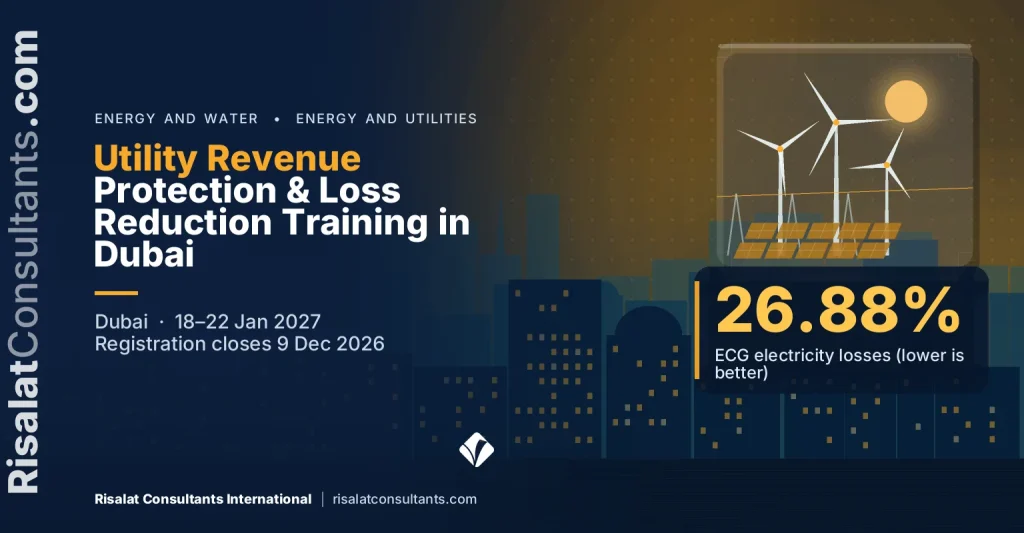
在加纳,世界银行2026年6月实施现状与结果报告将加纳能源部门恢复结果计划评为不满意。报告记录显示,截至2027年12月目标为19.20%,ECG电力损失率为26.88%;ECG和NEDCo合并财务亏损约为15.2亿美元,目标为5.25亿美元;截至2026年5月,该计划下尚未安装智能电表。在赞比亚,世界银行2026年5月赞比亚经济更新将ZESCO的财务脆弱性置于电力挑战的核心,并呼吁减少系统损失、加强收费和清偿欠款。
This five-day programme, designed by Risalat Consultants International, works through the commercial and operational systems that close this gap: energy accounting from feeder to customer, metering and customer indexing, revenue protection, billing and collection, invoice management for independent power producers, and the reporting that results-based financiers verify before they disburse. Each day uses the indicators and disbursement-linked results of live programmes as working material, so participants practise on the type of targets their own institutions are measured against.
Dubai gives the group a working reference point. The Dubai Electricity and Water Authority (DEWA) reports transmission and distribution losses of 2%, which allows participants to compare practices, systems and governance, not just headline numbers.
本培训项目可在以下方面加强机构能力:
- Energy accounting and loss measurement at feeder, transformer and district level
- Separating technical and commercial losses and targeting each correctly
- Metering strategy, prepaid and smart meter roll-out, and meter data management
- Customer indexing and the quality of the customer information system
- Revenue protection, inspection and regularisation of irregular connections
- Billing accuracy, collection efficiency and arrears recovery, including public sector accounts
- Managing power purchase invoices and payment priorities across the value chain
- Tariff, subsidy and shortfall analysis for finance ministries and regulators
- Disbursement-linked indicators, verification and evidence for results-based financing
- Performance dashboards that link district results to company finances
- Coordination between utilities, finance ministries and regulators on approvals
The programme is designed for distribution utilities, transmission companies, energy ministries, finance ministries and regulators in Ghana, Zambia and neighbouring countries, and for teams in programme implementation units that manage World Bank, AfDB and other financed energy operations.
Why Utility Revenue Protection Matters Now
The Ghana Programme is a results-based operation: money is released when agreed results are verified. Its June 2026 report shows how quickly delays in one link of the chain affect everything else. ECG had implemented district energy accounting in 20% of districts against a 100% target, collection efficiency stood at 85% against 93%, and the report repeatedly cites the lack of Commitment Authorisations from the Ministry of Finance, new procurement directives and disbursement caps as reasons for delay. The World Bank noted at approval that the Government of Ghana transfers about 2% of GDP each year to cover the sector’s shortfall.
In Zambia, the World Bank-financed National Energy Advancement and Transformation Programme aims to improve the financial sustainability of the sector, and the Zambia Economic Update recommends implementing the Multi-Year Tariff Framework to reach cost-reflective tariffs by 2027, alongside lower losses and stronger collection. Both countries have also adopted national energy compacts under Mission 300, which tie new investment in access to a financially sound distribution sector.
各机构日益需要能够做到以下几点的专业人员:
- Build an energy balance that management trusts, from bulk supply point to customer bill
- Explain where losses occur and what each intervention will recover
- Design metering programmes that improve collection, not only meter counts
- Prepare verifiable evidence for disbursement-linked results
- Manage invoices and payment priorities for power purchases in a transparent way
- Work with finance ministries on approvals and budget releases for programme activities
- Report sector finances clearly to boards, regulators and financiers
强大的能力有助于机构:
- Reduce the shortfall that the national budget has to cover
- 按时释放基于结果的融资
- Improve customer service and confidence in bills
- 为监管机构提供可靠的成本和损失数据以支持关税决策
- Attract private investment into generation and access
- 收集
- 清洗
- 存储
- 分析
- 决策
Who Should Attend This Utility Revenue Protection Training
本培训项目适合:
- Commercial, customer service and revenue protection managers of distribution utilities
- District and regional managers responsible for losses and collection
- Metering, meter data and customer information system managers
- Finance directors, treasury and credit control managers of utilities
- Programme implementation unit coordinators and M&E specialists on energy operations
- Energy ministry planning and sector finance officers
- Finance ministry officers responsible for energy sector transfers and fiscal risk
- Regulatory staff working on tariffs, performance standards and loss allowances
- Transmission company commercial and settlement staff
- Internal auditors and risk managers in power sector entities
勾选您的团队需要具备的能力。
培训项目目标
完成本培训项目后,学员将能够:
- Build and interpret an energy balance down to feeder and district level
- Separate technical and commercial losses and choose interventions for each
- Design a metering and customer indexing plan linked to revenue targets
- Run a revenue protection programme with clear inspection and regularisation rules
- Improve billing accuracy and collection, including arrears of public institutions
- 建立电力采购发票核实与支付控制机制
- Translate disbursement-linked indicators into work plans, data and evidence
- Anticipate approval and budget bottlenecks and agree a joint plan with the finance ministry
- Present utility performance and sector shortfall data to decision makers
- 为本单位制定90天行动计划
Utility Revenue Protection Training Structure & Contents
- The revenue chain from generation and power purchase to the customer bill
- How losses, collection gaps and below-cost tariffs combine into a sector shortfall
- Reading a results framework: losses, collection rate and cash recovery index
- Case study: the Ghana Energy Sector Recovery Programme and its 2027 targets
- Case study: ZESCO’s financial recovery in the Zambia Economic Update
- Group exercise: mapping the shortfall for a sample utility
- Building an energy balance at feeder, transformer and district level
- 技术损失与商业损失:计量和估算方法
- Metering strategy: prepaid, smart and bulk meters, and where each pays back
- Customer indexing and cleaning the customer information system
- Procurement and roll-out planning for large metering programmes
- Simulation: district energy accounting from raw data
- Designing inspection programmes using data analytics and loss hot spots
- 公平透明地规范违规接水行为
- Billing accuracy, disputes and customer communication
- Collecting from government and large customers, and managing arrears
- Customer satisfaction surveys as a performance tool
- Benchmarking session: utility performance practices in Dubai
- Verifying and paying power purchase and IPP invoices with integrated systems
- Payment priority mechanisms across the value chain, such as cash waterfalls
- Tariff paths, cost-reflective tariffs and protection for vulnerable customers
- Audited financial statements and transparency on set-offs and subsidies
- Working with finance ministries: commitment authorisations and budget releases
- Group work: a shortfall reduction plan for a sample sector
- How Programme-for-Results financing works: DLIs, verification and disbursement
- 将每个DLI转化为任务、负责人、数据源和证据文件
- Building a monthly loss and collection dashboard for management and boards
- 公用事业、部委和监管机构之间的协调平台
- Individual 90-day action plans and peer review
- Closing session and certificates
完整的每日课程内容
First Day | Where the money goes: losses, collection and the sector shortfall
- The revenue chain from generation and power purchase to the customer bill
- How losses, collection gaps and below-cost tariffs combine into a sector shortfall
- Reading a results framework: losses, collection rate and cash recovery index
- Case study: the Ghana Energy Sector Recovery Programme and its 2027 targets
- Case study: ZESCO’s financial recovery in the Zambia Economic Update
- Group exercise: mapping the shortfall for a sample utility
Second Day | Energy accounting, metering and customer indexing
- Building an energy balance at feeder, transformer and district level
- 技术损失与商业损失:计量和估算方法
- Metering strategy: prepaid, smart and bulk meters, and where each pays back
- Customer indexing and cleaning the customer information system
- Procurement and roll-out planning for large metering programmes
- Simulation: district energy accounting from raw data
Third Day | Revenue protection, billing and collection
- Designing inspection programmes using data analytics and loss hot spots
- 公平透明地规范违规接水行为
- Billing accuracy, disputes and customer communication
- Collecting from government and large customers, and managing arrears
- Customer satisfaction surveys as a performance tool
- Benchmarking session: utility performance practices in Dubai
Fourth Day | Sector finance, power purchase invoices and regulation
- Verifying and paying power purchase and IPP invoices with integrated systems
- Payment priority mechanisms across the value chain, such as cash waterfalls
- Tariff paths, cost-reflective tariffs and protection for vulnerable customers
- Audited financial statements and transparency on set-offs and subsidies
- Working with finance ministries: commitment authorisations and budget releases
- Group work: a shortfall reduction plan for a sample sector
Fifth Day | Results-based financing, dashboards and action planning
- How Programme-for-Results financing works: DLIs, verification and disbursement
- 将每个DLI转化为任务、负责人、数据源和证据文件
- Building a monthly loss and collection dashboard for management and boards
- 公用事业、部委和监管机构之间的协调平台
- Individual 90-day action plans and peer review
- Closing session and certificates
培训方法
The programme is practical and data-led. Sessions combine short expert inputs with work on real indicators, sample datasets and documents from live financed operations, so participants leave with tools they can apply the following week.
- Regional case studies from Ghana, Zambia and other utilities in Africa
- Simulations using sample energy balance, billing and collection data
- Group work on shortfall reduction and metering plans
- 关于公用事业商业运营和行业财务的专家领导课程
- Benchmarking discussion on Dubai’s utility performance practices
- 制定个人行动计划并获得同伴反馈
机构应用
本培训项目帮助机构加强:
- Loss reduction and revenue protection programmes
- Metering, customer indexing and customer information systems
- Collection and arrears management
- 发票核实与支付控制
- Results-based financing delivery and verification
- Coordination with finance ministries and regulators
学员将带着实用工具回到工作岗位,以提升:
- District energy balances and loss reporting
- Inspection targeting and regularisation procedures
- Monthly management dashboards
- DLI work plans and evidence files
- Board and ministry reporting on sector finances
区域相关性与应用
In Ghana, the Energy Sector Recovery Programme for Results was approved in June 2024 with a US$250 million IDA credit and a US$10 million ESMAP grant, and became effective in March 2025. Its June 2026 report shows that one result has been achieved, ECG’s publication of audited financial statements, while others are behind: the energy accounting system covers 20% of districts, smart meter installation has not started, and the integrated invoicing system for power producers is not yet in place. The World Bank expects delivery to accelerate with better coordination on approvals between implementing agencies and the Government. These are exactly the areas this programme covers.
根据世界银行的数据,在水力发电占总装机容量四分之三以上的赞比亚,2024年的干旱导致可利用电力减少了约三分之一。赞比亚经济简报指出,关税长期低于成本回收水平,亏损和疲软的收费状况给ZESCO的流动性造成了压力,并且政府对ZESCO的欠款以及对独立发电商的欠款应当得到解决。来自马拉维、津巴布韦、塞拉利昂、利比里亚以及其他面临类似配送挑战的国家的团队会发现这些工具同样具有直接的参考价值。
来源:世界银行实施状态与结果报告,加纳能源部门恢复计划(P173258),2026年6月30日(数据截至2026年5月)。
1. In the World Bank's June 2026 report, what were ECG's electricity losses compared with the December 2027 target?
The ISR for the Ghana Energy Sector Recovery Programme records ECG losses of 26.88% against a 19.20% target for December 2027.
2. Which reason does the World Bank repeatedly cite for delays to the Ghana Programme's targets?
The June 2026 ISR repeatedly notes that no Commitment Authorisation from the Ministry of Finance allowed the disbursements needed to reach targets.
3. 世界银行2026年5月的《赞比亚经济简报》推荐了什么关税改革?
The update recommends cost-reflective tariffs by 2027 under the Multi-Year Tariff Framework, with targeted protection for vulnerable households.
东道国概况:阿联酋
Dubai is a regional hub with frequent air connections to West, East and Southern Africa, and it hosts one of the most closely watched utilities in the world. DEWA reports that its electricity transmission and distribution network losses have been 2% since 2023, down from 3.3% in 2021, and that its customer minutes lost reached 0.82 minutes per customer in 2025. Its water network losses were reported at 4.4%.
迪拜电力和水务局还报告称,已安装了超过两00万块智能电表,阿联酋通讯社报道称,其正在投资70亿迪拉姆实施至2035年的智能电网战略,以提高网络效率并减少损失。对于致力于计量、能源核算和减损的公用事业公司而言,迪拜提供了一个有用的基准,展示了对数据、计量和网络管理的持续投资能够带来什么,并提供了讨论如何将其适应截然不同的运营条件的机会。
Expected Outcomes of Utility Revenue Protection Training
学员将能够:
- Produce a reliable district energy balance and loss report
- 按回收价值优先排序损失减少行动
- Plan metering and customer indexing linked to collection targets
- Strengthen controls on power purchase invoices and payments
- Translate results-based financing indicators into practical work plans
- Present a clear 90-day action plan to their management
Institutions that send a team from commercial, finance and programme units together gain the most, because the programme is built around the links between those functions.
每位学员£3,630 · 发票与银行转账 · 5人及以上团体可享折扣
同一机构五人及以上:请在申请发票时索取团体价。
Ten or more: an in-house version for your institution may cost less per person. Ask for an in-house quote.
注册截止时间为 17天后(2026年12月9日)
Who Will Deliver This Programme
Each date is delivered by a team assigned from Risalat's expert network for this subject. For this programme we assign:
How we choose them: Experience in the region of the participants or comparable settings; Command of the financier rules that apply (World Bank, ADB, AfDB, EU, UN) where relevant; Delivery in English; other languages on request for in-house groups; No conflict of interest with participants' institutions.
课程成果
培训开始前
- 学员课前评估
- 公用事业收入保护准备就绪评估
- 公用事业损失减少资源包
- 课前阅读资料
- 免费签证支持与咨询
培训期间
- 机场接机与欢迎协助
- Accommodation with breakfast: 6 nights, check-in Sunday 17 January 2027, check-out Saturday 23 January 2027 (one night before and one night after the programme)
- 欢迎交流晚宴
- Risalat培训礼包(背包、水瓶、马克杯、T恤、帽子、护照套、笔、笔记本、冰箱贴及钥匙扣)
- Comprehensive Utility Revenue Protection Training Manual
- District Energy Balance Template
- Loss Reduction Prioritisation Tool
- DLI Work Plan and Evidence Tracker
- Collection and Arrears Dashboard Template
- 实践研讨与模拟演练
- 小组讨论与同伴学习
- 每日午餐与茶歇
- 全面使用培训场地设施
- 装有数字学习资料的迷你平板电脑
- 实地考察(如适用)
- 城市休闲观光
培训结束后
- 结业证书
- Risalat培训项目参与表彰奖
- 培训后参考资料
- 90天行动计划审查
- Sample Revenue Protection Procedures
- 培训后支持与跟进指导
- 培训项目报告
Institutions that want a version tailored to their own data and districts can request an in-house programme. Teams can also start with our free project health check.
常见问题
该公用事业损失减少培训面向哪些对象?
Commercial, metering, finance and PIU staff of distribution utilities, plus energy ministry, finance ministry and regulatory officers working on sector finances.
Does the programme cover results-based financing?
Yes. The fifth day covers Programme-for-Results operations, disbursement-linked indicators, verification and evidence files, using the Ghana Energy Sector Recovery Programme as a case.
为什么本培训项目在迪拜举办?
DEWA reports transmission and distribution losses of 2% and has invested heavily in smart metering and grid management, which gives participants a practical benchmark.
能否以内训形式举办?
Yes. Institutions can request a tailored in-house version using their own district data through the Risalat request for proposal form.
迪拜培训课程Energy and Water training courses
为何选择在迪拜举办本培训项目
迪拜是通往非洲、亚洲和欧洲的一站直达枢纽,对许多国家的公民提供简便的签证政策,并拥有现代化的培训场地。
The Utility Revenue Protection & Loss Reduction Training in Dubai programme in January 2027 brings together officials and professionals from across the Middle East region and beyond. Sessions combine short inputs, case studies and group work on participants' own files, and the city's institutions can be added as a study visit on request.
交通:迪拜国际机场(DXB)。
使用免费的签证查询工具确认您是否需要签证,完成报名后即可申请邀请函。
其他城市的同主题培训
- Water Utility Corporate Turnaround and Performance Contract Oversight in Lisbon (Lisbon)
- Power Utility Commercial Loss Reduction and Billing Collection in Istanbul (Istanbul)
- Electricity Distribution Grid Digitalisation and Smart Metering in Casablanca (Casablanca)
- Medium and Low Voltage Grid Electrification and Substation Works in Dakar (Dakar)
- Groundwater Security and Urban-Rural Sanitation Network Expansion in Geneva (Geneva)
- Commercial Water Loss Reduction & Smart Metering Infrastructure in Dubai (Dubai)
迪拜的其他培训项目
Teams often travel here from Maldives, Sri Lanka, Bangladesh, Nepal, Pakistan, Afghanistan, Kazakhstan, Uzbekistan. Funding, visa letters and group rates are explained on each country page.
For teams and institutions
Bring your team
Teams that learn together apply more at work. Tell us how many people and how you would like to take part: we reply with a group quote within two working days.
Watch: this programme in short


该主题的其他日期和城市:公共财政管理培训课程(64个即将到来的日期)。
阿拉伯联合酋长国更多培训课程 · 中东所有培训项目 · 完整培训日历
在路线图中规划此项目:为什么重要、为什么要批准它、要计划的日期以及它所构建的职业生涯。