Points clés
- Dates
- 18–22 janv. 2027 (5 jours)
- Lieu
- Shared on registration, Dubai, United Arab Emirates
- Frais par participant
- 3 630 £ (GBP)
- Paiement
- Sur facture et par virement bancaire
- Clôture des inscriptions
- 9 déc. 2026
- Format
- 5-day short course: a practical capacity-building programme for government, NGO and project teams in Dubai
- Certificat
- Certificat de participation
- Option intra
- Organisez-le pour votre équipe, à vos dates
Sur cette page 15 sections
Présentation du programme
Electricity distribution companies sit at the point where a power sector either recovers its costs or passes them on to the national budget. Every unmetered connection, unread meter, uncollected bill and unreconciled power purchase invoice ends up as a shortfall that someone must finance. In Ghana and Zambia this question now shapes the fiscal position as much as the energy agenda.
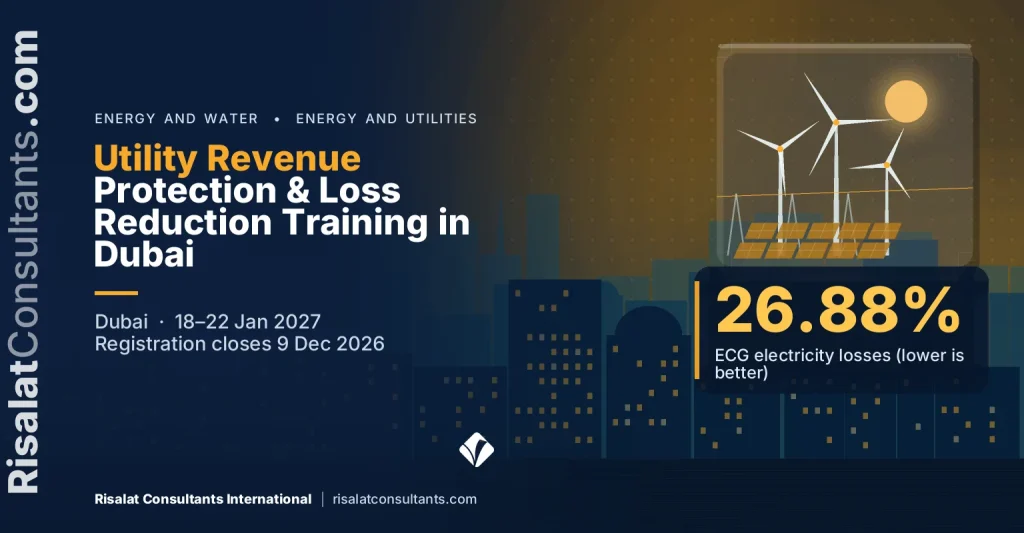
In Ghana, the World Bank’s June 2026 Implementation Status and Results Report rated the Ghana Energy Sector Recovery Programme for Results Unsatisfactory. It records ECG electricity losses of 26.88% against a December 2027 target of 19.20%, combined ECG and NEDCo financial losses of about US$1.52 billion against a target of US$525 million, and no smart meters yet installed under the Programme as of May 2026. In Zambia, the World Bank’s May 2026 Zambia Economic Update places the financial fragility of ZESCO at the centre of the electricity challenge and calls for lower system losses, stronger collection and the settlement of arrears.
This five-day programme, designed by Risalat Consultants International, works through the commercial and operational systems that close this gap: energy accounting from feeder to customer, metering and customer indexing, revenue protection, billing and collection, invoice management for independent power producers, and the reporting that results-based financiers verify before they disburse. Each day uses the indicators and disbursement-linked results of live programmes as working material, so participants practise on the type of targets their own institutions are measured against.
Dubai gives the group a working reference point. The Dubai Electricity and Water Authority (DEWA) reports transmission and distribution losses of 2%, which allows participants to compare practices, systems and governance, not just headline numbers.
Le programme renforce les capacités institutionnelles en matière de :
- Energy accounting and loss measurement at feeder, transformer and district level
- Separating technical and commercial losses and targeting each correctly
- Metering strategy, prepaid and smart meter roll-out, and meter data management
- Customer indexing and the quality of the customer information system
- Revenue protection, inspection and regularisation of irregular connections
- Billing accuracy, collection efficiency and arrears recovery, including public sector accounts
- Managing power purchase invoices and payment priorities across the value chain
- Tariff, subsidy and shortfall analysis for finance ministries and regulators
- Disbursement-linked indicators, verification and evidence for results-based financing
- Performance dashboards that link district results to company finances
- Coordination between utilities, finance ministries and regulators on approvals
The programme is designed for distribution utilities, transmission companies, energy ministries, finance ministries and regulators in Ghana, Zambia and neighbouring countries, and for teams in programme implementation units that manage World Bank, AfDB and other financed energy operations.
Why Utility Revenue Protection Matters Now
The Ghana Programme is a results-based operation: money is released when agreed results are verified. Its June 2026 report shows how quickly delays in one link of the chain affect everything else. ECG had implemented district energy accounting in 20% of districts against a 100% target, collection efficiency stood at 85% against 93%, and the report repeatedly cites the lack of Commitment Authorisations from the Ministry of Finance, new procurement directives and disbursement caps as reasons for delay. The World Bank noted at approval that the Government of Ghana transfers about 2% of GDP each year to cover the sector’s shortfall.
In Zambia, the World Bank-financed National Energy Advancement and Transformation Programme aims to improve the financial sustainability of the sector, and the Zambia Economic Update recommends implementing the Multi-Year Tariff Framework to reach cost-reflective tariffs by 2027, alongside lower losses and stronger collection. Both countries have also adopted national energy compacts under Mission 300, which tie new investment in access to a financially sound distribution sector.
Les institutions ont de plus en plus besoin de professionnels capables de :
- Build an energy balance that management trusts, from bulk supply point to customer bill
- Explain where losses occur and what each intervention will recover
- Design metering programmes that improve collection, not only meter counts
- Prepare verifiable evidence for disbursement-linked results
- Manage invoices and payment priorities for power purchases in a transparent way
- Work with finance ministries on approvals and budget releases for programme activities
- Report sector finances clearly to boards, regulators and financiers
Des capacités solides aident les institutions à :
- Reduce the shortfall that the national budget has to cover
- Release results-based financing on time
- Improve customer service and confidence in bills
- Support regulators with reliable cost and loss data for tariff decisions
- Attract private investment into generation and access
- Collecter
- Nettoyer
- Stocker
- Analyser
- Décider
Who Should Attend This Utility Revenue Protection Training
Ce programme s'adresse à :
- Commercial, customer service and revenue protection managers of distribution utilities
- District and regional managers responsible for losses and collection
- Gestionnaires du comptage, des données de comptage et des systèmes d'information clients
- Finance directors, treasury and credit control managers of utilities
- Programme implementation unit coordinators and M&E specialists on energy operations
- Energy ministry planning and sector finance officers
- Finance ministry officers responsible for energy sector transfers and fiscal risk
- Personnel de réglementation travaillant sur les tarifs, les normes de performance et les tolérances de pertes
- Personnel commercial et de règlement des sociétés de transport d'électricité
- Internal auditors and risk managers in power sector entities
Cochez ce que votre équipe doit être capable de faire.
Objectifs du programme
À l'issue de ce programme, les participants seront en mesure de :
- Build and interpret an energy balance down to feeder and district level
- Separate technical and commercial losses and choose interventions for each
- Design a metering and customer indexing plan linked to revenue targets
- Run a revenue protection programme with clear inspection and regularisation rules
- Improve billing accuracy and collection, including arrears of public institutions
- Set up controls for verifying and paying power purchase invoices
- Translate disbursement-linked indicators into work plans, data and evidence
- Anticipate approval and budget bottlenecks and agree a joint plan with the finance ministry
- Present utility performance and sector shortfall data to decision makers
- Préparer un plan d'action à 90 jours pour leur propre institution
Utility Revenue Protection Training Structure & Contents
- The revenue chain from generation and power purchase to the customer bill
- How losses, collection gaps and below-cost tariffs combine into a sector shortfall
- Reading a results framework: losses, collection rate and cash recovery index
- Case study: the Ghana Energy Sector Recovery Programme and its 2027 targets
- Case study: ZESCO’s financial recovery in the Zambia Economic Update
- Group exercise: mapping the shortfall for a sample utility
- Building an energy balance at feeder, transformer and district level
- Pertes techniques versus pertes commerciales : méthodes de mesure et d'estimation
- Metering strategy: prepaid, smart and bulk meters, and where each pays back
- Customer indexing and cleaning the customer information system
- Planification des achats et du déploiement pour les grands programmes de comptage
- Simulation: district energy accounting from raw data
- Designing inspection programmes using data analytics and loss hot spots
- Regularising irregular connections fairly and transparently
- Billing accuracy, disputes and customer communication
- Collecting from government and large customers, and managing arrears
- Customer satisfaction surveys as a performance tool
- Benchmarking session: utility performance practices in Dubai
- Verifying and paying power purchase and IPP invoices with integrated systems
- Payment priority mechanisms across the value chain, such as cash waterfalls
- Tariff paths, cost-reflective tariffs and protection for vulnerable customers
- Audited financial statements and transparency on set-offs and subsidies
- Working with finance ministries: commitment authorisations and budget releases
- Group work: a shortfall reduction plan for a sample sector
- How Programme-for-Results financing works: DLIs, verification and disbursement
- Turning each DLI into tasks, owners, data sources and evidence files
- Building a monthly loss and collection dashboard for management and boards
- Coordination platforms between utilities, ministries and regulators
- Individual 90-day action plans and peer review
- Closing session and certificates
Contenu détaillé jour par jour
Premier jour | Où va l'argent : pertes, recouvrement et déficit sectoriel
- The revenue chain from generation and power purchase to the customer bill
- How losses, collection gaps and below-cost tariffs combine into a sector shortfall
- Reading a results framework: losses, collection rate and cash recovery index
- Case study: the Ghana Energy Sector Recovery Programme and its 2027 targets
- Case study: ZESCO’s financial recovery in the Zambia Economic Update
- Group exercise: mapping the shortfall for a sample utility
Second Day | Energy accounting, metering and customer indexing
- Building an energy balance at feeder, transformer and district level
- Pertes techniques versus pertes commerciales : méthodes de mesure et d'estimation
- Metering strategy: prepaid, smart and bulk meters, and where each pays back
- Customer indexing and cleaning the customer information system
- Planification des achats et du déploiement pour les grands programmes de comptage
- Simulation: district energy accounting from raw data
Third Day | Revenue protection, billing and collection
- Designing inspection programmes using data analytics and loss hot spots
- Regularising irregular connections fairly and transparently
- Billing accuracy, disputes and customer communication
- Collecting from government and large customers, and managing arrears
- Customer satisfaction surveys as a performance tool
- Benchmarking session: utility performance practices in Dubai
Fourth Day | Sector finance, power purchase invoices and regulation
- Verifying and paying power purchase and IPP invoices with integrated systems
- Payment priority mechanisms across the value chain, such as cash waterfalls
- Tariff paths, cost-reflective tariffs and protection for vulnerable customers
- Audited financial statements and transparency on set-offs and subsidies
- Working with finance ministries: commitment authorisations and budget releases
- Group work: a shortfall reduction plan for a sample sector
Fifth Day | Results-based financing, dashboards and action planning
- How Programme-for-Results financing works: DLIs, verification and disbursement
- Turning each DLI into tasks, owners, data sources and evidence files
- Building a monthly loss and collection dashboard for management and boards
- Coordination platforms between utilities, ministries and regulators
- Individual 90-day action plans and peer review
- Closing session and certificates
Méthodologie de formation
Le programme est pratique et axé sur les données. Les sessions associent de brèves interventions d'experts à des travaux sur des indicateurs réels, des jeux de données d'échantillonnage et des documents tirés d'opérations financées en cours, de sorte que les participants repartent avec des outils qu'ils pourront appliquer dès la semaine suivante.
- Regional case studies from Ghana, Zambia and other utilities in Africa
- Simulations using sample energy balance, billing and collection data
- Group work on shortfall reduction and metering plans
- Expert-led sessions on utility commercial operations and sector finance
- Benchmarking discussion on Dubai’s utility performance practices
- Plan d'action individuel avec retours des pairs
Application institutionnelle
Ce programme aide les institutions à renforcer :
- Loss reduction and revenue protection programmes
- Metering, customer indexing and customer information systems
- Collection and arrears management
- Invoice verification and payment controls
- Results-based financing delivery and verification
- Coordination with finance ministries and regulators
Les participants repartent avec des outils pratiques pour améliorer :
- District energy balances and loss reporting
- Inspection targeting and regularisation procedures
- Monthly management dashboards
- Plans de travail des ID et dossiers justificatifs
- Board and ministry reporting on sector finances
Pertinence régionale & mise en application
In Ghana, the Energy Sector Recovery Programme for Results was approved in June 2024 with a US$250 million IDA credit and a US$10 million ESMAP grant, and became effective in March 2025. Its June 2026 report shows that one result has been achieved, ECG’s publication of audited financial statements, while others are behind: the energy accounting system covers 20% of districts, smart meter installation has not started, and the integrated invoicing system for power producers is not yet in place. The World Bank expects delivery to accelerate with better coordination on approvals between implementing agencies and the Government. These are exactly the areas this programme covers.
En Zambie, la sécheresse de 2024 a réduit la puissance disponible d'environ un tiers, selon la Banque mondiale, dans un système où l'hydroélectricité représente plus des trois quarts de la capacité installée. La note de conjoncture économique sur la Zambie indique que les tarifs ont longtemps été fixés en deçà du recouvrement des coûts, que les pertes et la faiblesse des recouvrements ont mis à mal la liquidité de ZESCO et que les arriérés du gouvernement envers ZESCO ainsi que ceux envers les producteurs indépendants d'électricité devraient être réglés. Les équipes du Malawi, du Zimbabwe, de Sierra Leone, du Liberia et d'autres pays confrontés à des défis de distribution similaires trouveront les mêmes outils directement pertinents.
Source : Rapport sur l'état d'avancement et les résultats de la Banque mondiale, Programme de redressement du secteur énergétique du Ghana (P173258), 30 juin 2026 (valeurs en date de mai 2026).
1. In the World Bank's June 2026 report, what were ECG's electricity losses compared with the December 2027 target?
The ISR for the Ghana Energy Sector Recovery Programme records ECG losses of 26.88% against a 19.20% target for December 2027.
2. Which reason does the World Bank repeatedly cite for delays to the Ghana Programme's targets?
The June 2026 ISR repeatedly notes that no Commitment Authorisation from the Ministry of Finance allowed the disbursements needed to reach targets.
3. What tariff reform does the World Bank's May 2026 Zambia Economic Update recommend?
The update recommends cost-reflective tariffs by 2027 under the Multi-Year Tariff Framework, with targeted protection for vulnerable households.
Profil du pays d'accueil – Émirats arabes unis
Dubai is a regional hub with frequent air connections to West, East and Southern Africa, and it hosts one of the most closely watched utilities in the world. DEWA reports that its electricity transmission and distribution network losses have been 2% since 2023, down from 3.3% in 2021, and that its customer minutes lost reached 0.82 minutes per customer in 2025. Its water network losses were reported at 4.4%.
La DEWA a également signalé l'installation de plus de deux millions de compteurs intelligents d'électricité et d'eau, et l'Agence de presse des Émirats rapporte qu'elle investit 7 milliards d'AED dans sa stratégie de réseau intelligent jusqu'en 2035 pour améliorer l'efficacité du réseau et réduire les pertes. Pour les services publics travaillant sur le comptage, la comptabilité énergétique et la réduction des pertes, Dubaï offre un point de référence utile sur ce qu'un investissement soutenu dans les données, le comptage et la gestion de réseau peut produire, et une chance de discuter de ce qui peut être adapté à des conditions d'exploitation très différentes.
Expected Outcomes of Utility Revenue Protection Training
Les participants seront en mesure de :
- Produce a reliable district energy balance and loss report
- Prioritise loss reduction actions by value recovered
- Plan metering and customer indexing linked to collection targets
- Strengthen controls on power purchase invoices and payments
- Translate results-based financing indicators into practical work plans
- Present a clear 90-day action plan to their management
Institutions that send a team from commercial, finance and programme units together gain the most, because the programme is built around the links between those functions.
3 630 £ par participant · facture et virement bancaire · réduction pour les groupes de 5 personnes ou plus
Cinq personnes ou plus d'une même organisation : demandez le tarif de groupe lors de votre demande de facture.
Ten or more: an in-house version for your institution may cost less per person. Ask for an in-house quote.
Registration closes in 17 days (9 Dec 2026)
Who Will Deliver This Programme
Each date is delivered by a team assigned from Risalat's expert network for this subject. For this programme we assign:
How we choose them: Experience in the region of the participants or comparable settings; Command of the financier rules that apply (World Bank, ADB, AfDB, EU, UN) where relevant; Delivery in English; other languages on request for in-house groups; No conflict of interest with participants' institutions.
Livrables de la formation
Avant le programme
- Pré-évaluation des participants
- Évaluation de l'état préparation à la protection des revenus des services publics
- Utility Loss Reduction Resource Pack
- Lectures préparatoires
- Aide et conseils gratuits pour le visa
Pendant le programme
- Accueil à l'aéroport & assistance à l'arrivée
- Accommodation with breakfast: 6 nights, check-in Sunday 17 January 2027, check-out Saturday 23 January 2027 (one night before and one night after the programme)
- Dîner de bienvenue et de réseautage
- Kit de formation Risalat (sac, gourde, mug, t-shirt, casquette, protège-passeport, stylos, carnet, magnet & porte-clés)
- Comprehensive Utility Revenue Protection Training Manual
- District Energy Balance Template
- Loss Reduction Prioritisation Tool
- DLI Work Plan and Evidence Tracker
- Collection and Arrears Dashboard Template
- Ateliers pratiques & simulations
- Discussions de groupe & apprentissage entre pairs
- Déjeuner et pauses-café quotidiens
- Accès complet aux installations du lieu de formation
- Mini tablette avec supports pédagogiques numériques
- Visite de terrain (le cas échéant)
- Visite récréative de la ville
Après le programme
- Certificat de participation
- Distinction Risalat de participation au programme
- Documents de référence après la formation
- Revue du plan d'action à 90 jours
- Sample Revenue Protection Procedures
- Accompagnement après la formation & conseils de suivi
- Rapport du programme
Institutions that want a version tailored to their own data and districts can request an in-house programme. Teams can also start with our free project health check.
Questions fréquentes
Who is this utility loss reduction training for?
Commercial, metering, finance and PIU staff of distribution utilities, plus energy ministry, finance ministry and regulatory officers working on sector finances.
Does the programme cover results-based financing?
Yes. The fifth day covers Programme-for-Results operations, disbursement-linked indicators, verification and evidence files, using the Ghana Energy Sector Recovery Programme as a case.
Pourquoi le programme se tient-il à Dubaï ?
DEWA reports transmission and distribution losses of 2% and has invested heavily in smart metering and grid management, which gives participants a practical benchmark.
Peut-il être dispensé en intra ?
Yes. Institutions can request a tailored in-house version using their own district data through the Risalat request for proposal form.
Training courses in DubaiEnergy and Water training courses
Pourquoi Dubaï pour ce programme
Dubaï est une plateforme accessible en un seul vol depuis l'Afrique, l'Asie et l'Europe, avec des visas simples pour de nombreuses nationalités et des lieux de formation modernes.
The Utility Revenue Protection & Loss Reduction Training in Dubai programme in January 2027 brings together officials and professionals from across the Middle East region and beyond. Sessions combine short inputs, case studies and group work on participants' own files, and the city's institutions can be added as a study visit on request.
Accès : aéroport international de Dubaï (DXB).
Vérifiez si vous avez besoin d'un visa avec le vérificateur de visa gratuit, et demandez une lettre d'invitation une fois inscrit.
Le même thème dans d'autres villes
- Water Utility Corporate Turnaround and Performance Contract Oversight in Lisbon (Lisbon)
- Power Utility Commercial Loss Reduction and Billing Collection in Istanbul (Istanbul)
- Electricity Distribution Grid Digitalisation and Smart Metering in Casablanca (Casablanca)
- Medium and Low Voltage Grid Electrification and Substation Works in Dakar (Dakar)
- Groundwater Security and Urban-Rural Sanitation Network Expansion in Geneva (Geneva)
- Commercial Water Loss Reduction & Smart Metering Infrastructure in Dubai (Dubai)
Autres programmes à Dubaï
Teams often travel here from Maldives, Sri Lanka, Bangladesh, Nepal, Pakistan, Afghanistan, Kazakhstan, Uzbekistan. Funding, visa letters and group rates are explained on each country page.
Pour les équipes et les institutions
Bring your team
Teams that learn together apply more at work. Tell us how many people and how you would like to take part: we reply with a group quote within two working days.
Watch: this programme in short


Autres dates et villes pour ce sujet : Cours de formation en gestion des finances publiques (64 dates à venir).
More training courses in the United Arab Emirates · Tous les programmes au Moyen-Orient · Calendrier complet des formations
Plan this programme in a roadmap: why it matters, why to approve it, the dates to plan and the career it builds.