Points clés
- Dates
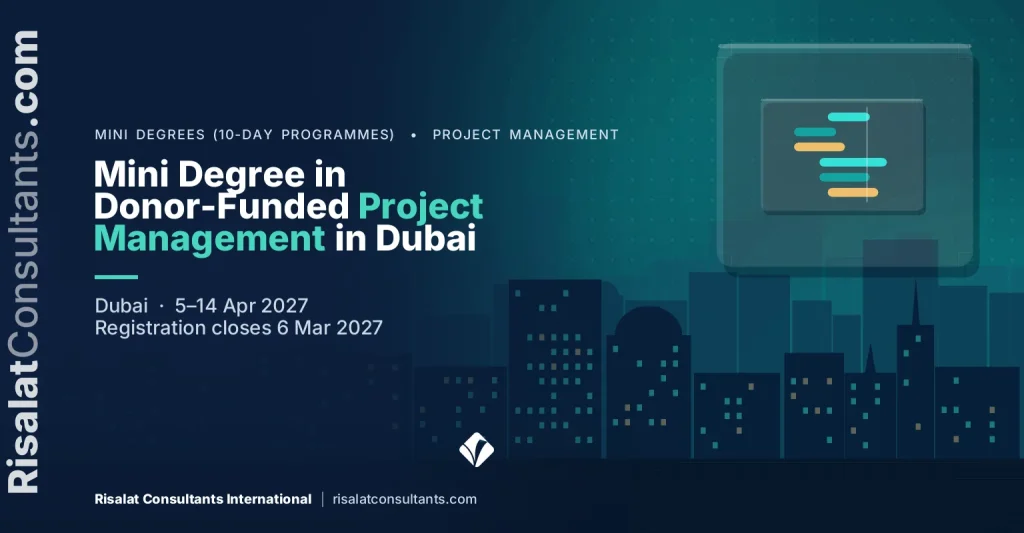
- 5–14 avr. 2027 (10 jours)
- Lieu
- Dubai, United Arab Emirates
- Frais par participant
- 4 950 £ (GBP)
- Paiement
- Sur facture et par virement bancaire
- Clôture des inscriptions
- 24 févr. 2027
- Format
- 10-day intensive programme (mini degree): a practical capacity-building programme for government, NGO and project teams in Dubai
- Certificat
- Certificat de participation
- Option intra
- Organisez-le pour votre équipe, à vos dates
Sur cette page 16 sections
About this mini degree: a ten-day intensive programme that combines two related short courses into one complete track, with more practice and a capstone exercise. Participants receive a Risalat certificate of completion; a mini degree is a professional programme, not an academic degree.
Free self-check: the procurement maturity assessment gives 30 questions on planning, tendering, contract management, integrity and e-procurement, with a score per area, in about 10 minutes.
Présentation du programme
This ten-day executive programme in Dubai delivers an end-to-end immersion in the management of development projects financed by multilateral and bilateral development partners. Designed as a professional mini degree rather than an academic qualification, it integrates project cycle management, administrative structuring, and fiduciary requirements into a unified practical syllabus. Participants gain systematic exposure to the operating principles required to navigate the policies of major institutions, including the World Bank, Asian Development Bank, African Development Bank, European Union, and United Nations agencies.
Across two rigorous working weeks, the curriculum breaks down the full operational sequence required by modern executing agencies and public sector departments. Learners examine how to establish a functioning Project Implementation Unit, structure compliant procurement strategies, control commitments through integrated project accounting, and institute required environmental and social risk safeguards. Through practical exercises based on actual project appraisals, attendees analyse core implementation problems and determine the corrective operational interventions required to maintain disbursement schedules and delivery milestones.
The training concludes with an intensive capstone simulation where teams formulate operational readiness action plans for complex capital or technical assistance interventions. By combining two interconnected short courses into a single continuous programme, this course eliminates the operational fragmentation that often impairs public sector capacity development. Successful participants receive a Risalat certificate of completion verifying their mastery of project governance, performance tracking, compliance verification, and formal facility closure mechanisms.
Public sector bodies, executing agencies, and project management offices increasingly handle co-financed portfolios that demand cross-functional mastery across administrative, financial, and technical disciplines. Fragmented training that treats procurement, financial control, and environmental safeguards as isolated tasks creates operational silos, leading to implementation bottlenecks, misprocurement risks, and audit qualifications. A unified ten-day curriculum equips management teams to coordinate the entire project lifespan seamlessly, ensuring that international loan agreements and grant facilities convert into accountable, compliant, and sustainable national development outcomes.
Delivered by Risalat Consultants International in Dubai, United Arab Emirates, it combines expert-led sessions, real cases and group work, so that participants can apply what they learn in their own institution.
The Programme Strengthens Institutional Capability
- International development architecture: mandates of the World Bank, ADB, AfDB, EU, and UN
- Key funding instruments: investment project financing, policy-based operations, and results-based facilities
- Project identification, strategic alignment, and the country partnership framework
- Appraisal fundamentals: technical, economic, institutional, and fiduciary assessments
- Financing agreements: covenants, conditions precedent to disbursement, and legal effectiveness
- Models for Project Implementation Units: integrated ministerial structures versus parallel PMUs
- Drafting the Project Operations Manual (POM): mandates, approval chains, and governance protocols
- Staffing, terms of reference, key performance indicators, and competitive recruitment rules
- Lancement et planification du projet
- Périmètre, calendrier et plans de travail
- Budgétisation et maîtrise des coûts
- Gestion des risques et des problèmes
It is designed for directors and staff of Project Implementation Units (PIUs) and Project Management Units (PMUs), planning and programme officers within ministries of finance, economy, and national development, procurement specialists, contract managers, and bid evaluation committee members on public schemes and others who want practical, current skills in project and programme management.
The Growing Importance of Mini Degree in Donor-Funded Project Management in Dubai
De nombreux projets échouent non par manque de fonds, mais en raison d'une planification insuffisante, de rôles flous et de décisions lentes. Les bailleurs et les gouvernements attendent des projets livrés dans les délais, dans le respect du budget et avec les résultats convenus.
Les équipes de projet des organismes publics et des projets financés par les bailleurs doivent conjuguer planification, gestion des risques, passation des marchés, contrôle financier et reporting. De solides compétences en gestion de projet permettent à ces éléments de fonctionner ensemble.
Les organisations ont de plus en plus besoin de professionnels capables de :
- Planifier des projets avec un périmètre, un calendrier et un budget clairs
- Gérer les risques et les problèmes avant qu'ils n'entraînent des retards
- Coordonner la passation des marchés, la finance et le travail technique
- Rendre compte clairement de l'avancement aux bailleurs et à la direction
- Diriger les équipes et gérer les parties prenantes
Des systèmes solides de gestion de projets et de programmes aident les organisations à :
- Livrer les projets dans les délais et le budget
- Réduire les retards et les dépassements de coûts
- Satisfaire aux exigences des bailleurs
- Atteindre les résultats convenus
This Mini Degree in Donor-Funded Project Management in Dubai programme brings these elements together in a practical format, so that participants understand not only what good practice looks like but also how to introduce it in their own setting, with the people and resources they have.
Who Should Attend This Mini Degree in Donor-Funded Project Management in Dubai Training?
Ce programme s'adresse à :
- Directors and staff of Project Implementation Units (PIUs) and Project Management Units (PMUs)
- Planning and programme officers within ministries of finance, economy, and national development
- Procurement specialists, contract managers, and bid evaluation committee members on public schemes
- Project accountants, financial controllers, and internal auditors overseeing donor facility accounts
- Environmental, social, and gender safeguard officers tracking compliance with multilateral frameworks
- Monitoring and evaluation specialists responsible for indicator tracking and donor reporting matrices
- Technical department specialists from public works, agriculture, health, education, and water utilities
- Programme managers from non-governmental organisations and managing contractors delivering donor-funded activities
- Public sector reform advisors and institutional capacity development consultants
- Gestionnaires de projets et de programmes
- Coordonnateurs et personnel des UGP
- Chargés de planification et de suivi
Le programme convient aussi bien aux professionnels expérimentés qu’à ceux qui prennent de nouvelles responsabilités. Les groupes réunissant plusieurs institutions et pays sont encouragés, car les participants apprennent beaucoup de l’expérience des autres.
Cochez ce que votre équipe doit être capable de faire.
Mini Degree in Donor-Funded Project Management in Dubai Training Objectives
Upon successful completion of this Mini Degree in Donor-Funded Project Management in Dubai Training, participants will be able to:
- Navigate international donor project cycles from initial programming and appraisal to formal project closure
- Establish robust Project Implementation Unit structures with transparent governance, operational manuals, and reporting lines
- Formulate realistic work breakdown structures, multi-year procurement plans, and activity-based project budgets
- Apply fiduciary controls and procurement standards aligned with World Bank, ADB, AfDB, and EU regulations
- Implement international environmental, social, and stakeholder engagement safeguards throughout project execution
- Produce verified progress reports and financial variance statements that meet international monitoring criteria
- Design practical project hand-over, asset disposal, and administrative completion plans for sovereign operations
- Expliquer le cycle de projet et le rôle de chaque partie prenante
- Préparer un plan de projet avec périmètre, calendrier et budget
- Établir un plan de travail et un diagramme de Gantt
Chaque objectif est mis en pratique pendant le programme à travers des exercices, des études de cas ou des travaux de groupe, afin que les participants repartent capables de le faire, et pas seulement de le décrire.
Contenu et structure du programme
- International development architecture: mandates of the World Bank, ADB, AfDB, EU, and UN
- Key funding instruments: investment project financing, policy-based operations, and results-based facilities
- Project identification, strategic alignment, and the country partnership framework
- Appraisal fundamentals: technical, economic, institutional, and fiduciary assessments
- Financing agreements: covenants, conditions precedent to disbursement, and legal effectiveness
- Models for Project Implementation Units: integrated ministerial structures versus parallel PMUs
- Drafting the Project Operations Manual (POM): mandates, approval chains, and governance protocols
- Staffing, terms of reference, key performance indicators, and competitive recruitment rules
- Establishing coordination with sector ministries, line agencies, and development partners
- Internal controls, risk governance frameworks, and ethics policies for executing personnel
- Translating the project appraisal document into detailed work breakdown structures (WBS)
- Critical path method and scheduling tools for civil works, goods, and consulting assignments
- Activity-based costing and linkage of physical milestones to disbursement schedules
- Cash flow forecasting and managing counter-party funds alongside donor proceeds
- Work plan baseline establishment, variance analysis, and formal revision protocols
- Core procurement principles: value for money, economy, integrity, fit for purpose, and transparency
- Drafting the Project Procurement Strategy for Development (PPSD) and market capability analysis
- Standard procurement documents for international competitive bidding, national bidding, and direct selection
- Evaluation criteria: lowest evaluated substantially responsive bid versus rated criteria mechanisms
- Bid evaluation committees: procedures, confidentiality, fairness, and no-objection applications
- Designated accounts, foreign currency risk, and direct payment procedures under donor rules
- Statement of expenditures (SOE), records-based withdrawal applications, and electronic submission systems
- Project financial reporting: Interim Financial Reports (IFRs) and annual sovereign statements
- External audit terms of reference, auditor appointment, and management letter resolution
- Preventing fraud and corruption: red flags in expenditure records and contract variations
- Briefing on Dubai large-scale infrastructure programme management and institutional governance
- Site review of modern capital project execution and operational coordination mechanisms
- Observation of logistics tracking, contractor oversight, and site safety management systems
- Examination of quality assurance protocols and technology-enabled site monitoring practices
- Debriefing session linking field observations to donor-funded physical infrastructure operations
- Overview of environmental and social standards: World Bank ESF and comparable regional frameworks
- Environmental and Social Impact Assessments (ESIA) and management plan (ESMP) operationalisation
- Land acquisition, involuntary resettlement planning, and livelihood restoration frameworks
- Grievance Redress Mechanisms (GRM): establishment, intake channels, dispute resolution, and logging
- Stakeholder engagement plans, disclosure requirements, and public consultation management
- Contract administration for FIDIC forms and donor-approved standard works contracts
- Consultant contract models: time-based versus lump-sum performance tracking and outputs
- Managing contract amendments, scope variations, price adjustments, and time extensions
- Dispute prevention, amicable settlement processes, and dispute adjudication boards
- Contractor performance default, termination protocols, and securities liquidation procedures
- Structuring the Results Framework: baselines, milestones, outcome indicators, and output targets
- Routine monitoring protocols, technical inspection cycles, and data collection integrity
- Mid-term reviews: preparation, portfolio adjustments, restructuring, and scope reallocation
- Standard donor progress reporting formats, dashboard analytics, and implementation rating systems
- Corrective action planning for delayed components, cost overruns, and non-compliance issues
- Administrative and financial project closure: grace periods, balance refunds, and account cancellation
- Asset handover procedures, warranties, operational maintenance plans, and sovereign transfer
- Preparation of Implementation Completion and Results Reports (ICR) and borrower contributions
- Capstone syndicate exercise: team formulation and defence of a complete project execution plan
- Evaluation panel review, programme debriefing, and distribution of Risalat certificates of completion
Contenu détaillé jour par jour
Le programme se déroule sur 10 jours. Chaque journée associe apports d'experts, travaux pratiques et un atelier ou une étude de cas de clôture :
- First Day: Day 1: Donor Project Lifecycle and Financing Frameworks
- Second Day: Day 2: PIU Institutional Setup and Project Governance
- Third Day: Day 3: Integrated Work Planning and Results-Based Budgeting
- Fourth Day: Day 4: Donor Procurement Regulations and Market Approach
- Fifth Day: Day 5: Financial Management, Disbursement, and Fiduciary Oversight
- Sixth Day: Day 6: Study Visit to Dubai Infrastructure and Logistics Initiatives
- Seventh Day: Day 7: Applied Workshop on Safeguards and Stakeholder Engagement
- Eighth Day: Day 8: Contract Administration and Supply Chain Execution
- Ninth Day: Day 9: Monitoring, Evaluation, and Adaptive Management
- Tenth Day: Day 10: Capstone Exercise, Project Handover, and Operational Closure
Contenu détaillé jour par jour
First Day | Day 1: Donor Project Lifecycle and Financing Frameworks
- International development architecture: mandates of the World Bank, ADB, AfDB, EU, and UN
- Key funding instruments: investment project financing, policy-based operations, and results-based facilities
- Project identification, strategic alignment, and the country partnership framework
- Appraisal fundamentals: technical, economic, institutional, and fiduciary assessments
- Financing agreements: covenants, conditions precedent to disbursement, and legal effectiveness
Workshop: Day 1: Donor Project Lifecycle and Financing Frameworks: Applying It to Your Institution
En petits groupes, les participants appliquent les méthodes du jour à des exemples tirés de leurs institutions et conviennent d'étapes concrètes pour la suite.
Second Day | Day 2: PIU Institutional Setup and Project Governance
- Models for Project Implementation Units: integrated ministerial structures versus parallel PMUs
- Drafting the Project Operations Manual (POM): mandates, approval chains, and governance protocols
- Staffing, terms of reference, key performance indicators, and competitive recruitment rules
- Establishing coordination with sector ministries, line agencies, and development partners
- Internal controls, risk governance frameworks, and ethics policies for executing personnel
Workshop: Day 2: PIU Institutional Setup and Project Governance: Applying It to Your Institution
En petits groupes, les participants appliquent les méthodes du jour à des exemples tirés de leurs institutions et conviennent d'étapes concrètes pour la suite.
Third Day | Day 3: Integrated Work Planning and Results-Based Budgeting
- Translating the project appraisal document into detailed work breakdown structures (WBS)
- Critical path method and scheduling tools for civil works, goods, and consulting assignments
- Activity-based costing and linkage of physical milestones to disbursement schedules
- Cash flow forecasting and managing counter-party funds alongside donor proceeds
- Work plan baseline establishment, variance analysis, and formal revision protocols
Case Study: Day 3: Integrated Work Planning and Results-Based Budgeting in Practice
Les participants analysent un cas réaliste, comparent les choix effectués aux bonnes pratiques et en tirent des enseignements applicables à leur propre contexte.
Fourth Day | Day 4: Donor Procurement Regulations and Market Approach
- Core procurement principles: value for money, economy, integrity, fit for purpose, and transparency
- Drafting the Project Procurement Strategy for Development (PPSD) and market capability analysis
- Standard procurement documents for international competitive bidding, national bidding, and direct selection
- Evaluation criteria: lowest evaluated substantially responsive bid versus rated criteria mechanisms
- Bid evaluation committees: procedures, confidentiality, fairness, and no-objection applications
Workshop: Day 4: Donor Procurement Regulations and Market Approach: Applying It to Your Institution
En petits groupes, les participants appliquent les méthodes du jour à des exemples tirés de leurs institutions et conviennent d'étapes concrètes pour la suite.
Fifth Day | Day 5: Financial Management, Disbursement, and Fiduciary Oversight
- Designated accounts, foreign currency risk, and direct payment procedures under donor rules
- Statement of expenditures (SOE), records-based withdrawal applications, and electronic submission systems
- Project financial reporting: Interim Financial Reports (IFRs) and annual sovereign statements
- External audit terms of reference, auditor appointment, and management letter resolution
- Preventing fraud and corruption: red flags in expenditure records and contract variations
Workshop: Day 5: Financial Management, Disbursement, and Fiduciary Oversight: Applying It to Your Institution
En petits groupes, les participants appliquent les méthodes du jour à des exemples tirés de leurs institutions et conviennent d'étapes concrètes pour la suite.
Sixth Day | Day 6: Study Visit to Dubai Infrastructure and Logistics Initiatives
- Briefing on Dubai large-scale infrastructure programme management and institutional governance
- Site review of modern capital project execution and operational coordination mechanisms
- Observation of logistics tracking, contractor oversight, and site safety management systems
- Examination of quality assurance protocols and technology-enabled site monitoring practices
- Debriefing session linking field observations to donor-funded physical infrastructure operations
Case Study: Day 6: Study Visit to Dubai Infrastructure and Logistics Initiatives in Practice
Les participants analysent un cas réaliste, comparent les choix effectués aux bonnes pratiques et en tirent des enseignements applicables à leur propre contexte.
Seventh Day | Day 7: Applied Workshop on Safeguards and Stakeholder Engagement
- Overview of environmental and social standards: World Bank ESF and comparable regional frameworks
- Environmental and Social Impact Assessments (ESIA) and management plan (ESMP) operationalisation
- Land acquisition, involuntary resettlement planning, and livelihood restoration frameworks
- Grievance Redress Mechanisms (GRM): establishment, intake channels, dispute resolution, and logging
- Stakeholder engagement plans, disclosure requirements, and public consultation management
Workshop: Day 7: Applied Workshop on Safeguards and Stakeholder Engagement: Applying It to Your Institution
En petits groupes, les participants appliquent les méthodes du jour à des exemples tirés de leurs institutions et conviennent d'étapes concrètes pour la suite.
Eighth Day | Day 8: Contract Administration and Supply Chain Execution
- Contract administration for FIDIC forms and donor-approved standard works contracts
- Consultant contract models: time-based versus lump-sum performance tracking and outputs
- Managing contract amendments, scope variations, price adjustments, and time extensions
- Dispute prevention, amicable settlement processes, and dispute adjudication boards
- Contractor performance default, termination protocols, and securities liquidation procedures
Workshop: Day 8: Contract Administration and Supply Chain Execution: Applying It to Your Institution
En petits groupes, les participants appliquent les méthodes du jour à des exemples tirés de leurs institutions et conviennent d'étapes concrètes pour la suite.
Ninth Day | Day 9: Monitoring, Evaluation, and Adaptive Management
- Structuring the Results Framework: baselines, milestones, outcome indicators, and output targets
- Routine monitoring protocols, technical inspection cycles, and data collection integrity
- Mid-term reviews: preparation, portfolio adjustments, restructuring, and scope reallocation
- Standard donor progress reporting formats, dashboard analytics, and implementation rating systems
- Corrective action planning for delayed components, cost overruns, and non-compliance issues
Case Study: Day 9: Monitoring, Evaluation, and Adaptive Management in Practice
Les participants analysent un cas réaliste, comparent les choix effectués aux bonnes pratiques et en tirent des enseignements applicables à leur propre contexte.
Tenth Day | Day 10: Capstone Exercise, Project Handover, and Operational Closure
- Administrative and financial project closure: grace periods, balance refunds, and account cancellation
- Asset handover procedures, warranties, operational maintenance plans, and sovereign transfer
- Preparation of Implementation Completion and Results Reports (ICR) and borrower contributions
- Capstone syndicate exercise: team formulation and defence of a complete project execution plan
- Evaluation panel review, programme debriefing, and distribution of Risalat certificates of completion
Capstone Exercise: Mini Degree in Donor-Funded Project Management in Dubai Action Plan for Your Institution
Les participants synthétisent la semaine dans un plan d'action pour leur institution, avec des priorités, des responsables et des premières étapes, puis le présentent à leurs pairs et aux animateurs pour recueillir leurs retours.
Mini Degree in Donor-Funded Project Management in Dubai Training Methodology
The programme utilises adult learning methodologies grounded in public sector operational reality. Training consists of interactive presentations, guided case reviews drawn from completed donor projects, institutional document analysis, and daily syndicate work. Participants analyse authentic standard procurement documents, project appraisal documents, financial reports, and environmental management matrices. Day 6 features an organised field exposure visit in Dubai, followed by a lighter, practical workshop on Day 7 to review operational safeguard instruments. The course concludes on Day 10 with a team-based capstone exercise in which cohorts apply the end-to-end framework to produce and present a fully articulated project implementation action plan.
Le programme associe :
- Sessions animées par des experts sur les pratiques actuelles
- Études de cas régionales et internationales
- Travaux de groupe et exercices pratiques
- Simulations et jeux de rôle le cas échéant
- Discussion des défis rencontrés par les participants dans l'exercice de leurs fonctions
- Apprentissage entre pairs, d'institutions et de pays différents
- Des outils et modèles pratiques à réutiliser au travail
- Réflexion quotidienne et plan d'action
Avant le programme, une courte pré-évaluation aide les animateurs à comprendre le rôle et les priorités de chaque participant, afin d’adapter les exemples et les exercices au groupe. Chaque journée se termine par une brève réflexion au cours de laquelle les participants notent ce qu’ils appliqueront dans leur travail.
Résultats attendus
Upon completion of this Mini Degree in Donor-Funded Project Management in Dubai Training, participants will be able to:
- Navigate and apply multilateral bank guidelines and operational policies across the whole project lifecycle
- Author comprehensive Project Operations Manuals, implementation schedules, and operational risk registers
- Execute procurement actions that align strictly with international open-competition and integrity standards
- Prepare compliant withdrawal applications, project financial accounts, and variance tracking spreadsheets
- Supervise environmental, social, health, and safety safeguard requirements on active project sites
- Plan and execute administrative project closeout, final account reconciliation, and structured asset handover
- Planifier des projets avec un périmètre, un calendrier et un budget clairs
- Gérer tôt les risques et les problèmes
Les participants repartent avec un plan d'action personnel et des outils pratiques utilisables dans leur institution dès la première semaine de retour. Les institutions qui envoient plusieurs participants peuvent s'appuyer sur le programme pour convenir de méthodes et de modèles communs entre équipes, ce qui facilite la pérennité des améliorations.
4 950 £ par participant · facture et virement bancaire · remise pour les groupes de 5 personnes ou plus
Cinq personnes ou plus d'une même organisation : demandez le tarif de groupe lors de votre demande de facture.
Ten or more: an in-house version for your institution may cost less per person. Ask for an in-house quote.
Registration closes in 95 days (24 Feb 2027)
Institutional Application of Mini Degree in Donor-Funded Project Management in Dubai Training
Ce programme aide les organisations à renforcer :
- Planification de projet
- Gestion des risques
- Coordination entre les fonctions
- Rapports d'avancement
- Gestion des parties prenantes
Les participants repartent avec des outils pratiques pour améliorer :
- Plans de travail
- Registres des risques
- Rapports d'avancement
- Préparation des missions
- Enseignements tirés
Le programme est conçu pour que l'apprentissage passe de la salle de formation à l'institution. Les participants travaillent, dans la mesure du possible, sur leurs propres processus et documents, et repartent avec un plan d'action que leurs responsables peuvent examiner et soutenir.
Pertinence régionale & mise en application
Europe
Les institutions européennes pratiquent la gestion de projets et de programmes dans le cadre de réglementations détaillées et de programmes de réforme. Les participants venus d'Europe peuvent comparer leurs pratiques avec celles de collègues d'autres régions et vérifier comment des méthodes éprouvées fonctionnent dans d'autres conditions.
Afrique
En Afrique, les ministères, agences et équipes de projet œuvrant dans la gestion de projets et de programmes travaillent de plus en plus aux côtés de programmes financés par les bailleurs qui exigent des systèmes clairs et des données probantes. Le programme aide les participants à adapter les bonnes pratiques aux institutions et aux ressources avec lesquelles ils travaillent.
Moyen-Orient
Au Moyen-Orient, les stratégies nationales de développement et les plans de diversification sollicitent de plus en plus la gestion de projets et de programmes. Les participants examinent comment bâtir, au sein des organismes publics et des entreprises, les capacités dont ces plans ont besoin.
Asie
Les institutions asiatiques conjuguent croissance rapide et programmes de modernisation ambitieux. Les participants venus d'Asie peuvent partager leur expérience du déploiement rapide de systèmes à grande échelle et découvrir les approches adoptées ailleurs.
Pacifique
Les petits États insulaires et du Pacifique font face à des contraintes particulières de taille, de distance et de capacités. Le programme met en avant des approches pratiques et proportionnées de la gestion de projets et de programmes, adaptées aux institutions de petite taille.
Holding the programme in Dubai, United Arab Emirates brings participants together away from their daily pressures, so they can compare how project and programme management is handled in different settings. The same programme can also be delivered in-house for one institution, in its own country or online, with cases taken from its current work.
Profil du pays d'accueil – Émirats arabes unis
Programmes, ateliers, immersions et formations à Dubaï, EAU, par Risalat Consultants International
Se former hors de son pays permet aux participants de se concentrer, de porter un regard neuf sur leur propre institution et de constituer un réseau avec des collègues d'autres pays.
Mini Degree in Donor-Funded Project Management in Dubai Training Deliverables
Les participants sont accompagnés avant, pendant et après le programme, afin que la préparation, l'apprentissage et le suivi forment une expérience continue.
Avant le programme
- Pré-évaluation des participants
- Mini Degree in Donor-Funded Project Management in Dubai Readiness Assessment
- Mini Degree in Donor-Funded Project Management in Dubai Resource Pack
- Lectures préparatoires
- Aide et conseils gratuits pour le visa
Pendant le programme
- Accueil à l'aéroport & assistance à l'arrivée
- Accommodation with breakfast: 11 nights, check-in Sunday 4 April 2027, check-out Thursday 15 April 2027 (one night before and one night after the programme)
- Dîner de bienvenue et de réseautage
- Kit de formation Risalat (sac, gourde, mug, t-shirt, casquette, protège-passeport, stylos, carnet, magnet & porte-clés)
- Comprehensive Mini Degree in Donor-Funded Project Management in Dubai Training Manual
- Modèle de plan de projet
- Modèle de plan de travail et de diagramme de Gantt
- Modèle de registre des risques
- Modèle de rapport d'avancement
- Ateliers pratiques & simulations
- Discussions de groupe & apprentissage entre pairs
- Déjeuner et pauses-café quotidiens
- Accès complet aux installations du lieu de formation
- Mini tablette avec supports pédagogiques numériques
- Visite de terrain (le cas échéant)
- Visite récréative de la ville
Après le programme
- Certificat de participation
- Distinction Risalat de participation au programme
- Documents de référence après la formation
- Liste de contrôle de préparation des missions de supervision
- Modèle d'enseignements tirés
- Accompagnement après la formation & conseils de suivi
- Rapport du programme
Institutions can also request a tailored in-house version of this programme, delivered at their premises or online. Request a proposal.
Common Challenges in Mini Degree in Donor-Funded Project Management in Dubai, And How This Training Helps
Comment les institutions peuvent-elles planifier des projets avec un périmètre, un calendrier et un budget clairs ?
The programme addresses this directly on the first day (Day 1: Donor Project Lifecycle and Financing Frameworks), where participants practise the methods involved and adapt them to their own institution, then build it into their action plan.
Comment les institutions peuvent-elles gérer les risques et les problèmes avant qu'ils n'entraînent des retards ?
The programme addresses this directly on the second day (Day 2: PIU Institutional Setup and Project Governance), where participants practise the methods involved and adapt them to their own institution, then build it into their action plan.
Comment les institutions peuvent-elles coordonner la passation des marchés, la finance et le travail technique ?
The programme addresses this directly on the third day (Day 3: Integrated Work Planning and Results-Based Budgeting), where participants practise the methods involved and adapt them to their own institution, then build it into their action plan.
Comment les institutions peuvent-elles rendre compte clairement de l'avancement aux bailleurs et à la direction ?
The programme addresses this directly on the fourth day (Day 4: Donor Procurement Regulations and Market Approach), where participants practise the methods involved and adapt them to their own institution, then build it into their action plan.
Comment les institutions peuvent-elles diriger les équipes et gérer les parties prenantes ?
The programme addresses this directly on the fifth day (Day 5: Financial Management, Disbursement, and Fiduciary Oversight), where participants practise the methods involved and adapt them to their own institution, then build it into their action plan.
Questions fréquentes
When and where does the Mini Degree in Donor-Funded Project Management in Dubai programme take place?
It runs from 5 Apr 2027 to 14 Apr 2027, in Dubai, United Arab Emirates. The registration deadline is shown at the top of this page.
Qui devrait participer ?
The programme is designed for directors and staff of Project Implementation Units (PIUs) and Project Management Units (PMUs), planning and programme officers within ministries of finance, economy, and national development, procurement specialists, contract managers, and bid evaluation committee members on public schemes, project accountants, financial controllers, and internal auditors overseeing donor facility accounts, and others who want practical skills in project and programme management.
Recevrai-je un certificat ?
Oui. Les participants qui terminent le programme reçoivent un certificat de participation délivré par Risalat Consultants International.
Ce programme peut-il être dispensé pour notre seule institution ?
Oui. Nous pouvons proposer une version intra sur mesure dans vos locaux, dans une autre ville ou en ligne, construite autour de vos propres cas. Utilisez la demande de proposition sur cette page.
Faut-il une expérience préalable en gestion de projets et de programmes ?
Aucune formation spécialisée n'est requise au-delà d'une expérience dans une fonction similaire. Une courte pré-évaluation aide les animateurs à adapter les sessions au groupe.
Who Will Deliver This Programme
Each date is delivered by a team assigned from Risalat's expert network for this subject. For this programme we assign:
How we choose them: Experience in the region of the participants or comparable settings; Command of the financier rules that apply (World Bank, ADB, AfDB, EU, UN) where relevant; Delivery in English; other languages on request for in-house groups; No conflict of interest with participants' institutions.
Names and short CVs of the assigned experts are shared with registered participants and sponsoring organisations before the programme, on request. Are you an expert in this subject? Join our expert network.
Training courses in DubaiCours de formation en gestion de projets et de contrats &
Pourquoi Dubaï pour ce programme
Dubaï est une plateforme accessible en un seul vol depuis l'Afrique, l'Asie et l'Europe, avec des visas simples pour de nombreuses nationalités et des lieux de formation modernes.
The Mini Degree in Donor-Funded Project Management in Dubai programme in April 2027 brings together officials and professionals from across the Middle East region and beyond. Sessions combine short inputs, case studies and group work on participants' own files, and the city's institutions can be added as a study visit on request.
Accès : aéroport international de Dubaï (DXB).
Vérifiez si vous avez besoin d'un visa avec le vérificateur de visa gratuit, et demandez une lettre d'invitation une fois inscrit.
Le même thème dans d'autres villes
- Mini Degree in Monitoring, Evaluation and Learning in Bangkok (Bangkok)
- Mini Degree in Procurement and Contract Management in Dubai (Dubai)
- Mini Degree in Public Financial Management in London (London)
- Evaluating Training Impact (Kirkpatrick and Beyond) in Kigali (Kigali)
- Développement du corps professoral en STIM et gouvernance de la recherche académique à Singapour (Singapour)
Autres programmes à Dubaï
- Refugee and Host Community Programme Management in Dubai
- Performance Audit for Supreme Audit Institutions in Dubai
- Artificial Intelligence for Public Sector Leaders Training in Dubai
- Records and Archives Management for Public Institutions in Dubai
- Small Island Landfill Rehabilitation and Leachate Containment in Dubai
Teams often travel here from Maldives, Sri Lanka, Bangladesh, Nepal, Pakistan, Afghanistan, Kazakhstan, Uzbekistan. Funding, visa letters and group rates are explained on each country page.
- World Bank Projects and Operations Banque mondiale
- ADB Projects and Tenders Banque asiatique de développement
Pour les équipes et les institutions
Bring your team
Teams that learn together apply more at work. Tell us how many people and how you would like to take part: we reply with a group quote within two working days.
Watch: this programme in short


Other dates and cities for this subject: Project Management for Donor-Funded Projects training courses (27 upcoming dates).
More training courses in the United Arab Emirates · Tous les programmes au Moyen-Orient · Calendrier complet des formations
Plan this programme in a roadmap: why it matters, why to approve it, the dates to plan and the career it builds.