Factos essenciais
- Datas
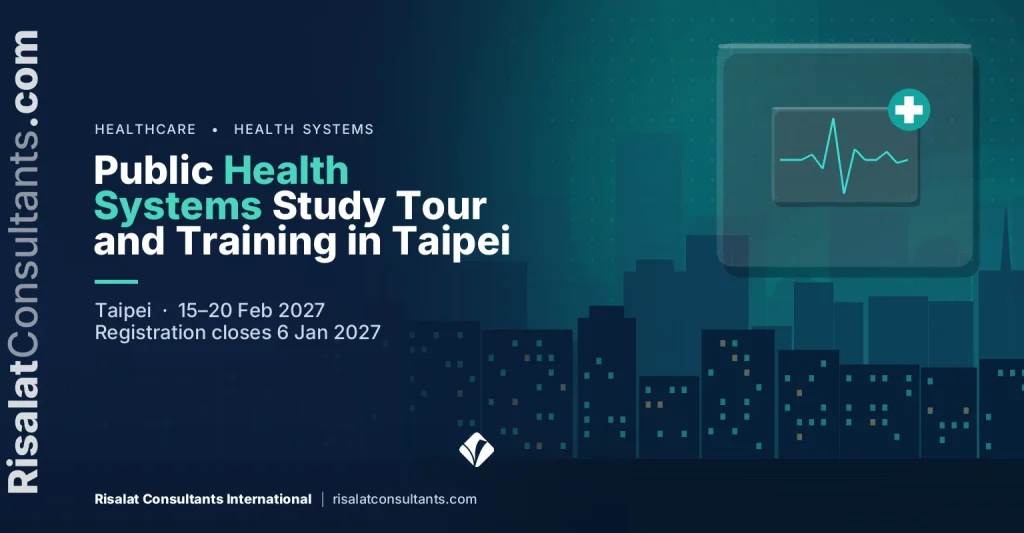
- 15–20 fev. 2027 (6 dias)
- Local
- Fortune Hiya Hotel, Taipei, Taiwan
- Preço por participante
- £5.370 (GBP)
- Pagamento
- Por fatura e transferência bancária
- Encerramento das inscrições
- 6 jan. 2027
- Formato
- 6-day short course: a practical capacity-building programme for government, NGO and project teams in Taipei
- Certificado
- Certificado de conclusão
- Opção interna
- Realize-o para a sua equipa, nas datas que preferir
Nesta página 16 secções
Visão geral do programa
Este programa prático de sistemas de saúde pública em Taipei foi concebido para profissionais que precisam de transformar orientações técnicas estabelecidas numa prática institucional fiável. Os participantes examinam as decisões, evidências, controlos e relações de trabalho que determinam se as melhorias perduram para além de um curso individual.
The learning journey covers health system governance and accountability, taiwan health financing and service pathways and primary care and referral coordination. Each topic is treated as an operational responsibility, not simply a theoretical concept.
Current primary guidance informs the programme, including WHO Health Systems Governance. Participants learn to identify which requirements apply to their organisation and how to document the reasoning behind their decisions.
The programme is hosted in Taipei, Taiwan. Case studies are adapted to the participant group; no external institutional visit, accreditation, funding allocation or regulatory endorsement is implied unless separately agreed and verified.
The Programme Strengthens Institutional Capability
- Health system governance and accountability
- Taiwan health financing and service pathways
- Primary care and referral coordination
- Population health surveillance and epidemiology
- Community health needs assessment
- Quality improvement and patient safety
- Health workforce and competency planning
- Digital health information and data quality
- Environmental and occupational health
- Health budgeting and purchasing
- Public health emergency readiness
- Institutional learning and transfer planning
- Apply a documented decision rule to public health systems
- Review evidence and data limitations for public health systems
- Define accountable owners and approval points for public health systems
- Record practical risks and corrective actions for public health systems
The emphasis is on practical templates, defensible decisions and an implementation plan that can be reviewed by a line manager.
The Growing Importance of Public Health Systems
Institutions are expected to show how their public health systems arrangements work in practice. Written policies alone cannot demonstrate sound decisions, quality assurance or follow-up when responsibilities are fragmented.
Official guidance provides a useful reference point: WHO Health Systems Governance. The programme converts that guidance into questions, checks and evidence that a team can use in its own operating environment.
A structured approach makes it easier to distinguish a genuine control weakness from a documentation gap, set priorities and communicate progress without relying on unsupported performance claims.
As organizações precisam cada vez mais de profissionais capazes de:
- Health system governance and accountability
- Taiwan health financing and service pathways
- Primary care and referral coordination
- Population health surveillance and epidemiology
- Community health needs assessment
- Quality improvement and patient safety
- Health workforce and competency planning
- Digital health information and data quality
- Environmental and occupational health
- Health budgeting and purchasing
- Apply a documented decision rule to institutional performance
Sistemas de saúde pública fortes ajudam as organizações a:
- Clarify decision rights and accountability
- Reduzir erros evitáveis e refação
- Use evidence consistently across teams
- Identify implementation risks earlier
- Make records easier to review
- Improve coordination between functions
- Prioritise limited staff time
- Support defensible reporting to leadership
- Track corrective actions to completion
The course focuses on improvements that can be implemented with realistic resources and assigned owners.
Who Should Attend This Public Health Systems Training?
Este programa destina-se a:
- Public health directors
- Health ministry planners
- Primary care managers
- Community health coordinators
- Epidemiologists
- Hospital administrators
- Health financing officers
- Health information officers
- Quality managers
- Health workforce planners
- Municipal health officers
- Donor-funded health project staff
Mixed teams are welcome where technical, operational and management perspectives need to be aligned. Participants should be able to discuss a current institutional process or case.
Assinale o que a sua equipa precisa de ser capaz de fazer.
Public Health Systems Training Objectives
Upon successful completion of this Public Health Systems Training, participants will be able to:
- Explain the relevant official framework and its scope
- Diagnose a current institutional capability gap
- Select fit-for-purpose methods and controls
- Prepare a traceable evidence and decision record
- Design an achievable improvement plan
- Set indicators and reporting responsibilities
- Present findings clearly to senior management
- Health system governance and accountability
- Taiwan health financing and service pathways
- Primary care and referral coordination
- Population health surveillance and epidemiology
- Community health needs assessment
Each objective is tested through an exercise, peer review or practical output during the programme.
Conteúdo e estrutura do programa
- Health system governance and accountability
- Taiwan health financing and service pathways
- Primary care and referral coordination
- Population health surveillance and epidemiology
- Community health needs assessment
- Quality improvement and patient safety
- Aplicar uma regra de decisão documentada à governação da saúde e aos percursos de atendimento
- Primary care and referral coordination
- Population health surveillance and epidemiology
- Community health needs assessment
- Quality improvement and patient safety
- Health workforce and competency planning
- Digital health information and data quality
- Apply a documented decision rule to primary and community health practice
- Community health needs assessment
- Quality improvement and patient safety
- Health workforce and competency planning
- Digital health information and data quality
- Environmental and occupational health
- Health budgeting and purchasing
- Apply a documented decision rule to quality and workforce improvement
- Health workforce and competency planning
- Digital health information and data quality
- Environmental and occupational health
- Health budgeting and purchasing
- Public health emergency readiness
- Institutional learning and transfer planning
- Apply a documented decision rule to health data and emergency preparedness
- Environmental and occupational health
- Health budgeting and purchasing
- Public health emergency readiness
- Institutional learning and transfer planning
- Health system governance and accountability
- Taiwan health financing and service pathways
- Apply a documented decision rule to study tour synthesis and action planning
Conteúdo completo, dia a dia
The five-day learning pathway moves from fundamentals to applied decisions, review and implementation.
- Day 1: Health governance and service pathways
- Day 2: Primary and community health practice
- Day 3: Quality and workforce improvement
- Day 4: Health data and emergency preparedness
- Day 5: Study tour synthesis and action planning
Conteúdo completo, dia a dia
First Day | Health governance and service pathways
- Health system governance and accountability
- Taiwan health financing and service pathways
- Primary care and referral coordination
- Population health surveillance and epidemiology
- Community health needs assessment
- Quality improvement and patient safety
- Aplicar uma regra de decisão documentada à governação da saúde e aos percursos de atendimento
- Review evidence and data limitations for health governance and service pathways
- Define accountable owners and approval points for health governance and service pathways
Workshop: Health governance and service pathways in practice
Working with a realistic public health systems scenario, participants review the available records, identify the decisions that require justification and produce a practical output. The group tests assumptions, records risks and receives structured peer feedback. The result is a reusable template and a clear next step for the participant’s organisation.
Second Day | Primary and community health practice
- Primary care and referral coordination
- Population health surveillance and epidemiology
- Community health needs assessment
- Quality improvement and patient safety
- Health workforce and competency planning
- Digital health information and data quality
- Apply a documented decision rule to primary and community health practice
- Review evidence and data limitations for primary and community health practice
- Definir responsáveis e pontos de aprovação para a prática de saúde primária e comunitária
Estudo de Caso: Prática de saúde primária e comunitária na prática
Working with a realistic public health systems scenario, participants review the available records, identify the decisions that require justification and produce a practical output. The group tests assumptions, records risks and receives structured peer feedback. The result is a reusable template and a clear next step for the participant’s organisation.
Third Day | Quality and workforce improvement
- Community health needs assessment
- Quality improvement and patient safety
- Health workforce and competency planning
- Digital health information and data quality
- Environmental and occupational health
- Health budgeting and purchasing
- Apply a documented decision rule to quality and workforce improvement
- Review evidence and data limitations for quality and workforce improvement
- Define accountable owners and approval points for quality and workforce improvement
Workshop: Quality and workforce improvement in practice
Working with a realistic public health systems scenario, participants review the available records, identify the decisions that require justification and produce a practical output. The group tests assumptions, records risks and receives structured peer feedback. The result is a reusable template and a clear next step for the participant’s organisation.
Quarto Dia | Dados de saúde e preparação para emergências
- Health workforce and competency planning
- Digital health information and data quality
- Environmental and occupational health
- Health budgeting and purchasing
- Public health emergency readiness
- Institutional learning and transfer planning
- Apply a documented decision rule to health data and emergency preparedness
- Review evidence and data limitations for health data and emergency preparedness
- Define accountable owners and approval points for health data and emergency preparedness
Estudo de Caso: Dados de saúde e preparação para emergências na prática
Working with a realistic public health systems scenario, participants review the available records, identify the decisions that require justification and produce a practical output. The group tests assumptions, records risks and receives structured peer feedback. The result is a reusable template and a clear next step for the participant’s organisation.
Fifth Day | Study tour synthesis and action planning
- Environmental and occupational health
- Health budgeting and purchasing
- Public health emergency readiness
- Institutional learning and transfer planning
- Health system governance and accountability
- Taiwan health financing and service pathways
- Apply a documented decision rule to study tour synthesis and action planning
- Review evidence and data limitations for study tour synthesis and action planning
- Define accountable owners and approval points for study tour synthesis and action planning
Capstone Exercise: Study tour synthesis and action planning in practice
Working with a realistic public health systems scenario, participants review the available records, identify the decisions that require justification and produce a practical output. The group tests assumptions, records risks and receives structured peer feedback. The result is a reusable template and a clear next step for the participant’s organisation.
Public Health Systems Training Methodology
Facilitated instruction is paired with guided analysis, realistic case files, group exercises and short individual reflections. Participants are encouraged to bring non-confidential examples and adapt the templates to their own procedures.
O programa combina:
- Breves exposições de especialistas
- Official framework interpretation
- Guided document review
- Practical worksheets
- Simulações específicas para funções
- Resolucao de problemas em grupo
- Case comparisons
- Peer feedback
- Facilitator demonstrations
- Decision logs
- Daily learning reflections
- Final action planning
Exercises emphasise evidence quality, transparent assumptions and the limits of what a particular source or case can establish.
Visitas técnicas e programa no terreno
The study tour element uses structured observation questions on governance, service pathways, data use and quality assurance. External visits are subject to host acceptance, access conditions and programme logistics; no institution or visit is presented as confirmed.
- Pre-visit learning objectives and confidentiality briefing
- Observation checklist for service delivery and management
- Comparação estruturada com as instituições participantes
- Post-visit synthesis and transferability assessment
Resultados esperados
Upon completion of this Public Health Systems Training, participants will be able to:
- Explicar os princípios orientadores relevantes para a sua função
- Identificar as fraquezas de processos mais materiais
- Use a documented checklist to assess current practice
- Prepare a decision and evidence log
- Select appropriate operational indicators
- Communicate findings to non-specialists
- Identificar funções e necessidades de recursos
- Draft a phased improvement roadmap
- Plan a review of progress and unresolved risks
Participants leave with a draft improvement plan and practical working materials, rather than an unsupported claim of organisational certification.
£5.370 por participante · fatura e transferência bancária · desconto para grupos de 5 ou mais pessoas
Cinco ou mais participantes da mesma organização: peça a tarifa de grupo no pedido de fatura.
Ten or more: an in-house version for your institution may cost less per person. Ask for an in-house quote.
As inscrições encerram em 45 dias (6 Jan 2027)
Institutional Application of Public Health Systems Training
Este programa ajuda as organizações a reforçar:
- Health system governance and accountability
- Taiwan health financing and service pathways
- Primary care and referral coordination
- Population health surveillance and epidemiology
- Community health needs assessment
- Quality improvement and patient safety
- Health workforce and competency planning
- Digital health information and data quality
- Environmental and occupational health
- Health budgeting and purchasing
- Apply a documented decision rule to institutional accountability
Os participantes regressam com ferramentas práticas para melhorar:
- Process mapping and responsibility allocation
- Evidence and document review
- Registos de riscos e problemas
- Quality checklists
- Management briefings
- Action plans with owners
- Indicadores de desempenho
- Peer review and escalation
- Post-training learning transfer
Teams can use the outputs in internal planning, supervision and professional development without assuming that a specific donor has allocated funds for this course.
Relevância regional e aplicação
Ásia
For organisations working in Asia, public health systems capabilities can support cross-border professional learning, service delivery and institutional reporting. The exercises are adaptable to local requirements; participants must verify the standards and laws that govern their own institution.
Europa
For organisations working in Europe, public health systems capabilities can support regulatory interpretation, documentation and accountable management. The exercises are adaptable to local requirements; participants must verify the standards and laws that govern their own institution.
África
For organisations working in Africa, public health systems capabilities can support capacity-building, programme implementation and resource prioritisation. The exercises are adaptable to local requirements; participants must verify the standards and laws that govern their own institution.
Médio Oriente
For organisations working in Middle East, public health systems capabilities can support institutional modernisation and performance management. The exercises are adaptable to local requirements; participants must verify the standards and laws that govern their own institution.
Regional examples are illustrative learning contexts, not claims that any particular project has commissioned or financed this programme.
1. What should an institution do before changing its public health systems procedures?
The official reference material on public health systems must be interpreted in its applicable context: https://www.who.int/health-topics/health-systems-governance
2. Which output best supports implementation after training?
A documented implementation plan helps translate the principles in WHO Health Systems Governance into operational practice.
3. Quando pode um fornecedor de formação afirmar que uma organização externa apoia um curso?
Publishing an official guideline does not by itself confer endorsement or accreditation.
- Recolher
- Limpar
- Armazenar
- Analisar
- Decidir
Host Country Profile – Taiwan
Taipei provides an international setting for structured professional learning, peer exchange and reflection away from routine office demands. The programme retains the original advertised destination.
The training content uses official international reference material and participant case studies. No claim is made that an institution in Taipei has endorsed the course or agreed to receive a study visit.
Travel documentation, visa eligibility, local entry rules and accommodation arrangements should be checked individually before booking. The programme team can provide administrative guidance but cannot guarantee admission or a visa.
Public Health Systems Training Deliverables
The following learning and participation services form the standard Risalat programme package, subject to the participant agreement and final logistical confirmation.
Antes do programa
- Avaliação prévia dos participantes
- Public Health Systems Readiness Assessment
- Public Health Systems Resource Pack
- Materiais de leitura preparatória
- Apoio e aconselhamento gratuitos em matéria de vistos
Durante o programa
- Recolha no aeroporto e apoio de boas-vindas
- Accommodation with breakfast: 7 nights, check-in Sunday 14 February 2027, check-out Sunday 21 February 2027 (one night before and one night after the programme)
- Jantar de boas-vindas e networking
- Kit de formação Risalat (saco, garrafa, caneca, t-shirt, boné, capa de passaporte, canetas, bloco de notas, íman e porta-chaves)
- Comprehensive Public Health Systems Training Manual
- Assessment checklist
- Decision log template
- Registo de riscos e ações
- Evidence review worksheet
- Management briefing template
- Workshops práticos e simulações
- Discussões de grupo e aprendizagem entre pares
- Almoço e pausas para café diários
- Acesso total às instalações do local de formação
- Mini tablet com materiais de aprendizagem digitais
- Visita de Campo (quando aplicavel, sujeita a confirmacao)
- Passeio recreativo pela cidade
Depois do programa
- Certificado de Conclusão
- Prémio Risalat de Reconhecimento da Participação no Programa
- Materiais de referência pós-formação
- Personal improvement roadmap
- Institutional action tracker
- Post-training reflection checklist
- Apoio pós-formação e orientação de acompanhamento
- Relatório do programa
Institutions may request a tailored in-house version through the Risalat proposal request form.
Common Challenges in Public Health Systems, And How This Training Helps
Como a nossa equipa pode identificar as lacunas de capacidades mais urgentes?
Day 1 addresses this challenge through a guided exercise on health governance and service pathways. Participants use a checklist, discuss competing choices and document an action that can be tested in their own institution.
How can we interpret official guidance consistently?
Day 2 addresses this challenge through a guided exercise on primary and community health practice. Participants use a checklist, discuss competing choices and document an action that can be tested in their own institution.
How can we improve decisions without adding unnecessary bureaucracy?
Day 3 addresses this challenge through a guided exercise on quality and workforce improvement. Participants use a checklist, discuss competing choices and document an action that can be tested in their own institution.
How can we demonstrate that evidence is reliable?
Day 4 addresses this challenge through a guided exercise on health data and emergency preparedness. Participants use a checklist, discuss competing choices and document an action that can be tested in their own institution.
How can we involve technical and management colleagues effectively?
Day 5 addresses this challenge through a guided exercise on study tour synthesis and action planning. Participants use a checklist, discuss competing choices and document an action that can be tested in their own institution.
How can we turn training into an institutional action plan?
Day 5 addresses this challenge through a guided exercise on study tour synthesis and action planning. Participants use a checklist, discuss competing choices and document an action that can be tested in their own institution.
Como podemos monitorizar as melhorias após o regresso dos participantes?
Day 5 addresses this challenge through a guided exercise on study tour synthesis and action planning. Participants use a checklist, discuss competing choices and document an action that can be tested in their own institution.
Explore further professional development options through Risalat programme categories and use the training needs assessment to prioritise team learning requirements.
Perguntas frequentes
Who is this programme intended for?
It is intended for professionals responsible for public health systems decisions, supervision or reporting.
Is previous experience required?
Professional familiarity is useful. A pre-assessment helps tailor the level of practical exercises.
Are institutional visits guaranteed?
No. Any external visit depends on host approval, access and logistics and is confirmed separately.
O que levarão os participantes de volta para o trabalho?
Templates, case notes, a documented action plan and post-training reference materials.
O programa pode ser realizado internamente?
Yes. Risalat can adapt the content to an institutional team and its operational priorities.
Who Will Deliver This Programme
Each date is delivered by a team assigned from Risalat's expert network for this subject. For this programme we assign:
How we choose them: Experience in the region of the participants or comparable settings; Command of the financier rules that apply (World Bank, ADB, AfDB, EU, UN) where relevant; Delivery in English; other languages on request for in-house groups; No conflict of interest with participants' institutions.
Cursos de formação em TaipéHealthcare training courses
Why Taipei for this programme
Taipei offers direct exposure to advanced public administration, digital governance initiatives, and modern transport infrastructure such as the Taipei Metro. Visiting delegations can observe institutions such as the Legislative Yuan and the National Development Council. The city is accessible globally through Taoyuan International Airport, which connects smoothly to the capital via dedicated express rail links.
O programa de Visita de Estudo e Formação em Sistemas de Saúde Pública em Taipé, em fevereiro de 2027, reúne funcionários e profissionais de toda a região da Ásia e de outros locais. As sessões combinam breves intervenções, estudos de caso e trabalho de grupo sobre os processos dos próprios participantes, sendo possível adicionar as instituições da cidade como visita de estudo a pedido.
Getting there: Taiwan Taoyuan International (TPE).
Verifique se precisa de visto com o Verificador de Vistos gratuito e peça uma carta-convite depois de se inscrever.
O mesmo tema noutras cidades
- Mini Degree in Environmental and Social Safeguards in Istanbul (Istanbul)
- Mini Degree in Donor-Funded Project Management in Dubai (Dubai)
- Mini Degree in Procurement and Contract Management in Dubai (Dubai)
- Refugee and Host Community Programme Management in Dubai (Dubai)
- AI for Agriculture and Food Security Training in Accra (Accra)
- AI for Climate Action, Disaster Risk and Early Warning Training in Copenhagen (Copenhagen)
- World Health Organization World Health Organization
- ILO: Skills and Lifelong Learning ILO
For teams and institutions
Bring your team
Teams that learn together apply more at work. Tell us how many people and how you would like to take part: we reply with a group quote within two working days.
Watch: this programme in short


Other dates and cities for this subject: Health Systems and Health Project Management training courses (111 upcoming dates).
Mais cursos de formação em Taiwan · Todos os programas na Ásia · Calendário de formação completo
Planear este programa num roteiro: porque importa, porque o aprovar, as datas a planear e a carreira que constrói.