Datos clave
- Fechas
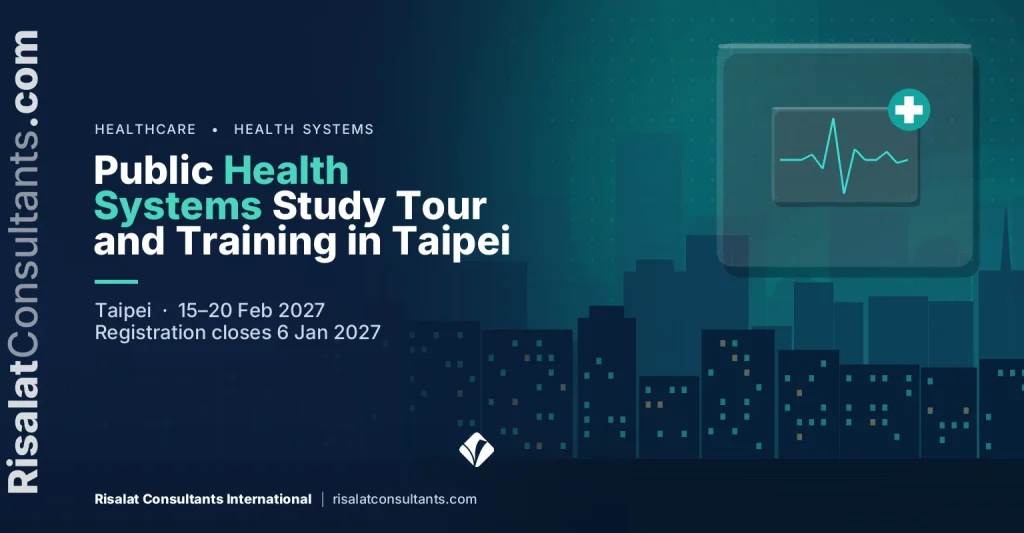
- 15–20 feb 2027 (6 días)
- Dónde
- Fortune Hiya Hotel, Taipei, Taiwan
- Tarifa por participante
- 5.370 £ (GBP)
- Pago
- Mediante factura y transferencia bancaria
- Cierre de inscripciones
- 6 ene 2027
- Formato
- 6-day short course: a practical capacity-building programme for government, NGO and project teams in Taipei
- Certificado
- Certificado de finalización
- Opción interna
- Impártalo para su equipo, en sus fechas
En esta página 16 secciones
Descripción del programa
Este programa práctico de sistemas de salud pública en Taipéi está diseñado para profesionales que deben convertir la orientación técnica establecida en una práctica institucional confiable. Los participantes examinan las decisiones, la evidencia, los controles y las relaciones de trabajo que determinan si las mejoras perduran más allá de un curso individual.
The learning journey covers health system governance and accountability, taiwan health financing and service pathways and primary care and referral coordination. Each topic is treated as an operational responsibility, not simply a theoretical concept.
Current primary guidance informs the programme, including WHO Health Systems Governance. Participants learn to identify which requirements apply to their organisation and how to document the reasoning behind their decisions.
The programme is hosted in Taipei, Taiwan. Case studies are adapted to the participant group; no external institutional visit, accreditation, funding allocation or regulatory endorsement is implied unless separately agreed and verified.
The Programme Strengthens Institutional Capability
- Health system governance and accountability
- Taiwan health financing and service pathways
- Primary care and referral coordination
- Population health surveillance and epidemiology
- Community health needs assessment
- Quality improvement and patient safety
- Health workforce and competency planning
- Digital health information and data quality
- Environmental and occupational health
- Health budgeting and purchasing
- Public health emergency readiness
- Institutional learning and transfer planning
- Apply a documented decision rule to public health systems
- Review evidence and data limitations for public health systems
- Define accountable owners and approval points for public health systems
- Record practical risks and corrective actions for public health systems
The emphasis is on practical templates, defensible decisions and an implementation plan that can be reviewed by a line manager.
The Growing Importance of Public Health Systems
Institutions are expected to show how their public health systems arrangements work in practice. Written policies alone cannot demonstrate sound decisions, quality assurance or follow-up when responsibilities are fragmented.
Official guidance provides a useful reference point: WHO Health Systems Governance. The programme converts that guidance into questions, checks and evidence that a team can use in its own operating environment.
A structured approach makes it easier to distinguish a genuine control weakness from a documentation gap, set priorities and communicate progress without relying on unsupported performance claims.
Las organizaciones necesitan cada vez más profesionales capaces de:
- Health system governance and accountability
- Taiwan health financing and service pathways
- Primary care and referral coordination
- Population health surveillance and epidemiology
- Community health needs assessment
- Quality improvement and patient safety
- Health workforce and competency planning
- Digital health information and data quality
- Environmental and occupational health
- Health budgeting and purchasing
- Apply a documented decision rule to institutional performance
Strong public health systems systems help organisations:
- Clarify decision rights and accountability
- Reducir errores evitables y trabajos repetidos
- Use evidence consistently across teams
- Identify implementation risks earlier
- Make records easier to review
- Improve coordination between functions
- Prioritise limited staff time
- Support defensible reporting to leadership
- Track corrective actions to completion
The course focuses on improvements that can be implemented with realistic resources and assigned owners.
Who Should Attend This Public Health Systems Training?
Este programa está dirigido a:
- Public health directors
- Health ministry planners
- Primary care managers
- Community health coordinators
- Epidemiologists
- Hospital administrators
- Health financing officers
- Health information officers
- Quality managers
- Health workforce planners
- Municipal health officers
- Donor-funded health project staff
Mixed teams are welcome where technical, operational and management perspectives need to be aligned. Participants should be able to discuss a current institutional process or case.
Marque lo que su equipo necesita ser capaz de hacer.
Public Health Systems Training Objectives
Upon successful completion of this Public Health Systems Training, participants will be able to:
- Explain the relevant official framework and its scope
- Diagnose a current institutional capability gap
- Select fit-for-purpose methods and controls
- Prepare a traceable evidence and decision record
- Design an achievable improvement plan
- Set indicators and reporting responsibilities
- Present findings clearly to senior management
- Health system governance and accountability
- Taiwan health financing and service pathways
- Primary care and referral coordination
- Population health surveillance and epidemiology
- Community health needs assessment
Each objective is tested through an exercise, peer review or practical output during the programme.
Contenido y estructura del programa
- Health system governance and accountability
- Taiwan health financing and service pathways
- Primary care and referral coordination
- Population health surveillance and epidemiology
- Community health needs assessment
- Quality improvement and patient safety
- Aplicar una regla de decisión documentada a la gobernanza de la salud y las vías de servicio
- Primary care and referral coordination
- Population health surveillance and epidemiology
- Community health needs assessment
- Quality improvement and patient safety
- Health workforce and competency planning
- Digital health information and data quality
- Apply a documented decision rule to primary and community health practice
- Community health needs assessment
- Quality improvement and patient safety
- Health workforce and competency planning
- Digital health information and data quality
- Environmental and occupational health
- Health budgeting and purchasing
- Apply a documented decision rule to quality and workforce improvement
- Health workforce and competency planning
- Digital health information and data quality
- Environmental and occupational health
- Health budgeting and purchasing
- Public health emergency readiness
- Institutional learning and transfer planning
- Apply a documented decision rule to health data and emergency preparedness
- Environmental and occupational health
- Health budgeting and purchasing
- Public health emergency readiness
- Institutional learning and transfer planning
- Health system governance and accountability
- Taiwan health financing and service pathways
- Apply a documented decision rule to study tour synthesis and action planning
Contenido completo día a día
The five-day learning pathway moves from fundamentals to applied decisions, review and implementation.
- Day 1: Health governance and service pathways
- Day 2: Primary and community health practice
- Day 3: Quality and workforce improvement
- Day 4: Health data and emergency preparedness
- Day 5: Study tour synthesis and action planning
Contenido completo día a día
First Day | Health governance and service pathways
- Health system governance and accountability
- Taiwan health financing and service pathways
- Primary care and referral coordination
- Population health surveillance and epidemiology
- Community health needs assessment
- Quality improvement and patient safety
- Aplicar una regla de decisión documentada a la gobernanza de la salud y las vías de servicio
- Review evidence and data limitations for health governance and service pathways
- Define accountable owners and approval points for health governance and service pathways
Workshop: Health governance and service pathways in practice
Working with a realistic public health systems scenario, participants review the available records, identify the decisions that require justification and produce a practical output. The group tests assumptions, records risks and receives structured peer feedback. The result is a reusable template and a clear next step for the participant’s organisation.
Second Day | Primary and community health practice
- Primary care and referral coordination
- Population health surveillance and epidemiology
- Community health needs assessment
- Quality improvement and patient safety
- Health workforce and competency planning
- Digital health information and data quality
- Apply a documented decision rule to primary and community health practice
- Review evidence and data limitations for primary and community health practice
- Definir responsables con rendición de cuentas y puntos de aprobación para la práctica de salud primaria y comunitaria
Estudio de caso: Práctica de salud primaria y comunitaria en la práctica
Working with a realistic public health systems scenario, participants review the available records, identify the decisions that require justification and produce a practical output. The group tests assumptions, records risks and receives structured peer feedback. The result is a reusable template and a clear next step for the participant’s organisation.
Third Day | Quality and workforce improvement
- Community health needs assessment
- Quality improvement and patient safety
- Health workforce and competency planning
- Digital health information and data quality
- Environmental and occupational health
- Health budgeting and purchasing
- Apply a documented decision rule to quality and workforce improvement
- Review evidence and data limitations for quality and workforce improvement
- Define accountable owners and approval points for quality and workforce improvement
Workshop: Quality and workforce improvement in practice
Working with a realistic public health systems scenario, participants review the available records, identify the decisions that require justification and produce a practical output. The group tests assumptions, records risks and receives structured peer feedback. The result is a reusable template and a clear next step for the participant’s organisation.
Cuarto día | Datos de salud y preparación para emergencias
- Health workforce and competency planning
- Digital health information and data quality
- Environmental and occupational health
- Health budgeting and purchasing
- Public health emergency readiness
- Institutional learning and transfer planning
- Apply a documented decision rule to health data and emergency preparedness
- Review evidence and data limitations for health data and emergency preparedness
- Define accountable owners and approval points for health data and emergency preparedness
Estudio de caso: Datos de salud y preparación para emergencias en la práctica
Working with a realistic public health systems scenario, participants review the available records, identify the decisions that require justification and produce a practical output. The group tests assumptions, records risks and receives structured peer feedback. The result is a reusable template and a clear next step for the participant’s organisation.
Fifth Day | Study tour synthesis and action planning
- Environmental and occupational health
- Health budgeting and purchasing
- Public health emergency readiness
- Institutional learning and transfer planning
- Health system governance and accountability
- Taiwan health financing and service pathways
- Apply a documented decision rule to study tour synthesis and action planning
- Review evidence and data limitations for study tour synthesis and action planning
- Define accountable owners and approval points for study tour synthesis and action planning
Capstone Exercise: Study tour synthesis and action planning in practice
Working with a realistic public health systems scenario, participants review the available records, identify the decisions that require justification and produce a practical output. The group tests assumptions, records risks and receives structured peer feedback. The result is a reusable template and a clear next step for the participant’s organisation.
Public Health Systems Training Methodology
La instrucción facilitada se combina con análisis guiados, expedientes de casos realistas, ejercicios grupales y breves reflexiones individuales. Se anima a los participantes a traer ejemplos no confidenciales y adaptar las plantillas a sus propios procedimientos.
El programa combina:
- Breves exposiciones de expertos
- Official framework interpretation
- Guided document review
- Practical worksheets
- Simulaciones específicas para cada función
- Resolución de problemas en grupo
- Case comparisons
- Peer feedback
- Facilitator demonstrations
- Decision logs
- Daily learning reflections
- Final action planning
Exercises emphasise evidence quality, transparent assumptions and the limits of what a particular source or case can establish.
Visitas técnicas y programa en terreno
The study tour element uses structured observation questions on governance, service pathways, data use and quality assurance. External visits are subject to host acceptance, access conditions and programme logistics; no institution or visit is presented as confirmed.
- Pre-visit learning objectives and confidentiality briefing
- Observation checklist for service delivery and management
- Comparación estructurada con las instituciones participantes
- Post-visit synthesis and transferability assessment
Resultados esperados
Upon completion of this Public Health Systems Training, participants will be able to:
- Explicar los principios rectores relevantes para su función
- Identificar las debilidades de procesos más materiales
- Use a documented checklist to assess current practice
- Prepare a decision and evidence log
- Select appropriate operational indicators
- Communicate findings to non-specialists
- Identificar funciones y necesidades de recursos
- Draft a phased improvement roadmap
- Plan a review of progress and unresolved risks
Participants leave with a draft improvement plan and practical working materials, rather than an unsupported claim of organisational certification.
5.370 £ por participante · factura y transferencia bancaria · descuento para grupos de 5 o más personas
Cinco o más personas de una misma organización: solicite la tarifa de grupo al pedir la factura.
Ten or more: an in-house version for your institution may cost less per person. Ask for an in-house quote.
La inscripción cierra en 44 días (6 ene 2027)
Institutional Application of Public Health Systems Training
Este programa ayuda a las organizaciones a fortalecer:
- Health system governance and accountability
- Taiwan health financing and service pathways
- Primary care and referral coordination
- Population health surveillance and epidemiology
- Community health needs assessment
- Quality improvement and patient safety
- Health workforce and competency planning
- Digital health information and data quality
- Environmental and occupational health
- Health budgeting and purchasing
- Apply a documented decision rule to institutional accountability
Los participantes regresan con herramientas prácticas para mejorar:
- Process mapping and responsibility allocation
- Evidence and document review
- Registros de riesgos y problemas
- Quality checklists
- Management briefings
- Action plans with owners
- Indicadores de rendimiento
- Peer review and escalation
- Post-training learning transfer
Teams can use the outputs in internal planning, supervision and professional development without assuming that a specific donor has allocated funds for this course.
Pertinencia y aplicación regionales
Asia
For organisations working in Asia, public health systems capabilities can support cross-border professional learning, service delivery and institutional reporting. The exercises are adaptable to local requirements; participants must verify the standards and laws that govern their own institution.
Europa
For organisations working in Europe, public health systems capabilities can support regulatory interpretation, documentation and accountable management. The exercises are adaptable to local requirements; participants must verify the standards and laws that govern their own institution.
África
For organisations working in Africa, public health systems capabilities can support capacity-building, programme implementation and resource prioritisation. The exercises are adaptable to local requirements; participants must verify the standards and laws that govern their own institution.
Oriente Medio
For organisations working in Middle East, public health systems capabilities can support institutional modernisation and performance management. The exercises are adaptable to local requirements; participants must verify the standards and laws that govern their own institution.
Regional examples are illustrative learning contexts, not claims that any particular project has commissioned or financed this programme.
1. What should an institution do before changing its public health systems procedures?
The official reference material on public health systems must be interpreted in its applicable context: https://www.who.int/health-topics/health-systems-governance
2. Which output best supports implementation after training?
A documented implementation plan helps translate the principles in WHO Health Systems Governance into operational practice.
3. ¿Cuándo puede un proveedor de capacitación afirmar que una organización externa respalda un curso?
Publishing an official guideline does not by itself confer endorsement or accreditation.
- Recopilar
- Depurar
- Almacenar
- Analizar
- Decidir
Host Country Profile – Taiwan
Taipei provides an international setting for structured professional learning, peer exchange and reflection away from routine office demands. The programme retains the original advertised destination.
The training content uses official international reference material and participant case studies. No claim is made that an institution in Taipei has endorsed the course or agreed to receive a study visit.
Travel documentation, visa eligibility, local entry rules and accommodation arrangements should be checked individually before booking. The programme team can provide administrative guidance but cannot guarantee admission or a visa.
Public Health Systems Training Deliverables
The following learning and participation services form the standard Risalat programme package, subject to the participant agreement and final logistical confirmation.
Antes del programa
- Evaluación previa del participante
- Public Health Systems Readiness Assessment
- Public Health Systems Resource Pack
- Materiales de lectura preparatoria
- Apoyo y asesoramiento gratuitos para el visado
Durante el programa
- Recogida en el aeropuerto y asistencia de bienvenida
- Accommodation with breakfast: 7 nights, check-in Sunday 14 February 2027, check-out Sunday 21 February 2027 (one night before and one night after the programme)
- Cena de bienvenida y networking
- Kit de formación de Risalat (bolsa, botella, taza, camiseta, gorra, funda de pasaporte, bolígrafos, cuaderno, imán y llavero)
- Comprehensive Public Health Systems Training Manual
- Assessment checklist
- Decision log template
- Registro de riesgos y acciones
- Evidence review worksheet
- Management briefing template
- Talleres prácticos y simulaciones
- Debates en grupo y aprendizaje entre pares
- Almuerzo y refrigerios diarios
- Acceso completo a las instalaciones de la sede de formación
- Mini Pad / tableta con materiales didácticos digitales
- Visita de campo (cuando corresponda, sujeto a confirmación)
- Recorrido turístico por la ciudad
Después del programa
- Certificado de finalización
- Reconocimiento a la participación en programas de Risalat
- Materiales de consulta posteriores a la formación
- Personal improvement roadmap
- Institutional action tracker
- Post-training reflection checklist
- Apoyo posterior a la formación y orientación de seguimiento
- Informe del programa
Institutions may request a tailored in-house version through the Risalat proposal request form.
Common Challenges in Public Health Systems, And How This Training Helps
¿Cómo puede nuestro equipo identificar las brechas de capacidad más urgentes?
Day 1 addresses this challenge through a guided exercise on health governance and service pathways. Participants use a checklist, discuss competing choices and document an action that can be tested in their own institution.
How can we interpret official guidance consistently?
Day 2 addresses this challenge through a guided exercise on primary and community health practice. Participants use a checklist, discuss competing choices and document an action that can be tested in their own institution.
How can we improve decisions without adding unnecessary bureaucracy?
Day 3 addresses this challenge through a guided exercise on quality and workforce improvement. Participants use a checklist, discuss competing choices and document an action that can be tested in their own institution.
How can we demonstrate that evidence is reliable?
Day 4 addresses this challenge through a guided exercise on health data and emergency preparedness. Participants use a checklist, discuss competing choices and document an action that can be tested in their own institution.
How can we involve technical and management colleagues effectively?
Day 5 addresses this challenge through a guided exercise on study tour synthesis and action planning. Participants use a checklist, discuss competing choices and document an action that can be tested in their own institution.
How can we turn training into an institutional action plan?
Day 5 addresses this challenge through a guided exercise on study tour synthesis and action planning. Participants use a checklist, discuss competing choices and document an action that can be tested in their own institution.
¿Cómo podemos monitorear las mejoras después de que los participantes regresen?
Day 5 addresses this challenge through a guided exercise on study tour synthesis and action planning. Participants use a checklist, discuss competing choices and document an action that can be tested in their own institution.
Explore further professional development options through Risalat programme categories and use the training needs assessment to prioritise team learning requirements.
Preguntas frecuentes
Who is this programme intended for?
It is intended for professionals responsible for public health systems decisions, supervision or reporting.
Is previous experience required?
Professional familiarity is useful. A pre-assessment helps tailor the level of practical exercises.
Are institutional visits guaranteed?
No. Any external visit depends on host approval, access and logistics and is confirmed separately.
¿Qué se llevarán los participantes a su trabajo?
Templates, case notes, a documented action plan and post-training reference materials.
¿Puede impartirse el programa de forma interna?
Yes. Risalat can adapt the content to an institutional team and its operational priorities.
Who Will Deliver This Programme
Each date is delivered by a team assigned from Risalat's expert network for this subject. For this programme we assign:
How we choose them: Experience in the region of the participants or comparable settings; Command of the financier rules that apply (World Bank, ADB, AfDB, EU, UN) where relevant; Delivery in English; other languages on request for in-house groups; No conflict of interest with participants' institutions.
Cursos de capacitación en TaipéiHealthcare training courses
Why Taipei for this programme
Taipei offers direct exposure to advanced public administration, digital governance initiatives, and modern transport infrastructure such as the Taipei Metro. Visiting delegations can observe institutions such as the Legislative Yuan and the National Development Council. The city is accessible globally through Taoyuan International Airport, which connects smoothly to the capital via dedicated express rail links.
El programa de Viaje de Estudio y Capacitación sobre Sistemas de Salud Pública en Taipéi en febrero de 2027 reúne a funcionarios y profesionales de toda la región de Asia y más allá. Las sesiones combinan breves aportaciones, estudios de caso y trabajo en grupo sobre los expedientes propios de los participantes, y las instituciones de la ciudad se pueden agregar como visita de estudio previa solicitud.
Getting there: Taiwan Taoyuan International (TPE).
Compruebe si necesita visado con el Verificador de visados gratuito y solicite una carta de invitación una vez inscrito.
El mismo tema en otras ciudades
- Mini Degree in Environmental and Social Safeguards in Istanbul (Istanbul)
- Mini Degree in Donor-Funded Project Management in Dubai (Dubai)
- Mini Degree in Procurement and Contract Management in Dubai (Dubai)
- Refugee and Host Community Programme Management in Dubai (Dubai)
- AI for Agriculture and Food Security Training in Accra (Accra)
- AI for Climate Action, Disaster Risk and Early Warning Training in Copenhagen (Copenhagen)
- World Health Organization World Health Organization
- ILO: Skills and Lifelong Learning ILO
For teams and institutions
Bring your team
Teams that learn together apply more at work. Tell us how many people and how you would like to take part: we reply with a group quote within two working days.
Watch: this programme in short



Other dates and cities for this subject: Health Systems and Health Project Management training courses (111 upcoming dates).
Más cursos de formación en Taiwán · Todos los programas en Asia · Calendario de formación completo
Planificar este programa en una hoja de ruta: por qué es importante, por qué aprobarlo, las fechas a planificar y la carrera que construye.