Ideas clave
- Understanding the Pilot Project Government Trap. In a pilot project government, testing becomes the dominant approach while national implementation remains delayed.
- Root Causes of Endless Government Pilot Projects. Fragmentation creates structural problems with the design, coordination, and delivery of transfer programs that are inherently political.
- How Pilot Projects Fragment Public Sector Reform. Public sector governance reform across developing nations produces disappointing results.
- Sector-by-Sector Analysis of Pilot Project Failures. Software development failures expose critical vulnerabilities in infrastructure pilot projects.
- The Cost of Perpetual Piloting on Institutional Capacity. State capacity represents an important prerequisite for policy implementation, yet institutional capacity, the ability of public institutions to implement specific policy mandates, remains…
En resumen: Los enfoques gubernamentales de proyectos piloto a menudo no logran ampliar las reformas. Conozca los obstáculos para la implementación sostenible y el cambio institucional.
Free self-check: the procurement maturity assessment gives 30 questions on planning, tendering, contract management, integrity and e-procurement, with a score per area, in about 10 minutes.
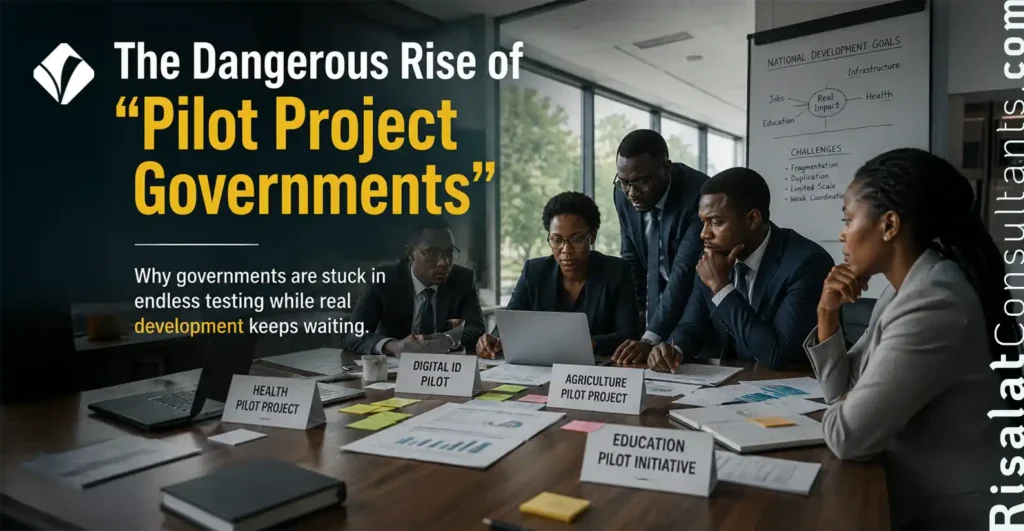
The pilot project government model is becoming increasingly common across developing countries, where governments remain trapped in endless cycles of pilot projects that never scale to national implementation, wasting resources and eroding institutional capacity while failing to deliver sustainable public value.
- Solo entre el 20% y el 25% de los programas piloto gubernamentales llegan a producción, y la mayoría fracasa debido a una planificación de ampliación inadecuada, brechas de financiación y la resistencia de las estructuras burocráticas establecidas.
- Donor dependency creates unsustainable reform cycles where projects collapse after external funding ends, leaving governments without local capacity or long-term financing models.
- Institutional fragmentation prevents coordination across agencies, resulting in disconnected reforms, repeated feasibility studies, and lack of cross-government integration.
- Los ciclos políticos perturban la continuidad a medida que las nuevas administraciones reinician iniciativas similares, tratando la ejecución como un ejercicio técnico en lugar de un compromiso político sostenido.
- Breaking free requires institutional ownership from day one, multi-year budget commitments, accountability systems that survive leadership changes, and treating scale-up as a core design requirement.
The solution isn’t more pilots, it’s building government capacity for sustained implementation through integrated systems, long-term financing, and political commitment that extends beyond electoral cycles.
Pilot project governments have become skilled at testing reforms but rarely implement them at scale. Governments in developing nations of all types launch hundreds of donor-funded projects annually, yet few transition beyond their original testing phases. Sub-Saharan Africa and South Asia see this pattern most. This piloting erodes institutional capacity and fragments public sector reform efforts. It undermines project sustainability once external funding ends. The cycle continues as new administrations restart similar initiatives and rebrand failures as breakthroughs. This analysis explores why governance reform remains trapped in pilot mode. It outlines pathways toward sustainable national implementation. This pattern reflects the growing prevalence of the pilot project government model across many developing countries.
Understanding the Pilot Project Government Trap
What Defines a Pilot Project Government
En un proyecto piloto gubernamental, las pruebas se convierten en el enfoque dominante mientras la implementación nacional sigue retrasada. Los gobiernos utilizan los proyectos piloto como ensayos a pequeña escala para probar nuevos modelos de prestación de servicios, políticas o tecnologías antes de comprometerse con la implementación completa. Los pilotos representan la etapa final de prueba previa al despliegue nacional en teoría, diseñada para identificar desafíos operativos y logísticos en entornos controlados. Estos mecanismos permiten a los departamentos verificar la viabilidad del proyecto en varias etapas de desarrollo y permiten correcciones de rumbo que limitan los costes y el tiempo cuando los resultados no alcanzan las expectativas.
The term “piloting” has come to mean many different things in government agencies. Some initiatives labeled as pilots are testing approaches with genuine experimentation. Others are predetermined policies with fixed delivery mechanisms where the spirit of experimentation is absent. This confusion creates situations where true policy pilots, designed as neutral trials with the potential to influence final products, are conflated with early evaluations of already-decided policies.
Pilot projects sit between policy formulation and implementation and allow small-scale testing in limited locations before broader adoption. Governments consider pilots when transformation involves significant service delivery changes, large scopes, new citizen interactions, possible collateral damage, costly implementation processes, or difficult-to-reverse outcomes. The challenge emerges when these small-scale experiments become permanent fixtures rather than transitional phases.
The Scale of Perpetual Piloting Across Nations
This pattern is a defining characteristic of the modern pilot project government model. The scale of perpetual piloting reveals a global pattern of stalled implementation. Only 20-25% of government AI proof-of-concepts progress to production. Three out of every four pilots fail to deliver sustained public value despite consuming budgets, engaging teams, and demonstrating potential. Research with 492 government leaders in 14 countries found that over 60% cite data privacy and security concerns as primary constraints, while 45% point to inadequate digital infrastructure and 42% identify ethical concerns as impediments.
Organizations routinely underestimate AI project costs by 500% to 1000% when scaling from pilot to production, which is equally troubling. The United Kingdom’s Parliament Public Accounts Committee found the government had no systematic mechanism to bring together learning from pilots and few examples of successful at-scale adoption in government. Clinical AI systems similarly remain confined to short-lived pilots or proof-of-concept demonstrations rather than becoming durable components of routine care.
Donor-funded projects in low and middle-income countries face comparable challenges. One government official in India described the development sector as “a graveyard of pilot projects” and noted that innovations commonly end when project funding stops, thereby limiting longer-term health impacts in countries with weak health systems. A development partner in Nigeria lamented that if a project dies after funding, it cannot be considered successful. Short project periods of three to four years limit achievements and create waste and uncertainty for implementers and governments alike, with one year spent on recruitment and the last six months on winding up.
Why Pilot Projects Rarely Move Beyond the Testing Phase
Several structural factors prevent pilot projects from achieving national scale. Pilots often run in controlled settings that fail to account for real constraints, legacy system issues, or compliance requirements. The observer effect explains some short-term success: individuals participating in pilot projects work harder because managers watch more closely than usual, but performance drops when projects end and organizations revert to old behavioral patterns.
Funding constraints materialize through boundary work that influences whether interventions receive support beyond pilot phases. The relatively short pilot duration of 18 months limits organizations’ ability to fully implement, embed, or expand project outputs, with many locations only fully mobilizing once external support is commissioned. District-level mental health programs demonstrate this trap, where every location demands context-specific customization and creates endless cycles of bespoke pilots that never translate to sustainable programs.
Government systems operate under different optimization parameters than startup-style innovation. Organizations lack structured processes for AI deployment and miss iterative development, continuous learning, and adaptive governance requirements. Teams focus on AI capabilities instead of desired outcomes, while organizations lack complete cost models covering infrastructure, maintenance, training, and ongoing operations. Technically promising systems fail to transition into stable operational use, so ownership structures remain fragmented, accountability boundaries unclear, and deployment depends on temporary resources or individual champions rather than durable institutional arrangements. As a result, the pilot project government cycle continues even when pilots demonstrate positive results.
Causas fundamentales de los proyectos piloto gubernamentales interminables
Institutional Fragmentation and Weak Coordination
Fragmentation creates structural problems with the design, coordination, and delivery of transfer programs that are inherently political. Different programs use different targeting approaches, various payment pathways, and separate beneficiary lists in each organization. This results in inefficiencies, inequities, overlaps, and gaps in coverage. Social protection ministries often struggle with weak institutional capacity. Program effectiveness drops and fragmentation increases, which diminishes the profile of responsible ministries and reduces allocated resources. Multiple ministries implementing social transfers in parallel fragment responsibility further, while non-governmental organizations filling government vacuums accelerate additional fragmentation.
Los fallos de coordinación afectan el rendimiento económico en los sistemas de gobernanza metropolitana. Los estudios muestran que la presencia de múltiples gobiernos locales genera mayores costos de transacción y barreras para la difusión de políticas que promueven el crecimiento. Los problemas complejos solo se resuelven parcialmente cuando la acción gubernamental se fragmenta, ya que la especialización segmenta artificialmente los problemas en lugar de presentar concepciones integradas de las causas y los remedios. Los ciudadanos que enfrentan dificultades experimentan los efectos directos de una coordinación inadecuada cuando intentan obtener la gama completa de servicios que necesitan del gobierno. La fragmentación institucional es una de las características definitorias de un gobierno de proyectos piloto.
Donor-Funded Projects and External Dependency
Las iniciativas financiadas por donantes suelen buscar mejoras rápidas con resultados ambiciosos vinculados a ciclos de proyectos a corto plazo. La transición hacia la titularidad nacional rara vez es automática. Muchos programas experimentan con éxito nuevas prácticas, pero no logran integrarlas en las normas normativas, de financiación e institucionales. La financiación de donantes bilaterales como USAID a menudo se presenta en tramos de uno a cinco años con plazos fijos de ejecución. Un funcionario gubernamental señaló que cualquier fondo de donantes debería durar al menos seis o siete años, ya que un año se destina a la contratación y los últimos seis meses a la conclusión.
International donor agencies spent approximately $1.36 billion on building boreholes and wells in sub-Saharan Africa that quickly became inoperative. About 50,000 non-functioning water points resulted from poor construction, lack of expertise, failure by users, and poor technology choice. Lack of capacity building underlies many failed donor-funded projects, as implementation represents a battle half won when sponsors fail to think over elements that guarantee long-term value.
Donor dependency frequently reinforces the pilot project government model by prioritizing short-term projects over long-term implementation systems.
Sustainability falters once external support ends. District-level quality improvement teams weakened following donor program conclusions in Ghana. Accreditation reforms stalled after external technical advisors withdrew in Kenya. Provincial quality improvement frameworks failed to be fully embedded within public financing mechanisms in Pakistan. Over-reliance on external technical assistance left critical functions without local support, while domestic funding streams proved insufficient to sustain improvements independently.
Absence of Scale-Up Strategies and Implementation Plans
Los proyectos piloto rara vez tienen en cuenta los requisitos de implementación a gran escala durante las pruebas de campo. Los proyectos tienden a implementarse con niveles de insumos y apoyo que posteriormente no se pueden mantener cuando las innovaciones se llevan a escala. El soporte financiero suele cesar una vez que se han probado la viabilidad, la efectividad y la eficiencia. Las innovaciones exitosas no logran escalar porque no se han asegurado los recursos financieros necesarios.
Pasar de un proyecto piloto exitoso a su implementación nacional representa uno de los mayores desafíos en el desarrollo. El problema rara vez es la intervención en sí, sino la brecha entre las condiciones de investigación y las realidades complejas y con recursos limitados en las que operan los sistemas gubernamentales. Muchos programas de desarrollo desaparecen una vez que finaliza el apoyo externo porque nunca se estableció verdaderamente la apropiación por parte del gobierno. El compromiso genuino del gobierno debe comenzar durante la fase piloto, no después.
Political Cycles and Leadership Discontinuity
Los ciclos electorales suelen influir en las políticas de protección social tanto en los países en desarrollo como en los desarrollados. Los políticos en el poder adoptan políticas fiscales expansivas o modifican la composición del gasto público para ganar el apoyo de los votantes antes de las elecciones. Cuanto mayor sea el tiempo transcurrido desde las elecciones anteriores y, por tanto, más próxima esté la fecha de las próximas elecciones, mayor será la proporción del presupuesto de protección social contra la pandemia asignada a la asistencia social y la protección de los ingresos.
Frequent leadership changes disrupt governance continuity and cause policy reversals and inefficiencies. Leaders with short terms focus on immediate political gains rather than long-term national development. This creates instability that prevents countries from maintaining stable equilibrium. Weak institutional capacity results from insufficient completeness of reform. Health system reforms in most countries fail due to deficiencies in political leadership and long-term commitment to reform programs. Policymaker and manager instability represents a global issue. Frequent changes in political circumstances and management instability cause unfamiliarity of new managers with reform.
How Pilot Projects Fragment Public Sector Reform
Disconnected Reforms Across Government Agencies
La reforma de la gobernanza del sector público en las naciones en desarrollo produce resultados decepcionantes. Muchas iniciativas no funcionan bien a pesar de la sustancial inversión de los donantes. Las reformas operan como intervenciones aisladas en lugar de esfuerzos integrados para abordar los desafíos sistémicos. Los procedimientos lineales tradicionales y la planificación estratégica dominan y tratan la reforma como actividades independientes desconectadas de ecosistemas institucionales más amplios.
The problem stems from viewing each component of the public sector reform agenda as a separate effort. Reforms are attempts to alter the state’s political economy. Center-of-government reforms in Bosnia and Herzegovina, Indonesia, and other nations focused on policy coordination, ranging from aid coordination to poverty reduction and inter-ministerial commissions. Progress varied depending on political contexts. Bosnia and Herzegovina’s fragmented state saw only technical gains materialize, as non-cooperation and exclusivity characterized relations between component governments.
Organizational reviews and restructuring remain popular across developing countries. Studies conclude that creating new formal institutions fails to replace or sideline old informal ways of doing things. As a result, reforms often produce uneven outcomes even where progress is achieved. The most successful reform appeared in Indonesia’s poverty reduction coordination, driven by strong government leadership, although outcomes of the two poverty programs remained unknown.
Repeated Feasibility Studies Without Action
Pilot studies assess the feasibility of methods and procedures for larger studies. Samples are usually small and unrepresentative. Parameter estimates and standard errors may be inaccurate and result in misleading power calculations. The focus has shifted toward exploring feasibility rather than scaling interventions. This creates cycles where governments repeatedly test without implementing.
Implementation trials require partnerships with end-users. Few full implementation randomized controlled trials undertake feasibility and pilot work in advance. Implementation feasibility studies explore strategies to improve intervention implementation across multiple levels, including individuals and organizational systems. The complexity of influencing behavior change extends the role of feasibility studies to identifying potential causal mechanisms and refining intervention strategies iteratively.
Standardized guidance for implementation trials exists, but information on conducting feasibility and pilot studies for implementation interventions remains limited. This gap contributes to lack of exploratory work and a limited evidence base for effective implementation intervention design. Many reviews designed by small numbers of civil servants in Ministries of Finance proceed with limited interaction with civil society and key stakeholders. This restricts opportunities for reform coalition formation.
Lack of Institutional Ownership and Accountability
Temporary islands of excellence emerge from pilot approaches but fail to strengthen government capacity for future delivery. Moreover, these isolated successes bring coordination and principal-agent problems to the forefront, precisely the issues that pay and rationalization reforms ostensibly address. Surveys can identify problems, but whether issues are addressed depends on political will by leaders to act on information.
Systems approaches require working across organizational boundaries and government levels. Governments struggle with this fundamental requirement. Transforming systems may begin with change in one organization, but supporting structures from accompanying services to legal frameworks must reform simultaneously to achieve results. Especially when addressing complex problems, a gap exists between policy design and implementation.
Stubborn problems like corruption and patronage persist despite reform efforts. Building technical competence proves insufficient to guarantee success across all countries where corruption remains a major challenge. Effective public sector governance depends on complex systems of interdependent institutions requiring detailed reform. This makes it difficult to monitor or notice progress at total levels. The success or failure of public sector reform depends not merely on technical know-how or resource availability but on political tasks shaped by political settlement dynamics.
Sector-by-Sector Analysis of Pilot Project Failures
Infrastructure Projects Stuck in Testing Phases
Software development failures expose critical vulnerabilities in infrastructure pilot projects. Crossrail, once Europe’s flagship infrastructure initiative with a budget of roughly £17 billion, experienced delays starting in 2015 when tunneling finished but train and signaling software remained underdeveloped. The project team’s decision to overlap construction with dynamic testing created enormous pressure. Yet few meaningful results could be acquired because software had not reached required development levels. This unsuccessful testing effort consumed spare time and construction space and caused further delays and cost increases.
Railway systems across the United States implementing Positive Train Control faced persistent software challenges. By 2018, nine passenger railroads reported encountering software maturity issues that included bugs during testing. The situation worsened by 2019 when 31 of 37 railroads identified software issues as major or moderate challenges. Infrastructure projects keep underestimating software complexity and treat it as ancillary rather than central to project success.
Governance Reform Initiatives Without Integration
UN integration reforms introduced between 1997 and 2007 failed to increase efficiency in multidimensional peace operations. Reform impact was diminished by absence of accompanying incentives or effective organizational change backed by long-term political engagement. The reforms did not meet efficiency goals of minimizing duplication or effectiveness goals to maximize coherent management of peace operations. These failures stem from lack of motivation for UN agencies to share resources and work together. Rare instances of success resulted from work by outstanding individuals rather than systemic change.
Fragmentation of the UN structure means agencies differ in operating procedures, accountability mechanisms, funding streams and operational mandates. This creates barriers to communication between agencies. Top-down development of peace operation mandates has little input from field staff about feasibility or resource limits. Mandates keep increasing in detail and ignore limited capacity of in-country UN systems.
Health and Education Pilot Programs
Healthcare AI initiatives demonstrate the “pilotitis” syndrome, where high pilot activity produces low policy integration. Despite proliferation of pilots, very few AI initiatives advance to nationwide deployment or long-term institutional adoption. About 80% of AI projects fail to scale beyond the pilot phase in healthcare settings. Many AI projects become isolated, donor driven and unsustainable instead of transforming health systems. Servers go offline and trained staff move on once funding ends.
Interoperability challenges compound these failures. Brazil’s Unified Health System operated with multiple government and private electronic health record platforms that did not communicate with one another. Several sub-Saharan African countries like Kenya, South Africa and Rwanda have vertical health programs for HIV, TB and maternal health that each deploy separate digital tools. AI pilots often integrate with one vertical system but not with broader national architecture and this limits scalability.
Climate Action and Agriculture Pilot Schemes
Developmental researchers call India “a burial ground for pilots” because numerous successful pilots fail to scale. The problem lies in implementation methods rather than feasibility testing. Everyone involved attempts to demonstrate success even when impact is absent. Pilots are implemented in locations with good infrastructure, often on large farmers’ fields. Institutions assume their role is making the pilot succeed rather than testing real-life viability.
Agricultural technology scaling faces complex stakeholder coordination challenges. Solar irrigation pumps in India under PM KUSUM demonstrate institutional silos. The Ministry of New and Renewable Energy oversees implementation even though agriculture falls under state-level responsibility. Karnataka’s agriculture department has no involvement and this creates problems because farmers are more familiar with agriculture departments that handle subsidies and farm necessities.
Digital Transformation and Public Financial Management Pilots
Government digital transformation surveys with more than 1,200 officials from over 70 countries reveal that only 30% of organizations assess their digital capabilities as ahead of public sector peers. Nearly 70% lag behind the private sector. Financial Management Information Systems projects across more than 80 countries over 30 years provide operational guidance, yet implementation remains challenging. System designs following technical considerations prove less effective in solving budget management problems. Transaction processing through FMIS needs detailed coverage to ensure credible information. The benefits are limited to transactions processed through the system. This illustrates how a pilot project government approach can limit the long-term value of digital reforms.
The Cost of Perpetual Piloting on Institutional Capacity
Erosion of Government Implementation Skills
State capacity represents an important prerequisite for policy implementation, yet institutional capacity, the ability of public institutions to implement specific policy mandates, remains difficult to measure, assess, and reform at the country level. Reform leaders confronting sound policies face the fundamental problem of getting myriad government agencies, staffed by thousands of bureaucrats and state personnel, to deliver. The culture of bureaucracies, including the incentives, beliefs, expectations, and norms shared among state personnel, are the foundations of state capacity.
Policy changes alone won’t bring about sustained improvements in national competitiveness, as reforms can fail unless attention is paid to the capacity of institutions that must carry them out. Capacity building requires governments to understand what they should do, communicate it clearly, and then follow through on implementation, with accountability for results. Governments need capacities to design policies, acquire analytical skills, identify problems, develop implementation skills, and establish monitoring and evaluation mechanisms with feedback loops to improve policy design.
The acquisition of these capacities is critical for policy ownership, as ownership cannot exist for policies that governments did not design. Without capacity to define regulatory frameworks and enforce them, many reforms fail whatever their technical merit. Donors themselves can damage the capacity of the very governments they attempt to assist.
Project Sustainability Challenges After Donor Exit
Sustainability denotes a project’s capacity to remain operational and continue achieving its objectives after donor support has been withdrawn. The anticipation is that any intervention must yield sustainable benefits and impacts on people, yet donor-funded projects in developing minority communities display questionable sustainability.
Studies in Binga District revealed that challenges emerged after donor assistance withdrawal. This resulted in stagnancy or collapse of some projects and affected community development. Most donor-funded projects in Marsabit were unsustainable after withdrawal of funding. The failure of many community development projects, especially after the lapse of external support, calls for in-depth investigation of factors that influence sustainability.
Experience demonstrates that most development projects implemented by NGOs shine and perform well as long as NGOs support such projects. When they withdraw support, projects collapse. When projects collapse, great losses are incurred not only for NGOs but also for community members who lose project benefits and time spent during design and implementation. Some donor-funded projects in Sudan existed and performed activities after foreign assistance withdrawal due to direct involvement of beneficiaries in all project phases, though lack of progress occurred in activities without effective supervision and alternative national support.
District-level quality improvement teams weakened following donor program conclusions in Ghana. Accreditation reforms stalled after external technical advisors withdrew in Kenya. Similar challenges have been observed in other reform initiatives where domestic funding and institutional ownership were insufficient to sustain improvements independently. These patterns reveal how over-reliance on external technical assistance leaves critical functions without local support. Sustainability failures are among the most common outcomes of a pilot project government environment.
Loss of Public Trust in Government Effectiveness
Low levels of trust in major institutions, especially the federal government, represent a persistent problem with serious consequences for democracy. Trust in government has been in decline since the 1960s, with recent years seeing distrust in both government and politicians reach near record levels. When people don’t trust their government, they are more likely to opt out of voting and other types of civic participation. This creates a fundamental disconnect between citizens and the only institution with resources, responsibility, and authority to serve all.
Only 31% now say the federal government’s effect on the U.S. is positive, down from 42% in 2022, while 66% say the effect is negative. Higher percentages characterize the federal government negatively, with 85% agreeing the federal government is wasteful, up 15 percentage points from 2022. About three-quarters of respondents say the government is corrupt, up from 67%, and two-thirds agree the government is incompetent, up from 56%.
Trust in public institutions is associated with road quality and perceived corruption levels. When government produces high-quality public services and is perceived as free from corruption, citizens tend to have more trust. Trust is critical for governance and increases voluntary compliance towards public policies. Compliance via consent, as opposed to compulsion, represents the quickest way to implement effective policies. Political trust during crises has been associated with greater compliance with government policies, making trust a vital asset for delivering effective interventions.
Why Pilot Project Governments Fail to Scale Nationally
Missing Interoperability Between Government Systems
E-government deployments resemble a patchwork of incompatible information and communications technology solutions rather than flexible and reusable assets. Agencies deploy new ICT systems with specifications relevant to their particular needs but without adequate attention to connecting, exchanging, and reusing data with other agencies’ ICT systems. E-record systems in Botswana are not interoperable within or between public and private sectors. This results in duplication of effort, manual data sharing, non-standardized reporting procedures, and unnecessary expenditure.
Los desafíos burocráticos debido a la naturaleza de la burocracia y la autonomía de la que disfrutan las diferentes agencias agravan estos problemas técnicos. A las agencias con culturas arraigadas que no valoran la apertura les resulta difícil compartir datos con otras agencias. Las iniciativas recientes de reforma de la gestión pública que respaldan la desagregación han dado lugar a la competencia entre diferentes agencias públicas y han otorgado mayor autonomía a las unidades organizativas. Sin interoperabilidad, el modelo gubernamental de proyecto piloto produce sistemas aislados en lugar de servicios públicos integrados.
Inadequate Long-Term Financing Models
AI pilots in the Global South are initiated and sustained by donor or NGO funding, which prioritizes breakthroughs but rarely guarantees long-term financing. Governments often lack budgetary space to absorb costs of licensing, cloud infrastructure, or technical support once grants end. This creates a cycle where pilots demonstrate feasibility but collapse due to financial unsustainability. AI-based diagnostic imaging tools piloted in countries such as Kenya and Rwanda showed strong results for TB detection. Hospitals struggled to pay for recurring software subscriptions and data storage when donor funding ended.
Resistance from Established Bureaucratic Structures
Los funcionarios públicos, en particular aquellos que han ocupado cargos durante períodos prolongados, tienden a resistirse a las nuevas políticas y cambios procedimentales que puedan alterar el statu quo. Esta resistencia se origina en el miedo a perder autoridad, estabilidad laboral o influencia dentro de la jerarquía administrativa. La interferencia política surge como otro impedimento. Los nombramientos en el sector público a menudo se basan en la lealtad política en lugar del mérito, lo que da como resultado una burocracia ineficiente y dependiente.
Knowledge Transfer Failures
One in three unsuccessful projects is affected adversely due to untimely or inaccurate knowledge transfer. Incomplete transfer of knowledge occurs when project members must interact with consultants who refuse to sell their knowledge and omit information significant for project success. Loss of team members creates intellectual leaks of great value. Accumulated knowledge and skills related to projects become irreplaceable once personnel leave.
Cómo liberarse del ciclo de proyectos piloto
Building True Institutional Capacity for Reform
To escape perpetual piloting, you need co-creation approaches that include stakeholder needs and point of view from early planning stages. Systems thinking lets you explore multiple influence levels and contextual settings before implementation begins. Seven frameworks reference this point of view explicitly and advocate for systems-grounded frames built with the core team. You must integrate implementation considerations early. Assessment of acceptability to both end-users and stakeholders proves significant for large-scale intervention success. Building implementation capacity is essential for moving beyond the pilot project government mindset.
Establishing Measurable Implementation Frameworks
Los diseños de evaluación deben ser iterativos y cíclicos. Preste atención a las experiencias de los cocreadores durante todo el proceso. Siete estudios reconocen la necesidad de una evaluación cíclica. Esto ayuda a garantizar que las intervenciones sigan siendo sostenibles en contextos del mundo real y replicables en otros lugares. Los investigadores pueden abordar los obstáculos de implementación evaluando las percepciones de las partes interesadas y ajustando las intervenciones en consecuencia.
Creating Donor Coordination Mechanisms
Coordination among donors prevents duplication and supports identification of synergies. It enables joint initiatives that line up with shared priorities. Formal working groups or taskforces represent the most common coordination structures. National contexts vary, so mechanisms must remain flexible to evolve over time and integrate with emerging cross-boundary coordination activity.
Garantizar la continuidad del liderazgo más allá de los ciclos políticos
National Development Frameworks that remain independent of political cycles address frequent leadership changes. These changes disrupt governance continuity. The shift from pilot projects to lasting national implementation requires more than funding. It demands institutional capacity and governance systems. Implementation leadership and long-term reform strategies matter too. Explore our executive training and capacity-building programs. These programs are designed for governments, donor-funded projects, public sector institutions, and development professionals. They work to strengthen implementation effectiveness, institutional resilience, and lasting reform outcomes.
Requirements for Sustainable National Implementation
Institutional Ownership and Cross-Agency Integration
Sustainable national implementation depends on institutionalizing experimentation by embedding it into national programs and frameworks. Vertical scale-up requires working with state stakeholders at the design stage. This ensures government and state institutions play appropriate roles in supporting reforms through legislation, policy and service delivery. Cross-agency integration allows governments to look at sectors, agencies and programs. They can structure spending that best serves national development objectives over time. Replacing the pilot project government approach requires institutional ownership, financing, and accountability mechanisms designed for scale.
Long-Term Budget Allocation and Resource Planning
Los marcos de gasto plurianual proporcionan enfoques ordenados, estratégicos y con visión de futuro. Ayudan a los gobiernos a establecer prioridades, asignar recursos y controlar la ejecución presupuestaria. Estos marcos combinan los objetivos deseados con presupuestos anuales realistas. Aumentan la certeza de financiamiento para las prioridades políticas a mediano plazo. La asignación de recursos debe cubrir la inversión en las capacidades centrales de la organización en finanzas, TI, recursos humanos, salvaguardas y gestión de riesgos.
Accountability Systems and Progress Monitoring
Accountability mechanisms require monitoring systems, comparison processes and control mechanisms. This helps ensure accountability information is interpreted and used effectively. Social accountability monitoring has participatory budgeting, public expenditure tracking and monitoring of public service delivery.
Policy Experimentation with Built-In Scale-Up Pathways
Clear pathways for scaling up interventions that prove successful or phasing down those that fail are critical. Structures for policy experimentation must remain reversible and adaptable. This will aid scaling up or discontinuing initiatives without major disruption.
Conclusión
The pilot project government model represents more than poor planning; it reflects deeper institutional and political challenges that prevent governments from moving beyond testing phases. Breaking this cycle requires fundamental changes in how reforms are designed and financed. Technical solutions alone won’t be enough. Governments must build institutional ownership from day one, establish multi-year financing commitments, and create accountability mechanisms that survive political transitions. Donor organizations should change from funding isolated pilots to supporting integrated implementation systems. The path from pilot to national scale exists, but only when stakeholders treat implementation as a political challenge requiring sustained commitment rather than a technical problem requiring another feasibility study.
Preguntas frecuentes
Q1. What percentage of government AI pilot projects actually make it to full implementation?
Only 20-25% of government AI proof-of-concepts progress to production, meaning approximately three out of every four pilots fail to deliver sustained public value despite consuming budgets and demonstrating potential during testing phases.
¿Por qué los programas piloto exitosos a menudo colapsan después de que finaliza la financiación de los donantes?
Los proyectos piloto suelen depender de financiación externa con plazos fijos de 1 a 5 años, pero los gobiernos a menudo carecen de la capacidad presupuestaria para absorber costos continuos como licencias de software, mantenimiento de infraestructura y soporte técnico una vez que se retira la asistencia de los donantes, lo que lleva al colapso del proyecto a pesar de su eficacia probada.
Q3. How does institutional fragmentation prevent pilot projects from scaling nationally?
Different government agencies use separate systems, targeting approaches, and beneficiary lists without coordination, creating inefficiencies and coverage gaps. This fragmentation means pilot successes in one department cannot easily integrate with other agencies’ systems or scale across government.
P4. ¿Qué papel desempeñan los ciclos políticos para evitar que los proyectos piloto se conviertan en programas permanentes?
Frequent leadership changes and electoral cycles disrupt governance continuity, causing policy reversals and shifting priorities. New administrations often restart similar initiatives rather than continuing existing pilots, as leaders focus on immediate political gains instead of long-term implementation.
Q5. What fundamental changes are needed to move beyond perpetual piloting?
Governments must establish institutional ownership from the start, create multi-year financing commitments independent of donor cycles, build cross-agency coordination mechanisms, and develop accountability systems that survive political transitions rather than treating each pilot as an isolated technical experiment.
Ver

- World Health Organization World Health Organization
- OCDE (Organización para la Cooperación y el Desarrollo Económicos) OCDE
Know people who should read this? Become an Ambassador or write with Risalat.
Socios para el éxito de los proyectos desde 2011: diagnósticos, asesoría y aprendizaje aplicado para ministerios, organismos públicos y equipos de proyecto.
¿Necesita ayuda para llevar esto a la práctica?
Empiece con un diagnóstico gratuito de 10 minutos o hable con nuestros expertos.