Ключевые факты
- Даты
- 22–26 февр. 2027 (5 дней)
- Где
- TBD, Kaohsiung, Taiwan
- Стоимость на одного участника
- £3 860 (GBP)
- Оплата
- По счету банковским переводом
- Регистрация закрывается
- 18 дек. 2026
- Формат
- 5-day short course: a practical capacity-building programme for government, NGO and project teams in Kaohsiung
- Сертификат
- Сертификат о прохождении
- Корпоративный формат
- Проведите ее для своей команды в удобные вам даты
На этой странице 15 разделов
Обзор программы
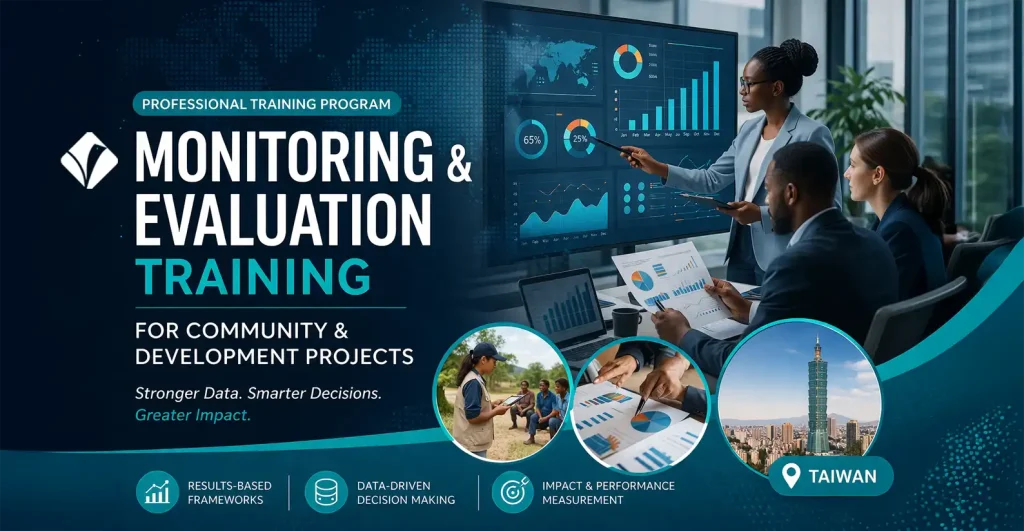
The Monitoring and Evaluation for Community Projects Training in Kaohsiung is an applied five-day professional development programme for officials, managers and specialists responsible for decisions, assurance and implementation. It connects technical methods with practical work products that participants can adapt to their own institutions.
Бесплатная экспресс-проверка: оценка систем мониторинга, оценки и обучения (M&E и MEAL) позволяет примерно за 10 минут получить балл вашей системы и узнать, какие пробелы следует устранить в первую очередь.
Программа проводится в Гаосюне, Тайвань. Она предназначена для государственных учреждений, проектных команд, финансируемых донорами, регуляторов и организаций, которым необходимы документированные решения и надежные операционные средства контроля. Площадка является учебным местом, а не заявлением о том, что местное учреждение предоставляет подтвержденный технический визит.
Участники работают с реалистичными, но вымышленными файлами кейсов, охватывающими теорию изменений, базовые показатели и качество данных. Упражнения позволяют разграничить требования конкретного донора или юрисдикции и общую передовую практику. Никакого финансирования проектов или договоренностей о номинациях не предполагается.
Учебный план выстраивает непрерывный рабочий процесс от первоначальной оценки и планирования до сбора данных, обеспечения качества, управленческой отчетности и институционального мониторинга. Он также побуждает участников выявлять пробелы в существующей политике перед применением любой международной справочной базы.
The Programme Strengthens Institutional Capability
- Теория изменений
- Results chains
- Community indicators
- Baselines
- Участие в мониторинге
- Survey tools
- Качество данных
- Gender disaggregation
- Feedback channels
- Evaluation questions
- Outcome harvesting
- Обзоры извлеченных уроков
- Dashboard design
- Отчетность
- Адаптивное управление
Each participant builds a portfolio of draft tools and a short implementation plan, with responsibilities, verification points and a timetable for management review.
- Ресурсы
- Мероприятия
- Результаты деятельности
- Конечные результаты
- Воздействие
The Growing Importance of Monitoring and evaluation for community projects
Institutions are expected to demonstrate not only that activities have been completed, but that decisions are consistent, traceable and proportionate to risk. In monitoring and evaluation for community projects, weak definitions, fragmented records and unclear accountability can make otherwise sound work difficult to defend or improve.
The reference materials listed below offer official frameworks relevant to parts of this curriculum. They do not establish that any named institution has committed funds to this course. Participants should check the rules governing their own country, employer and financed project before adopting the examples.
Организациям все больше нужны специалисты, способные:
- Assess theory of change using documented criteria
- Assess results chains using documented criteria
- Assess community indicators using documented criteria
- Assess baselines using documented criteria
- Assess participatory monitoring using documented criteria
- Assess survey tools using documented criteria
- Assess data quality using documented criteria
- Assess gender disaggregation using documented criteria
- Assess feedback channels using documented criteria
- Assess evaluation questions using documented criteria
- Assess outcome harvesting using documented criteria
- Assess learning reviews using documented criteria
Strong monitoring and evaluation for community projects systems help organisations:
- Improve the consistency of feedback channels
- Improve the consistency of evaluation questions
- Improve the consistency of outcome harvesting
- Improve the consistency of learning reviews
- Improve the consistency of dashboard design
- Improve the consistency of reporting
- Improve the consistency of adaptive management
A workable system needs clear ownership, tested records and decisions that can be reviewed independently. The sessions translate these requirements into small, repeatable routines rather than a one-off report.
1. Какой подход лучше всего поддерживает теорию изменений?
Программа применяет документированные решения и проверки фактических данных к теории изменений; требования должны сверяться с соответствующими исходными руководящими документами.
2. Какой подход лучше всего поддерживает базовые показатели?
The programme applies documented decisions and evidence checks to baselines; requirements must be checked against the relevant original guidance.
3. Which approach best supports data quality?
Программа применяет документально оформленные решения и проверки достоверности данных; требования должны сверяться с соответствующими оригинальными руководствами.
Who Should Attend This Monitoring and Evaluation for Community Projects Training?
Программа предназначена для:
- Ministry department directors
- Government policy analysts
- Project implementation unit managers
- Project management unit coordinators
- Technical assistance team leaders
- Внутренние аудиторы
- Compliance officers
- Procurement specialists
- Finance managers
- Monitoring and evaluation officers
- Data and reporting analysts
- Сотрудники по обеспечению качества программ
- Institutional development specialists
- Public sector trainers
- Контактные лица партнеров по развитию
- Консультанты, поддерживающие государственные органы
Participants should bring a description of one institutional process they wish to improve, without sharing confidential personal or commercial information.
Отметьте, что должна уметь ваша команда.
Цели обучения мониторингу и оценке общественных проектов
По успешном завершении данного обучения по мониторингу и оценке общественных проектов участники смогут:
- Explain the institutional purpose and limitations of monitoring and evaluation for community projects
- Assess existing procedures against relevant documented requirements
- Определение ключевых заинтересованных сторон и прав на принятие решений
- Prioritise operational risks and quality weaknesses
- Select appropriate methods and tools for the task
- Document assumptions and supporting evidence
- Design practical controls and review checkpoints
- Ответственное использование выборочных наборов данных или файлов дел
- Communicate findings to decision-makers
- Подготовить соразмерный план действий и ресурсов
- Monitor follow-up and adjust implementation
The emphasis is on demonstrable workplace outputs, with peer feedback and facilitator review of the methods selected.
Содержание и структура программы
- Map community needs and programme assumptions
- Различие между мероприятиями, результатами (выпусками) и эффектами (конечными результатами)
- Построение партисипативной теории изменений
- Identify intended and unintended effects
- Определение круга заинтересованных сторон и бенефициаров
- Map equity and inclusion risks
- Draft evaluation questions
- Select indicators that reflect community priorities
- Define baselines, targets and disaggregation
- Design simple survey and observation tools
- Plan sampling and respondent protection
- Назначение ролей по сбору и проверке данных
- Establish a monitoring calendar
- Создание справочных листов индикаторов
- Facilitate community monitoring discussions
- Design accessible feedback and complaints channels
- Проверка данных на точность и полноту
- Avoid coercion and protect confidentiality
- Use mobile data collection where appropriate
- Triangulate field records and community accounts
- Identify bias and missing population groups
- Compare process, outcome and impact evaluation
- Develop credible contribution questions
- Select qualitative and quantitative methods
- Review equity and gender-responsive analysis
- Assess sustainability of community outcomes
- Проведение семинаров по обучению и рефлексии
- Write evidence-based evaluation findings
- Design an M&E governance and staffing matrix
- Build an indicator dashboard and report template
- Set feedback-to-management escalation rules
- Schedule periodic data quality reviews
- Link evidence to budget and work planning
- Определение требований партнеров к отчетности
- Создание девяностодневного плана улучшений
Полное содержание по дням
The five-day sequence builds from diagnosis to an institutional improvement proposal. Each day includes guided technical work and a documented practical exercise.
- First Day: Community results and theory of change
- Second Day: Indicators, baselines and data collection
- Третий день: Участие в мониторинге и качество данных
- Четвертый день: Оценка, инклюзивность и обучение
- Fifth Day: M&E system design and community accountability
Полное содержание по дням
Первый день | Результаты на уровне общин и теория изменений
- Map community needs and programme assumptions
- Различие между мероприятиями, результатами (выпусками) и эффектами (конечными результатами)
- Построение партисипативной теории изменений
- Identify intended and unintended effects
- Определение круга заинтересованных сторон и бенефициаров
- Map equity and inclusion risks
- Draft evaluation questions
- Create a project results chain
Workshop: Community results and theory of change application
Working in small teams, participants apply the day’s methods to a fictional institutional scenario. They produce a short decision-ready artefact, record key assumptions, identify unresolved evidence gaps and receive structured feedback. The output is retained for the final institutional action plan.
Second Day | Indicators, baselines and data collection
- Select indicators that reflect community priorities
- Define baselines, targets and disaggregation
- Design simple survey and observation tools
- Plan sampling and respondent protection
- Назначение ролей по сбору и проверке данных
- Establish a monitoring calendar
- Создание справочных листов индикаторов
- Build a baseline collection plan
Workshop: Indicators, baselines and data collection application
Working in small teams, participants apply the day’s methods to a fictional institutional scenario. They produce a short decision-ready artefact, record key assumptions, identify unresolved evidence gaps and receive structured feedback. The output is retained for the final institutional action plan.
Third Day | Participatory monitoring and data quality
- Facilitate community monitoring discussions
- Design accessible feedback and complaints channels
- Проверка данных на точность и полноту
- Avoid coercion and protect confidentiality
- Use mobile data collection where appropriate
- Triangulate field records and community accounts
- Identify bias and missing population groups
- Подготовка журнала учета мероприятий по повышению качества данных
Case Study: Participatory monitoring and data quality application
Working in small teams, participants apply the day’s methods to a fictional institutional scenario. They produce a short decision-ready artefact, record key assumptions, identify unresolved evidence gaps and receive structured feedback. The output is retained for the final institutional action plan.
Четвертый день | Оценка, инклюзивность и обучение
- Compare process, outcome and impact evaluation
- Develop credible contribution questions
- Select qualitative and quantitative methods
- Review equity and gender-responsive analysis
- Assess sustainability of community outcomes
- Проведение семинаров по обучению и рефлексии
- Write evidence-based evaluation findings
- Convert recommendations into actions
Workshop: Evaluation, inclusion and learning application
Working in small teams, participants apply the day’s methods to a fictional institutional scenario. They produce a short decision-ready artefact, record key assumptions, identify unresolved evidence gaps and receive structured feedback. The output is retained for the final institutional action plan.
Пятый день | Разработка систем мониторинга и оценки и подотчетность перед обществом
- Design an M&E governance and staffing matrix
- Build an indicator dashboard and report template
- Set feedback-to-management escalation rules
- Schedule periodic data quality reviews
- Link evidence to budget and work planning
- Определение требований партнеров к отчетности
- Создание девяностодневного плана улучшений
- Present an M&E system and learning plan
Capstone Exercise: M&E system design and community accountability application
Working in small teams, participants apply the day’s methods to a fictional institutional scenario. They produce a short decision-ready artefact, record key assumptions, identify unresolved evidence gaps and receive structured feedback. The output is retained for the final institutional action plan.
Monitoring and Evaluation for Community Projects Training Methodology
Facilitators use short briefings, individual exercises and group-based problem solving. Case data are illustrative, with assumptions made explicit; the exercises do not represent an audit or certification of any real organisation.
Программа сочетает:
- Expert-led technical briefings
- Проведение обзоров политики и процессов
- Обезличенные или вымышленные досье кейсов
- Spreadsheet and template exercises
- Small-group scenario analysis
- Role-based decision simulations
- Peer comparison of institutional practices
- Guided risk and control mapping
- Structured facilitator feedback
- Ежедневные размышления об усвоенном материале
- Action planning and presentation practice
- Проверка соответствия исходным стандартам
Participants can adapt worksheets to their own institution after reviewing local legal requirements, confidentiality rules and management approvals.
Ожидаемые результаты
Upon completion of this Monitoring and Evaluation for Community Projects Training, participants will be able to:
- Present a baseline of current institutional practice
- Подготовка реестра рисков и проблем
- Draft a quality assurance checklist
- Explain key requirements to colleagues
- Подготовьте убедительную управленческую справку
- Разработка плана работы с доказательствами и записями
- Identify priorities for staff development
- Set measurable implementation milestones
- Evaluate whether controls are operating as intended
- Представить предложение по институциональному совершенствованию
These are intended learning outcomes, not guaranteed changes in an employer’s systems or compliance status.
£3 860 за участника · счет и банковский перевод · группам от 5 человек предоставляется скидка
Пять и более участников от одной организации: укажите групповой тариф в запросе счета.
Ten or more: an in-house version for your institution may cost less per person. Ask for an in-house quote.
Регистрация закрывается через 26 дней (18 дек. 2026 г.)
Обучение институциональному применению мониторинга и оценки для общественных проектов
Программа помогает организациям укрепить:
- Ownership of theory of change
- Ownership of results chains
- Ownership of community indicators
- Ownership of baselines
- Ownership of participatory monitoring
- Ownership of survey tools
- Ownership of data quality
- Ownership of gender disaggregation
- Ownership of feedback channels
- Ownership of evaluation questions
- Ownership of outcome harvesting
- Ownership of learning reviews
Участники возвращаются с практическими инструментами для улучшения:
- Documentation and review of feedback channels
- Documentation and review of evaluation questions
- Documentation and review of outcome harvesting
- Документирование и рассмотрение обзоров обучения
- Documentation and review of dashboard design
- Documentation and review of reporting
- Documentation and review of adaptive management
Institutions can use the draft outputs as a starting point for a tailored in-house programme, internal working group or management-approved improvement initiative.
Региональная актуальность и применение
Европа
For teams working in Europe, monitoring and evaluation for community projects can support public-sector assurance, regulatory alignment and accountable reporting. The relevant rules and financing conditions differ by country and project, so the programme uses comparative methods without assuming a uniform legal or regulatory system.
Африка
For teams working in Africa, monitoring and evaluation for community projects can support implementation capacity and evidence for financed programmes. The relevant rules and financing conditions differ by country and project, so the programme uses comparative methods without assuming a uniform legal or regulatory system.
Ближний Восток
For teams working in Middle East, monitoring and evaluation for community projects can support institutional modernisation and governance of large initiatives. The relevant rules and financing conditions differ by country and project, so the programme uses comparative methods without assuming a uniform legal or regulatory system.
Азия и Тихоокеанский регион
For teams working in Asia and the Pacific, monitoring and evaluation for community projects can support cross-agency coordination and delivery in varied operating contexts. The relevant rules and financing conditions differ by country and project, so the programme uses comparative methods without assuming a uniform legal or regulatory system.
Межрегиональная групповая работа позволяет участникам сравнить практические подходы, обеспечивая при этом защиту конфиденциальной институциональной информации.
Host Country Profile – Taiwan
Kaohsiung in Taiwan is the established location for this programme. Training is designed around classroom exercises, group discussion and international peer learning rather than an unverified promise of access to a specific government agency.
The host setting allows participants to examine how monitoring and evaluation for community projects can be organised in a professional training environment. Official frameworks and case materials are reviewed in class; a local organisation is not represented as a programme partner unless separately confirmed.
International participants should verify entry conditions for Taiwan using official consular channels based on their nationality and residence status. Travel routes, appointment availability, transit requirements and local arrangements can change, so visa assistance is advisory and entry is never guaranteed.
Результаты обучения по программе «Мониторинг и оценка для общественных проектов»
The following support package and learning materials are designed to help participants prepare, take part and transfer the learning into their workplace.
До программы
- Предварительная оценка участников
- Monitoring and evaluation for community projects Readiness Assessment
- Monitoring and evaluation for community projects Resource Pack
- Материалы для предварительного чтения
- Бесплатная визовая поддержка и консультации
Во время программы
- Встреча в аэропорту и приветственное сопровождение
- Accommodation with breakfast: 6 nights, check-in Sunday 21 February 2027, check-out Saturday 27 February 2027 (one night before and one night after the programme)
- Приветственный ужин для нетворкинга
- Комплект участника Risalat (сумка, бутылка, кружка, футболка, кепка, обложка для паспорта, ручки, блокнот, магнит и брелок)
- Comprehensive Monitoring and evaluation for community projects Training Manual
- Шаблон «Теория изменений»
- Results Chains Template
- Community Indicators Template
- Baselines Template
- Participatory Monitoring Template
- Практические семинары и симуляции
- Групповые дискуссии и обмен опытом
- Ежедневный обед и кофе-брейки
- Полный доступ к инфраструктуре места проведения
- Мини-планшет с цифровыми учебными материалами
- Field Visit (where applicable and confirmed)
- Развлекательная экскурсия по городу
После программы
- Сертификат о прохождении
- Награда Risalat за участие в программе
- Справочные материалы после обучения
- Theory Of Change Checklist
- Baselines Working Template
- Data Quality Action Plan
- Поддержка и консультации после обучения
- Отчет по программе
Institutions seeking a customised group version can request a tailored proposal. Participants may also explore the programme categories and institutional capacity diagnostic.
Основные проблемы мониторинга и оценки для общественных проектов и то, как помогает это обучение
How can we identify the real capability gap?
The first day combines baseline assessment with stakeholder mapping so teams can distinguish a skills gap from a process or accountability problem.
How can we make decisions consistent and defensible?
The second day introduces documented criteria, practical templates and quality checks so reviewers can reconstruct why an option was chosen.
How can we improve data and evidence quality?
The third day uses case records and verification steps to help participants identify missing, contradictory or unreliable information.
Как представлять сложные результаты исследования высшему руководству?
The fourth day turns technical findings into concise management messages, supporting evidence and clear recommendations.
Как мы можем координировать команды между отделами?
The programme defines decision rights, handovers and escalation points in a realistic institutional workflow.
Как управлять неопределенностью, не изобретая точность?
Сессии требуют от участников документирования предположений, ограничений и альтернативных интерпретаций перед вынесением рекомендаций.
How can we sustain improvements after training?
Итоговый проект пятого дня определяет ответственных лиц, этапы, показатели и процесс последующего контроля для управляемого плана действий.
Часто задаваемые вопросы
How can we identify the real capability gap?
The first day combines baseline assessment with stakeholder mapping so teams can distinguish a skills gap from a process or accountability problem.
How can we make decisions consistent and defensible?
The second day introduces documented criteria, practical templates and quality checks so reviewers can reconstruct why an option was chosen.
How can we improve data and evidence quality?
The third day uses case records and verification steps to help participants identify missing, contradictory or unreliable information.
Как представлять сложные результаты исследования высшему руководству?
The fourth day turns technical findings into concise management messages, supporting evidence and clear recommendations.
Как мы можем координировать команды между отделами?
The programme defines decision rights, handovers and escalation points in a realistic institutional workflow.
Who Will Deliver This Programme
Each date is delivered by a team assigned from Risalat's expert network for this subject. For this programme we assign:
How we choose them: Experience in the region of the participants or comparable settings; Command of the financier rules that apply (World Bank, ADB, AfDB, EU, UN) where relevant; Delivery in English; other languages on request for in-house groups; No conflict of interest with participants' institutions.
Training courses in KaohsiungM&E & Performance Management training courses
Why Kaohsiung for this programme
Kaohsiung serves as a major maritime hub, housing the Port of Kaohsiung alongside key research facilities at National Sun Yat-sen University. Visiting officials can study port logistics, public transit systems, and industrial transition projects. The city is accessible via its own international airport and direct high-speed rail connections from Taipei.
Программа «Обучение мониторингу и оценке общинных проектов в Гаосюне» в феврале 2027 года объединяет должностных лиц и профессионалов из стран Азии и других регионов. Сессии сочетают в себе краткие доклады, тематические исследования и групповую работу над собственными материалами участников, а учреждения города могут быть добавлены в качестве учебной поездки по запросу.
Как добраться: Международный аэропорт Гаосюн (KHH).
Узнайте, нужна ли вам виза, с помощью бесплатного сервиса «Проверка визы» и запросите приглашение после регистрации.
Та же тема в других городах
- Mini Degree in Environmental and Social Safeguards in Istanbul (Istanbul)
- Disaster Risk Management and Early Warning Systems in Nagoya (Nagoya)
- Disaster Risk Management and Early Warning Systems in Sapporo (Sapporo)
- Mini Degree in Climate Finance and Resilience in Copenhagen (Copenhagen)
- Disaster Risk Management and Early Warning Systems in Hiroshima (Hiroshima)
- Disaster Risk Management and Early Warning Systems in Sendai (Sendai)
См. также: Мониторинг, оценка и обучение · бесплатный конструктор паспорта индикатора · все программы
Для команд и организаций
Bring your team
Teams that learn together apply more at work. Tell us how many people and how you would like to take part: we reply with a group quote within two working days.
Watch: this programme in short


Другие даты и города для этой темы: учебные курсы по мониторингу и оценке (59 предстоящих дат).
Другие учебные курсы на Тайване · Все программы в Азии · Полный календарь обучения
Запланировать эту программу в дорожной карте: почему это важно, зачем это утверждать, даты планирования и карьера, которую это создает.