Ключевые факты
- Даты
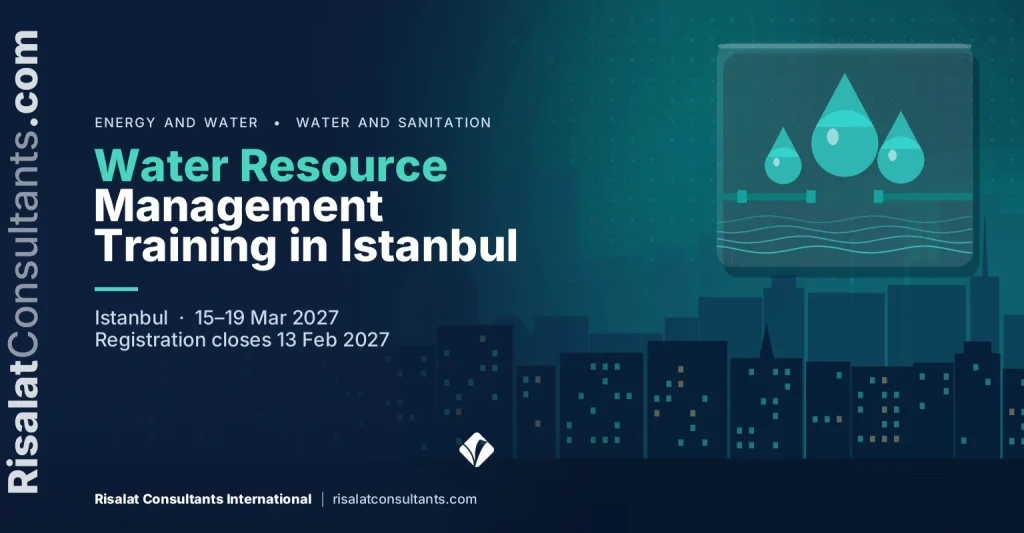
- 15–19 мар. 2027 (5 дней)
- Где
- Shared on registration, Istanbul, Türkiye
- Стоимость на одного участника
- £3 630 (GBP)
- Оплата
- По счету банковским переводом
- Регистрация закрывается
- 13 февр. 2027
- Сертификат
- Сертификат о прохождении
- Корпоративный формат
- Проведите ее для своей команды в удобные вам даты
On this page 16 sections
Обзор программы
In short: Water resource management is the planning, allocation, measurement and financing of water so that a basin’s limited supply meets farming, cities, energy and the environment without exhausting it. For an irrigation agency it means knowing how much water enters each canal, where it is lost, who receives it, what it costs to deliver and how the system will cope with drought. This five-day programme turns those principles into working tools for ministries, project units and district water service bodies.
Water Resource Management Training in Istanbul is designed for the teams now carrying out Central Asia’s largest irrigation reforms. In Uzbekistan, the World Bank’s press release on the National Irrigation and Energy Efficiency Improvement Project (P504600) notes that agriculture uses about 90% of the country’s water, that about 2.4 million hectares (56% of irrigated land) depend on pumps, and that some 1,700 pumping stations consume around 7.2 billion kWh a year, roughly 16% of national electricity use. The same source expects water availability to fall by 30–40% while irrigation demand rises by about 25%.
Subproject documents show what this means on the ground. A June 2026 initial environmental examination for the R8 canal system in Khorezm, prepared under the ADB-financed Climate Adaptive Water Resources Management in the Aral Sea Basin Sector Project (53120-001), reports irrigation efficiency of about 40% in the area and water withdrawals above plan in every year from 2019 to 2022, by 65%, 19%, 24% and 48%. The works aim to raise system conveyance efficiency from about 0.56 to 0.80 across a command area of 19,992 hectares.
Institutions are changing at the same time. The national programme for water resources management and irrigation development for 2025–2028, approved in August 2025, confirms 159 district “Water Supply Services” bodies formed from former district irrigation departments with greater financial autonomy, plans meters on 5,200 pumps, digital systems on 12,000 observation wells and a sector training centre with 200 places. New bodies, new meters and new financing rules all need staff who can use them.
The programme brings these threads together: basin planning and allocation, irrigation efficiency, water accounting, pumping energy, user organisations, environmental and social risk, cost recovery and climate adaptation, all applied through the procedures of ADB- and World Bank-financed projects.
Программа укрепляет институциональный потенциал в следующих областях
- Integrated water resource management principles applied to irrigated basins
- Basin water balances and seasonal allocation plans
- Water limits, withdrawal plans and drought allocation rules
- Irrigation efficiency analysis at canal, system and field level
- Canal lining and modernisation investment choices
- Pumping station energy audits and efficiency planning
- Service agreements between water service bodies and users
- Water user associations and participatory management
- Operation and maintenance planning and asset registers
- Water fees, cost recovery and O&M budgeting
- Environmental and social risk screening for irrigation works
- Environmental management plans and grievance mechanisms
- Climate risk, drought preparedness and adaptation planning
- Results frameworks and indicators for irrigation projects
The result is a team that can show where its water goes and plan each season with evidence.
The Growing Importance of Water Resource Management
Money for irrigation modernisation is arriving faster than the systems to manage it. The World Bank’s USD 200 million credit for P504600, with USD 23.2 million of government co-financing, will concrete-line 259 km of eight primary canals linked to the Amu Darya and Syr Darya, build about 470 hydraulic structures and install gated outlets with flowmeters and a SCADA system across five regions. The Bank expects water losses to fall by about 540 million cubic meters a year and electricity use by more than 165 million kWh a year.
ADB’s Aral Sea Basin sector project, recorded at about USD 154 million including grant resources, finances climate-adaptive irrigation and drainage in the Amu Darya and Zarafshan basins. Its subproject documents also list an output to strengthen the capacity of water management organisations and water consumer associations on infrastructure management and water use efficiency. A draft Uzbekistan 2030 strategy, reported in January 2026, notes that 66% of the 18,700 km of main and inter-farm canals still have earthen beds.
Организациям все больше нужны специалисты, способные:
- Building basin and system water balances from field data
- Setting and enforcing withdrawal limits by canal and season
- Comparing planned and actual withdrawals and explaining the gap
- Prioritising canal sections for lining using loss and cost data
- Running energy audits on pumping stations
- Designing service agreements with water users
- Supporting water user associations to collect fees and maintain assets
- Preparing O&M budgets linked to asset condition
- Screening irrigation works for environmental and social risk
- Preparing drought response and allocation rules
- Reporting results against ADB and World Bank indicators
Strong water resource management systems help organisations:
- Deliver the water savings that financiers and government expect
- Reduce electricity bills for pumped irrigation
- Allocate water fairly between upstream and downstream users
- Plan for dry years before they arrive
- Protect new canal assets through proper maintenance
- Give farmers a reliable and predictable service
- Pass audits with clear records of water and money
- Attract further investment and private operators
Canal lining saves water only when someone measures flows before and after, adjusts allocations and maintains the canal. This training builds that chain of evidence, from the measuring point to the ministry report.
Source: ADB Climate Adaptive Water Resources Management in the Aral Sea Basin Sector Project, R8 subproject initial environmental examination (June 2026)
1. Roughly what share of Uzbekistan's electricity is used by irrigation pumping stations?
The World Bank reports that about 1,700 pumping stations use around 7.2 billion kWh a year, roughly 16% of national electricity use.
2. What irrigation efficiency does the June 2026 assessment report for the R8 canal area in Khorezm?
The ADB-financed R8 subproject assessment reports irrigation efficiency of about 40% and aims to raise system conveyance efficiency from about 0.56 to 0.80.
3. How many district 'Water Supply Services' bodies does Uzbekistan's 2025–2028 water programme describe?
The programme approved in August 2025 describes 159 bodies formed from district irrigation departments and given greater financial autonomy.
Who Should Attend This Water Resource Management Training?
Программа предназначена для:
- Senior officials of ministries of water resources and agriculture
- Basin and regional irrigation administration managers
- Heads and engineers of district water service bodies
- Project implementation unit directors and coordinators
- PIU engineers, monitoring and evaluation specialists
- Специалисты по экологическим и социальным гарантиям
- Procurement and contract management staff of water projects
- Pumping station managers and energy engineers
- Water user association leaders and federation staff
- Finance and tariff officers responsible for O&M budgets
- Planning and climate adaptation officers
- Supervision consultants and design engineers
- PPP unit staff and private operators of water facilities
Mixed teams from one institution gain most.
Отметьте, что должна уметь ваша команда.
Water Resource Management Training Objectives
Upon successful completion of this Water Resource Management Training, participants will be able to:
- Explain integrated water resource management in a basin context
- Build a simple water balance for a canal system
- Draft seasonal allocation and drought rules
- Calculate conveyance and field application efficiency
- Rank canal modernisation options by water and cost savings
- Design a measurement and water accounting plan
- Identify energy savings in pumping stations
- Prepare a service agreement between a water service body and users
- Plan support for water user associations
- Screen subprojects for environmental and social risk
- Prepare a costed O&M and cost recovery plan
- Report results in the format financiers expect
Each objective is linked to a workshop output, so participants leave with drafts they can finish at home.
Содержание и структура программы
- Integrated water resource management: principles and practice
- The basin as the planning unit: Amu Darya and Syr Darya examples
- Building a basin and system water balance
- Competing uses: irrigation, drinking water, energy and ecosystems
- Withdrawal limits and seasonal allocation planning
- Why actual withdrawals exceed plans: causes and controls
- National strategies: the 2025–2028 programme and 2030 targets
- Conveyance, distribution and field application efficiency
- Measuring losses: seepage, operational spills and unauthorised use
- Canal lining: where it pays and where it does not
- Hydraulic structures, gated outlets and flow control
- Gravity supply versus pumping: design trade-offs
- Drainage, salinity and waterlogging
- Asset condition surveys and prioritisation
- Water accounting concepts: inflow, consumption and return flow
- Flow measurement methods for canals and outlets
- Pump meters, electricity meters and data quality
- SCADA, telemetry and digital observation wells
- Pumping station energy audits and efficiency indicators
- From data to decisions: dashboards and monthly reports
- Verifying savings claimed by projects
- Water service bodies with financial autonomy: roles and accountability
- Service agreements and service standards for water users
- Water user associations: formation, governance and federations
- Irrigation management transfer: international lessons
- O&M budgets, asset registers, fees and cost recovery
- PPP management of water facilities: oversight and contracts
- Environmental and social screening under ADB and World Bank policies
- Climate projections and reduced water availability
- Drought preparedness plans and trigger levels
- Flood risk and early warning in river basins
- Results frameworks and indicators for irrigation projects
- Procurement and contract oversight for canal works
- Supervision, quality control and handover
- Reporting to ADB and the World Bank
Полное содержание по дням
The five days move from the basin to the canal, the pump, the user and the financier.
- Day 1: basin planning, water balances and allocation
- Day 2: irrigation efficiency and canal modernisation
- Day 3: water accounting, measurement and pumping energy
- Day 4: water service bodies, users, finance and risk
- Day 5: climate adaptation, project delivery and action plans
Полное содержание по дням
First Day | Basin Planning and Water Allocation
- Integrated water resource management: principles and practice
- The basin as the planning unit: Amu Darya and Syr Darya examples
- Building a basin and system water balance
- Competing uses: irrigation, drinking water, energy and ecosystems
- Withdrawal limits and seasonal allocation planning
- Why actual withdrawals exceed plans: causes and controls
- National strategies: the 2025–2028 programme and 2030 targets
- Roles of ministries, basin bodies and district services
Workshop: Reading a Water Balance
Teams receive a simplified data set modelled on a canal system where withdrawals ran above plan for four years. They build a water balance, identify where the difference between plan and use arises, and propose three allocation rules for the next season. Results are compared and discussed against the limits each team works with at home.
Second Day | Irrigation Efficiency and Canal Modernisation
- Conveyance, distribution and field application efficiency
- Measuring losses: seepage, operational spills and unauthorised use
- Canal lining: where it pays and where it does not
- Hydraulic structures, gated outlets and flow control
- Gravity supply versus pumping: design trade-offs
- Drainage, salinity and waterlogging
- Asset condition surveys and prioritisation
- Lessons from World Bank and ADB canal modernisation
Workshop: Prioritising Canal Sections for Lining
Using loss estimates, command areas and cost figures, teams rank ten canal sections for investment. They test how the ranking changes when energy savings from reduced pumping are included, and prepare a one-page justification suitable for a project steering committee.
Third Day | Water Accounting, Measurement and Pumping Energy
- Water accounting concepts: inflow, consumption and return flow
- Flow measurement methods for canals and outlets
- Pump meters, electricity meters and data quality
- SCADA, telemetry and digital observation wells
- Pumping station energy audits and efficiency indicators
- From data to decisions: dashboards and monthly reports
- Verifying savings claimed by projects
- Data governance between agencies and districts
Workshop: Designing a Measurement Plan
Each team designs a measurement and reporting plan for one canal system with a pumping station. The plan sets measuring points, frequencies, responsibilities and a monthly report format, and shows how the data will prove the water and energy savings a financier expects to see.
Fourth Day | Service Bodies, Users, Finance and Risk
- Water service bodies with financial autonomy: roles and accountability
- Service agreements and service standards for water users
- Water user associations: formation, governance and federations
- Irrigation management transfer: international lessons
- O&M budgets, asset registers, fees and cost recovery
- PPP management of water facilities: oversight and contracts
- Environmental and social screening under ADB and World Bank policies
- Grievance mechanisms, land and tree compensation issues
- Women’s participation in water management
Case Study: Strengthening Water User Organisations
Participants study a regional irrigation project where a review found that farmer organisations needed more support to take over operation and maintenance, and where grievance resolution lagged behind target. Teams design a support package covering training, fee collection, maintenance planning and grievance handling for their own context.
Fifth Day | Climate Adaptation and Project Delivery
- Climate projections and reduced water availability
- Drought preparedness plans and trigger levels
- Flood risk and early warning in river basins
- Results frameworks and indicators for irrigation projects
- Procurement and contract oversight for canal works
- Supervision, quality control and handover
- Reporting to ADB and the World Bank
- Building a 12-month institutional action plan
Capstone Exercise: A Water Management Improvement Plan
Teams combine the week’s outputs into one improvement plan for their organisation: an allocation rule, a measurement plan, a canal priority list, a user support package and an O&M budget outline. Each plan is presented to a panel, which tests whether the actions are realistic, costed and linked to project indicators.
Water Resource Management Training Methodology
The training is built around documents participants use at work: water balances, allocation plans, environmental assessments and results frameworks, with short inputs followed by exercises on realistic data.
Программа сочетает:
- Short expert presentations with clear frameworks
- Case studies from ADB- and World Bank-financed projects
- Water balance, efficiency and canal prioritisation exercises
- Measurement and reporting plan design
- Pumping energy audit practice
- Role plays between service bodies and water users
- Environmental and social screening exercises
- Взаимная оценка результатов работы команд
- A capstone plan presented to a panel
Sessions can be supported in English and Russian where the group needs it. Facilitators adapt examples to the participants’ basins and projects, and every tool is shared in editable form.
Технические визиты и выездная программа
Where a host confirms in advance, the programme includes a half-day visit to a water infrastructure facility in the Istanbul area to see measurement, control and maintenance in operation. Hosts are confirmed for each cohort; if no visit is possible, an extended case session on Türkiye’s irrigation management experience replaces it.
Ожидаемые результаты
Upon completion of this Water Resource Management Training, participants will be able to:
- Present a water balance for their own system
- Explain the gap between planned and actual withdrawals
- Propose allocation and drought rules for the next season
- Rank canal investments using loss, energy and cost data
- Set up a measurement and monthly reporting routine
- Identify quick energy savings at pumping stations
- Support water user associations with a clear package
- Screen subprojects for environmental and social risk
- Report progress in line with financier requirements
Participants also return with a 12-month action plan agreed within their team.
£3 630 за участника · счет и банковский перевод · группам от 5 человек предоставляется скидка
Пять и более участников от одной организации: укажите групповой тариф в запросе счета.
Десять и более человек: корпоративная версия для вашей организации может обойтись дешевле в расчете на одного участника. Запросите расчет корпоративной программы.
До закрытия регистрации 102 дня (13 февр. 2027)
Institutional Application of Water Resource Management Training
Программа помогает организациям укрепить:
- Basin and district water allocation planning
- Water accounting and data management
- Canal and pump asset management
- Energy management in pumped irrigation
- Service delivery to farmers
- Water user association support
- O&M financing and cost recovery
- Управление экологическими и социальными рисками
- Project monitoring and reporting
- Contractor and PPP oversight
Участники возвращаются с практическими инструментами для улучшения:
- Water balance templates
- Allocation and drought rule formats
- Canal prioritisation matrices
- Measurement plan templates
- Pumping energy audit checklists
- Service agreement outlines
- O&M budget and fee calculators
- Environmental and social screening checklists
Institutions that want to identify skill gaps before nominating staff can use Risalat’s training needs assessment or the institutional capacity assessment. For a wider view of Uzbekistan’s situation, read our article on water resource management in Uzbekistan.
Региональная актуальность и применение
Центральная Азия
Uzbekistan is the main focus. The World Bank’s P504600 targets canal losses and pumping energy in Karakalpakstan, Bukhara, Kashkadarya, Namangan and Surkhandarya, while ADB’s Aral Sea Basin project works in the Amu Darya and Zarafshan basins. The R8 assessment in Khorezm shows the core management problem: withdrawals above plan, low efficiency and a need to prove savings. A procurement concern raised with ADB in early 2026 was referred to its procurement and integrity offices, a reminder that contract processes need the same care as hydraulics.
Южная Азия
In Nepal, the World Bank approved USD 137 million in May 2025 for the third phase of the Rani Jamara Kulariya irrigation modernisation (P507433), bringing year-round irrigation to 17,500 more hectares in Kailali and including support for the water users association. The December 2024 review of the previous phase reported 629 hectares of new irrigated area against a 2,000-hectare target and only 29.4% of grievances resolved against a 60% target. In Bangladesh, a proposed ADB loan of USD 150 million for adaptive river system management (59172-001) would rehabilitate about 104 km of riverbanks under a preliminary environmental Category A.
Африка
In Rwanda, the Volcanoes Community Resilience Project, promoted by the Rwanda Water Resources Board with World Bank and other partners, combines flood control, catchment restoration, early warning and capacity building. The EIB signed EUR 65 million for it in August 2026. Its mix of water, land and community issues mirrors the multi-agency coordination that irrigation reforms need.
Across these regions the same questions recur: how much water is really used, who maintains new assets and how to show results.
- Фонды
- Организация
- Проект
- Результаты
- MRV
Профиль принимающей страны – Турция
Istanbul is Türkiye’s largest city and a meeting point between Central Asia, Europe and the Middle East. Its conference facilities, hotels and transport links suit multi-agency delegations, and teams can plan together away from daily operations.
Türkiye offers useful benchmarks for irrigation management. The General Directorate of State Hydraulic Works (DSI) plans and builds the main irrigation systems, and from 1993, with government and World Bank support, it transferred the management of many systems to water user organisations. A review published by the US National Academies reported that these organisations managed 91% of DSI-built irrigation systems, with performance indicators better than before transfer, but also that they spent only a small share of their budgets on maintenance. Both the success and the maintenance gap are directly relevant to Uzbekistan’s new district water service bodies. The Southeastern Anatolia Project (GAP) on the Euphrates and Tigris, planned with 22 dams, 19 hydropower plants and about 1.82 million hectares of irrigation, shows the scale of basin-level planning.
Travel is straightforward for Uzbek delegations. Uzbekistan Airways has operated daily direct services between Tashkent and Istanbul, and other carriers also fly the route; check current schedules when booking. Türkiye introduced visa-free entry for ordinary Uzbek passport holders in 2018, and Kun.uz reported an allowance of up to 90 days; participants should confirm current rules with the Embassy of Türkiye in Tashkent before travel. Mid-March is usually mild in Istanbul and the dates fall after Ramadan and Eid al-Fitr in 2027.
Water Resource Management Training Deliverables
Risalat provides a complete service before, during and after the programme so participants can focus on learning and planning.
До программы
- Предварительная оценка участников
- Water Resource Management Readiness Assessment
- Water Resource Management Resource Pack
- Материалы для предварительного чтения
- Бесплатная визовая поддержка и консультации
- Встреча в аэропорту и приветственное сопровождение
- Проживание с завтраком
- Приветственный ужин для нетворкинга
Во время программы
- Комплект участника Risalat (сумка, бутылка, кружка, футболка, кепка, обложка для паспорта, ручки, блокнот, магнит и брелок)
- Comprehensive Water Resource Management Training Manual
- Water Balance Template
- Canal Prioritisation Matrix
- Measurement and Reporting Plan Template
- Pumping Energy Audit Checklist
- Service Agreement Outline
- O&M Budget and Fee Calculator
- Практические семинары и симуляции
- Групповые дискуссии и обмен опытом
- Ежедневный обед и кофе-брейки
- Полный доступ к инфраструктуре места проведения
- Мини-планшет с цифровыми учебными материалами
- Выездной визит (при наличии)
- Развлекательная экскурсия по городу
После программы
- Сертификат о прохождении
- Награда Risalat за участие в программе
- Справочные материалы после обучения
- Drought Allocation Rule Template
- 12-Month Institutional Action Plan
- Поддержка и консультации после обучения
- Отчет по программе
Ministries, water service bodies and project units can also request this programme as a tailored in-house course built around their own basins, canals and projects, delivered in English or Russian. Request a tailored proposal and Risalat will design it with your team.
Common Challenges in Water Resource Management, And How This Training Helps
How can we explain why actual withdrawals exceed the plan?
The gap usually comes from missing measurement, unclear limits and informal releases. Day 1 builds a water balance that shows where the difference arises, and Day 3 adds the measuring points needed to track it each month.
How do we decide which canals to line first?
Lining budgets are limited and losses vary by section. The Day 2 workshop ranks sections by water saved, energy saved and cost, producing a justification a steering committee can approve.
How can pumping costs be reduced without cutting supply?
Pumped irrigation uses about 16% of Uzbekistan’s electricity according to the World Bank. Day 3 covers energy audits, pump scheduling and rehabilitation choices that cut kWh per cubic metre delivered.
How should new district water service bodies work with farmers?
Financial autonomy brings duties to users. Day 4 covers service agreements, service standards and fee collection, using international lessons from irrigation management transfer.
How do we keep new canals maintained after the project ends?
Experience in Türkiye and elsewhere shows maintenance spending often falls short. Day 4 builds an asset register and O&M budget linked to cost recovery.
How can environmental and social issues be handled without delaying works?
Tree cutting, encroachment and land issues can stall subprojects. Day 4 practises screening, management plans and grievance handling so issues are resolved early.
How do we prepare for years with much less water?
With water availability expected to fall by 30–40%, Day 5 develops drought trigger levels and allocation rules that can be agreed before a dry season starts.
Часто задаваемые вопросы
What is water resource management?
It is the planning, allocation, measurement and financing of water so that a basin's limited supply meets farming, cities, energy and the environment over time. For irrigation agencies it covers water balances, allocation rules, canal efficiency, metering, user organisations, maintenance funding and drought planning.
Who should attend this water resource management training?
Officials of water and agriculture ministries, basin and district water service managers, PIU staff of ADB and World Bank irrigation projects, safeguards and procurement specialists, pumping station managers and water user association leaders.
Какие проекты используются в качестве кейсов?
Mainly Uzbekistan's World Bank-financed National Irrigation and Energy Efficiency Improvement Project (P504600) and ADB's Climate Adaptive Water Resources Management in the Aral Sea Basin project, with regional cases from Nepal, Bangladesh and Rwanda.
Why is the training held in Istanbul?
Istanbul has direct flights from Tashkent and easy entry for Uzbek citizens, and Türkiye's experience transferring irrigation management to water user organisations offers practical lessons for new district water service bodies.
Can the programme be delivered in-house or in Russian?
Yes. Institutions can request a tailored in-house version built around their own basins and projects, with delivery in English or Russian, through Risalat's proposal form.
Все программы в СтамбулеДругие программы по энергетике и водным ресурсам
Почему эта программа проходит в Стамбуле
Стамбул расположен между Европой и Азией, сюда есть прямые рейсы из большинства столиц, а для многих делегаций действует упрощенный визовый режим.
The Water Resource Management Training in Istanbul programme in March 2027 brings together officials and professionals from across the Europe and Asia region and beyond. Sessions combine short inputs, case studies and group work on participants' own files, and the city's institutions can be added as a study visit on request.
Как добраться: аэропорт Стамбула (IST).
Узнайте, нужна ли вам виза, с помощью бесплатного сервиса «Проверка визы» и запросите приглашение после регистрации.
Та же тема в других городах
- Финтех и цифровая трансформация в исламских финансах (Доха)
- Инновационные стратегии экотуризма и устойчивых путешествий (Сан-Хосе)
- Обучение по управлению проблемными кредитами и стратегиям взыскания задолженности (Ханой)
- Sustainable Integrated Waste Management Training and Exposure (Istanbul)
Другие программы в Стамбуле
- Обучение по управлению экологическими и социальными рисками при восстановлении после наводнений в Стамбуле
- Обучение по управлению конфликтами и миростроительству в Стамбуле
- Обучение по исламскому банкингу, финансам и финансовым услугам, соответствующим нормам шариата
- Семинар по Международным стандартам финансовой отчетности (МСФО) для продвинутого уровня в Стамбуле
- Обучение по стратегическому управлению здравоохранением в Стамбуле
Другие учебные курсы в Турции · Все программы в Европе · Полный календарь обучения