Key facts
- Dates
- 22–26 Feb 2027 (5 days)
- Where
- Richmond Hotel, Copenhagen, Denmark
- Fee per participant
- £3,820 (GBP)
- Payment
- By invoice and bank transfer
- Registration closes
- 31 Dec 2026
- Who it is for
- Environmental Specialists; Social Development Specialists; Project Managers
- Certificate
- Certificate of completion
- In-house option
- Run it for your team, on your dates
Programme Overview
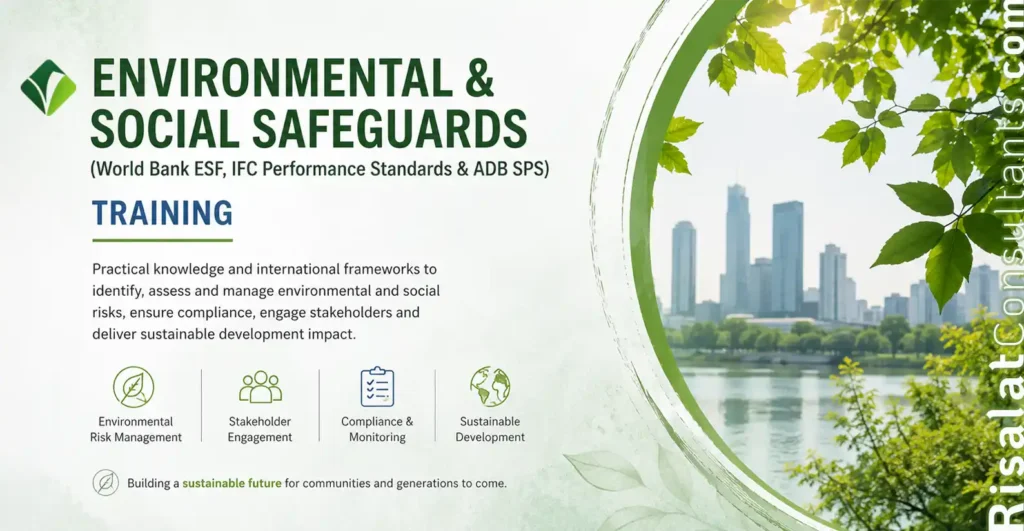
Environmental & Social Safeguards (World Bank ESF, IFC Performance Standards & ADB SPS) Training equips professionals with practical knowledge, tools, and internationally recognized frameworks required to identify, assess, manage, monitor, and mitigate environmental and social risks associated with development projects, infrastructure investments, climate initiatives, energy programmes, and donor-funded operations.
Development organizations, governments, financial institutions, and private sector entities increasingly operate in environments where environmental sustainability, social inclusion, stakeholder engagement, climate resilience, biodiversity protection, and community well-being are critical considerations for project success. Donors, development banks, investors, and regulatory authorities now require stronger environmental and social risk management systems to ensure projects deliver sustainable benefits while minimizing adverse impacts.
This training provides participants with practical approaches to environmental and social safeguards implementation, compliance management, stakeholder engagement, risk assessment, monitoring systems, and sustainable project delivery aligned with international best practices and safeguard requirements.
Professionals seeking stronger capabilities in project performance, development effectiveness, and sustainable project implementation may also benefit from our Project Management for Development & Humanitarian Sectors Training and Monitoring & Evaluation of Community & Development Projects Training.
The programme strengthens institutional capability in:
- Environmental and social safeguards
- Environmental and social risk assessment
- World Bank Environmental and Social Framework (ESF)
- IFC Performance Standards
- ADB Safeguard Policy Statement (SPS)
- Environmental and social management systems
- Stakeholder engagement and consultation
- Resettlement and livelihood restoration
- Climate and social resilience
- Environmental compliance and monitoring
- Social inclusion and community development
- Sustainable project implementation
The programme combines internationally recognized safeguards frameworks with practical applications relevant to governments, development agencies, NGOs, INGOs, infrastructure projects, energy projects, transport projects, climate initiatives, donor-funded programmes, and private sector investments.
Watch a brief introduction to the importance of environmental and social safeguards in sustainable development projects and donor-funded operations:
The Growing Importance of Environmental and Social Safeguards
Organizations increasingly require professionals capable of:
- Managing environmental and social risks
- Applying World Bank ESF requirements
- Implementing IFC Performance Standards
- Supporting ADB SPS compliance
- Conducting stakeholder consultations
- Managing social impacts and community risks
- Strengthening environmental governance
- Addressing climate-related risks
- Supporting sustainable infrastructure development
- Enhancing project sustainability and resilience
Strong environmental and social safeguards systems help organizations:
- Reduce project risks
- Improve compliance performance
- Strengthen donor confidence
- Enhance stakeholder trust
- Improve community acceptance
- Support sustainable development outcomes
- Reduce implementation delays
- Strengthen environmental performance
- Improve social inclusion
- Enhance institutional accountability
Weak safeguards systems often result in project delays, community opposition, environmental degradation, compliance challenges, reputational risks, funding constraints, and reduced development impact.
International organizations increasingly apply the World Bank Environmental and Social Framework, IFC Performance Standards, and ADB Safeguard Policy Statement to strengthen environmental sustainability, social responsibility, stakeholder engagement, and long-term project success.
Who Should Attend This Environmental and Social Safeguards Training
This programme is designed for:
- Environmental Specialists
- Social Development Specialists
- Project Managers
- Programme Managers
- Safeguards Officers
- ESG Professionals
- Government Officials
- Development Practitioners
- Infrastructure Professionals
- Engineers
- Urban Development Specialists
- Energy Sector Professionals
- Climate Change Specialists
- Donor-Funded Project Teams
- NGO and INGO Personnel
- Development Bank Professionals
- Community Engagement Officers
- Sustainability Managers
- Environmental Consultants
- Social Risk Management Specialists
Tick what your team needs to be able to do.
Programme Objectives
By the end of this programme participants will be able to:
- Apply international environmental and social safeguards frameworks
- Understand World Bank ESF requirements
- Apply IFC Performance Standards
- Implement ADB SPS principles
- Conduct environmental and social risk assessments
- Strengthen stakeholder engagement processes
- Manage environmental and social risks effectively
- Develop safeguards monitoring systems
- Improve safeguards compliance and reporting
- Support sustainable project implementation
- Strengthen community engagement and social inclusion
- Develop practical safeguards action plans
This programme strengthens organizational capability in environmental governance, social risk management, stakeholder engagement, safeguards compliance, sustainability planning, and development effectiveness.
Environmental and Social Safeguards Training Structure & Contents
First Day | Foundations of Environmental & Social Safeguards Frameworks
- Introduction to environmental and social safeguards
- Global trends in safeguards and sustainability
- World Bank Environmental and Social Framework (ESF)
- Environmental and Social Standards (ESS)
- IFC Performance Standards
- ADB Safeguard Policy Statement (SPS)
- Environmental and social governance principles
- Institutional safeguards responsibilities
Exercise: Safeguards framework mapping and compliance assessment
Strong safeguards foundations help organizations improve project planning, reduce implementation risks, strengthen accountability, and improve development outcomes.
Second Day | Environmental & Social Risk Assessment and Management
- Environmental screening and categorization
- Social screening and risk identification
- Environmental impact assessment principles
- Social impact assessment principles
- Climate and disaster risk considerations
- Biodiversity and ecosystem protection
- Cumulative impact assessment
- Environmental and social management planning
Workshop: Environmental and social risk assessment exercise
Organizations increasingly require robust environmental and social risk assessment systems to support sustainable project implementation and regulatory compliance.
Third Day | Stakeholder Engagement, Social Inclusion & Community Development
- Stakeholder identification and mapping
- Stakeholder engagement planning
- Community consultation processes
- Grievance redress mechanisms
- Free, Prior and Informed Consent (FPIC)
- Gender and social inclusion considerations
- Vulnerable groups and social protection
- Community participation and ownership
- Case Study: Stakeholder engagement and community consultation planning
Effective stakeholder engagement strengthens trust, reduces project conflicts, improves project acceptance, and supports sustainable development outcomes.
Fourth Day | Safeguards Implementation, Monitoring & Compliance
- Environmental and social management plans
- Monitoring and reporting systems
- Compliance monitoring approaches
- Corrective action planning
- Environmental and social audits
- Contractor management and supervision
- Incident management and reporting
- Safeguards performance indicators
- Workshop: Safeguards monitoring and compliance framework development
Strong monitoring systems help organizations demonstrate compliance, improve accountability, strengthen performance management, and reduce implementation risks.
Fifth Day | Sustainability, Development Impact & Institutional Strengthening
- Project sustainability planning
- Resettlement and livelihood restoration principles
- Environmental restoration approaches
- Institutional capacity strengthening
- Safeguards integration into project management
- Knowledge management and organizational learning including MEAL approaches
- Development impact and sustainability
- Future trends in environmental and social safeguards
Capstone Exercise: Environmental & Social Safeguards Action Plan
Successful safeguards implementation requires strong leadership, effective risk management, stakeholder participation, compliance systems, sustainability planning, and continuous institutional learning.
£3,820 per participant · invoice and bank transfer · groups of 5 or more receive a discount
Five or more from one organisation: ask for the group rate on the invoice request.
Ten or more: an in-house version for your institution may cost less per person. Ask for an in-house quote.
Registration closes in 64 days (31 Dec 2026)
Programme Methodology
This programme uses a highly practical and interactive methodology combining:
- Expert-led safeguards sessions
- International safeguards case studies
- Environmental and social risk simulations
- Stakeholder engagement exercises
- Safeguards compliance workshops
- Environmental assessment activities
- Social risk management exercises
- Group discussions and peer learning
- Practical planning workshops
- Development project applications
Participants develop practical tools, templates, and safeguards approaches that can be immediately applied within their organizations.
- Funds
- Entity
- Project
- Results
- MRV
Host Country Profile – Denmark
Denmark is internationally recognized for its strong environmental governance, sustainability leadership, climate action initiatives, social inclusion policies, and commitment to sustainable development.
The country has established a global reputation for balancing economic growth, environmental protection, social responsibility, and stakeholder participation through effective governance systems and innovative policy approaches.
Copenhagen provides an excellent environment for learning, professional networking, and exposure to international best practices in sustainability, environmental management, social development, stakeholder engagement, and responsible project implementation.
Denmark’s leadership in sustainability, renewable energy, environmental governance, and stakeholder-inclusive development provides valuable practical insights for professionals responsible for safeguards implementation and sustainable project delivery.
Institutional Application
This programme supports organizations in strengthening:
- Environmental and social risk management
- Safeguards compliance systems
- Stakeholder engagement practices
- Environmental governance
- Social inclusion strategies
- Climate resilience planning
- Monitoring and reporting systems
- Community development initiatives
- Sustainability planning
- Institutional accountability
Participants return with practical tools to improve:
- Project sustainability
- Environmental performance
- Social risk management
- Community engagement
- Compliance monitoring
- Stakeholder trust
- Development effectiveness
- Organizational resilience
- Long-term project impact
Strong safeguards systems are increasingly essential for project success, donor confidence, sustainability outcomes, and responsible development.
Regional Relevance & Application
Africa
Supporting infrastructure development, energy projects, climate adaptation initiatives, social inclusion programmes, environmental protection efforts, and donor-funded investments.
South Asia
Strengthening environmental governance, community engagement, sustainable infrastructure development, disaster resilience, and social safeguards implementation.
Southeast Asia
Supporting climate resilience, environmental sustainability, infrastructure investments, biodiversity protection, and stakeholder engagement initiatives.
Middle East
Enhancing environmental risk management, social development programmes, infrastructure modernization, climate adaptation, and sustainable development planning.
Europe & Central Asia
Strengthening safeguards compliance, environmental management systems, sustainability initiatives, stakeholder engagement, and responsible investment practices.
Across these regions, organizations increasingly require professionals capable of managing environmental and social risks while supporting sustainable and inclusive development.
Expected Outcomes
Participants will be able to:
- Apply international safeguards frameworks effectively
- Improve environmental and social risk management
- Strengthen stakeholder engagement processes
- Enhance safeguards compliance systems
- Support sustainable project implementation
- Improve monitoring and reporting practices
- Manage social and environmental risks proactively
- Strengthen community participation approaches
- Improve institutional safeguards capacity
- Develop practical safeguards action plans
Participants leave with practical tools and frameworks to strengthen safeguards performance, environmental sustainability, social inclusion, compliance management, and development effectiveness.
Course Deliverables
Before the Programme
- Participant Pre-Assessment
- Environmental & Social Safeguards Readiness Assessment
- Complimentary Visa Support & Advisory
During the Programme
- Airport Pickup & Welcome Assistance
- Accommodation with Breakfast
- Welcome Networking Dinner
- Risalat Training Kit (Bag, Bottle, Mug, T-Shirt, Cap, Passport Cover, Pens, Notebook, Magnet & Keychain)
- Comprehensive Training Manual
- Environmental & Social Safeguards Toolkit
- World Bank ESF Reference Materials
- IFC Performance Standards Guide
- ADB SPS Reference Framework
- Environmental Risk Assessment Templates
- Stakeholder Engagement Planning Tools
- Monitoring & Reporting Resources
- Practical Workshops and Simulations
- Group Discussions and Peer Learning
- Daily Lunch and Refreshments
- Full Access to Training Venue Facilities
- Mini Pad / Tablet with Digital Learning Materials
- Access to Safeguards Resources
- Field Visit (where applicable)
- Entertaining City Tour
- Certificate of Completion
- Risalat Programme Participation Recognition Award
After the Programme
- Post-Training Reference Materials
- Environmental & Social Safeguards Toolkit
- Practical Institutional Recommendations
- Post-Training Support & Follow-Up Guidance
- Programme Report
Common Environmental & Social Safeguards Challenges – And How This Training Helps
How can organizations comply with World Bank ESF, IFC Performance Standards, and ADB safeguard requirements?
Many organizations struggle to interpret and implement multiple safeguards frameworks across different projects and funding arrangements. This training provides practical guidance on safeguards requirements, compliance obligations, risk management processes, and implementation approaches aligned with internationally recognized frameworks.
How can projects identify environmental and social risks before implementation begins?
Projects often face challenges because risks are identified too late. Participants learn practical screening, assessment, categorization, and risk management approaches that help organizations identify and address potential issues early in the project lifecycle.
How can organizations improve stakeholder engagement and community consultations?
Meaningful stakeholder engagement is critical for project acceptance and sustainability. This programme introduces practical consultation techniques, stakeholder mapping tools, grievance mechanisms, and community engagement strategies that strengthen trust and participation.
How can projects manage environmental and social risks throughout implementation?
Environmental and social risks can evolve over time. Participants learn how to establish monitoring systems, management plans, corrective actions, reporting mechanisms, and adaptive safeguards approaches that support continuous risk management.
How can institutions strengthen safeguards monitoring, reporting, and compliance systems?
Many organizations face challenges in demonstrating compliance and reporting project performance. The training provides practical tools for monitoring, compliance verification, safeguards reporting, performance measurement, and accountability management.
Organizations seeking stronger monitoring and accountability systems may also benefit from our Results-Based Monitoring & Evaluation Training & Coaching Programme.
How can projects balance infrastructure development, environmental protection, and social inclusion?
Development projects often require balancing competing priorities. Participants explore practical strategies for integrating environmental sustainability, stakeholder needs, social inclusion, and development objectives into project planning and implementation.
How can organizations reduce safeguard-related implementation delays and compliance risks?
Poor safeguards management can lead to delays, community opposition, and funding challenges. This training helps participants identify common implementation risks and develop proactive approaches to improve project performance and compliance.
How can institutions build long-term safeguards capacity across multiple projects?
Sustainable safeguards systems require more than project-level compliance. Participants learn how to strengthen institutional safeguards frameworks, governance systems, staff capacity, organizational learning, and long-term safeguards performance.