حقائق رئيسية
- المواعيد
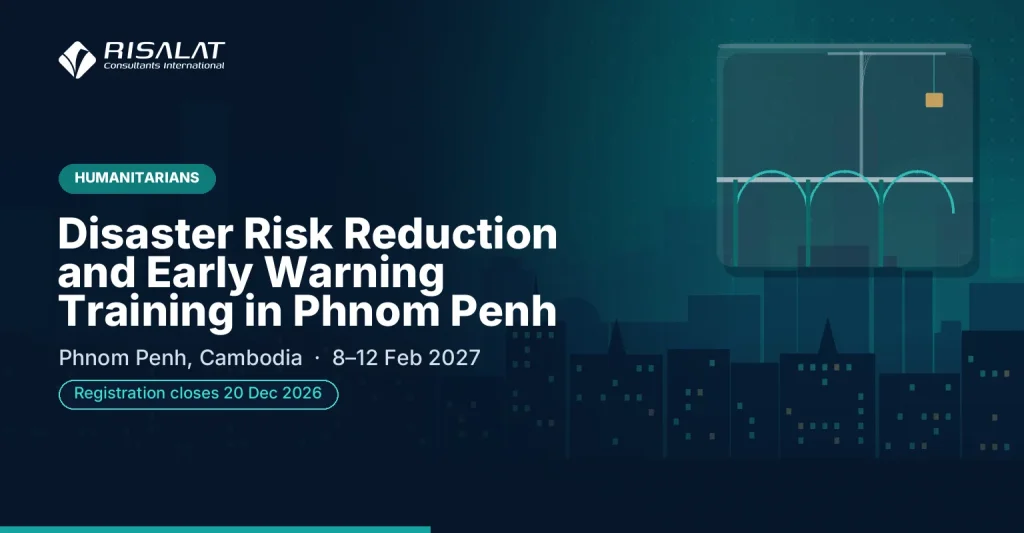
- 8–12 فبراير 2027 (5 أيام)
- المكان
- Samnang Laor Hotel، بنوم بنه، كمبوديا
- الرسوم لكل مشارك
- £3,220 (جنيه إسترليني)
- الدفع
- بالفاتورة والتحويل المصرفي
- إغلاق التسجيل
- 20 ديسمبر 2026
- الشهادة
- شهادة إتمام
- الخيار المؤسسي
- نفّذه لفريقك، في المواعيد التي تناسبك
نظرة عامة على البرنامج
Floods, droughts, storms and lightning cause repeated losses across the Lower Mekong. In late September 2026 Cambodia’s National Committee for Disaster Management (NCDM) reported more than 25,000 families affected by flooding in ten provinces, with close to 3,000 families moved to higher ground. Events like these show why prevention, early warning and preparedness now sit at the centre of public planning rather than at its edge.
The Sendai Framework for Disaster Risk Reduction 2015–2030 remains the global reference. Its midterm review, concluded at the United Nations in May 2023, found progress on only two of the seven global targets and called for a clear shift from managing disasters to managing risk: stronger governance, risk-informed investment and better data.
Cambodia offers a practical setting for that shift. The 2015 Law on Disaster Management gives NCDM the national lead, the National Action Plan for Disaster Risk Reduction 2024–2028 is under implementation, and a National Roadmap for Early Warnings for All (2025–2028) was released in November 2025. In June 2026 the government, UNDP and partners launched a Green Climate Fund-supported project to put that roadmap into practice in four high-risk provinces.
This five-day Disaster Risk Reduction Training in Phnom Penh takes participants through the full risk management cycle: understanding hazards, exposure and vulnerability; participatory risk assessment; end-to-end early warning, including flood forecasting, climate prediction and tsunami warning concepts; preparedness and contingency planning; mitigation options; and recovery and reconstruction that reduces future risk.
Sessions draw on real financed operations in Cambodia and the region as case material, and the week closes with an exposure visit so participants can see how forecasting, warning and community preparedness work in practice.
يعزز البرنامج القدرات المؤسسية في
- Applying the Sendai Framework priorities and targets to national and local plans
- Hazard identification and multi-hazard risk assessment
- Exposure, vulnerability and capacity assessment
- Participatory and community-based risk assessment
- Gender-responsive and disability-inclusive risk reduction
- End-to-end, people-centred early warning systems
- Flood, drought and weather forecasting for decision-makers
- Use of seasonal climate outlooks and forecast-based risk estimation
- Last-mile warning dissemination and feedback
- Preparedness, contingency and evacuation planning
- Anticipatory action and pre-arranged financing
- Structural and non-structural mitigation options analysis
- Risk-informed planning of roads, irrigation and public buildings
- Post-disaster needs assessment and recovery planning
- Building back better in reconstruction
- Coordination between national, provincial, district and commune committees
- Monitoring, evaluation and reporting on disaster risk reduction plans
- Action planning and institutional follow-up
The aim is practical: each participant leaves with a costed, realistic action plan for their own organisation, built from tools tested during the week.
The Growing Importance of Disaster Risk Reduction
Global attention has moved towards early warning and risk knowledge. The UN Early Warnings for All initiative aims to cover everyone on earth with effective warnings by 2027. The 2025 global status report by UNDRR and WMO found that 119 countries, about 60 percent, now report a multi-hazard early warning system, yet fewer than one-third report solid capability in risk knowledge, the first pillar of any warning chain.
Financiers are acting on this. The World Bank’s Southeast Asia Disaster Risk Management Project 2 in Cambodia, approved in 2022 with US$169 million of IDA credit, rebuilds flood-damaged rural roads and trains Ministry of Rural Development staff in disaster risk management and post-disaster needs assessment. The Cambodia Water Security Improvement Project, approved in 2024 with US$145 million, supports climate-informed river basin plans and more hydrometeorological stations.
These investments need people who can turn data into decisions: officials who understand forecasts, can plan with communities, and can show results to financiers and the public.
تحتاج المؤسسات بشكل متزايد إلى مهنيين قادرين على:
- Reading and explaining hazard, exposure and vulnerability data
- Leading participatory risk assessments with communities
- Translating Sendai targets into local indicators
- Interpreting river, rainfall and seasonal forecasts
- Designing warning messages that people understand and act on
- Planning last-mile communication for women, older people and persons with disabilities
- Preparing and testing contingency and evacuation plans
- Setting trigger-based anticipatory actions
- Comparing mitigation options on cost and benefit
- Screening infrastructure projects for disaster and climate risk
- Running post-disaster damage and needs assessments
- Coordinating many agencies under one command structure
Strong disaster risk reduction systems help organisations:
- Protect lives and livelihoods before hazards strike
- Reduce repeat damage to roads, schools and irrigation
- Use limited budgets on prevention rather than repeated repair
- Respond faster with clear roles and pre-agreed triggers
- Meet the risk-management expectations of financiers
- Build public trust in official warnings
- Recover in ways that lower future risk
- Show measurable progress against national and Sendai targets
For project implementation units, risk reduction is also a delivery issue: a flood that destroys a newly built road or canal sets a project back by years. Building risk thinking into design, procurement and supervision protects both people and investment.
Source: UNDRR and WMO, Global Status of Multi-Hazard Early Warning Systems 2025
1. What did the 2023 midterm review of the Sendai Framework find on its seven global targets?
IISD's report on the May 2023 high-level meeting notes the review found progress on only two of seven targets.
2. Which early warning pillar did the 2025 UNDRR-WMO global status report identify as least developed?
The 2025 report found fewer than one-third of countries report risk knowledge capabilities, the least developed pillar.
3. What is EWS1294 in Cambodia?
People in Need describes EWS1294 as a voice-based mobile warning system run with NCDM and recognised as Cambodia's national early warning system.
Who Should Attend This Disaster Risk Reduction Training?
صُمم هذا البرنامج من أجل:
- Officials of national disaster management committees and secretariats
- Members of provincial, district and commune disaster management committees
- Staff of ministries of interior, rural development, water resources, agriculture and environment
- Meteorological and hydrological service staff
- Disaster risk management and climate adaptation specialists
- Project implementation unit managers of infrastructure and water projects
- Environmental and social safeguards officers
- Urban and local development planners
- Emergency response and civil protection officers
- Programme staff of humanitarian organisations and Red Cross Red Crescent societies
- NGO and community-based organisation field coordinators
- Staff of development agencies and UN programmes
- Monitoring and evaluation officers working on resilience programmes
- Gender and social inclusion advisers
- Private sector business continuity and risk managers
A quick training needs assessment helps nominate the right staff. Mixed teams from one institution, for example a committee secretariat with its sector partners, gain most because they can agree a joint action plan during the week.
حدّد ما يحتاج فريقك إلى القدرة على إنجازه.
Disaster Risk Reduction Training Objectives
Upon successful completion of this Disaster Risk Reduction Training, participants will be able to:
- Explain disaster risk as a function of hazard, exposure, vulnerability and capacity
- Apply the four priorities and seven targets of the Sendai Framework to their institution
- Identify and evaluate natural hazards using available data and maps
- Conduct vulnerability and capacity assessments with communities
- Use participatory tools to rank risks and agree priorities
- Describe the four pillars of an end-to-end early warning system
- Interpret flood, weather and seasonal climate forecasts for decisions
- Plan an effective preparedness and response strategy with clear triggers
- Analyse mitigation options and select those with the best value
- Plan recovery and reconstruction that reduces future risk
- Strengthen the roles of government, communities, NGOs and the private sector
- Prepare a monitored action plan for their organisation
Each objective is linked to a session, an exercise and a tool that participants keep after the programme.
محتوى البرنامج وهيكله
- Introduction to disaster risk management
- Hazard, exposure, vulnerability and capacity: key terms
- Principles of disaster risk management
- The Sendai Framework: goal, priorities and seven targets
- Findings of the 2023 midterm review and the political declaration
- Links with the Paris Agreement and the Sustainable Development Goals
- Cambodia’s Law on Disaster Management and committee structure
- The disaster risk management process step by step
- Identifying and evaluating hazards: floods, drought, storms, lightning
- Hazard mapping with open data sources
- Exposure analysis for people, housing and infrastructure
- Vulnerability and capacity assessment methods
- Community participatory tools: seasonal calendars, transect walks, risk ranking
- Conducting a participatory risk assessment
- Early Warnings for All: goals and the four pillars
- Cambodia’s National EW4ALL Roadmap 2025–2028
- Weather and flood forecasting: how forecasts are produced
- Regional flood and drought forecasting in the Mekong basin
- Climate prediction and seasonal outlooks
- Tsunami early warning concepts and coastal hazards
- Forecast-based risk estimation and impact-based warnings
- Framework for disaster preparedness
- Contingency planning at national, provincial and commune level
- Evacuation planning and safe shelters
- Response mechanisms and coordination structures
- Anticipatory action: triggers, actions and pre-arranged funds
- Decision-making tools under uncertainty
- Disaster mitigation concepts and strategies
- Disaster recovery and reconstruction principles
- Post-disaster needs assessment basics
- Building back better
- Incorporating DRR into humanitarian sectors: shelter, WASH, health, food security
- Mainstreaming risk into development plans and budgets
- Planning, monitoring and evaluating DRR strategies
- Exposure visit to a disaster management or forecasting setting
المحتوى الكامل يوماً بيوم
The programme runs over five days, moving from risk understanding to warning, preparedness, mitigation and recovery.
- Day 1: disaster risk concepts and the Sendai Framework
- Day 2: hazard, vulnerability and participatory risk assessment
- Day 3: end-to-end early warning and forecasting
- Day 4: preparedness, anticipatory action and mitigation
- Day 5: recovery, mainstreaming, exposure visit and action plans
المحتوى الكامل يوماً بيوم
First Day | Disaster Risk Concepts and Global Frameworks
- Introduction to disaster risk management
- Hazard, exposure, vulnerability and capacity: key terms
- Principles of disaster risk management
- The Sendai Framework: goal, priorities and seven targets
- Findings of the 2023 midterm review and the political declaration
- Links with the Paris Agreement and the Sustainable Development Goals
- Cambodia’s Law on Disaster Management and committee structure
- The National Action Plan for DRR 2024–2028
- Approaches and applied tools for managing disaster risk
Workshop: Mapping Your Institution Against Sendai
Teams take the seven Sendai targets and map which ones their organisation contributes to, what data it holds and where gaps lie. Using a simple matrix, they score current capacity and identify two priority actions. Groups compare results and discuss how national targets cascade to provincial and commune plans, setting up the action plan they will build during the week.
Second Day | Hazard, Vulnerability and Participatory Risk Assessment
- The disaster risk management process step by step
- Identifying and evaluating hazards: floods, drought, storms, lightning
- Hazard mapping with open data sources
- Exposure analysis for people, housing and infrastructure
- Vulnerability and capacity assessment methods
- Community participatory tools: seasonal calendars, transect walks, risk ranking
- Conducting a participatory risk assessment
- Gender, age and disability in risk assessment
- Disaster loss databases and risk information
Case Study: Flood Risk in the Tonle Sap Region
Using public information on the Tonle Sap area, which World Bank documents describe as hit hard by the 2020 floods, groups build a simple risk profile for a fictional commune. They combine hazard, exposure and vulnerability layers, run a mock participatory ranking with role-played villagers and agree three risk reduction priorities to present to a district committee.
Third Day | End-to-End Early Warning and Forecasting
- Early Warnings for All: goals and the four pillars
- Cambodia’s National EW4ALL Roadmap 2025–2028
- Weather and flood forecasting: how forecasts are produced
- Regional flood and drought forecasting in the Mekong basin
- Climate prediction and seasonal outlooks
- Tsunami early warning concepts and coastal hazards
- Forecast-based risk estimation and impact-based warnings
- Last-mile dissemination: voice calls, radio, loudspeakers and volunteers
- Lessons from the EWS1294 mobile warning system
- Testing, feedback and trust in warnings
Workshop: Designing a Warning Chain That Reaches Everyone
Participants trace a river level reading from a gauge to a household. They design the message, the channels and the timing for three groups: farmers, a school and persons with disabilities. Using the four EW4ALL pillars as a checklist, they find weak links, assign responsibilities and set simple indicators to test whether warnings arrive in time and lead to action.
Fourth Day | Preparedness, Anticipatory Action and Mitigation
- Framework for disaster preparedness
- Contingency planning at national, provincial and commune level
- Evacuation planning and safe shelters
- Response mechanisms and coordination structures
- Anticipatory action: triggers, actions and pre-arranged funds
- Decision-making tools under uncertainty
- Disaster mitigation concepts and strategies
- Structural and nature-based options analysis
- Iterative risk management in infrastructure projects
Case Study: Risk-Proofing a Rural Road and Irrigation Investment
Drawing on the design of the World Bank-financed road reconstruction work and the Cambodia Water Security Improvement Project, teams review a sample project and identify where floods and drought could cause losses. They compare options such as raised embankments, larger culverts, retention areas and maintenance plans, estimate rough costs and benefits, and agree what to change in design and supervision.
Fifth Day | Recovery, Mainstreaming and Action Planning
- Disaster recovery and reconstruction principles
- Post-disaster needs assessment basics
- Building back better
- Incorporating DRR into humanitarian sectors: shelter, WASH, health, food security
- Mainstreaming risk into development plans and budgets
- Planning, monitoring and evaluating DRR strategies
- Exposure visit to a disaster management or forecasting setting
- Reflection on the visit and lessons for home institutions
- Action plan development and peer review
Capstone Exercise: Institutional DRR Action Plan
Each participant or team completes a twelve-month action plan for their own institution, using the assessments and tools from the week. Plans set objectives, responsible units, resources, indicators and links to national plans or financed projects. Peers and the facilitator review each plan, and the final version becomes part of the programme report.
Disaster Risk Reduction Training Methodology
The programme uses adult learning methods built around real cases, so participants practise the tools they will use at work.
يجمع البرنامج بين:
- Short expert presentations with open discussion
- Case studies from financed projects in Cambodia and the region
- Participatory risk assessment role plays
- Hazard mapping exercises with open data
- Early warning chain design workshops
- Tabletop simulation of a flood emergency
- Forecast interpretation drills
- Options analysis and simple cost-benefit exercises
- Video examples of warning and response in action
- Peer learning across countries and sectors
- An exposure visit linked to the week’s themes
- Individual and team action planning with feedback
Participants are encouraged to bring their own plans, maps and project documents so that exercises use real material.
Before the programme, institutions can use Risalat’s free institutional capacity assessment to identify their main gaps and focus the week accordingly.
الزيارات الفنية والبرنامج الميداني
Towards the end of the week, Risalat arranges an exposure visit so participants can see how the methods discussed are applied in practice and speak with professionals who work in the disaster management field.
Depending on availability, the visit may cover a hydrological or forecasting setting, a disaster management coordination function, or a community preparedness or early warning activity. Visits are confirmed with host organisations closer to the programme dates, and the final programme is shared with participants in advance. A structured reflection session follows the visit so lessons feed directly into each action plan.
النتائج المتوقعة
Upon completion of this Disaster Risk Reduction Training, participants will be able to:
- Lead a multi-hazard risk assessment with communities
- Use risk information to set local priorities
- Assess and strengthen their early warning chain
- Write clear, actionable warning messages
- Prepare tested contingency and evacuation plans
- Define triggers for anticipatory action
- Select mitigation measures with good value for money
- Plan inclusive recovery that reduces future risk
- Report progress against national and Sendai targets
- Implement a twelve-month institutional DRR action plan
These outcomes are designed to be visible at work within months: a revised plan, a tested warning message or a risk-screened project design.
£3,220 لكل مشارك · فاتورة وتحويل مصرفي · خصم للمجموعات المكوّنة من 5 مشاركين أو أكثر
خمسة مشاركين أو أكثر من مؤسسة واحدة: اطلبوا سعر المجموعة عند طلب الفاتورة.
Ten or more: an in-house version for your institution may cost less per person. Ask for an in-house quote.
Registration closes in 48 days (20 Dec 2026)
Institutional Application of Disaster Risk Reduction Training
يدعم هذا البرنامج المؤسسات في تعزيز:
- Disaster risk governance and committee coordination
- Risk information systems and loss databases
- Multi-hazard early warning procedures
- Preparedness and contingency planning
- Anticipatory action protocols
- Risk screening of infrastructure projects
- Community engagement and participation
- Gender and disability inclusion in DRR
- Post-disaster assessment readiness
- Recovery and reconstruction planning
- Monitoring and reporting on DRR plans
- Partnerships with humanitarian and development actors
يعود المشاركون بأدوات عملية لتحسين:
- نماذج تقييم المخاطر
- Vulnerability and capacity assessment checklists
- Early warning chain review forms
- Warning message templates
- Contingency plan outlines
- Anticipatory action trigger tables
- Mitigation options scoring sheets
- DRR action plan and monitoring framework
Organisations wanting to track results after the programme can pair the action plan with Risalat’s M&E and MEAL assessment.
الأهمية الإقليمية والتطبيق
آسيا
Asia-Pacific has the highest reported coverage of multi-hazard early warning systems, at 72 percent of countries in the 2025 global status report, yet floods and droughts continue to cause heavy losses in the Mekong basin. The Mekong River Commission’s regional centre in Phnom Penh extended its flood forecasting work to drought in 2019, and national agencies are building on regional data.
أفريقيا
Africa recorded the fastest improvement in early warning comprehensiveness since 2015 but still has the lowest scores. Chad, Ethiopia and Somalia are among the seven countries in the same Green Climate Fund-supported EW4All project as Cambodia, which makes peer exchange directly useful.
المحيط الهادئ
Small island developing States show the lowest reported coverage, at 43 percent, and face cyclones, storm surge and tsunami risk. Fiji is part of the same EW4All project, and participants from the Pacific can compare community warning approaches with Cambodia’s.
أمريكا اللاتينية
The Americas and Caribbean report 51 percent coverage. Ecuador and Antigua and Barbuda are also in the EW4All project, giving a shared framework for comparing warning governance and preparedness.
الشرق الأوسط
Flash floods, drought and heat affect many Middle Eastern countries, alongside protracted humanitarian crises. The tools for risk assessment, anticipatory action and humanitarian integration covered here apply directly.
Across all regions, the midterm review message is the same: invest in prevention and risk knowledge, not only response.
نبذة عن البلد المضيف – كمبوديا
Phnom Penh, Cambodia’s capital, sits where the Mekong, Tonle Sap and Bassac rivers meet. It is compact, affordable and home to government ministries, UN agencies, development partners and the Mekong River Commission’s regional flood and drought centre, which makes it a practical place to study water-related risk.
Cambodia is a useful benchmark because it combines high exposure with a clear institutional framework. Close to 80 percent of the population lives in rural, climate-sensitive areas and about 65 percent rely on agriculture. The 2015 Law on Disaster Management, the NAP-DRR 2024–2028, the EW4ALL roadmap and the EWS1294 mobile warning system, which the government recognises as the national early warning system, give participants a full set of policies and tools to examine.
تصل الرحلات الدولية الآن إلى مطار تيشو الدولي، الذي افتُتح في سبتمبر 2025 وحلّ محل مطار بنوم بنه الدولي. ويمكن لمواطني كثير من الجنسيات الحصول على تأشيرة إلكترونية كمبودية عبر الإنترنت أو تأشيرة عند الوصول؛ وينبغي للمشاركين التحقق من القواعد السارية لدى وزارة الخارجية الكمبودية أو السفارة، وتقدّم Risalat خطابات دعم التأشيرة.
Disaster Risk Reduction Training Deliverables
يحصل كل مشارك على مجموعة كاملة من المواد والأدوات العملية قبل البرنامج وخلاله وبعده.
قبل البرنامج
- التقييم المسبق للمشاركين
- Disaster Risk Reduction Readiness Assessment
- Disaster Risk Reduction Resource Pack
- مواد قراءة تحضيرية
- دعم واستشارات مجانية بشأن التأشيرة
- الاستقبال من المطار والمساعدة عند الوصول
- إقامة مع الإفطار
- عشاء ترحيبي للتعارف
أثناء البرنامج
- حقيبة Risalat التدريبية (حقيبة، وقارورة، وكوب، وقميص، وقبعة، وغلاف جواز سفر، وأقلام، ودفتر، ومغناطيس وميدالية مفاتيح)
- Comprehensive Disaster Risk Reduction Training Manual
- Multi-Hazard Risk Assessment Template
- Vulnerability and Capacity Assessment Toolkit
- Early Warning Chain Review Checklist
- Warning Message Design Templates
- Contingency and Evacuation Plan Outline
- Anticipatory Action Trigger Table
- Mitigation Options Scoring Sheet
- ورش عمل عملية ومحاكاة
- مناقشات جماعية وتعلم من الأقران
- غداء ومرطبات يومية
- الاستفادة الكاملة من مرافق مكان التدريب
- جهاز Mini Pad / جهاز لوحي مزود بمواد تعليمية رقمية
- زيارة ميدانية (حسب الاقتضاء)
- جولة ترفيهية في المدينة
بعد البرنامج
- شهادة الإتمام
- جائزة Risalat تقديراً للمشاركة في البرنامج
- مواد مرجعية بعد التدريب
- Institutional DRR Action Plan Template
- Sendai Target Monitoring Worksheet
- Digital Library of Key DRR Frameworks
- الدعم بعد التدريب وإرشادات المتابعة
- تقرير البرنامج
Ministries, disaster management committees, project units and humanitarian organisations can also request a tailored in-house version of this programme, adapted to their hazards and plans, through our request a proposal form.
Common Challenges in Disaster Risk Reduction, And How This Training Helps
How can we move from responding to disasters to reducing risk?
Day 1 links the Sendai priorities and midterm review findings to each institution’s mandate, and the capstone on Day 5 turns that into funded prevention actions.
How can we build risk knowledge when data is limited?
Day 2 shows how to combine open hazard data, local knowledge and participatory tools to produce a usable risk profile without expensive studies.
How can warnings reach the most vulnerable people in time?
Day 3 covers last-mile channels and inclusive messaging, with lessons from EWS1294 and the EW4ALL roadmap’s focus on women, indigenous peoples and persons with disabilities.
How can managers act on uncertain forecasts?
Day 3 forecast drills and Day 4 decision tools explain probability, thresholds and triggers so managers can act early with confidence.
How can we coordinate many agencies during an emergency?
Day 4 contingency planning and the flood simulation clarify roles across national, provincial and commune committees and partners.
How can infrastructure projects avoid repeated flood damage?
The Day 4 case study on roads and irrigation shows how to screen designs and choose mitigation measures with good value for money.
How can recovery reduce future risk instead of rebuilding it?
Day 5 covers post-disaster needs assessment and building back better so reconstruction plans include risk reduction from the start.
How can we show results to leaders and financiers?
The monitoring sessions and the Day 5 action plan set indicators linked to national plans and Sendai targets, ready for reporting.
الأسئلة الشائعة
Who is this Disaster Risk Reduction Training for?
Officials of disaster management committees, sector ministries, meteorological and hydrological services, project implementation units, humanitarian organisations and NGOs working on risk, preparedness or resilience.
Does the programme include a field or exposure visit?
Yes. An exposure visit linked to forecasting, coordination or community preparedness is arranged towards the end of the week; visits are confirmed with host organisations before the programme.
Which frameworks does the training use?
The Sendai Framework 2015–2030 and its 2023 midterm review, the Early Warnings for All four pillars, and Cambodia's Law on Disaster Management and National Action Plan for DRR 2024–2028 as a national example.
Is early warning covered in detail?
A full day covers end-to-end early warning: risk knowledge, flood and weather forecasting, seasonal climate outlooks, tsunami warning concepts, last-mile dissemination and testing.
Can this training be delivered in-house?
Yes. Institutions can request a tailored version for their own hazards, plans and projects through Risalat's request a proposal form.
جميع البرامج في بنوم بنهالمزيد من البرامج للعاملين في المجال الإنساني
لماذا بنوم بنه لهذا البرنامج
اختيرت بنوم بنه، كمبوديا، لهذا البرنامج لسهولة الوصول إليها بالنسبة للمشاركين المتوقعين ولتوفر أماكن مناسبة للتدريب العملي والتفاعلي.
The Disaster Risk Reduction and Early Warning Training in Phnom Penh programme in February 2027 brings together officials and professionals. Sessions combine short inputs, case studies and group work on participants' own files, and the city's institutions can be added as a study visit on request.
تحقق مما إذا كنت بحاجة إلى تأشيرة عبر أداة التحقق من التأشيرة المجانية، واطلب خطاب دعوة بعد إتمام تسجيلك.
الموضوع نفسه في مدن أخرى
- برنامج بناء القدرات في المخاطر المناخية والأمن الصحي (مانيلا)
- برنامج تدريبي في الإدارة الاستراتيجية للأزمات والحد من المخاطر المؤسسية في سنغافورة
- برنامج تدريبي في إدارة مخاطر الفيضانات والقدرة على الصمود المناخي والتكيف مع الفيضانات الحضرية (طوكيو)
- برنامج تدريبي في نظم المعلومات الجغرافية والاستشعار عن بعد لإدارة مخاطر الكوارث في فيينتيان
برامج أخرى في بنوم بنه
- برنامج تدريبي في العمليات والإدارة المالية في بنوم بنه
- برنامج تدريبي في المساواة بين الجنسين والإدماج الاجتماعي والموازنة المراعية للنوع الاجتماعي
- برنامج تدريبي في إدارة الطوارئ والتأهب للكوارث في كمبوديا
- برنامج تدريبي في مهارات إدارة الموارد البشرية والشؤون الإدارية في بنوم بنه
- برنامج تدريبي في إدارة الحياة البرية وصونها
المزيد من الدورات التدريبية في كمبوديا · جميع البرامج في آسيا · تقويم التدريب الكامل