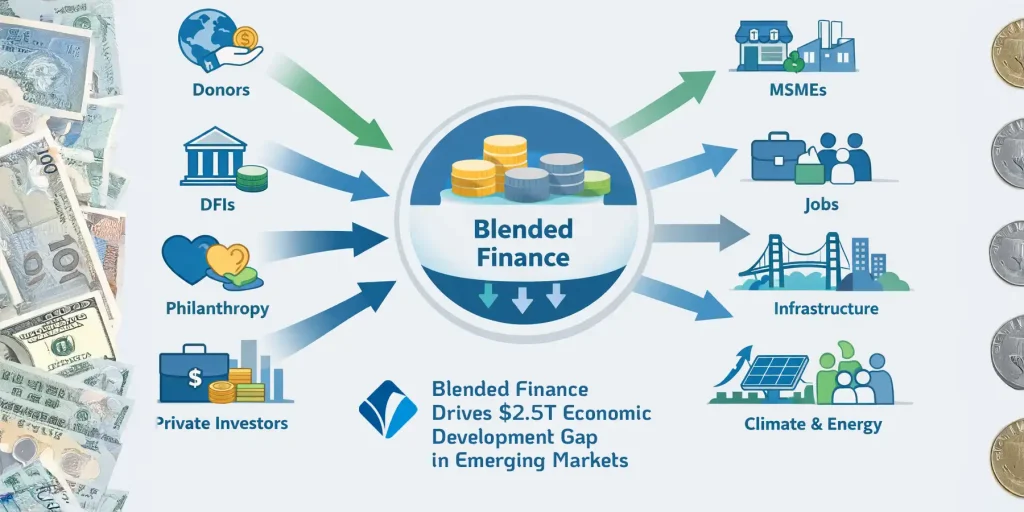
In short: Blended finance explained: how it works, the main instruments, typical concessional levels, why mobilisation falls short and how to prepare projects.
Principais conclusões
O financiamento misto pode atrair capital privado para projetos de desenvolvimento, mas apenas quando é utilizado para os projetos certos, com os instrumentos adequados e sem mais subsídios do que o necessário.
- Uma definição. As finanças mistas utilizam fundos públicos ou filantrópicos de desenvolvimento para atrair investimento privado para projetos com objetivos de desenvolvimento.
- Many instruments. guarantees, first-loss capital, concessional loans, equity and grants for preparation are the main tools.
- Modest subsidy. IFC reports an average concessional level of 4.7 percent of total project cost across a sample of its deals from FY2010 to FY2025.
- Below expectations. the OECD notes blended finance has mobilised relatively limited private finance and has not scaled as hoped.
- Preparation decides. bankable, well-prepared projects attract private finance; weak ones do not, whatever the subsidy.
Introdução
O financiamento misto é a utilização estratégica de fundos de desenvolvimento públicos ou filantrópicos para atrair investimento privado para projetos que servem objetivos de desenvolvimento, tais como energia limpa, água, financiamento de pequenas empresas ou adaptação às alterações climáticas. O dinheiro para o desenvolvimento assume uma parte do risco ou custo que os investidores privados não aceitariam por conta própria, para que o projeto se torne viável para investimento e o capital privado possa seguir-se.
Para ministérios, bancos de desenvolvimento e equipes de projetos, o financiamento misto é atraente porque os orçamentos públicos sozinhos não conseguem pagar pelos investimentos de que os países precisam. Também é fácil de ser mal utilizado: os subsídios podem ir para negócios que teriam acontecido de qualquer maneira, ou os projetos podem ser estruturados de maneiras que o setor público não consegue gerenciar. Este guia explica como o financiamento misto funciona, o que as evidências mostram e como os governos podem se preparar para ele.
How Blended Finance Works
A typical blended structure has three groups of participants:
- Prestadores de financiamento para o desenvolvimento: doadores, instituições de financiamento do desenvolvimento e fundos filantrópicos que fornecem dinheiro concessional ou proteção contra riscos
- Private investors and lenders: banks, funds and companies that provide most of the capital on commercial terms
- The project or borrower: a company, utility, financial institution or public-private partnership that uses the money
The concessional part improves the risk-return balance for private investors. For example, a guarantee may cover some losses, or a first-loss tranche may absorb the first defaults in a loan portfolio, so commercial lenders are willing to lend at terms the project can afford.
The Main Blended Finance Instruments
| Instrument | Como funciona | Typical use |
|---|---|---|
| Guarantees | Cover part of the losses lenders or investors may suffer | Infrastructure, small business lending, local currency loans |
| First-loss capital | Absorbs the first losses before other investors are affected | Funds and loan portfolios |
| Concessional or subordinated loans | Lower interest, longer tenor or repaid after senior lenders | Projects with good impact but thin margins |
| Equity | Ownership stake that takes higher risk | Empresas em fase inicial e fundos |
| Grants and technical assistance | Pay for preparation, studies or capacity | Project preparation, market building |
Qual é o Subsídio Típico?
IFC publishes data on its own blended concessional finance portfolio. Across a sample covering FY2010 to FY2025, the average concessional level was 4.7 percent of total project cost. IFC describes this as a sample with limits, and it is not a rule for other deals, but it shows an important point: in many transactions, a relatively small concessional share supports a much larger total investment.
The principle behind this is minimum concessionality: using only as much subsidy as needed to make the deal work, so that public money is not wasted and markets are not distorted.
Why Blended Finance Has Fallen Short
The OECD’s 2025 DAC Blended Finance Guidance notes that blended finance has mobilised relatively limited private finance and has not scaled as rapidly as hoped. Common reasons include:
- Too few well-prepared, bankable projects
- Small, one-off deals with high transaction costs
- Limited standardisation, so each deal is negotiated from scratch
- Weak transparency on terms and results
- Currency and country risks that instruments do not fully address
Blended Finance, PPPs and Ordinary Development Loans
Blended finance is often confused with other forms of finance. A public-private partnership is a long-term contract under which a private party delivers and often finances a public service or asset; it may or may not use blended finance. An ordinary development loan finances a government directly, without aiming to mobilise private investors. Blended finance is defined by its purpose: using development money to bring in private capital that would not otherwise come.
How Governments Can Prepare Projects for Blended Finance
- Start with the development goal. Be clear what the project must achieve and how it will be measured.
- Prepare the project properly. Feasibility, environmental and social studies, and a clear revenue model are what investors look at first.
- Identify the real barrier. Is it risk, cost, currency, tenor or market size? The instrument should match the barrier.
- Allocate risks clearly. Decide which risks the public sector, the development partner and private investors each carry.
- Use the least subsidy needed. Test whether the deal would happen with less concessional money.
- Planear as obrigações do setor público. As garantias e os passivos contingentes devem ser registados e geridos.
- Measure and publish results. Track both the private money mobilised and the development outcomes.
A Simple Example
Consider a municipal water utility that needs to replace leaking networks. The investment would reduce water losses and improve revenue, but lenders see the utility as risky. A development bank provides a partial guarantee on a commercial loan, a donor grant pays for the feasibility study and a performance-based contract, and the utility commits to tariff and collection improvements. The guarantee lowers the lenders’ risk, the grant makes the project bankable and the utility’s commitments give lenders confidence. Each party knows exactly which risk it carries.
Quem Faz O Quê Dentro do Governo
Os acordos de financiamento misto afetam várias áreas do governo, sendo a coordenação fraca um motivo comum para estagnarem.
| Institution | Função típica |
|---|---|
| Ministry of finance | Approves guarantees and contingent liabilities, manages fiscal risk and debt |
| Line ministry or utility | Defines the project, prepares studies and manages delivery |
| PPP unit | Structures partnerships, runs competitive selection and monitors contracts |
| Debt management office | Records guarantees and assesses their effect on debt sustainability |
| Regulator | Sets tariffs and service standards that affect project revenue |
| Supreme audit institution | Reviews value for money and the use of public funds |
Agreeing these roles early, and naming one lead institution for each deal, saves months of negotiation.
Financiamento Misto para o Clima e Adaptação
Climate projects are a frequent use of blended finance because many have clear public benefits but uncertain or slow revenue. Renewable energy with a reliable buyer can often attract private lenders with modest support. Adaptation projects, such as flood protection or resilient water supply, are harder: they protect value rather than create new revenue, so they usually need a larger public or grant share, or a revenue source such as a tariff or a public payment linked to performance.
For governments, this means being realistic. Not every climate project can be made attractive to private investors, and forcing a commercial structure onto a project without revenue can create hidden costs for the public budget later.
Competências de que os Governos Precisam para Financiamento Misto
- Project preparation: feasibility studies, environmental and social assessment and financial models
- Risk analysis: understanding which risks are being transferred and what they could cost
- Negotiation: working with lenders, investors and development partners on term sheets
- Gestão de risco fiscal: registo e monitorização de garantias e passivos contingentes
- Gestão de contratos: monitorização do desempenho ao longo da vida do acordo
- Results measurement: tracking development outcomes, not only money mobilised
Common Mistakes to Avoid
- Starting with the instrument. Choose the guarantee or loan only after the real barrier is clear.
- Underestimating preparation. Rushed studies lead to expensive renegotiation later.
- Hiding contingent liabilities. Guarantees that are not recorded can become sudden budget costs.
- Measuring only money mobilised. A deal that attracts investors but does not improve services has failed its purpose.
- Relying on advisers alone. Government teams need enough expertise to question advice and own decisions.
Key Terms
- Concessional finance: money provided on terms better than the market, such as lower interest or longer repayment.
- Mobilisation: private finance attracted into a project because of the development finance involved.
- Minimum concessionality: using only the subsidy needed to make the deal happen.
- Contingent liability: a cost the government may have to pay if a specified event occurs, such as a guarantee being called.
- Bankable project: a project prepared well enough that lenders are willing to finance it.
Questions to Ask a Development Partner About a Blended Offer
- What exactly is the concessional element, and why is that amount needed?
- Quais riscos o instrumento cobre e quais permanecem com o governo ou o projeto?
- Are there fees, conditions or reporting duties that add cost or delay?
- How will the private finance mobilised be measured and reported?
- What happens if the project underperforms or a guarantee is called?
- Can the structure be repeated for similar projects, or is it a one-off?
Clear answers to these questions help the government compare offers, avoid hidden costs and build a pipeline of deals that can be replicated rather than negotiated from scratch each time.
Construindo um Pipeline, Não Apenas Negócios
Uma das razões pelas quais o financiamento misto não ganhou escala é que muitos acordos são pequenos e únicos. Os governos podem ajudar preparando grupos de projetos semelhantes, tais como várias centrais solares ou vários serviços de água municipais, utilizando documentos padrão e termos de partilha de risco acordados. Isto reduz os custos de transação para todos e dá aos investidores uma razão para desenvolverem conhecimentos especializados no país.
Transparency and Public Trust
Como o financiamento misto utiliza dinheiro público para apoiar o retorno privado, a transparência é fundamental. Publicar os principais termos de cada acordo, o subsídio envolvido, os riscos assumidos pelo setor público e os resultados alcançados ajuda os parlamentos, os auditores e os cidadãos a avaliarem se o dinheiro foi bem utilizado. Também ajuda outras agências a aprender com cada acordo, o que apoia a padronização de que o financiamento misto necessita para crescer. Os governos que acordam regras de divulgação com os parceiros de desenvolvimento no início evitam questões difíceis mais tarde e constroem a confiança de que os futuros acordos dependem.
Perguntas críticas que os líderes governamentais e de projetos devem fazer
Would this investment happen without the subsidy?
Em caso afirmativo, o dinheiro concessional não é necessário. Em caso negativo, verifique se o subsídio é o mínimo exigido.
Do we have bankable projects ready?
A preparação é o obstáculo mais comum. Invista na viabilidade e estruturação antes de procurar investidores.
Que riscos estamos a assumir?
Record guarantees and other contingent liabilities, and assess them as part of public debt management.
How will we measure development results?
Acordar indicadores tanto para a mobilização como para os resultados antes de o acordo ser assinado.
Do our teams have the skills to negotiate?
Structuring and negotiating blended deals needs finance, legal and sector expertise inside government.
Como a Risalat pode ajudar
Risalat supports ministries, utilities and project units on climate finance, PPPs and investment preparation through its programmes and in-house assignments. Teams preparing proposals can start with the free climate finance proposal readiness check, or request a tailored proposal.
Perguntas frequentes
O que é finança mista?
The use of public or philanthropic development money to attract private investment into projects that serve development goals, usually by taking on some risk or cost that private investors would not accept alone.
What instruments does blended finance use?
Common instruments include guarantees, first-loss capital, subordinated or concessional loans, equity, grants for project preparation and technical assistance.
How much concessional money do blended deals use?
IFC reports that across a sample of its blended concessional finance portfolio from FY2010 to FY2025, the average concessional level was 4.7 percent of total project cost. It is a historical average for that sample, not a rule.
Terá o financiamento misto mobilizado tanto capital privado quanto o esperado?
No. The OECD notes that blended finance has mobilised relatively limited private finance and has not scaled as rapidly as hoped.
Ver
Know people who should read this? Become an Ambassador or write with Risalat.
Parceiros no sucesso dos projetos desde 2011: diagnósticos, apoio consultivo e aprendizagem aplicada para ministérios, organismos públicos e equipas de projeto.
Precisa de ajuda para pôr isto em prática?
Comece com um diagnóstico gratuito de 10 minutos ou fale com os nossos especialistas.