In short: Blended finance explained: how it works, the main instruments, typical concessional levels, why mobilisation falls short and how to prepare projects.
Ideas clave
Las finanzas mixtas pueden aportar dinero privado a proyectos de desarrollo, pero solo cuando se utilizan para los proyectos correctos, con los instrumentos adecuados y sin más subsidio del necesario.
- Una definición. Las finanzas mixtas utilizan dinero de desarrollo público o filantrópico para atraer inversión privada hacia proyectos con objetivos de desarrollo.
- Many instruments. guarantees, first-loss capital, concessional loans, equity and grants for preparation are the main tools.
- Modest subsidy. IFC reports an average concessional level of 4.7 percent of total project cost across a sample of its deals from FY2010 to FY2025.
- Below expectations. the OECD notes blended finance has mobilised relatively limited private finance and has not scaled as hoped.
- Preparation decides. bankable, well-prepared projects attract private finance; weak ones do not, whatever the subsidy.
Introducción
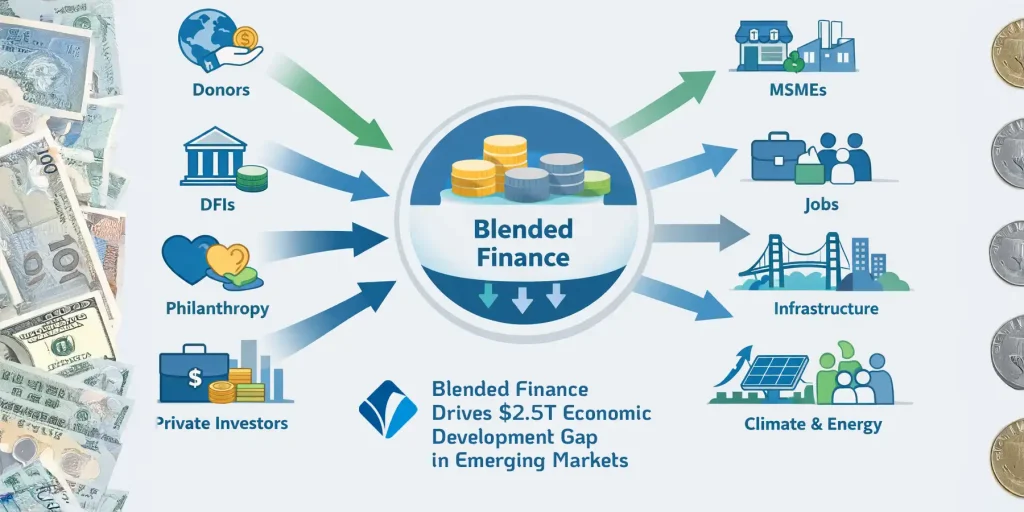
Las finanzas mixtas son el uso estratégico de fondos de desarrollo públicos o filantrópicos para atraer inversión privada hacia proyectos que sirven a objetivos de desarrollo, como la energía limpia, el agua, el financiamiento de pequeñas empresas o la adaptación al cambio climático. Los fondos de desarrollo asumen una parte del riesgo o costo que los inversores privados no aceptarían por sí mismos, de modo que el proyecto se vuelve invertible y el capital privado puede sumarse.
Para ministerios, bancos de desarrollo y equipos de proyectos, la financiación mixta es atractiva porque los presupuestos públicos por sí solos no pueden pagar la inversión que los países necesitan. También es fácil de mal utilizar: los subsidios pueden ir a acuerdos que habrían ocurrido de todos modos, o los proyectos pueden estructurarse de maneras que el sector público no puede gestionar. Esta guía explica cómo funciona la financiación mixta, qué muestran los evidencia y cómo los gobiernos pueden prepararse para ella.
How Blended Finance Works
A typical blended structure has three groups of participants:
- Proveedores de financiación para el desarrollo: donantes, instituciones financieras de desarrollo y fondos filantrópicos que proporcionan fondos concesionales o protección contra riesgos
- Private investors and lenders: banks, funds and companies that provide most of the capital on commercial terms
- The project or borrower: a company, utility, financial institution or public-private partnership that uses the money
The concessional part improves the risk-return balance for private investors. For example, a guarantee may cover some losses, or a first-loss tranche may absorb the first defaults in a loan portfolio, so commercial lenders are willing to lend at terms the project can afford.
The Main Blended Finance Instruments
| Instrument | Cómo funciona | Typical use |
|---|---|---|
| Guarantees | Cover part of the losses lenders or investors may suffer | Infrastructure, small business lending, local currency loans |
| First-loss capital | Absorbs the first losses before other investors are affected | Funds and loan portfolios |
| Concessional or subordinated loans | Lower interest, longer tenor or repaid after senior lenders | Projects with good impact but thin margins |
| Equity | Ownership stake that takes higher risk | Empresas y fondos en fase inicial |
| Grants and technical assistance | Pay for preparation, studies or capacity | Project preparation, market building |
¿Cuánto es un subsidio típico?
IFC publishes data on its own blended concessional finance portfolio. Across a sample covering FY2010 to FY2025, the average concessional level was 4.7 percent of total project cost. IFC describes this as a sample with limits, and it is not a rule for other deals, but it shows an important point: in many transactions, a relatively small concessional share supports a much larger total investment.
The principle behind this is minimum concessionality: using only as much subsidy as needed to make the deal work, so that public money is not wasted and markets are not distorted.
Why Blended Finance Has Fallen Short
The OECD’s 2025 DAC Blended Finance Guidance notes that blended finance has mobilised relatively limited private finance and has not scaled as rapidly as hoped. Common reasons include:
- Too few well-prepared, bankable projects
- Small, one-off deals with high transaction costs
- Limited standardisation, so each deal is negotiated from scratch
- Weak transparency on terms and results
- Currency and country risks that instruments do not fully address
Blended Finance, PPPs and Ordinary Development Loans
Blended finance is often confused with other forms of finance. A public-private partnership is a long-term contract under which a private party delivers and often finances a public service or asset; it may or may not use blended finance. An ordinary development loan finances a government directly, without aiming to mobilise private investors. Blended finance is defined by its purpose: using development money to bring in private capital that would not otherwise come.
How Governments Can Prepare Projects for Blended Finance
- Start with the development goal. Be clear what the project must achieve and how it will be measured.
- Prepare the project properly. Feasibility, environmental and social studies, and a clear revenue model are what investors look at first.
- Identify the real barrier. Is it risk, cost, currency, tenor or market size? The instrument should match the barrier.
- Allocate risks clearly. Decide which risks the public sector, the development partner and private investors each carry.
- Use the least subsidy needed. Test whether the deal would happen with less concessional money.
- Planificar las obligaciones del sector público. Las garantías y los pasivos contingentes deben registrarse y gestionarse.
- Measure and publish results. Track both the private money mobilised and the development outcomes.
A Simple Example
Consider a municipal water utility that needs to replace leaking networks. The investment would reduce water losses and improve revenue, but lenders see the utility as risky. A development bank provides a partial guarantee on a commercial loan, a donor grant pays for the feasibility study and a performance-based contract, and the utility commits to tariff and collection improvements. The guarantee lowers the lenders’ risk, the grant makes the project bankable and the utility’s commitments give lenders confidence. Each party knows exactly which risk it carries.
Quién hace qué dentro del gobierno
Las transacciones de financiación mixta afectan a varias áreas del gobierno, y la debilidad en la coordinación es una razón común por la que se estancan.
| Institution | Rol típico |
|---|---|
| Ministry of finance | Approves guarantees and contingent liabilities, manages fiscal risk and debt |
| Line ministry or utility | Defines the project, prepares studies and manages delivery |
| PPP unit | Structures partnerships, runs competitive selection and monitors contracts |
| Debt management office | Records guarantees and assesses their effect on debt sustainability |
| Regulator | Sets tariffs and service standards that affect project revenue |
| Supreme audit institution | Reviews value for money and the use of public funds |
Agreeing these roles early, and naming one lead institution for each deal, saves months of negotiation.
Financiamiento mixto para el clima y la adaptación
Climate projects are a frequent use of blended finance because many have clear public benefits but uncertain or slow revenue. Renewable energy with a reliable buyer can often attract private lenders with modest support. Adaptation projects, such as flood protection or resilient water supply, are harder: they protect value rather than create new revenue, so they usually need a larger public or grant share, or a revenue source such as a tariff or a public payment linked to performance.
For governments, this means being realistic. Not every climate project can be made attractive to private investors, and forcing a commercial structure onto a project without revenue can create hidden costs for the public budget later.
Habilidades que los gobiernos necesitan para las finanzas mixtas
- Project preparation: feasibility studies, environmental and social assessment and financial models
- Risk analysis: understanding which risks are being transferred and what they could cost
- Negotiation: working with lenders, investors and development partners on term sheets
- Gestión de riesgos fiscales: registro y seguimiento de garantías y pasivos contingentes
- Gestión de contratos: seguimiento del desempeño durante la vida útil del acuerdo
- Results measurement: tracking development outcomes, not only money mobilised
Common Mistakes to Avoid
- Starting with the instrument. Choose the guarantee or loan only after the real barrier is clear.
- Underestimating preparation. Rushed studies lead to expensive renegotiation later.
- Hiding contingent liabilities. Guarantees that are not recorded can become sudden budget costs.
- Measuring only money mobilised. A deal that attracts investors but does not improve services has failed its purpose.
- Relying on advisers alone. Government teams need enough expertise to question advice and own decisions.
Key Terms
- Concessional finance: money provided on terms better than the market, such as lower interest or longer repayment.
- Mobilisation: private finance attracted into a project because of the development finance involved.
- Minimum concessionality: using only the subsidy needed to make the deal happen.
- Contingent liability: a cost the government may have to pay if a specified event occurs, such as a guarantee being called.
- Bankable project: a project prepared well enough that lenders are willing to finance it.
Questions to Ask a Development Partner About a Blended Offer
- What exactly is the concessional element, and why is that amount needed?
- ¿Qué riesgos cubre el instrumento y cuáles se quedan con el gobierno o el proyecto?
- Are there fees, conditions or reporting duties that add cost or delay?
- How will the private finance mobilised be measured and reported?
- What happens if the project underperforms or a guarantee is called?
- Can the structure be repeated for similar projects, or is it a one-off?
Clear answers to these questions help the government compare offers, avoid hidden costs and build a pipeline of deals that can be replicated rather than negotiated from scratch each time.
Construcción de una cartera de proyectos, no acuerdos aislados
Una de las razones por las que las finanzas mixtas no se han ampliado es que muchos acuerdos son pequeños y únicos. Los gobiernos pueden ayudar preparando grupos de proyectos similares, como varias plantas solares o varias empresas municipales de agua, utilizando documentos estándar y términos acordados de reparto de riesgos. Esto reduce los costos de transacción para todos y da a los inversores una razón para desarrollar experiencia en el país.
Transparency and Public Trust
Debido a que las finanzas mixtas utilizan dinero público para respaldar los rendimientos privados, la transparencia es importante. Publicar los términos principales de cada acuerdo, el subsidio involucrado, los riesgos que asume el sector público y los resultados logrados ayuda a los parlamentos, auditores y ciudadanos a juzgar si el dinero fue bien utilizado. También ayuda a otras agencias a aprender de cada acuerdo, lo que apoya la estandarización que las finanzas mixtas necesitan para crecer. Los gobiernos que acuerdan reglas de divulgación con los socios para el desarrollo al principio evitan preguntas difíciles más adelante y construyen la confianza de la que dependen los futuros acuerdos.
Preguntas críticas que deberían plantearse los responsables gubernamentales y de proyectos
Would this investment happen without the subsidy?
Si es afirmativo, no se necesita el dinero concesional. Si es negativo, verifique que el subsidio sea el mínimo requerido.
Do we have bankable projects ready?
La preparación es el cuello de botella más común. Invierta en viabilidad y estructuración antes de buscar inversores.
¿Qué riesgos estamos asumiendo?
Record guarantees and other contingent liabilities, and assess them as part of public debt management.
How will we measure development results?
Acordar los indicadores tanto para la movilización como para los resultados antes de firmar el acuerdo.
Do our teams have the skills to negotiate?
Structuring and negotiating blended deals needs finance, legal and sector expertise inside government.
Cómo puede ayudar Risalat
Risalat supports ministries, utilities and project units on climate finance, PPPs and investment preparation through its programmes and in-house assignments. Teams preparing proposals can start with the free climate finance proposal readiness check, or request a tailored proposal.
Preguntas frecuentes
¿Qué es la financiación mixta?
The use of public or philanthropic development money to attract private investment into projects that serve development goals, usually by taking on some risk or cost that private investors would not accept alone.
What instruments does blended finance use?
Common instruments include guarantees, first-loss capital, subordinated or concessional loans, equity, grants for project preparation and technical assistance.
How much concessional money do blended deals use?
IFC reports that across a sample of its blended concessional finance portfolio from FY2010 to FY2025, the average concessional level was 4.7 percent of total project cost. It is a historical average for that sample, not a rule.
¿Ha movilizado las finanzas mixtas tanto dinero privado como se esperaba?
No. The OECD notes that blended finance has mobilised relatively limited private finance and has not scaled as rapidly as hoped.
Ver
Know people who should read this? Become an Ambassador or write with Risalat.
Socios para el éxito de los proyectos desde 2011: diagnósticos, asesoría y aprendizaje aplicado para ministerios, organismos públicos y equipos de proyecto.
¿Necesita ayuda para llevar esto a la práctica?
Empiece con un diagnóstico gratuito de 10 minutos o hable con nuestros expertos.