Ключевые выводы
- Background and practical significance. A staggering $4 trillion annual financing gap exists in global economic development to meet the Sustainable Development Goals (SDGs).
- Indicators of economic development in emerging markets. Emerging markets show specific developmental characteristics.
- Definition and core principles of blended finance. Blended finance means "the strategic use of development finance and philanthropic funds to mobilize private capital flows to emerging and frontier markets".
- Blended finance vs traditional microfinance models. Traditional microfinance focuses on individual entrepreneurs through small loans, while blended finance tackles larger systemic funding gaps.
- Application for public agencies and donor-funded projects. Green financing for MSMEs has grown by a lot, rising from $4.2 billion annually in 2015 to $14.5 billion in 2020.
In short: How Blended Finance Drives $2.5T Economic Development Gap in requires practical choices about resources, evidence and implementation. This guide explains the main opportunities and constraints, and how organisations can turn the underlying ideas into measurable decisions.
Background and practical significance
Background and practical significance
A staggering $4 trillion annual financing gap exists in global economic development to meet the Sustainable Development Goals (SDGs). Micro, Small, and Medium Enterprises (MSMEs) struggle to access affordable financing, especially in emerging markets, despite their vital role in economies worldwide. These enterprises make up 90% of all businesses and provide more than half of all jobs globally. Africa's employment numbers show MSMEs contributing to 70% of total jobs. Blended finance has emerged as an effective solution to help tackle affordable financing challenge.
Economic development goes beyond simple growth metrics. It includes sustainable business creation, job generation, and better living standards. MSMEs generate 40% of national income in emerging economies and will create 600 million jobs by 2030. These businesses face significant funding hurdles, with Africa's financing gap exceeding $331 billion.
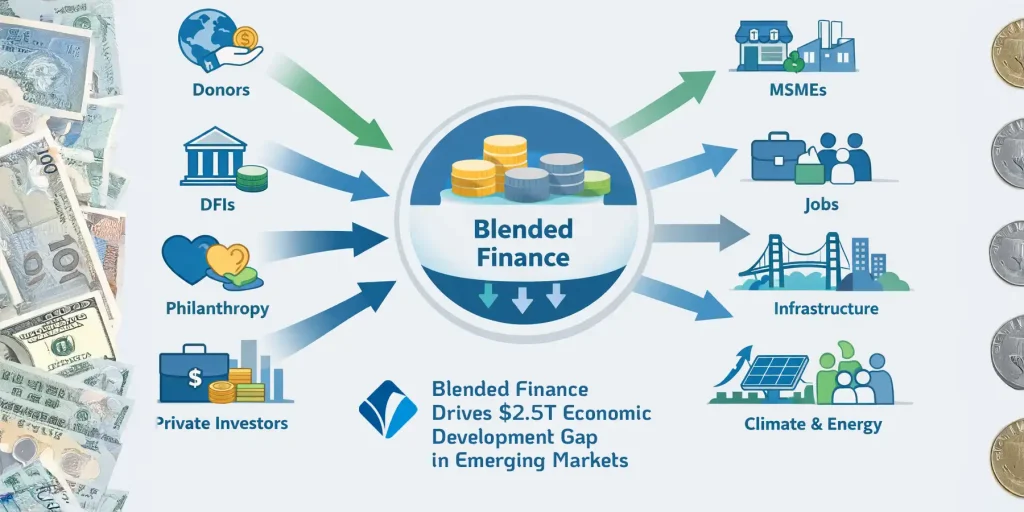
The World Economic Forum defines blended finance as "the strategic use of development finance and philanthropic funds to mobilize private capital flows to emerging and frontier markets". This approach combines donor's concessional funding with resources from development finance institutions or commercial capital. Effective implementation of blended finance requires strong governance and financial management for sustainable project development to ensure transparency, accountability, and confidence among private investors.The goal is to develop private markets and support broader development objectives.
Blended finance shows promise but hasn't reached its full potential. Private capital mobilized through blended finance reached only $14 billion in 2022 – a small fraction of the trillions needed for meaningful economic development. This piece examines how blended finance mechanisms can bridge this gap, boost MSME investments, and accelerate sustainable economic growth in emerging markets.
Understanding the 2.5T Economic Development Gap
The world's economic development faces a huge funding shortfall. The financing gap has grown by 2.9 trillion USD in 2023, showing almost a 50% jump from the deficit recorded just three years earlier.
Что такое экономическое развитие и как его измеряют?
Экономическое развитие выходит за рамки простых показателей роста и включает повышение экономического благосостояния и качества жизни. Экономический рост сосредоточен на производительности рынка и увеличении ВВП, тогда как экономическое развитие представляет собой более широкий процесс повышения общего уровня жизни. Развитие создает физические, человеческие, финансовые и социальные активы, которые обеспечивают более высокое и широко распределенное экономическое благополучие.
Методы оценки опираются на несколько ключевых показателей:
Реальный ВВП на душу населения (с учетом паритета покупательной способности)
Темпы сокращения бедности
Доступ к основным услугам (здравоохранение, образование, безопасная вода)
Развитие инфраструктуры
Показатели ожидаемой продолжительности жизни и младенческой смертности
Индекс человеческого развития (ИЧР) объединяет эти факторы в целостную систему измерения, учитывающую индексы ожидаемой продолжительности жизни, образования и дохода.
For how blended finance drives $2.5t economic development gap in, a useful implementation plan should explicitly consider learning outcomes, institutional roles and the time available for implementation. A responsible decision starts by identifying who experiences the problem, who has authority to respond, and what information would change the proposed action. These questions help separate an attractive concept from a feasible intervention.
For example, an organisation considering a new initiative can document the existing process, consult the people who use it, select a manageable pilot and record its baseline. The pilot should have a named owner, a delivery timetable, a complaints route and a realistic operating budget. Progress should be judged against observed results rather than the number of meetings, workshops or announcements completed.
Показатели экономического развития на развивающихся рынках
Показатели экономического развития на развивающихся рынках
Emerging markets show specific developmental characteristics. These markets achieve rapid economic growth rates of 6-7% annually (versus under 3% for developed economies). On top of that, they typically show increasing industrialization, growing middle classes, improving infrastructure, and rising foreign direct investment. Emerging market economies make up 80% of the world's population and contribute almost 70% of global GDP growth.
Роль ММСП в сокращении разрыва в развитии
Микро-, малые и средние предприятия служат опорой экономического развития во всем мире. На них приходится около 90% всех предприятий и более 50% мировой занятости. В странах с развивающейся экономикой ММСП обеспечивают 40% ВВП.
All the same, MSMEs don't deal very well with financing challenges. Latest data reveals the MSME finance gap across 119 emerging markets stands at approximately, equivalent to 19% of GDP. This gap grows to nearly 9 trillion USD when informal enterprises are included. Women-owned MSMEs face an especially severe shortage, representing 34% of the total gap. These financing constraints need immediate attention to enable job creation and economic diversification that MSMEs uniquely provide. Addressing these challenges requires targeted capacity development, starting with structured learning needs assessment training to align institutional skills with financing and investment-readiness requirements.
Как смешанное финансирование работает на практике
Blended finance helps unlock commercial capital flows for sustainable development, especially in emerging markets. This financial mechanism creates a bridge between public and private sectors and opens up investment opportunities where traditional funding models don't work well.
For how blended finance drives $2.5t economic development gap in, a useful implementation plan should explicitly consider costs, procurement options, stakeholder incentives and the risks of premature scaling. A responsible decision starts by identifying who experiences the problem, who has authority to respond, and what information would change the proposed action. These questions help separate an attractive concept from a feasible intervention.
For example, an organisation considering a new initiative can document the existing process, consult the people who use it, select a manageable pilot and record its baseline. The pilot should have a named owner, a delivery timetable, a complaints route and a realistic operating budget. Progress should be judged against observed results rather than the number of meetings, workshops or announcements completed.
Определение и ключевые принципы смешанного финансирования
Определение и ключевые принципы смешанного финансирования
Blended finance means "the strategic use of development finance and philanthropic funds to mobilize private capital flows to emerging and frontier markets". Different organizations can invest among other partners while meeting their own goals. The key principles help increase capital by extending limited development finance, boost impact through shared knowledge resources, and deliver risk-adjusted returns that match market expectations.
Государственно-частные структуры капитала: капитал первых убытков, гарантии и вложения в капитал
Смешанное финансирование использует несколько механизмов, чтобы снижать риски и привлекать частный капитал:
First-loss capital: Public or philanthropic funds take the original losses to protect private investors. Each dollar of concessional capital can attract 3-10 times more private investment through this strategic layering.
Guarantees and risk insurance: These tools boost credit through assurances against specific risks. Guarantees work best to bring in private finance without requiring immediate fund outflows from donors.
Concessional loans/equity: Below-market terms in the capital structure reduce overall cost and give extra protection to private investors.
Technical assistance: Grant-funded facilities make commercial projects more viable before or after investment.
For how blended finance drives $2.5t economic development gap in, a useful implementation plan should explicitly consider quality assurance, privacy or environmental safeguards where relevant, and transparent reporting. A responsible decision starts by identifying who experiences the problem, who has authority to respond, and what information would change the proposed action. These questions help separate an attractive concept from a feasible intervention.
For example, an organisation considering a new initiative can document the existing process, consult the people who use it, select a manageable pilot and record its baseline. The pilot should have a named owner, a delivery timetable, a complaints route and a realistic operating budget. Progress should be judged against observed results rather than the number of meetings, workshops or announcements completed.
Смешанное финансирование и традиционные модели микрофинансирования
Смешанное финансирование и традиционные модели микрофинансирования
Традиционное микрофинансирование ориентировано на отдельных предпринимателей и предоставляет небольшие займы, тогда как смешанное финансирование устраняет более крупные системные пробелы в финансировании. Микрофинансирование сочетает финансовые услуги с поддержкой развития бизнеса для уязвимых групп. Смешанное финансирование создает многоуровневые структуры капитала, объединяющие институциональных инвесторов, институты финансирования развития и коммерческие банки. Этот подход поддерживает микрофинансирование, предлагая механизмы гарантий. Они помогают микрофинансовым организациям расширять кредитование сверх того, что позволило бы одно лишь донорское финансирование.
Как смешанное финансирование открывает возможности для роста ММСП
ММСП – основа африканской экономики. Эти предприятия обеспечивают до 50% ВВП и около 80% занятости. Они составляют 95% всех предприятий континента, поэтому их успех жизненно важен для устойчивого экономического роста.
Addressing the 331B MSME financing gap in Africa
African small and medium enterprises face a massive funding gap. Ghana's financing shortfall stands at USD 5 billion – one of the continent's largest gaps. Deal Source Africa (DSA) offers innovative solutions through hybrid deal rooms, transaction advisory services, and investment readiness training. DSA has already connected 94 businesses with 18 investors during its pilot phase. Addressing MSME financing gaps also requires strengthening public financial management systems, as seen in ongoing reform efforts such as public financial management reforms in Ghana, which improve budget credibility and investor trust.
For how blended finance drives $2.5t economic development gap in, a useful implementation plan should explicitly consider the difference between a pilot that works once and a process that an institution can sustain. A responsible decision starts by identifying who experiences the problem, who has authority to respond, and what information would change the proposed action. These questions help separate an attractive concept from a feasible intervention.
For example, an organisation considering a new initiative can document the existing process, consult the people who use it, select a manageable pilot and record its baseline. The pilot should have a named owner, a delivery timetable, a complaints route and a realistic operating budget. Progress should be judged against observed results rather than the number of meetings, workshops or announcements completed.
Application for public agencies and donor-funded projects
Смешанное финансирование климатически устойчивого сельского хозяйства и энергетики
Green financing for MSMEs has grown by a lot, rising from $4.2 billion annually in 2015 to $14.5 billion in 2020. This capital supports climate-resilient projects like solar-powered irrigation for smallholder farmers and regenerative agricultural practices. As noted by the World Economic Forum, blended finance initiatives are increasingly being deployed to accelerate climate solutions by aligning private capital behind sustainable development goals.
Green products cost 75-85% more than traditional alternatives. However, blended finance mechanisms combine concessional funding with commercial capital to make these investments viable.
Кейс: GAVI и программы чистой энергетики для ММСП
Global Alliance for Vaccines and Immunisations (GAVI) shows how blended finance benefits MSMEs. GAVI's partnership with programs like the Universal Green Energy Program has aided funding up to 50 million USD. MSMEs represent 55% of the beneficiaries. These program
For how blended finance drives $2.5t economic development gap in, a useful implementation plan should explicitly consider the needs of implementing agencies, suppliers, community representatives and development partners. A responsible decision starts by identifying who experiences the problem, who has authority to respond, and what information would change the proposed action. These questions help separate an attractive concept from a feasible intervention.
For example, an organisation considering a new initiative can document the existing process, consult the people who use it, select a manageable pilot and record its baseline. The pilot should have a named owner, a delivery timetable, a complaints route and a realistic operating budget. Progress should be judged against observed results rather than the number of meetings, workshops or announcements completed.
For a ministry or project implementation unit, the practical sequence is to agree the public purpose, map responsibilities across agencies, identify procurement and safeguard requirements, and record the evidence needed for approval. Where a donor finances the work, the project team should use the applicable financing agreement, procurement framework and environmental and social commitments rather than assuming that one generic procedure applies to every project.
Consider a hypothetical donor-funded programme with a limited implementation period. The project manager could commission a baseline assessment, involve local stakeholders in defining service standards, test the proposed intervention in a small number of sites and evaluate performance before expansion. An independent review of expenditure and outcomes can reveal whether the programme is reaching intended beneficiaries and whether the implementing agency can maintain it after external financing ends.
Implementation checklist
- Define the decision and intended beneficiaries.
- Confirm legal, financial and operational constraints.
- Set a baseline and measurable indicators.
- Assign owners and establish stakeholder feedback.
- Pilot, evaluate and revise before scaling.
Часто задаваемые вопросы
What is the main practical benefit?
It helps decision-makers connect the topic to defined needs, realistic resources and observable outcomes.
What should an organisation assess first?
Start with a baseline, stakeholder needs, delivery responsibilities and applicable legal requirements.
Which implementation risks deserve attention?
Pay attention to affordability, institutional capacity, inclusion, data quality and ongoing maintenance.
How can progress be measured?
Use a small set of baseline-linked indicators, user feedback and periodic independent review.
How does this apply to donor-funded projects?
Apply the project financing agreement and relevant procurement, safeguard, monitoring and reporting obligations.
Знаете тех, кому стоит это прочитать? Станьте амбассадором Risalat или напишите статью вместе с Risalat под своим именем.
Партнеры в успехе проектов с 2011 года: диагностика, консультационная поддержка и прикладное обучение для министерств, государственных ведомств и проектных команд.
Нужна помощь, чтобы применить это на практике?
Начните с бесплатной 10-минутной диагностики или обратитесь к нашим экспертам.