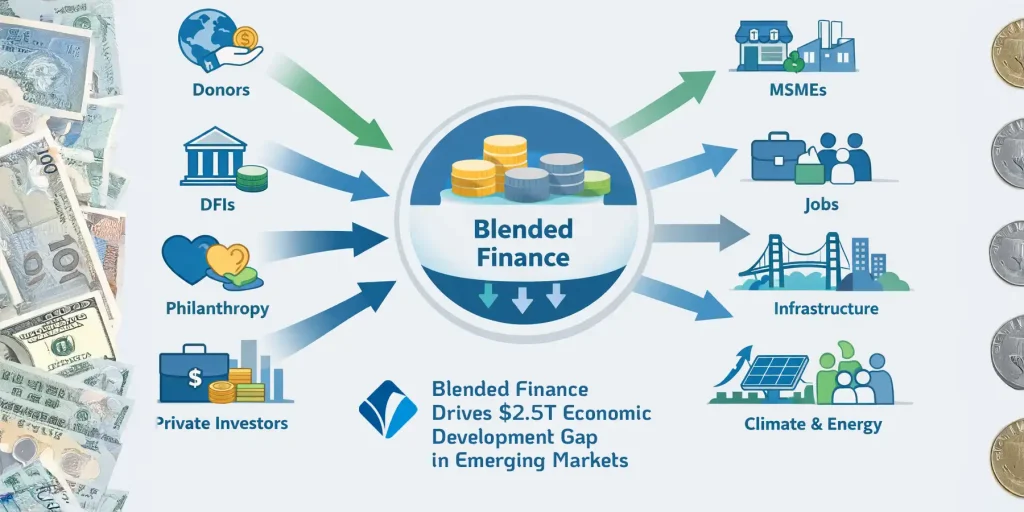
In short: Blended finance explained: how it works, the main instruments, typical concessional levels, why mobilisation falls short and how to prepare projects.
Points essentiels
Blended finance can bring private money into development projects, but only when it is used for the right projects, with the right instruments and no more subsidy than needed.
- A definition. blended finance uses public or philanthropic development money to attract private investment into projects with development goals.
- Many instruments. guarantees, first-loss capital, concessional loans, equity and grants for preparation are the main tools.
- Modest subsidy. IFC reports an average concessional level of 4.7 percent of total project cost across a sample of its deals from FY2010 to FY2025.
- Below expectations. the OECD notes blended finance has mobilised relatively limited private finance and has not scaled as hoped.
- Preparation decides. bankable, well-prepared projects attract private finance; weak ones do not, whatever the subsidy.
Introduction
Blended finance is the strategic use of public or philanthropic development money to attract private investment into projects that serve development goals, such as clean energy, water, small business finance or climate adaptation. The development money takes on a part of the risk or cost that private investors would not accept on their own, so that the project becomes investable and private capital can follow.
For ministries, development banks and project teams, blended finance is attractive because public budgets alone cannot pay for the investment countries need. It is also easy to misuse: subsidies can go to deals that would have happened anyway, or projects can be structured in ways the public sector cannot manage. This guide explains how blended finance works, what the evidence shows and how governments can prepare for it.
How Blended Finance Works
A typical blended structure has three groups of participants:
- Development finance providers: donors, development finance institutions and philanthropic funds that provide concessional money or risk protection
- Investisseurs privés et prêteurs : banques, fonds et entreprises qui fournissent la majeure partie du capital à des conditions commerciales
- The project or borrower: a company, utility, financial institution or public-private partnership that uses the money
The concessional part improves the risk-return balance for private investors. For example, a guarantee may cover some losses, or a first-loss tranche may absorb the first defaults in a loan portfolio, so commercial lenders are willing to lend at terms the project can afford.
The Main Blended Finance Instruments
| Instrument | Comment ça marche | Typical use |
|---|---|---|
| Garanties | Cover part of the losses lenders or investors may suffer | Infrastructure, small business lending, local currency loans |
| Capital de première perte | Absorbe les premières pertes avant que les autres investisseurs ne soient touchés | Funds and loan portfolios |
| Concessional or subordinated loans | Lower interest, longer tenor or repaid after senior lenders | Projects with good impact but thin margins |
| Equity | Ownership stake that takes higher risk | Early-stage companies and funds |
| Grants and technical assistance | Pay for preparation, studies or capacity | Project preparation, market building |
Quel est le montant typique d'une subvention ?
IFC publishes data on its own blended concessional finance portfolio. Across a sample covering FY2010 to FY2025, the average concessional level was 4.7 percent of total project cost. IFC describes this as a sample with limits, and it is not a rule for other deals, but it shows an important point: in many transactions, a relatively small concessional share supports a much larger total investment.
The principle behind this is minimum concessionality: using only as much subsidy as needed to make the deal work, so that public money is not wasted and markets are not distorted.
Why Blended Finance Has Fallen Short
The OECD’s 2025 DAC Blended Finance Guidance notes that blended finance has mobilised relatively limited private finance and has not scaled as rapidly as hoped. Common reasons include:
- Too few well-prepared, bankable projects
- Small, one-off deals with high transaction costs
- Limited standardisation, so each deal is negotiated from scratch
- Weak transparency on terms and results
- Currency and country risks that instruments do not fully address
Blended Finance, PPPs and Ordinary Development Loans
Blended finance is often confused with other forms of finance. A public-private partnership is a long-term contract under which a private party delivers and often finances a public service or asset; it may or may not use blended finance. An ordinary development loan finances a government directly, without aiming to mobilise private investors. Blended finance is defined by its purpose: using development money to bring in private capital that would not otherwise come.
How Governments Can Prepare Projects for Blended Finance
- Start with the development goal. Be clear what the project must achieve and how it will be measured.
- Prepare the project properly. Feasibility, environmental and social studies, and a clear revenue model are what investors look at first.
- Identify the real barrier. Is it risk, cost, currency, tenor or market size? The instrument should match the barrier.
- Allocate risks clearly. Decide which risks the public sector, the development partner and private investors each carry.
- Use the least subsidy needed. Test whether the deal would happen with less concessional money.
- Plan the public sector’s obligations. Guarantees and contingent liabilities must be recorded and managed.
- Measure and publish results. Track both the private money mobilised and the development outcomes.
A Simple Example
Considérons un service d'eau municipal qui doit remplacer des réseaux qui fuient. L'investissement permettrait de réduire les pertes d'eau et d'améliorer les revenus, mais les prêteurs considèrent ce service comme risqué. Une banque de développement accorde une garantie partielle sur un prêt commercial, une subvention de donateur finance l'étude de faisabilité et un contrat fondé sur la performance, et le service s'engage à améliorer ses tarifs et son recouvrement. La garantie réduit le risque des prêteurs, la subvention rend le projet bancable et les engagements du service d'eau donnent confiance aux prêteurs. Chaque partie sait exactement quel risque elle assume.
Who Does What Inside Government
Blended finance deals touch several parts of government, and weak coordination is a common reason they stall.
| Institution | Rôle type |
|---|---|
| Ministry of finance | Approves guarantees and contingent liabilities, manages fiscal risk and debt |
| Line ministry or utility | Defines the project, prepares studies and manages delivery |
| PPP unit | Structures partnerships, runs competitive selection and monitors contracts |
| Debt management office | Records guarantees and assesses their effect on debt sustainability |
| Regulator | Sets tariffs and service standards that affect project revenue |
| Supreme audit institution | Reviews value for money and the use of public funds |
Agreeing these roles early, and naming one lead institution for each deal, saves months of negotiation.
Blended Finance for Climate and Adaptation
Les projets climatiques sont un cas d'utilisation fréquent de la finance mixte, car nombre d'entre eux présentent des avantages publics clairs, mais des revenus incertains ou lents. Énergie renouvelable dotée d'un acheteur fiable peut souvent attirer des prêteurs privés avec un soutien modeste. Les projets d'adaptation, tels que la protection contre les inondations ou l'approvisionnement en eau résilient, sont plus difficiles : ils protègent la valeur plutôt de créer de nouveaux revenus, de sorte qu'ils nécessitent généralement une part publique ou de subvention plus importante, ou une source de revenus telle qu'un tarif ou un paiement public lié à la performance.
For governments, this means being realistic. Not every climate project can be made attractive to private investors, and forcing a commercial structure onto a project without revenue can create hidden costs for the public budget later.
Skills Governments Need for Blended Finance
- Project preparation: feasibility studies, environmental and social assessment and financial models
- Risk analysis: understanding which risks are being transferred and what they could cost
- Negotiation: working with lenders, investors and development partners on term sheets
- Fiscal risk management: recording and monitoring guarantees and contingent liabilities
- Gestion des contrats: suivi des performances tout au long du contrat
- Results measurement: tracking development outcomes, not only money mobilised
Common Mistakes to Avoid
- Starting with the instrument. Choose the guarantee or loan only after the real barrier is clear.
- Underestimating preparation. Rushed studies lead to expensive renegotiation later.
- Hiding contingent liabilities. Guarantees that are not recorded can become sudden budget costs.
- Measuring only money mobilised. A deal that attracts investors but does not improve services has failed its purpose.
- Relying on advisers alone. Government teams need enough expertise to question advice and own decisions.
Key Terms
- Financement concessionnel : fonds accordés à des conditions plus avantageuses que celles du marché, telles que des taux d'intérêt inférieurs ou des délais de remboursement plus longs.
- Mobilisation: private finance attracted into a project because of the development finance involved.
- Minimum concessionality: using only the subsidy needed to make the deal happen.
- Contingent liability: a cost the government may have to pay if a specified event occurs, such as a guarantee being called.
- Bankable project: a project prepared well enough that lenders are willing to finance it.
Questions to Ask a Development Partner About a Blended Offer
- What exactly is the concessional element, and why is that amount needed?
- Quels risques l'instrument couvre-t-il, et lesquels restent à la charge du gouvernement ou du projet ?
- Are there fees, conditions or reporting duties that add cost or delay?
- How will the private finance mobilised be measured and reported?
- What happens if the project underperforms or a guarantee is called?
- Can the structure be repeated for similar projects, or is it a one-off?
Clear answers to these questions help the government compare offers, avoid hidden costs and build a pipeline of deals that can be replicated rather than negotiated from scratch each time.
Building a Pipeline, Not Single Deals
One of the reasons blended finance has not scaled is that many deals are small and unique. Governments can help by preparing groups of similar projects, such as several solar plants or several municipal water utilities, using standard documents and agreed risk-sharing terms. This lowers transaction costs for everyone and gives investors a reason to build expertise in the country.
Transparency and Public Trust
Étant donné que la finance mixte utilise des fonds publics pour soutenir les rendements privés, la transparence est essentielle. Publier les principales conditions de chaque transaction, la subvention impliquée, les risques pris par le secteur public et les résultats obtenus aide les parlements, les auditeurs et les citoyens à juger si l'argent a été bien utilisé. Cela aide également d'autres agences à tirer des enseignements de chaque transaction, ce qui favorise la standardisation dont la finance mixte a besoin pour se développer. Les gouvernements qui conviennent de règles de divulgation avec les partenaires de développement dès le départ évitent les questions difficiles par la suite et renforcent la confiance dont dépendent les transactions futures.
Les questions essentielles que les responsables publics et les chefs de projet devraient se poser
Would this investment happen without the subsidy?
Si oui, l'argent concessionnel n'est pas nécessaire. Si non, vérifier que la subvention est le minimum requis.
Do we have bankable projects ready?
La préparation est le goulet d'étranglement le plus courant. Investissez dans la faisabilité et la structuration avant de rechercher des investisseurs.
Which risks are we taking on?
Record guarantees and other contingent liabilities, and assess them as part of public debt management.
Comment allons-nous mesurer les résultats du développement ?
Agree indicators for both mobilisation and outcomes before the deal is signed.
Do our teams have the skills to negotiate?
Structuring and negotiating blended deals needs finance, legal and sector expertise inside government.
Comment Risalat peut vous aider
Risalat supports ministries, utilities and project units on climate finance, PPPs and investment preparation through its programmes and in-house assignments. Teams preparing proposals can start with the free climate finance proposal readiness check, or request a tailored proposal.
Questions fréquentes
Qu'est-ce que la finance mixte ?
The use of public or philanthropic development money to attract private investment into projects that serve development goals, usually by taking on some risk or cost that private investors would not accept alone.
What instruments does blended finance use?
Common instruments include guarantees, first-loss capital, subordinated or concessional loans, equity, grants for project preparation and technical assistance.
How much concessional money do blended deals use?
IFC reports that across a sample of its blended concessional finance portfolio from FY2010 to FY2025, the average concessional level was 4.7 percent of total project cost. It is a historical average for that sample, not a rule.
Le financement mixte a-t-il mobilisé autant de capitaux privés que prévu ?
Non. L'OCDE note que la finance mixte a mobilisé des financements privés relativement limités et n'a pas progressé aussi rapidement qu'espéré.
Regarder
Know people who should read this? Become an Ambassador or write with Risalat.
Partenaires de la réussite des projets depuis 2011 : diagnostics, conseil et apprentissage appliqué pour les ministères, les organismes publics et les équipes de projet.
Besoin d'aide pour passer à la pratique ?
Commencez par un diagnostic gratuit de 10 minutes ou échangez avec nos experts.