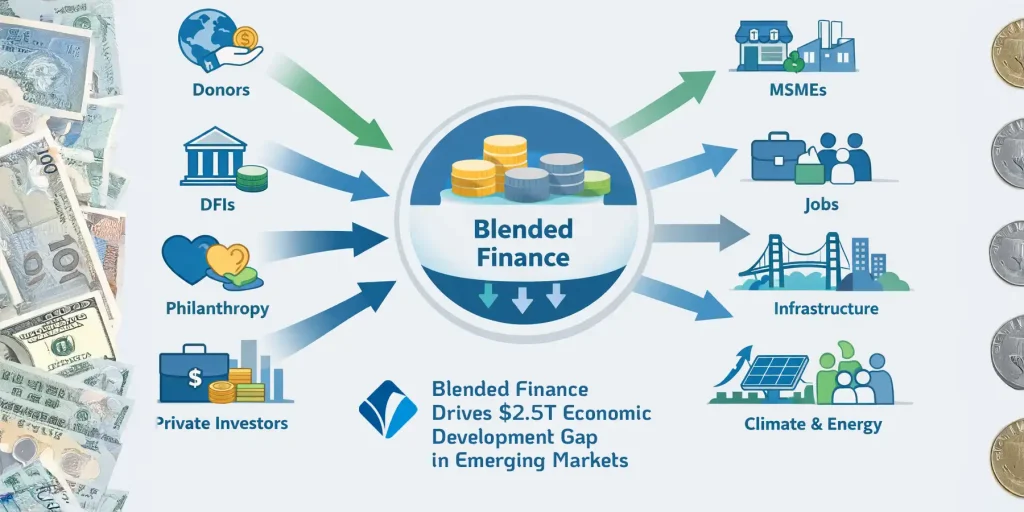
In short: Blended finance explained: how it works, the main instruments, typical concessional levels, why mobilisation falls short and how to prepare projects.
要点总结
混合融资能够为发展项目引入私人资本,但前提是将其用于正确的项目、采用正确的工具,且补贴额度恰到好处。
- 定义。混合融资利用公共或慈善发展资金吸引私人投资于具有发展目标的领域。
- Many instruments. guarantees, first-loss capital, concessional loans, equity and grants for preparation are the main tools.
- Modest subsidy. IFC reports an average concessional level of 4.7 percent of total project cost across a sample of its deals from FY2010 to FY2025.
- Below expectations. the OECD notes blended finance has mobilised relatively limited private finance and has not scaled as hoped.
- Preparation decides. bankable, well-prepared projects attract private finance; weak ones do not, whatever the subsidy.
引言
混合金融是指战略性地利用公共或慈善发展资金,吸引私人投资进入服务于发展目标的项目,例如清洁能源、水务、小微企业融资或气候适应。发展资金承担了私人投资者无法独自接受的一部分风险或成本,从而使项目具备可投资性,并吸引私人资本跟进。
对于各部委、开发银行和项目团队而言,混合融资之所以具有吸引力,是因为仅靠公共预算无法支付国家所需的投资。它也很容易被滥用:补贴可能会流向本来就会进行的交易,或者项目的结构设计可能导致公共部门无法管理。本指南解释了混合融资的工作原理、证据表明的内容以及政府如何为此做好准备。
How Blended Finance Works
A typical blended structure has three groups of participants:
- 发展融资提供方:提供优惠资金或风险保障的捐赠方、发展金融机构和慈善基金
- Private investors and lenders: banks, funds and companies that provide most of the capital on commercial terms
- The project or borrower: a company, utility, financial institution or public-private partnership that uses the money
The concessional part improves the risk-return balance for private investors. For example, a guarantee may cover some losses, or a first-loss tranche may absorb the first defaults in a loan portfolio, so commercial lenders are willing to lend at terms the project can afford.
The Main Blended Finance Instruments
| Instrument | 运作方式 | Typical use |
|---|---|---|
| Guarantees | Cover part of the losses lenders or investors may suffer | Infrastructure, small business lending, local currency loans |
| First-loss capital | Absorbs the first losses before other investors are affected | Funds and loan portfolios |
| Concessional or subordinated loans | Lower interest, longer tenor or repaid after senior lenders | Projects with good impact but thin margins |
| Equity | Ownership stake that takes higher risk | 初创企业与基金 |
| Grants and technical assistance | Pay for preparation, studies or capacity | Project preparation, market building |
典型的补贴金额是多少?
IFC publishes data on its own blended concessional finance portfolio. Across a sample covering FY2010 to FY2025, the average concessional level was 4.7 percent of total project cost. IFC describes this as a sample with limits, and it is not a rule for other deals, but it shows an important point: in many transactions, a relatively small concessional share supports a much larger total investment.
The principle behind this is minimum concessionality: using only as much subsidy as needed to make the deal work, so that public money is not wasted and markets are not distorted.
Why Blended Finance Has Fallen Short
The OECD’s 2025 DAC Blended Finance Guidance notes that blended finance has mobilised relatively limited private finance and has not scaled as rapidly as hoped. Common reasons include:
- Too few well-prepared, bankable projects
- Small, one-off deals with high transaction costs
- Limited standardisation, so each deal is negotiated from scratch
- Weak transparency on terms and results
- Currency and country risks that instruments do not fully address
Blended Finance, PPPs and Ordinary Development Loans
Blended finance is often confused with other forms of finance. A public-private partnership is a long-term contract under which a private party delivers and often finances a public service or asset; it may or may not use blended finance. An ordinary development loan finances a government directly, without aiming to mobilise private investors. Blended finance is defined by its purpose: using development money to bring in private capital that would not otherwise come.
How Governments Can Prepare Projects for Blended Finance
- Start with the development goal. Be clear what the project must achieve and how it will be measured.
- Prepare the project properly. Feasibility, environmental and social studies, and a clear revenue model are what investors look at first.
- Identify the real barrier. Is it risk, cost, currency, tenor or market size? The instrument should match the barrier.
- Allocate risks clearly. Decide which risks the public sector, the development partner and private investors each carry.
- Use the least subsidy needed. Test whether the deal would happen with less concessional money.
- 规划公共部门的义务。必须记录和管理担保及或有负债。
- Measure and publish results. Track both the private money mobilised and the development outcomes.
A Simple Example
Consider a municipal water utility that needs to replace leaking networks. The investment would reduce water losses and improve revenue, but lenders see the utility as risky. A development bank provides a partial guarantee on a commercial loan, a donor grant pays for the feasibility study and a performance-based contract, and the utility commits to tariff and collection improvements. The guarantee lowers the lenders’ risk, the grant makes the project bankable and the utility’s commitments give lenders confidence. Each party knows exactly which risk it carries.
政府内部各司其职
混合融资交易涉及政府的多个部门,协调不力是其陷入停滞的常见原因。
| Institution | 典型角色 |
|---|---|
| Ministry of finance | Approves guarantees and contingent liabilities, manages fiscal risk and debt |
| Line ministry or utility | Defines the project, prepares studies and manages delivery |
| PPP unit | Structures partnerships, runs competitive selection and monitors contracts |
| Debt management office | Records guarantees and assesses their effect on debt sustainability |
| Regulator | Sets tariffs and service standards that affect project revenue |
| Supreme audit institution | Reviews value for money and the use of public funds |
Agreeing these roles early, and naming one lead institution for each deal, saves months of negotiation.
气候与适应混合融资
Climate projects are a frequent use of blended finance because many have clear public benefits but uncertain or slow revenue. Renewable energy with a reliable buyer can often attract private lenders with modest support. Adaptation projects, such as flood protection or resilient water supply, are harder: they protect value rather than create new revenue, so they usually need a larger public or grant share, or a revenue source such as a tariff or a public payment linked to performance.
For governments, this means being realistic. Not every climate project can be made attractive to private investors, and forcing a commercial structure onto a project without revenue can create hidden costs for the public budget later.
政府开展混合融资所需的技能
- Project preparation: feasibility studies, environmental and social assessment and financial models
- Risk analysis: understanding which risks are being transferred and what they could cost
- Negotiation: working with lenders, investors and development partners on term sheets
- 财政风险管理:记录并监督担保与或有负债
- 合同管理: 监督整个交易生命周期的绩效
- Results measurement: tracking development outcomes, not only money mobilised
Common Mistakes to Avoid
- Starting with the instrument. Choose the guarantee or loan only after the real barrier is clear.
- Underestimating preparation. Rushed studies lead to expensive renegotiation later.
- Hiding contingent liabilities. Guarantees that are not recorded can become sudden budget costs.
- Measuring only money mobilised. A deal that attracts investors but does not improve services has failed its purpose.
- Relying on advisers alone. Government teams need enough expertise to question advice and own decisions.
Key Terms
- Concessional finance: money provided on terms better than the market, such as lower interest or longer repayment.
- Mobilisation: private finance attracted into a project because of the development finance involved.
- Minimum concessionality: using only the subsidy needed to make the deal happen.
- Contingent liability: a cost the government may have to pay if a specified event occurs, such as a guarantee being called.
- Bankable project: a project prepared well enough that lenders are willing to finance it.
Questions to Ask a Development Partner About a Blended Offer
- What exactly is the concessional element, and why is that amount needed?
- 该工具涵盖哪些风险,哪些风险仍由政府或项目承担?
- Are there fees, conditions or reporting duties that add cost or delay?
- How will the private finance mobilised be measured and reported?
- What happens if the project underperforms or a guarantee is called?
- Can the structure be repeated for similar projects, or is it a one-off?
Clear answers to these questions help the government compare offers, avoid hidden costs and build a pipeline of deals that can be replicated rather than negotiated from scratch each time.
构建项目储备,而非单一交易
混合融资未能规模化的原因之一是许多交易规模小且具有独特性。政府可以通过使用标准文件和商定的风险共担条款,准备一组相似的项目(例如几个太阳能发电厂或几个市政水务公司)来提供帮助。这降低了所有人的交易成本,并为投资者在该国建立专业知识提供了理由。
Transparency and Public Trust
由于混合融资使用公共资金来支持私人回报,因此透明度至关重要。公布每笔交易的主要条款、所涉及的补贴、公共部门承担的风险以及取得的成果,有助于议会、审计人员和公民判断资金是否得到良好使用。它还帮助其他机构从每笔交易中吸取经验,这支持了混合融资发展所需的标准化。与发展伙伴在初期就达成披露规则的政府可以避免后期的困难问题,并建立未来交易赖以进行的信任。
政府和项目负责人应当提出的关键问题
Would this investment happen without the subsidy?
如果是,则不需要优惠资金。如果否,请检查补贴是否为所需的最低额度。
Do we have bankable projects ready?
准备工作是最常见的瓶颈。在寻求投资者之前,应先投资于可行性研究和架构设计。
我们正在承担哪些风险?
Record guarantees and other contingent liabilities, and assess them as part of public debt management.
How will we measure development results?
在签署协议前就动员和成果指标达成一致。
Do our teams have the skills to negotiate?
Structuring and negotiating blended deals needs finance, legal and sector expertise inside government.
Risalat能提供哪些帮助
Risalat supports ministries, utilities and project units on climate finance, PPPs and investment preparation through its programmes and in-house assignments. Teams preparing proposals can start with the free climate finance proposal readiness check, or request a tailored proposal.
常见问题
什么是混合融资?
The use of public or philanthropic development money to attract private investment into projects that serve development goals, usually by taking on some risk or cost that private investors would not accept alone.
What instruments does blended finance use?
Common instruments include guarantees, first-loss capital, subordinated or concessional loans, equity, grants for project preparation and technical assistance.
How much concessional money do blended deals use?
IFC reports that across a sample of its blended concessional finance portfolio from FY2010 to FY2025, the average concessional level was 4.7 percent of total project cost. It is a historical average for that sample, not a rule.
混合金融调动的私人资金是否达到了预期?
No. The OECD notes that blended finance has mobilised relatively limited private finance and has not scaled as rapidly as hoped.
观看
Know people who should read this? Become an Ambassador or write with Risalat.
自2011年以来始终是项目成功的合作伙伴,为政府部委、公共机构和项目团队提供诊断评估、咨询支持与应用型学习。