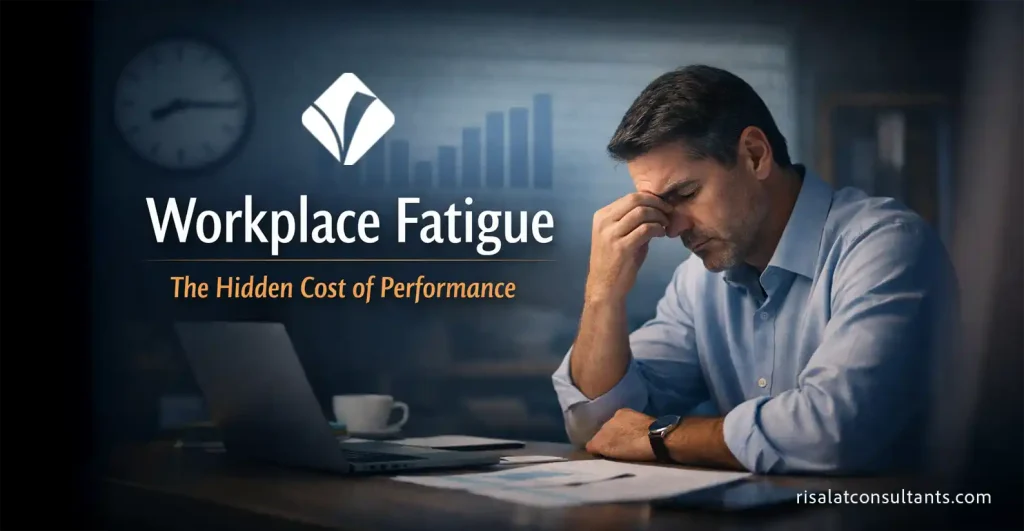
In short: Discover the impact of workplace fatigue on productivity and costs. Learn how to address this hidden challenge in your organization.
Free self-check: the governance self-audit gives a quick check of governance, controls and accountability, in about 10 minutes.
The Hidden Cost of Workplace Fatigue: What Your Budget Isn’t Telling You
Workplace fatigue quietly erodes an organization’s performance. Studies show that 76% of employees feel fatigued during work hours, which reduces productivity by 20%. Each tired employee costs their employer around $2,000 yearly in lost productivity. Most companies don’t factor fatigue into their budget forecasts and operational plans.
Workplace fatigue extends far beyond simple tiredness. Workers struggle when they face long hours, uneven workload distribution, and insufficient recovery time. Research shows that 7 out of 10 employees are either struggling or suffering, leading to presenteeism, disengagement, and rising health costs. Employees who sleep less than six hours per night face a 2.9 times higher risk of workplace injury. With only 35% of the workforce driving the majority of performance outcomes, fatigue becomes a structural business risk. Managing human energy is therefore not optional, it is a strategic necessity.
O Custo Real da Fadiga no Local de Trabalho
“The calculator demonstrates that doing nothing to address fatigue costs employers a lot more than they think.” – Deborah A.P. Hersman, President and CEO of the National Safety Council, leader in workplace safety and health initiatives
A maioria das organizações subestima o verdadeiro impacto financeiro da fadiga no local de trabalho. Mais de um terço dos americanos dorme menos de sete horas por noite, e mais de 10% dormem menos de seis horas. Este défice de sono crónica cria uma crise de desempenho oculta que afeta diretamente a produtividade no local de trabalho, a segurança e a qualidade da tomada de decisões.
The loss in productivity from fatigue shows up in ways that companies rarely track. Employees who sleep fewer than six hours per night cost employers approximately six workdays annually in lost productivity. Those who sleep six to seven hours still cost 3.7 workdays yearly. This drain happens through poor concentration, slower reactions, and reduced brain function.
O Journal of Occupational and Environmental Medicine publicou uma investigação que demonstra que a fadiga pode reduzir a produtividade em 20%. A privação de sono altera as regiões do cérebro que controlam o pensamento. Isto tem um grande impacto na tomada de decisões, na manutenção do foco e na concentração.
Night and rotating shift workers miss work twice as often as day shift workers. The problem gets worse with physical and mental exhaustion building up over time. Workers on shifts lasting 10 hours or longer face higher injury risks. Their performance keeps getting worse throughout these long shifts.
O impacto financeiro para além dos dias de baixa médica
O dinheiro perdido devido à fadiga no local de trabalho atinge montantes impressionantes. Uma empresa com 1.000 colaboradores perde tipicamente cerca de 2,5 milhões de dólares por ano em despesas relacionadas com a fadiga. Isto inclui 671.000 dólares de trabalhadores ausentes e 1,9 milhões de dólares de colaboradores presentes mas com baixo desempenho.
Healthcare costs add another big expense to fatigue-related problems. Companies could save an extra $1.3 million in healthcare spending by helping employees sleep better. Some specific health issues cost even more – one employee with untreated sleep apnea can cost their employer over $7,400 extra in healthcare every year.
The financial impact scales dramatically with organizational size. Research shows that an average Fortune 500 company with approximately 52,000 employees loses nearly $198 million annually due to fatigue-related productivity loss and safety risks. In high-risk sectors such as transportation, a 1,000-employee operation can lose over $1.5 million per year due to fatigue-driven inefficiencies.
Why traditional budgets miss the fatigue factor
Regular budgeting methods can’t catch fatigue-related costs for several reasons. The usual approach takes last year’s numbers as a starting point. It then makes standard changes based on company goals and economic factors like inflation. This creates a fixed picture that doesn’t match the changing nature of human performance.
Rigid budgets cause another big problem. Making these budgets takes three to four months and uses up 20-30% of senior executives’ and financial managers’ time. Once set, these budgets become fixed reference points instead of flexible tools.
Real-world results highlight this disconnect. A study of planning and forecasting found that 55% of people thought their budget assumptions became useless within six months. This happens because standard budgeting systems can’t account for human factors like fatigue that change throughout the year.
What Causes Workplace Fatigue?
Root causes of workplace fatigue stem from organizational structures and personal factors that lead to worker exhaustion. Workplace fatigue happens due to long working hours, poor shift designs, or when workers can’t recover between work periods. This complex issue affects about 20% of US workers who work shifts or alternate their schedules to keep up with our 24-hour society.
Long hours and poor workload design
Long working hours are major contributors to workplace fatigue. Almost a quarter of American workers put in more than 40 hours each week. Both very high and low workload levels can cause fatigue. High-pressure situations force people to concentrate intensely for too long, while boring, repetitive tasks make workers lose focus and become less alert. Work schedules with long shifts, night work, and little recovery time make fatigue worse. Jobs with rotating shifts often give workers little control but high pressure, which creates an exhausting environment.
Lack of recovery time and rest culture
Workers need proper recovery time to avoid fatigue. Irregular shift patterns, especially night work, disrupt the body’s natural sleep cycle and lead to poor sleep quality with frequent interruptions. Shift workers usually get lighter, shorter sleep during the day, and noise often wakes them up. Sleep debt builds up over several workdays when there isn’t enough time between shifts. Short breaks with relaxation activities help reduce job stress and fatigue. However, many organizational cultures implicitly discourage proper recovery periods, as shown by expectations to stay connected outside work hours.
This pattern reflects broader structural shifts in how work is organized and digitized, a transformation examined in our work on Digital Workplace Evolution, where modern workplace design and constant connectivity reshape human performance and energy dynamics.
Emotional exhaustion and mental overload
Os fatores mentais desempenham um papel importante na fadiga no local de trabalho de várias maneiras. As pessoas experienciam sobrecarga cognitiva quando não conseguem processar informação e tomar decisões de forma eficaz. A OMS afirma que o esgotamento (burnout) resulta do stress profissional de longo prazo com três sinais principais: falta de energia, sentimento de distanciamento em relação ao trabalho e pior desempenho profissional. Os empregos que exigem trabalho emocional - onde as pessoas devem controlar os seus sentimentos enquanto trabalham com outros - tornam os trabalhadores especialmente propensos à fadiga. Alguns setores são mais afetados do que outros. Por exemplo, um estudo concluiu que 71,2% dos profissionais de saúde lidaram com fadiga relacionada com o trabalho.
Systemic stressors beyond the workplace
Outside factors make workplace fatigue worse in ways that traditional management often misses. Personal life issues like childcare, working multiple jobs, and home situations affect how tired workers become. Sleep problems from health conditions, medicines, and lifestyle choices add to workplace fatigue. Things like nicotine, caffeine, and alcohol affect sleep quality. The spillover-crossover model shows how work experiences affect home life and family members. This creates a cycle where family responsibilities prevent proper rest and increase workplace fatigue. Temp workers face unique challenges and report more fatigue along with longer, irregular, and unpredictable hours compared to permanent staff.
How Workplace Fatigue Undermines Organizational Capacity
“Many of us have been conditioned to just power through our fatigue, but worker health and safety on the job are compromised when we don’t get the sleep we need.” – Deborah A.P. Hersman, President and CEO of the National Safety Council, leader in workplace safety and health initiatives
Fatigue reduces an organization’s ability to operate well and creates ripple effects across systems. Research shows that fatigue works like alcohol in our bodies – being awake for 17 hours equals a blood alcohol content of 0.05. After 21 hours without sleep, it matches the legal limit of 0.08.
Tomada de decisões e inovação reduzidas
A fadiga prejudica a nossa capacidade de pensar e planear tarefas complexas. Os trabalhadores tomam piores decisões quando estão cansados, o que conduz a um fraco desempenho no local de trabalho. Os primeiros sinais manifestam-se no adiamento de decisões e em atrasos. Se não forem controladas, as pessoas tornam-se menos dispostas a assumir riscos inteligentes e deixam de apresentar novas ideias. As empresas tecnológicas mais afetadas pela fadiga de mudança registaram uma queda de 7,2 pontos percentuais nas suas margens operacionais. Os seus retornos totais para os acionistas caíram 12,4 pontos percentuais ao longo de três anos, em comparação com as empresas que lidaram melhor com o problema.
Increased errors and safety risks
Safety problems from workplace fatigue are serious. Tired workers react slower, process information poorly, forget things, and stay less alert. In fact, fatigue played a role in major disasters like the Chernobyl nuclear accident, Texas City incident, and Exxon Valdez oil spill. Night shift workers face 30% more workplace accidents than morning shift workers. Fatigue causes 20% of major road accidents, which costs between £115-£240 million yearly in work accidents.
Impact on project delivery and timelines
Gestão de projetos takes a big hit from fatigue. Teams dealing with ongoing change fatigue see 45% fewer suggestions from employees and 38% less experimental work. Project fatigue damages project management offices and their goals, especially when wrapping up projects. Teams lose most project managers during the execution phase, which creates uncertainty.
Presenteeism vs absenteeism: the hidden drain
Presenteeism (coming to work sick) hurts organizations more than absenteeism, though both damage workplace morale and productivity. Money lost from presenteeism can be 1.5 times more than losses from absenteeism. Studies confirm that presenteeism, not absenteeism, makes workers more likely to face moderate or severe exhaustion. Both issues hurt work performance, even when accounting for health status and other factors. This hidden problem leads to more mistakes, lower quality work, and reduces team productivity.
Managing Workplace Fatigue at the Organizational Level
Organizations must approach workplace fatigue as a systemic operational risk rather than an individual weakness. Sustainable performance requires redesigning work structures, leadership practices, and recovery systems. A structured fatigue management framework strengthens institutional resilience, reduces safety incidents, and protects long-term productivity.
Fatigue management is therefore not only a productivity concern but a safety imperative. This connection between worker energy, regulatory compliance, and operational risk was central to our work in the Occupational Safety & Health Administration – Amsterdam program, where structured safety governance frameworks were explored to mitigate fatigue-related risks.
Redesigning schedules and workload distribution
Os horários de rotação de dia para tarde e noite funcionam melhor do que os padrões de rotação inversa porque correspondem aos nossos ritmos biológicos naturais. Manter os turnos abaixo de 12 horas ajuda a prevenir a acumulação de fadiga. As organizações devem definir limites claros de horas de trabalho com intervalos obrigatórios: 15 minutos a cada 2,5 horas, 30 minutos após 5 horas e mais 30 minutos após 10 horas. As equipas podem reduzir o esforço físico e mental partilhando tarefas entre os membros.
Embedding rest and recovery into operations
Recovery isn’t just nice to have – it’s a skill that needs planning and boundaries. Work design must include recovery through:
- Proper sleep facilities when needed
- Recovery areas with quiet zones and green spaces
- Regular no-meeting times in calendars
- Short breaks that boost thinking ability and energy
Studies show that good recovery leads to better sleep, stronger resilience, higher job satisfaction, and less emotional exhaustion.
Training managers to recognize and respond to fatigue
Supervisors play a crucial role in spotting employee fatigue. Manager training should show how energy affects problem-solving, listening, critical thinking, and patience, essential leadership skills. Low energy brings irritability, negativity, lack of interest, and poor focus. Training must cover early fatigue signs, company policies to handle issues, and regular reviews to keep improving.
Effective performance systems are a cornerstone of sustainable workforce energy and organizational success. Our Effective Performance Management Training in Goa helps leaders align performance expectations, coaching practices, and energy-aware evaluation approaches to reduce fatigue-related productivity loss and build resilient teams.
Creating feedback loops to monitor energy levels
Bons sistemas de feedback ajudam a rastrear os níveis de fadiga em toda a organização. As auditorias de energia ajudam os gestores a identificar os seus padrões de energia e a trabalhar na “zona de utilidade”. Isto ajuda as pessoas a monitorizar a sua energia ao longo do dia e a agendar tarefas difíceis quando estão mais alertas. Ferramentas como dispositivos vestíveis, software de desempenho e autorrelatos fornecem informações úteis para gerir a fadiga.
Os sistemas de monitorização e avaliação estratégica são essenciais para transformar dados em melhoria de desempenho. Através do nosso trabalho de Monitorização e Avaliação de Desempenho Estratégico em Espanha, as organizações aprendem a avaliar padrões de energia humana, integrar indicadores de bem-estar em painéis de desempenho e incorporar a melhoria contínua nos sistemas de trabalho.
Building a Culture of Sustainable Energy to Reduce Workplace Fatigue
Organizations that prioritize sustainable human energy outperform those that rely on endurance and overextension. When employees perceive that wellbeing is genuinely valued, engagement, creativity, and retention improve significantly. Building an energy-aware culture shifts performance management from pressure-driven output to long-term productivity sustainability.
Práticas de liderança que priorizam o bem-estar
Leaders build the foundation for organizational energy sustainability through their daily actions. Leaders affect workplace mental health more than doctors or therapists, according to research. Good leaders show empathy, create psychological safety, and set an example for wellbeing behaviors. They take real breaks during vacations, set clear email boundaries, and hold walking meetings.
Shifting from grind culture to performance sustainability
The traditional grind culture celebrates constant hustle and long hours. This leads to burnout, poor work-life balance, and high turnover rates. Performance sustainability focuses on energy clarity rather than constant intensity. Leadership becomes about sustainability rather than endurance after age 40. Leaders who practice sustainability make better decisions under pressure and communicate better.
Institutionalizing energy management policies
Organizations need clear policies with principles and specific targets to manage energy effectively. These policies should offer flexibility, which helps boost employee participation, loyalty and retention. Companies should reward sustainable behaviors to show they value energy management. Your organization might need to rethink capacity building if it faces productivity loss, delivery delays, or staff burnout. Risalat’s global learning and development programs can strengthen organizational resilience, boost workforce performance, and embed green energy management into your governance and operations.
A fadiga no local de trabalho não é uma fraqueza pessoal, é um risco estrutural de governação. As instituições que medem, gerem e desenham em torno da energia humana superam consistentemente aquelas que a ignoram. Se a sua organização está a enfrentar um declínio na produtividade, atrasos na entrega de projetos ou aumento do esgotamento, a solução não é o aumento da pressão, mas sim um desenho de trabalho mais inteligente.
Integrar estes princípios nos sistemas de recursos humanos exige estratégias estruturadas de recursos humanos. A nossa formação em Gestão Sustentável de Recursos Humanos apoia as organizações a alinhar o bem-estar, a produtividade e o desempenho a longo prazo através do desenho sustentável da força de trabalho.
Utilização de tecnologia para monitorizar e apoiar os níveis de energia
Employees welcome on-the-job data collection to improve their performance and wellbeing – 90% support this approach. However, companies must avoid stealth monitoring as it hurts trust and morale. The right technology helps managers spot early signs of burnout and optimize workflows. This enables them to provide customized support.
Aligning human energy with strategic goals
Organizations achieve measurable strategic gains when human energy management aligns with corporate objectives. Companies in the top 20% for employee wellbeing outperform the S&P 500 by approximately 520 basis points in stock performance. The data is clear: investing in workforce energy is not a wellness initiative, it is a competitive advantage.
Ver
Know people who should read this? Become an Ambassador or write with Risalat.
Parceiros no sucesso dos projetos desde 2011: diagnósticos, apoio consultivo e aprendizagem aplicada para ministérios, organismos públicos e equipas de projeto.
Precisa de ajuda para pôr isto em prática?
Comece com um diagnóstico gratuito de 10 minutos ou fale com os nossos especialistas.