关键信息
- 日期
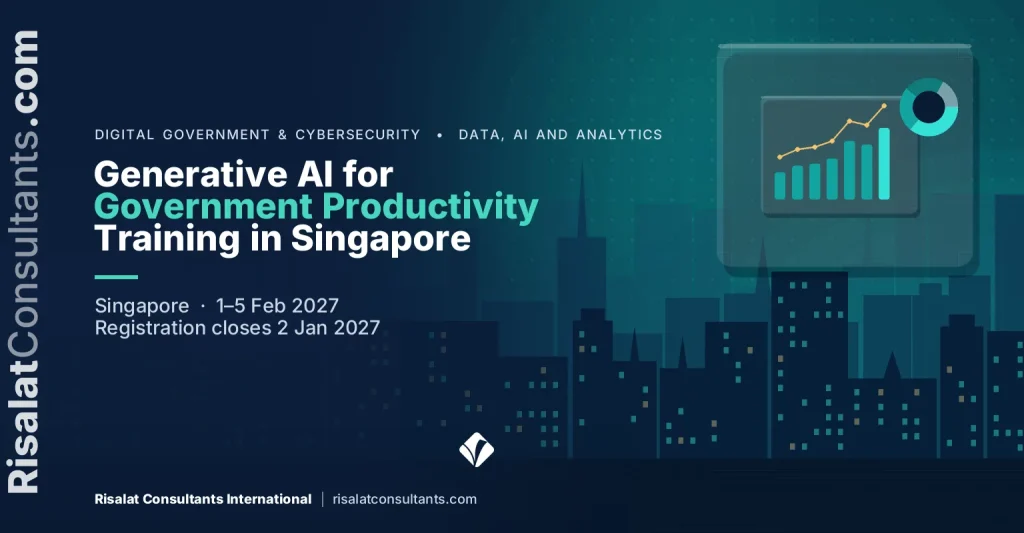
- 2027年2月1–5日(5天)
- 地点
- 新加坡
- 每位学员费用
- £3,450(英镑)
- 付款
- 通过发票和银行转账付款
- 报名截止
- 2027年1月2日
- 形式
- 5-day short course: a practical capacity-building programme for government, NGO and project teams in Singapore
- 证书
- 结业证书
- 内训选项
- 按您的日期,为您的团队专场举办
本页内容16个部分
培训项目概述
Public sector organisations face growing pressures to deliver complex programmes with constrained administrative resources. Generative artificial intelligence offers immediate opportunities to enhance productivity across civil services, project implementation units, and public bodies. This five-day course equips participants with the practical skills required to integrate generative AI tools into routine workflows, including policy drafting, briefing preparation, donor reporting, and structured stakeholder communications, ensuring public servants can produce high-quality documentation in significantly less time.
Free self-check: the digital readiness assessment gives how ready your institution is for digital services, data and AI, in about 10 minutes.
Effective public sector deployment requires strict adherence to institutional standards, accuracy, and rigorous oversight. Participants will examine foundational prompt engineering techniques, structured output evaluation, and methods for mitigating algorithmic hallucinations. By working through realistic public administration scenarios, attendees learn how to interrogate AI-generated content critically, cross-reference source material, and maintain robust accountability mechanisms that satisfy the verification standards expected by national governments, development banks, and international oversight entities.
Hosted in Singapore, a recognised leader in digital government and public sector innovation, the programme addresses critical governance dimensions. Attendees examine data privacy, confidentiality protocols, and intellectual property risks associated with commercial and open-source models. The curriculum guides participants in establishing practical institutional guidelines, acceptable use policies, and team workflows, allowing organisations to harness productivity gains safely while upholding public trust and aligning with international principles on ethical artificial intelligence.
Governments and donor-financed projects supporting economic development, public sector modernisation, and infrastructure delivery are integrating artificial intelligence at a rapid pace. Multilateral frameworks, including the OECD AI Principles, the UNESCO Recommendation on the Ethics of Artificial Intelligence, and the European Union AI Act, now establish clear expectations for transparent, secure, and responsible deployment. Public institutions and project implementation units must ensure their personnel possess the operational capability to utilise these technologies safely, protecting sensitive public data while meeting the heightened reporting and efficiency requirements of international financing partners.
本培训项目由Risalat Consultants International在新加坡举办,结合专家主讲、真实案例与小组练习,帮助学员将所学应用于本单位工作。
The Programme Strengthens Institutional Capability
- Core architectures of large language models and operational implications for public administration
- Landscape of public sector generative AI: capabilities, common constraints, and failure modes
- Alignment with international standards: OECD AI Principles and UNESCO Ethics Recommendations
- Identifying high-value, low-risk administrative workflows suited for immediate AI integration
- Practical laboratory: establishing secure individual accounts, tool baselines, and interface setup
- Principles of structured prompt design: context provision, constraints, role specification, and formatting
- Drafting ministerial correspondence, press releases, and executive speaking notes using zero-shot and few-shot methods
- Developing terms of reference, project concepts, and standard operating procedures for donor operations
- 数字战略与转型规划
- 数据治理与数据质量
- 数据分析与可视化
- 网络安全基础与风险管理
It is designed for senior civil servants and public agency directors seeking to improve departmental workflow efficiency, project directors and managers of donor-financed projects funded by the World Bank, ADB, AfDB, EU, and UN, public sector policy analysts, researchers, and technical advisors responsible for documentation and strategy and others who want practical, current skills in digital government, data and technology.
- 收集
- 清洗
- 存储
- 分析
- 决策
The Growing Importance of Generative AI for Government Productivity
数字服务、数据和新技术正在改变机构的工作方式和服务公民的方式。做得好,服务将更快捷、更经济、更透明;做得不好,则会浪费资金并使数据面临风险。
机构需要能够规划数字化变革、负责任地管理数据、保护系统并在决策中运用数据证据的人才。如今,这些技能已是所有职能部门的普遍要求,而不仅限于IT部门。
各机构日益需要具备以下能力的专业人员:
- 规划切实解决问题的数字化举措
- 管理数据质量、保护与共享
- 分析数据并清晰呈现
- 管理网络与技术风险
- 带领员工完成数字化变革
健全的数字政府、数据与技术体系有助于机构:
- 提供更快捷、更便利的服务
- 在决策中更好地利用数据
- 保护系统和个人数据
- 从技术投资中获取价值
This Generative AI for Government Productivity programme brings these elements together in a practical format, so that participants understand not only what good practice looks like but also how to introduce it in their own setting, with the people and resources they have.
Who Should Attend This Generative AI for Government Productivity Training?
本培训项目适合:
- Senior civil servants and public agency directors seeking to improve departmental workflow efficiency
- Project directors and managers of donor-financed projects funded by the World Bank, ADB, AfDB, EU, and UN
- Public sector policy analysts, researchers, and technical advisors responsible for documentation and strategy
- Monitoring and evaluation officers requiring enhanced tools for data synthesis and qualitative reporting
- Procurement, contract administration, and project operations professionals in implementation units
- Communication officers, press secretaries, and public engagement specialists in public authorities
- Digital transformation leads, institutional development advisers, and administrative reform team members
- Legal, governance, and compliance officers responsible for internal acceptable use guidelines and data integrity
- 信息通信技术经理与官员
- 数字化转型负责人
- 数据分析师与统计人员
- 信息安全官员
本培训项目既适合经验丰富的专业人员,也适合刚承担新职责的人员。我们鼓励来自不同机构和国家的学员组成混合小组,因为学员能从彼此的经验中获益良多。
勾选您的团队需要具备的能力。
Generative AI for Government Productivity Training Objectives
Upon successful completion of this Generative AI for Government Productivity Training, participants will be able to:
- Apply structured prompt engineering techniques to draft complex policy briefs, operational manuals, and project documentation
- Synthesise lengthy multi-sector reports, evaluations, and stakeholder submissions using verified generative AI models
- Implement systematic verification protocols to detect hallucinations, biases, and factual inaccuracies in AI-generated drafts
- Assess data protection, confidentiality, and cybersecurity risks before introducing institutional data into AI systems
- Align everyday artificial intelligence workflows with the OECD AI Principles and the UNESCO Recommendation on the Ethics of AI
- Formulate organisation-specific acceptable use policies, compliance checklists, and risk tiers for departmental deployment
- Design phased departmental productivity roadmaps to integrate generative AI tools into daily project administration
- 阐述数字政府与数据应用的主要趋势
- 规划与服务目标挂钩的数字化举措
- 运用数据治理和质量原则
每项目标都会在培训期间通过练习、案例或小组作业加以实践,使学员结业时不仅能够描述,更能够实际运用。
培训项目内容与结构
- Core architectures of large language models and operational implications for public administration
- Landscape of public sector generative AI: capabilities, common constraints, and failure modes
- Alignment with international standards: OECD AI Principles and UNESCO Ethics Recommendations
- Identifying high-value, low-risk administrative workflows suited for immediate AI integration
- Practical laboratory: establishing secure individual accounts, tool baselines, and interface setup
- Principles of structured prompt design: context provision, constraints, role specification, and formatting
- Drafting ministerial correspondence, press releases, and executive speaking notes using zero-shot and few-shot methods
- Developing terms of reference, project concepts, and standard operating procedures for donor operations
- Techniques for chain-of-thought prompting to address multi-step policy inquiries and planning scenarios
- Practical laboratory: creating a reusable institutional prompt repository for routine departmental drafting
- Techniques for processing, summarising, and extracting key findings from technical studies and evaluations
- Conducting rapid qualitative thematic analysis across citizen feedback, surveys, and stakeholder submissions
- Integrating AI into literature reviews and comparative policy research while preserving academic integrity
- Querying and structuring complex unstructured data for monitoring, evaluation, and donor progress reporting
- Practical laboratory: transforming multi-volume project appraisal documents into concise operational briefs
- Mitigating hallucinations: source attribution, automated verification loops, and human-in-the-loop review
- Protecting official data: commercial training opt-outs, enterprise data isolation, and credential management
- Addressing bias, inclusion, and representation risks in automated drafting and policy analysis
- Compliance benchmarks: learning from the EU AI Act risk categorisation and cross-border data transfer rules
- Practical laboratory: red-teaming government prompts to identify vulnerabilities, bias, and output errors
- Drafting acceptable use policies and operational guidelines for ministerial and project teams
- Establishing risk-tier matrices for categorising permitted, restricted, and prohibited AI tasks
- Change management strategies for overcoming administrative resistance and standardising usage
- Measuring administrative productivity gains and operational quality impacts across project teams
- Cap-stone exercise: presenting a departmental AI adoption roadmap and institutional governance framework
完整的每日课程内容
本培训项目为期5天。每天均包含专家讲授、实践练习,并以研讨会或案例研究收尾:
- First Day: Generative AI Foundations and Public Sector Applications
- Second Day: Advanced Prompting for Drafting, Briefings, and Correspondence
- Third Day: Information Synthesis, Qualitative Research, and Data Analysis
- Fourth Day: Verification, Risk Mitigation, and Data Governance
- Fifth Day: Institutional Adoption, Guidelines, and Operational Roadmaps
完整的每日课程内容
First Day | Generative AI Foundations and Public Sector Applications
- Core architectures of large language models and operational implications for public administration
- Landscape of public sector generative AI: capabilities, common constraints, and failure modes
- Alignment with international standards: OECD AI Principles and UNESCO Ethics Recommendations
- Identifying high-value, low-risk administrative workflows suited for immediate AI integration
- Practical laboratory: establishing secure individual accounts, tool baselines, and interface setup
Workshop: Generative AI Foundations and Public Sector Applications: Applying It to Your Institution
学员分成小组,将当天所学方法应用于本机构的实例,并商定切实可行的后续步骤。
Second Day | Advanced Prompting for Drafting, Briefings, and Correspondence
- Principles of structured prompt design: context provision, constraints, role specification, and formatting
- Drafting ministerial correspondence, press releases, and executive speaking notes using zero-shot and few-shot methods
- Developing terms of reference, project concepts, and standard operating procedures for donor operations
- Techniques for chain-of-thought prompting to address multi-step policy inquiries and planning scenarios
- Practical laboratory: creating a reusable institutional prompt repository for routine departmental drafting
Workshop: Advanced Prompting for Drafting, Briefings, and Correspondence: Applying It to Your Institution
学员分成小组,将当天所学方法应用于本机构的实例,并商定切实可行的后续步骤。
Third Day | Information Synthesis, Qualitative Research, and Data Analysis
- Techniques for processing, summarising, and extracting key findings from technical studies and evaluations
- Conducting rapid qualitative thematic analysis across citizen feedback, surveys, and stakeholder submissions
- Integrating AI into literature reviews and comparative policy research while preserving academic integrity
- Querying and structuring complex unstructured data for monitoring, evaluation, and donor progress reporting
- Practical laboratory: transforming multi-volume project appraisal documents into concise operational briefs
Case Study: Information Synthesis, Qualitative Research, and Data Analysis in Practice
学员分析真实案例,将案例中的决策与良好实践进行比较,并总结出可在自身环境中运用的经验。
Fourth Day | Verification, Risk Mitigation, and Data Governance
- Mitigating hallucinations: source attribution, automated verification loops, and human-in-the-loop review
- Protecting official data: commercial training opt-outs, enterprise data isolation, and credential management
- Addressing bias, inclusion, and representation risks in automated drafting and policy analysis
- Compliance benchmarks: learning from the EU AI Act risk categorisation and cross-border data transfer rules
- Practical laboratory: red-teaming government prompts to identify vulnerabilities, bias, and output errors
Workshop: Verification, Risk Mitigation, and Data Governance: Applying It to Your Institution
学员分成小组,将当天所学方法应用于本机构的实例,并商定切实可行的后续步骤。
Fifth Day | Institutional Adoption, Guidelines, and Operational Roadmaps
- Drafting acceptable use policies and operational guidelines for ministerial and project teams
- Establishing risk-tier matrices for categorising permitted, restricted, and prohibited AI tasks
- Change management strategies for overcoming administrative resistance and standardising usage
- Measuring administrative productivity gains and operational quality impacts across project teams
- Cap-stone exercise: presenting a departmental AI adoption roadmap and institutional governance framework
Capstone Exercise: Generative AI for Government Productivity Action Plan for Your Institution
学员将一周所学整合为本机构的行动计划,明确优先事项、负责人和初步行动,并进行展示,听取同伴和讲师的反馈。
Generative AI for Government Productivity Training Methodology
The training employs an applied, hands-on methodology tailored specifically to the operational realities of government ministries and donor-financed project units. Instruction alternates between interactive briefings on technical standards, live software demonstrations, and extensive workstation exercises using non-confidential public sector datasets. Participants complete individual drafting assignments, collaborative policy simulations, and peer critique sessions focused on output accuracy. Each delegate works directly with current tools to test prompt architectures, audit machine responses for factual reliability, and build tailored administrative frameworks ready for immediate workplace application.
本培训项目融合了:
- 专家主讲当前实践
- 区域及国际案例研究
- 小组作业与实践练习
- 视情况安排模拟演练与角色扮演
- 探讨学员自身面临的挑战
- 跨机构、跨国家的同伴学习
- 可带回工作岗位的实用工具与模板
- 每日反思与行动规划
培训开始前,简短的课前评估可帮助讲师了解每位学员的岗位职责和重点关注事项,以便根据学员群体调整案例和练习。每天结束时安排简短的反思环节,学员记录下将在工作中应用的内容。
预期成果
Upon completion of this Generative AI for Government Productivity Training, participants will be able to:
- Produce fully articulated institutional briefs, project summaries, and formal correspondence in significantly reduced timeframes
- Execute rigorous auditing protocols that verify the accuracy, citations, and logic of artificial intelligence outputs
- Protect institutional information by applying rigorous data classification rules to external software interfaces
- Deploy a functional repository of custom system prompts designed for public policy, reporting, and administrative tasks
- Implement an institutional acceptable use policy that defines operational permissions, constraints, and audit trails
- Lead internal departmental training and workflow modernisation initiatives aligned with international ethical frameworks
- 规划与服务目标挂钩的数字化举措
- 运用数据治理和质量原则
学员结业时将获得个人行动计划和实用工具,回到工作岗位的第一周即可在机构中应用。派出多名学员的机构可借助本培训项目,在各团队之间统一方法和模板,使改进成果更易持续。
每位学员£3,450 · 发票与银行转账 · 5人及以上团体可享折扣
同一机构五人及以上:请在申请发票时索取团体价。
Ten or more: an in-house version for your institution may cost less per person. Ask for an in-house quote.
注册截止于 43天后 (2027年1月2日)
Institutional Application of Generative AI for Government Productivity Training
本培训项目帮助机构加强:
- 数字战略
- 数据治理
- 数据驱动的决策
- 网络安全
- 技术管理
学员将带着实用工具回到工作岗位,以提升:
- 数据清单
- 仪表板
- 风险登记册
- 技术采购
- 变革计划
本培训项目的设计旨在让学习成果从课堂延伸至机构。学员尽可能围绕自身的流程和文件开展练习,并在结业时带走一份可供其主管审阅和支持的行动计划。
区域相关性与应用
欧洲
欧洲机构在详尽的监管框架和改革议程下开展数字政府、数据与技术工作。来自欧洲的学员可以将自身实践与其他地区的同行进行比较,并检验成熟方法在不同条件下的适用性。
非洲
在整个非洲,从事数字政府、数据与技术工作的政府部委、机构和项目团队,越来越多地与捐助方资助的项目协同运作,而这些项目要求有清晰的制度和证据。本培训项目帮助学员将良好实践与其所在机构及可用资源相结合。
中东
在中东,国家发展战略和多元化计划对数字政府、数据与技术提出了越来越高的要求。学员将探讨如何在公共机构和企业内部建立实现这些计划所需的能力。
亚洲
亚洲各国的机构在快速发展的同时,推进着雄心勃勃的现代化计划。来自亚洲的学员可以分享快速扩展系统的经验,并借鉴其他地区的做法。
太平洋地区
小岛屿国家和太平洋国家在规模、距离和能力方面面临特殊制约。本培训项目重点介绍适合小型机构、务实且适度的数字政府、数据与技术方法。
在新加坡举办本培训项目,可使学员暂时远离日常工作压力,共同比较不同环境下数字政府、数据和技术的推进方式。本项目也可为单个机构在其本国或以线上方式举办内训,并采用该机构当前工作中的案例。
东道国概况:新加坡
Risalat Consultants International在新加坡举办的培训项目、研讨会、实地见习与培训课程
在本国以外学习,可让学员专心投入,以全新视角审视本机构,并有机会与其他国家的同行建立人脉网络。
Generative AI for Government Productivity Training Deliverables
学员在培训前、培训中及培训后均可获得支持,使准备、学习与跟进形成连贯完整的体验。
培训开始前
- 学员课前评估
- Generative AI for Government Productivity Readiness Assessment
- Generative AI for Government Productivity Resource Pack
- 课前阅读资料
- 免费签证支持与咨询
培训期间
- 机场接机与欢迎协助
- Accommodation with breakfast: 6 nights, check-in Sunday 31 January 2027, check-out Saturday 6 February 2027 (one night before and one night after the programme)
- 欢迎交流晚宴
- Risalat培训礼包(背包、水瓶、马克杯、T恤、帽子、护照套、笔、笔记本、冰箱贴及钥匙扣)
- Comprehensive Generative AI for Government Productivity Training Manual
- 数字化成熟度检查清单
- 数据清单模板
- 仪表板规划模板
- 技术风险登记册
- 实践研讨与模拟演练
- 小组讨论与同伴学习
- 每日午餐与茶歇
- 全面使用培训场地设施
- 装有数字学习资料的迷你平板电脑
- 实地考察(如适用)
- 城市休闲观光
培训结束后
- 结业证书
- Risalat培训项目参与表彰奖
- 培训后参考资料
- 数据治理自我评估
- 数字项目审查检查清单
- 培训后支持与跟进指导
- 培训项目报告
Institutions can also request a tailored in-house version of this programme, delivered at their premises or online. Request a proposal.
Common Challenges in Generative AI for Government Productivity, And How This Training Helps
机构如何规划切实解决问题的数字化举措?
The programme addresses this directly on the first day (Generative AI Foundations and Public Sector Applications), where participants practise the methods involved and adapt them to their own institution, then build it into their action plan.
机构如何管理数据质量、保护与共享?
The programme addresses this directly on the second day (Advanced Prompting for Drafting, Briefings, and Correspondence), where participants practise the methods involved and adapt them to their own institution, then build it into their action plan.
机构如何分析数据并清晰呈现?
The programme addresses this directly on the third day (Information Synthesis, Qualitative Research, and Data Analysis), where participants practise the methods involved and adapt them to their own institution, then build it into their action plan.
机构如何管理网络与技术风险?
The programme addresses this directly on the fourth day (Verification, Risk Mitigation, and Data Governance), where participants practise the methods involved and adapt them to their own institution, then build it into their action plan.
机构如何带领员工完成数字化变革?
The programme addresses this directly on the fifth day (Institutional Adoption, Guidelines, and Operational Roadmaps), where participants practise the methods involved and adapt them to their own institution, then build it into their action plan.
常见问题
When and where does the Generative AI for Government Productivity programme take place?
It runs from 1 Feb 2027 to 5 Feb 2027, in Singapore. The registration deadline is shown at the top of this page.
谁应参加?
The programme is designed for senior civil servants and public agency directors seeking to improve departmental workflow efficiency, project directors and managers of donor-financed projects funded by the World Bank, ADB, AfDB, EU, and UN, public sector policy analysts, researchers, and technical advisors responsible for documentation and strategy, monitoring and evaluation officers requiring enhanced tools for data synthesis and qualitative reporting, and others who want practical skills in digital government, data and technology.
我能获得证书吗?
能。完成本培训项目的学员将获得Risalat Consultants International颁发的结业证书。
本培训项目能否仅为我们机构单独举办?
可以。我们可以在贵机构所在地、其他城市或在线提供量身定制的内训版本,并围绕贵机构自身的案例设计内容。请使用本页面的方案建议书申请表。
我是否需要具备数字政府、数据和技术方面的经验?
除具备相关岗位经验外,无需其他专业背景。简短的课前评估可帮助讲师根据学员群体调整课程。
Who Will Deliver This Programme
Each date is delivered by a team assigned from Risalat's expert network for this subject. For this programme we assign:
How we choose them: Experience in the region of the participants or comparable settings; Command of the financier rules that apply (World Bank, ADB, AfDB, EU, UN) where relevant; Delivery in English; other languages on request for in-house groups; No conflict of interest with participants' institutions.
应请求,指定专家的姓名和简短简历将在项目开始前提供给注册学员和赞助机构。您是该领域的专家吗?加入我们的专家网络。
新加坡培训课程Technology training courses
为何选择在新加坡举办本培训项目
新加坡以高效的公共服务、电子政务和城市规划而闻名,非常适合开展考察访问。
The Generative AI for Government Productivity Training in Singapore programme in February 2027 brings together officials and professionals from across the Asia region and beyond. Sessions combine short inputs, case studies and group work on participants' own files, and the city's institutions can be added as a study visit on request.
交通:樟宜机场(SIN)。
使用免费的签证查询工具确认您是否需要签证,完成报名后即可申请邀请函。
其他城市的同主题培训
新加坡的其他培训项目
- Incident Investigation and Root Cause Analysis in Singapore
- Extractive Industries Governance and EITI Implementation in Singapore
- 新加坡危险与大宗废弃物海上装卸与处置
- Inter-Island Aviation Logistics and Sustainable Air Cargo Operations in Singapore
- Air Navigation Services Modernisation and Instrument Flight Procedures in Singapore
相关:公共机构人工智能治理 · 免费人工智能治理准备度评估 · 全部培训项目
Teams often travel here from Timor-Leste, Sri Lanka, Bangladesh, Bhutan, Myanmar, Cambodia, Lao PDR, Vietnam. Funding, visa letters and group rates are explained on each country page.
- 经济合作与发展组织(OECD) OECD
- 联合国开发计划署(UNDP) 联合国开发计划署
- 开放合同伙伴关系(Open Contracting Partnership) 开放合同伙伴关系(Open Contracting Partnership)
For teams and institutions
Bring your team
Teams that learn together apply more at work. Tell us how many people and how you would like to take part: we reply with a group quote within two working days.
Other dates and cities for this subject: Digital Government and Data Governance training courses (116 upcoming dates).
在路线图中规划此项目:为什么重要、为什么要批准它、要计划的日期以及它所构建的职业生涯。