Key facts
- Dates
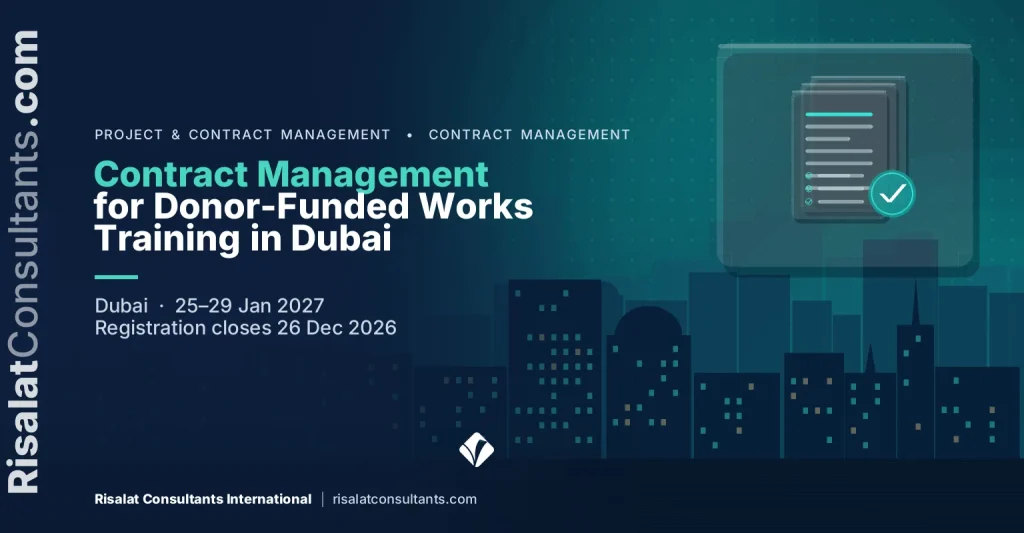
- 25–29 Jan 2027 (5 days)
- Where
- Shared on registration, Dubai, UAE
- Fee per participant
- £3,630 (GBP)
- Payment
- By invoice and bank transfer
- Registration closes
- 26 Dec 2026
- Certificate
- Certificate of completion
- In-house option
- Run it for your team, on your dates
Programme Overview
Contract Management for Donor-Funded Works Training in Dubai is a five-day programme for the teams that administer works contracts after signature: project coordinators, resident engineers, procurement and contract officers, accountants who certify payments and the internal auditors who review them. It is designed around the issues that Tanzania’s audit and procurement oversight bodies have documented in the past year, and it is open to teams from other countries facing the same pressures.
The Controller and Auditor General’s annual general report on development projects for 2024/25, submitted to the President on 30 March 2026, found that 107 of the 320 projects assessed for procurement compliance complied only with exceptions. The contract management chapter is specific: variations and addenda worth TZS 66.08 billion and USD 2.28 million were approved and paid without the required authorisation; TZS 11.35 billion was paid while performance securities were absent or expired; contractor claims of TZS 81.79 billion were settled late, beyond the 56-day period in the general conditions; and interest on late payments reached TZS 8.23 billion.
The same report records TZS 30.12 billion of works on a contract under the Tanzania Cities Transforming Infrastructure and Competitiveness (TACTIC) project starting before tender board approval, and additional works of TZS 7.12 billion carried out in two councils without approval from the President’s Office, Regional Administration and Local Government (PO-RALG). The World Bank’s November 2024 implementation support mission for TACTIC (P171189), a US$278 million credit, had already noted Tier 1 works at 30–70% physical progress against 75% of time elapsed, extensions needed on four contracts and payment delays with a risk of penalty interest.
These are systems issues: unclear approval routes at council level, securities not tracked against expiry, stalled certification and scattered contract data. The Public Procurement Regulatory Authority (PPRA) has added an e-contract management module to the National e-Procurement System of Tanzania (NeST), but a system helps only when users apply consistent rules.
Over five days in Dubai, participants work through the administration cycle of a donor-financed works contract, using published audit patterns as case material, and leave with templates their units can adopt the following week.
The Programme Strengthens Institutional Capability In
- Contract management planning from the day of signature
- Delegated authority for variations, addenda and additional works
- Development partner no-objection requirements during implementation
- Change control registers and variation valuation
- Performance security tracking, renewal and calls
- Advance payment guarantees and advance recovery schedules
- Measurement, interim payment certification and approval workflows
- Payment timelines and the avoidance of late-payment interest
- Extension of time requests and delay assessment
- Contractor capacity due diligence before award and at mobilisation
- Contract records in NeST’s e-contract management module
- Tender board and accounting officer approvals before works begin
- Audit file preparation and responses to management letters
- Action plans that close prior audit recommendations
The aim is a contract administration routine in which each payment, change and security can be traced to an authorised decision, so that the next audit cycle confirms progress rather than repeating findings.
The Growing Importance of Contract Management for Donor-Funded Works
Public procurement carries most of Tanzania’s spending. The World Bank, when approving the US$50 million Public Finance Management and Procurement Systems for Service Delivery Programme in March 2024, noted that around 70% of the annual budget, about US$13 billion, is spent through procurement. Much of that value is in works contracts, where the risk shifts after award from the tender process to the way the contract is run.
Oversight is tightening. PPRA’s 2024/25 performance report, presented on 30 March 2026, put compliance at 79% across 943 audited entities, but also identified TZS 12.6 billion paid for unexecuted work on 39 contracts and contracts worth TZS 101.3 billion awarded without budget approval. The President directed PPRA to name poor performers in its next report. The CAG’s general reports for the same year noted that only 36.7% of 38,181 earlier recommendations had been fully implemented, and that weak contract management affected energy, roads and other infrastructure.
Organisations increasingly require professionals capable of:
- Confirming authority and funding before instructing any change
- Obtaining development partner no-objection where the financing agreement requires it
- Valuing variations from contract rates and fair market evidence
- Maintaining a live register of performance securities and guarantees
- Certifying interim payments within the contractual period
- Calculating the exposure created by late payment
- Assessing extension of time claims against programme evidence
- Recording contract events and documents in NeST
- Preparing evidence packs for auditors
- Turning audit recommendations into dated actions
Strong contract management systems help organisations:
- Avoid paying interest on certificates that sit unprocessed
- Prevent unapproved variations from becoming audit queries
- Protect public funds through valid securities and guarantees
- Keep works within approved budgets and time
- Maintain good standing with development partners
- Reduce disputes with contractors
- Close audit recommendations faster
Source: CAG Annual General Report on the Audit of Development Projects FY2024/25
1. How much interest on late payments did the CAG report for development projects in 2024/25?
The CAG's 2024/25 development projects report puts interest on late payments at TZS 8.23 billion, of which about TZS 6.69 billion related to airport projects.
2. What share of earlier CAG recommendations had been fully implemented, across all audits, according to the 2024/25 general reports?
The National Audit Office reported that 36.7% of 38,181 earlier recommendations had been fully implemented.
3. What did PPRA introduce in NeST during 2024/25 that matters most for contract administrators?
PPRA's 2024/25 performance report noted a new e-contract management module and a dedicated appeals module in NeST.
Who Should Attend This Contract Management for Donor-Funded Works Training?
This programme is designed for:
- Project coordinators and deputy coordinators of donor-financed projects
- Project Coordination Team and Project Implementation Team members
- Municipal, city and district engineers
- Resident engineers and supervision consultants
- Procurement management unit heads and officers
- Contract managers and contract administrators
- Quantity surveyors and cost engineers
- Accountants and finance officers who process certificates
- Internal auditors and audit committee members
- Tender board members and secretaries
- Staff of roads, urban and airport agencies managing works
- Officers of procurement regulators and oversight bodies
Teams of three to five people from the same project, combining engineering, procurement, finance and audit roles, gain the most because the exercises reproduce the hand-offs between those units.
Tick what your team needs to be able to do.
Contract Management for Donor-Funded Works Training Objectives
Upon successful completion of this Contract Management for Donor-Funded Works Training, participants will be able to:
- Set up a contract management plan and responsibility matrix for a works contract
- Apply a change control procedure that confirms authority, funding and no-objection
- Value variations and prepare addenda that withstand audit
- Track, renew and call performance securities and advance payment guarantees
- Certify interim payments within contractual periods and prevent interest claims
- Assess extension of time requests using programme and records evidence
- Check contractor capacity before award and during mobilisation
- Use NeST’s e-contract management module to keep a complete contract record
- Manage claims and reduce the risk of disputes
- Close contracts properly through taking-over, defects liability and final account
- Prepare a response plan that closes prior audit recommendations
Every objective is tied to a working tool that participants complete during the week and adapt for their own contracts.
Programme Contents and Structure
- What the CAG and PPRA 2024/25 findings tell project teams
- Financing agreement, procurement regulations and national law: how they interact
- Prior review, post review and no-objection during implementation
- Roles of the employer, the Engineer, the contractor and the tender board
- Delegated authority and the accounting officer’s responsibilities
- Contract management plans and responsibility matrices
- Key dates, notice periods and the 56-day payment clock
- Sources of change: design gaps, quantity errors and new requirements
- Change control procedure from request to instruction
- Confirming budget, authority and no-objection before instructing
- Valuing variations from rates, prices and fair valuation
- Addenda to works and consultancy contracts
- Contingency use and cumulative variation limits
- Additional works requested by councils or stakeholders
- Purpose and form of performance securities
- Advance payment guarantees and reducing guarantee values
- Verifying issuing banks and guarantee wording
- Building a securities register with expiry alerts
- Renewal requests and calls before expiry
- Linking payment approval to valid securities
- Advance payment recovery schedules in interim certificates
- Measurement and the interim payment certificate
- Processing times for each step from submission to payment
- Contractual payment periods and the trigger for interest
- Calculating the cost of a late certificate
- Budget and cash planning so certified amounts can be paid
- Extension of time: notices, evidence and assessment
- Liquidated damages and their correct application
- NeST modules and the place of e-contract management
- What a complete digital contract record contains
- Contract performance reporting to management and development partners
- Taking-over, defects liability and final inspection
- Final accounts, release of securities and retention
- Contractor performance evaluation
- Preparing for the auditor’s visit
Full day-by-day contents
The five days follow the life of a works contract from signature to close-out.
- Day 1: the contract, the financing agreement and approval routes
- Day 2: variations, change control and works before approval
- Day 3: securities, guarantees and advance recovery
- Day 4: interim payments, delays and late-payment interest
- Day 5: e-contract records, close-out and audit follow-up
Full day-by-day contents
First Day | Contract Foundations and Approval Routes
- What the CAG and PPRA 2024/25 findings tell project teams
- Financing agreement, procurement regulations and national law: how they interact
- Prior review, post review and no-objection during implementation
- Roles of the employer, the Engineer, the contractor and the tender board
- Delegated authority and the accounting officer’s responsibilities
- Contract management plans and responsibility matrices
- Key dates, notice periods and the 56-day payment clock
- Contractor capacity checks at award and mobilisation
Workshop: Building an Approval Map for a Donor-Funded Works Contract
Teams take a sample urban roads contract and map every decision that needs approval, from the start of works to the final account. For each decision they name the approving body, the document that records it and the point at which the development partner must be consulted. The map is tested against the CAG finding that works on a TACTIC contract began before tender board approval.
Second Day | Variations, Change Control and Works Approval
- Sources of change: design gaps, quantity errors and new requirements
- Change control procedure from request to instruction
- Confirming budget, authority and no-objection before instructing
- Valuing variations from rates, prices and fair valuation
- Addenda to works and consultancy contracts
- Contingency use and cumulative variation limits
- Additional works requested by councils or stakeholders
- Design review findings and how to respond before works start
- Maintaining a variation register for audit
Case Study: Additional Works Without Approval in Urban Councils
Based on the CAG’s TACTIC findings, where cost escalation of TZS 10.98 billion in four urban councils was linked to feasibility, design and bill of quantities weaknesses, and two councils executed TZS 7.12 billion of additional works without PO-RALG approval. Participants rebuild the decision trail, identify where approval should have been sought and draft a change control note that would have prevented the finding.
Third Day | Securities, Guarantees and Advance Recovery
- Purpose and form of performance securities
- Advance payment guarantees and reducing guarantee values
- Verifying issuing banks and guarantee wording
- Building a securities register with expiry alerts
- Renewal requests and calls before expiry
- Linking payment approval to valid securities
- Advance payment recovery schedules in interim certificates
- Monitoring the use of advances by contractors
Workshop: Securities and Guarantees Register
Each team builds a register for a portfolio of eight contracts, with values, issuing banks, expiry dates and recovery balances. Facilitators then introduce events such as a time extension, a guarantee about to lapse and a suspected misuse of an advance, and teams decide what action to take and who must approve it, drawing on the CAG findings on expired securities and unrecovered advances.
Fourth Day | Payments, Delays and Interest Exposure
- Measurement and the interim payment certificate
- Processing times for each step from submission to payment
- Contractual payment periods and the trigger for interest
- Calculating the cost of a late certificate
- Budget and cash planning so certified amounts can be paid
- Extension of time: notices, evidence and assessment
- Liquidated damages and their correct application
- Contractor cash-flow problems and early warning
- Claims records and dispute avoidance
Workshop: Payment Pipeline Simulation
Participants follow three interim payment certificates through a simulated approval chain of Engineer, project team, finance unit and treasury. Delays are introduced at each stage, and teams calculate the interest that would accrue. They then redesign the workflow to meet the contractual period, reflecting the CAG finding of TZS 8.23 billion in interest on late payments.
Fifth Day | E-Contract Records, Close-Out and Audit
- NeST modules and the place of e-contract management
- What a complete digital contract record contains
- Contract performance reporting to management and development partners
- Taking-over, defects liability and final inspection
- Final accounts, release of securities and retention
- Contractor performance evaluation
- Preparing for the auditor’s visit
- Turning audit recommendations into a dated action plan
Capstone Exercise: Contract Health Review and Audit Response Plan
Each team reviews a contract from its own project, or a case file provided, against a checklist covering approvals, variations, securities, payments, records and close-out. Teams score the contract, identify the three weakest areas and present a 90-day plan, with owners and dates, to a panel acting as an accounting officer and a development partner task team.
Contract Management for Donor-Funded Works Training Methodology
The programme is practical. Short briefings are followed by exercises on sample contract clauses, certificates, guarantees and correspondence, so that each idea is applied on the same day.
The programme combines:
- Short briefings on each stage of contract administration
- Clause reading of general and particular conditions
- Case studies built on published audit findings
- Securities register and expiry tracking practice
- Payment workflow simulation
- Walk-through of contract record keeping in an e-procurement system
- Mixed team work across engineering, procurement and finance
- A capstone review of a participant’s own contract
Facilitators are practitioners with experience of works contracts financed by the World Bank and other development partners. Before travelling, teams can complete Risalat’s free project health check to identify the areas they want to focus on.
Expected Outcomes
Upon completion of this Contract Management for Donor-Funded Works Training, participants will be able to:
- Confirm authority and funding before any change is instructed
- Keep every security and guarantee valid for the life of the contract
- Certify and pay within contractual periods
- Value variations fairly and document them fully
- Assess delay and extension requests on evidence
- Keep a complete contract record in NeST
- Close contracts and release securities correctly
- Respond to audit findings with dated, owned actions
Institutions should see fewer unapproved changes, shorter payment times and better-prepared audit files within the first reporting period after the programme.
£3,630 per participant · invoice and bank transfer · groups of 5 or more receive a discount
Five or more from one organisation: ask for the group rate on the invoice request.
Ten or more: an in-house version for your institution may cost less per person. Ask for an in-house quote.
Registration closes in 55 days (26 Dec 2026)
Institutional Application of Contract Management for Donor-Funded Works Training
This programme supports organisations in strengthening:
- Contract management procedures for project and council level
- Delegation of authority for variations and additional works
- Securities and guarantees management
- Interim payment processing and cash planning
- Contractor due diligence and performance monitoring
- Use of NeST for contract records
- Coordination between project teams and local government councils
- Audit response and recommendation follow-up
Participants return with practical tools to improve:
- Contract management plan template
- Approval and no-objection map
- Variation request, valuation and register forms
- Securities and guarantees register with expiry alerts
- Advance recovery schedule
- Interim payment tracker with interest calculator
- Extension of time assessment checklist
- Close-out and audit file checklist
Procurement units can also use the free procurement maturity diagnostic to see how contract administration fits within their wider procurement system. For background on the audit findings that shaped this programme, read our analysis of the CAG report 2024/25 and contract management in Tanzania.
Regional Relevance & Application
Africa
Tanzania is the starting point. The CAG’s 2024/25 development projects report and PPRA’s 2024/25 performance report describe the same pattern across roads, airports and urban works: unapproved changes, lapsed securities, slow certification and interest on late payments, with TZS 6.69 billion of interest attributed to airport projects alone. TACTIC, delivered by PO-RALG with participating councils, shows how these issues arise when many local government teams manage contracts under one financing agreement. Similar structures operate in other East and Southern African countries.
Asia
South and Central Asian ministries manage large donor-financed works programmes under comparable frameworks, and the securities registers, payment trackers and change control procedures used here transfer directly.
Middle East
Gulf governments deliver large public works under unified procurement rules. Dubai’s Law No. 12 of 2020 on contracts and warehouse management set common procurement rules for Dubai government entities, giving participants a reference point on how a government standardises contract processes.
Across regions, teams find that the weak points in contract administration are similar, which makes the exchange between participants one of the most useful parts of the week.
Host Country Profile – United Arab Emirates
Dubai is the largest city of the United Arab Emirates and a regional centre for business, aviation and conferences. Its hotels and meeting facilities are used to hosting government delegations, and the city’s compact business districts suit an intensive five-day programme.
Dubai is a useful benchmark for public works delivery. Law No. 12 of 2020, effective from January 2021, set unified rules for contracts and procurement across Dubai government entities, with the Department of Finance issuing guidelines and policies. In December 2024 the Roads and Transport Authority awarded the AED 20.5 billion Dubai Metro Blue Line contract, a 30 km line with 14 stations, after an international tender, with operations targeted for September 2029. Participants can discuss how large contracts of this kind are planned, monitored and reported.
Travel from Tanzania is straightforward. Emirates lists a direct service between Dar es Salaam and Dubai of about five hours twenty minutes. According to the UAE government portal, Tanzania does not appear on the visa-on-arrival lists, so Tanzanian participants need an entry permit before travel, sponsored by an eligible UAE entity such as a hotel, airline or company; Risalat provides visa support. Rules change, so participants should confirm current requirements with the UAE embassy.
Contract Management for Donor-Funded Works Training Deliverables
Participants receive a complete package before, during and after the programme so that learning continues once they return to work.
Before the Programme
- Participant Pre-Assessment
- Contract Management Readiness Assessment
- Contract Management for Donor-Funded Works Resource Pack
- Preparatory Reading Materials
- Complimentary Visa Support & Advisory
- Airport Pickup & Welcome Assistance
- Accommodation with Breakfast
- Welcome Networking Dinner
During the Programme
- Risalat Training Kit (Bag, Bottle, Mug, T-Shirt, Cap, Passport Cover, Pens, Notebook, Magnet & Keychain)
- Comprehensive Contract Management for Donor-Funded Works Training Manual
- Variation Register and Change Control Templates
- Securities and Guarantees Register
- Interim Payment Tracker and Interest Calculator
- Contract Health Review Checklist
- Practical Workshops & Simulations
- Group Discussions & Peer Learning
- Daily Lunch and Refreshments
- Full Access to Training Venue Facilities
- Mini Pad / Tablet with Digital Learning Materials
- Field Visit (where applicable)
- Entertaining City Tour
After the Programme
- Certificate of Completion
- Risalat Programme Participation Recognition Award
- Post-Training Reference Materials
- Audit Response Action Plan Template
- 90-Day Contract Improvement Plan
- Post-Training Support & Follow-Up Guidance
- Programme Report
Project teams, ministries and local government authorities can also request a tailored in-house version built around their own contracts and audit findings. Please use our request a proposal form.
Common Challenges in Contract Management for Donor-Funded Works, And How This Training Helps
How can we stop variations being paid before they are approved?
The Second Day sets out a change control procedure that confirms budget, delegated authority and development partner no-objection before any instruction, and gives teams a variation register that links each payment to an approval.
How can councils avoid starting works before tender board approval?
The First Day workshop builds an approval map for the whole contract, showing which body approves each step and when the financier must be consulted, so site teams know what must be in place before mobilisation.
How can we keep performance securities valid for the whole contract?
The Third Day register tracks expiry dates against the contract programme and extensions of time, with alerts that trigger renewal requests or calls before a security lapses.
How can we make sure advance payments are recovered and properly used?
Participants build recovery schedules into interim certificates and practise responding when an advance appears to have been used for unrelated costs, a risk the TACTIC mission noted.
How can we avoid paying interest on late certificates?
The Fourth Day payment simulation measures time at each approval step and shows teams how to redesign the workflow and cash plan so certified amounts are paid within the contractual period.
How can we judge whether a contractor can deliver before we award?
The First Day covers capacity checks on finance, equipment and personnel at award and mobilisation, responding to the CAG finding that such checks were not done in the councils audited.
How can NeST help us manage contracts, not just tenders?
The Fifth Day walks through what a complete digital contract record should contain and how to use the e-contract management module to keep approvals, certificates and securities in one place.
How can we close audit recommendations instead of seeing them repeated?
The capstone turns findings into a dated action plan with owners and evidence, so the next audit can confirm implementation.
Frequently Asked Questions
Who is this contract management training for?
Project coordinators, engineers, procurement and contract officers, finance staff who process certificates, and internal auditors working on donor-financed works contracts.
Why is it designed around Tanzania?
The CAG's 2024/25 development projects report and PPRA's 2024/25 report set out specific contract management findings, such as unapproved variations, lapsed securities and interest on late payments, which the programme uses as case material.
Does it cover NeST?
Yes. The Fifth Day covers the e-contract management module of the National e-Procurement System of Tanzania and what a complete digital contract record should contain.
Is it relevant to teams outside Tanzania?
Yes. The tools apply to any works contract financed by the World Bank or another development partner, and participants from other countries are welcome.
Can it be delivered in-house?
Yes. Institutions can request a tailored version built around their own contracts through Risalat's proposal form.
All programmes in DubaiMore Project & Contract Management programmes
More training courses in United Arab Emirates · All programmes in Middle East · Full training calendar